
Comedian John Crist is a funny guy, but he hits really close to home on this video. Comedy can be prophetic. Ouch.
Author Archives: Clarke Morledge
About Clarke Morledge

Assorted Best of 2018 Blog Posts
As a way of ending off the year, I thought I would highlight some of the year’s best Internet blog posts and stories, that offer thoughtful reflections that inform Christian faith and practice. This is meant to supplement a “Best of Summer 2018” Veracity posting, from a few months ago (a lot has happened this year in the world of theology!). Some posts are Bible “geeky,” some deal with contemporary challenges to the Gospel, some are on church history, and nearly all I had to say, “I need to come back to that one, and give it more thought!” Bearing all of that in mind, here is my list of the rest of the best blog posts and stories of 2018:
- Something first, for the Christmas season. The year 2018 marks the 200th anniversary of when “Silent Night” was first set to music, in 1818, during the aftermath of the Napoleonic Wars… (and while we are it, the Medieval Manuscripts blog answers, “What is the oldest Christmas carol?“)
- While thinking about Christmas, a theology professor that I met years ago in seminary, Telford Work, writes about stereotypes we all have about Mary, the mother of Jesus.
- Losing Billy Graham in 2018 was like an end of an era. Historian George Marsden once said that an “evangelical” is someone who finds the opinions of Billy Graham acceptable. Will evangelicalism survive as a cohesive movement? Christianity Today has a great collection of essays chronicling the life and influence of the perhaps the world’s greatest modern evangelist.
- Eugene Peterson, the author of The Message translation/paraphrase, one of the most popular Bibles ever, died in 2018. This brought to mind a real Bible “geeky” story, that started off the year 2018: A scholarly scuffle between evangelical New Testament scholar, N.T. Wright, and Eastern Orthodox theologian, David Bentley Hart, over Bible translations. Wright critically reviewed Hart’s translation of the New Testament at the Christian Century (hidden by a paywall), and Hart returned the favor by digging back at Wright over Wright’s own translation of the New Testament. Wright has had his problems for years among some Protestant evangelicals, but Hart has received mixed reviews from others on his own translation efforts (see Wesley Hill, not-favorable, and Wyatt Houtz, favorable, and a noted rebuke from Alan Jacobs). Lesson learned: While I do appreciate the work of individual bible scholars, I still maintain that a Bible translation done by a committee of scholars, as with the English Standard Version (ESV), has the level of accountability that a Bible translation done by a single scholar simply does not have. The same is true about the notes in study Bibles!
- Speaking of those who have died in 2018, one of the most influential authors I read as a young believer in Christ died this past year, missiologist David Hesselgrave, director of the School of World Mission, at Trinity Evangelical Divinity School. His book Communicating Christ Cross-Culturally was the textbook used by many college-aged Christians in the 1980s, for short and long-term mission trips. Hesselgrave raised a lot of questions as to what is a “biblical absolute” versus a “cultural relative,” when in comes to reaching people for Jesus, in a cross cultural context. Here is a remembrance by Christianity Today editor, Ed Stetzer.
- He has been called a “gateway drug to Christianity.” Who is it? None other than Canadian psychologist Jordan Peterson. What makes Peterson a strange ally to the Christian faith is that he publicly identifies himself as an atheist, yet Jordan Peterson thinks that the stories of the Bible can help to inspire people to better live in a postmodern world, and in particular resolve the crisis of masculinity in today’s society. The Gospel Coalition blogger Joe Carter explains why Jordan Peterson matters.
- Ligonier Ministries, founded by the late R.C. Sproul, joined with Lifeway publishers to conduct a survey, “The State of Theology,” as to what American evangelical Christians believe about Christianity. Some of the results are rather disheartening, as apparently there are many “evangelical Christians” who say that they believe in the doctrine of the Triune nature of God, but who also believe that “Jesus is the first and greatest being created by God,” a view that has been condemned as heresy for nearly 1600 years. Apparently, the level of theological comprehension of basic Christian truths in our churches is sadly lacking.
- Could the “Nazareth Inscription” be the oldest surviving evidence supporting the historicity of Christianity? In the 19th century, a French archaeologist acquired a stone tablet, engraved with an edict from an unnamed Caesar, ordering capital punishment for anyone caught disturbing graves or tombs. Kyle Harper, in the Los Angeles Review of Books, tells the fascinating tale. If you just want the highlights, you can read them on the ThinkTheology blog.
- Also from the world of archaeology in the Middle East, some scholars believe they may have found the first extra-biblical evidence for the existence of the prophet Isaiah…. (Plus a few other archaeological stories of note).
- The year 2018 marked the 40th anniversary of the signing of the Chicago Statement on Biblical Inerrancy, the most influential evangelical statement in my living memory. Breakpoint, a ministry started by the late Chuck Colson, sponsored a symposium, offering reflections on the Chicago Statement. I particularly resonated with the views of theologian Peter Leithart, “The Chicago statement articulated a Christian view of Scripture, and, whatever refinements and elaborations may be necessary, it should remain a touchstone for Evangelicals…. The statement on hermeneutics is less satisfying. Given their circumstances, the authors were right to focus on the “propositional” and “factual” content of Scripture. But Scripture’s speech acts aren’t always indicative; its truth isn’t simply correspondence to fact.” A very measured and nuanced perspective from Leithart, that offers wisdom that I hope others will embrace.
- Ian Paul, at the Psephizo blog, is one of my favorite Bible teaching bloggers. As a Brit, some of his Church of England specific posts will not appeal to Americans, but when he addresses issues like the apparent contradictory accounts of the death of Judas in the New Testament, or Paul’s teaching in Romans 1, that people are “without excuse” when looking at the natural world, or where is the Spirit in the Lord’s Prayer, or who was the first Immanuel?, his crisp thinking invites engagement, even if some might not agree with him. His posts on the Book of Revelation are provocative, (and here), as they offer a vastly different perspective that many American evangelicals have never considered, but probably should.
- Biblical scholar Michael Heiser, at the Logos Bible software website, on why Christians differ over the meaning of “the Rapture,” with a short article entitled “How Many Times is Jesus Coming Back?” Some believe that Jesus is returning twice (John MacArthur) while others believe that Jesus is returning just once (John Piper).Perfect for folks who get their shorts all up in a bunch about this type of stuff, instead of approaching fellow believers in love.
- Whatever happened to the Ark of the Covenant? National Geographic has a short article summarizing the strangest reports of the Ark being found, including the claim made by the late fringe archaeologist, Ron Wyatt. But Biblical scholar Michael Heiser shows, from the Scriptures, why the Ark of the Covenant will never be found. Indiana Jones makes for great story telling, but not truth-telling.
- An informative take about the influence of paganism, by British medievalist Alison Hudson, on “Pumpkins and pagans,” for those Christians who are leery about Halloween pumpkin carvings.
- My small group was studying the Book of Acts this year, and some were puzzled that Acts 8:37 is missing from modern Bibles. “Dust Off the Bible” sets the record straight, particularly for those sincere folk who think the KJV is the only Bible translation worth reading.
- Here is one more for my small group: Nearly everyone in my group holds to “Believer’s Baptism,” rejecting infant baptism. I can appreciate this view, but it is helpful to consider that there are also thoughtful Christians who once held “anti-infant” baptism views, but who are now advocates of infant baptism. Alastair Roberts, a blogger with Mere Orthodoxy, is one of them, with this essay, “How I changed my mind on infant baptism.”
- Medieval historian Charlotte Allen has a really interesting article at First Things about Peter Damian, a central figure during the First Crusade, with particular relevance to the current cultural debate on same-sex relations.
- Tired of the same contemporary Christian worship music, week after week? Have you ever wondered how Christians prior to the 1990s utilized music in their worship services? Now, I am all for contemporary music (I am a guitar player, after all), but we are currently raising a generation of young people in our churches, who generally have little to no appreciation of the great wealth of sacred music, in the history of the church. Ken Myers, the brilliant mind behind Mars Hill Audio, the NPR-like Christian audio magazine of cultural commentary, that long predated the Internet, has a new website, CanticaSacra.org, with a wealth of stories about sacred music, much of it that has been long forgotten. Myers is music director at an Anglican church, near Charlottesville, Virginia.
- In the early 1990s, I devoured the writings of Elaine Pagels, the Princeton historian of early Christianity, who famously wrote on the The Gnostic Gospels, primarily because she was just such a great writer, and because her writings were pretty much all I could find about early Christian history at the Barnes and Noble’s bookstore in those days. However, I was always bothered by her infatuation with the Gnostics, but she also kept a lot of her personal views private. Baptist theologian Denny Burk reviews Pagels’ recent autobiographical memoir, and he puts the finger on why Pagels is sadly so reticent about the hope found in Christian orthodoxy.
- Would you think it possible to write a 1,376 page history and devastating critique of Christian Universalism, the teaching in some circles that everyone will be saved in the end? Apparently, St. Louis University professor Michael McClymond has done such a thing. A quick glance at the table of contents is mind-blowing. Justin Taylor at the Gospel Coalition interviews McClymond about his book.
- My wife and I had the privilege of visiting Rome this year. Baylor University historian Philip Jenkins was also in Italy, about the same time, mostly in Ravenna, but he has some interesting reflections of Rome, including several churches we were able to visit. Jenkins book Jesus Wars is on my “to-be-read” list.
- Crossway book publishers has an interesting infographic on how long it takes people to read the different books of the Bible. How much time do you spend reading the Bible?
- Gospel Coalition blogger, Trevin Wax, and an editor for the Christian Standard Bible (CSB), writes about the concept of “worldview,” after interviewing evangelical scholars who wonder if whether Christian “worldview” is really a helpful category or not. I wrote about some of the new CSB study Bibles, including the CSB Worldview Study Bible, earlier this year.
- Gospel Coalition writer, Dan Doriani, whom I heard preach earlier this year, gives us a thoughtful warning about the use and misuse of Christian jargon, of words like “broken,” “authentic,” and “surrender.”
- Not directly related to the Bible, I do find that the centennial anniversary of the end of the Great War gives Christians a lot to think about. The outcomes of World War I have continued to have a major impact on our world today, and an impact on the church. A New Yorker article by historian Adam Hochschild forced me to rethink the common narrative as to how the war actually ended.
- A few years ago, a niece of mine met Christ through the ministry of Campus Outreach, in the Midwest. Coming from an InterVarsity Christian Fellowship background, I knew very little about Campus Outreach on college campuses. Sarah Eekhoff Zylstra, at The Gospel Coalition, tells the story behind Frank Barker, and the beginnings of this growing college campus ministry.
- Alisa Childers, former contemporary Christian music personality with ZoeGirl, and now an up-and-coming Christian apologist, stirred up a hornet’s nest for suggesting that there are “3 Beliefs Some Progressive Christians and Atheists Share.” I would smooth out some of the edges of Alisa’s article, but she is on the right track, pretty well explaining why I reject “progressive Christianity,” as it is a theological dead-end: What is to keep “progressive Christians” from becoming atheists? If the progressivism trend associated with the now post-evangelical Rob Bell, Rachel Held Evans, Derek Webb (formerly of Caedmon’s Call), and Bart Campolo (son of Tony Campolo) concerns you, and you do not know what to make of it, you should check out Alisa’s article. However, you should also read some of the pushback Alisa received on Twitter about her article. Pete Enns’ response on his podcast, has a lot of wisdom, but methinks Pete lumps Alisa too much into the nice, tidy box of “fundamentalism”. My take: Not every Christian wrestles with doubt. But some do. Churches can provide an environment where Christians can work through their doubts, which sadly many churches do NOT do, but you do NOT need to totally abandon historically orthodox faith in the process, either. A humorous take on the whole topic is at the Babylon Bee.
- For years, evangelical Christians had looked upon Dietrich Bonhoeffer, the 20th century German theologian, who participated in a plot to assassinate Adolph Hitler, with a good amount of suspicion, until author Eric Metaxas wrote his popular biography of Bonhoeffer in 2010. Though I thoroughly enjoyed Metaxas’ book, I got the sense that there was a bit more hagiography going on than was properly deserved. Laura M. Fabrycky’s review of Stephen R. Haynes book, The Battle for Bonhoeffer, cogently argues that even the most well-intentioned observers of history tend to read more into their subject, than the evidence actually supports, to serve modern purposes. Haynes wrote a previous book, Noah’s Curse, that I read a few years ago, that discusses how the Bible got misused to support American enslavement of Africans.
- A cordial debate, at this year’s Evangelical Theological Society conference, featured a proposal by Southern Baptist theologian, Tom Schreiner, arguing that the extraordinary gifts of the Spirit are not to be found in the church today, as articulated in a short book that Schreiner wrote, reviewed at the ReadingActs blog. Schreiner also recently wrote a commentary on 1 Corinthians, that expands on this topic: Cessationism and the Charismatic Movement in dialogue. In response, London British pastor, Andrew Wilson, responds to Schreiner, as featured in three posts at the ThinkTheology blog (#1, #2, and #3). A good way of thinking through the cessationism vs. charismatic issue.
- The November death of young missionary John Allen Chau, at the hands of an isolated tribal group, on the North Sentinel Island, recalls the martyrdom of Jim Elliot, among the Waorani tribe, in 1956. But we probably would not have known much about Jim Elliot if it was not for the expert writing talents of his widowed wife, Elisabeth Elliot. Blogger Matthew Loftus at MereOrthodoxy gives us a survey and review of the late Elisabeth Elliot’s continued influence and writings.
- Australian scholar Marg Mowczko writes a critique of the ESV Study Bible notes on 1 Timothy 2:12, demonstrating that the battle over “women in ministry” will probably be with us still for a long, long time. Churches that are considering “women as elders” should proceed with the greatest of caution, if at all, as the debate is very contentious, where even the best evangelical scholars can not come to an agreement.
- Southern California pastor John MacArthur, is the big name behind this past fall’s “Statement on Social Justice and the Gospel,” yet another statement made by evangelicals regarding the fight against cultural trends infiltrating the church. However, this time, this “statement” has left a lot of Christians talking past one another. Christianity Today’s Quick to Listen podcast explains the aggravation many feel.
- If you think that the decline in traditional forms of organized Christian faith has led to a rise in zealous political cults, then you are not the only one: Andrew Sullivan makes the case that political activism has been slowly replacing traditional forms of Christianity, as an alternative method to finding spiritual meaning in life. Politics, on both the extreme “left” and the extreme “right,” has become the new substitute for genuine Christian faith.
- Peter J. Williams, a British evangelical intellectual at Tyndale House, recently released a short, and amazingly easy to read book entitled Can We Trust the Gospels?, which I hope to put on my reading list soon. Here is Williams with a short essay, introducing the book, on the question: “Do the Gospels Contradict Themselves?” First Things editor, Peter Leithart, offers his review.
- Before ending on something meaningful, here is a blog post story that I am very, VERY glad I missed, that I only learned of recently. On July 27, 2018, we mere earthlings experienced the longest lunar eclipse of the 21st century, coinciding with the planet Mars being as close as possible to the earth, a combination of events that only happens once every 25,000 years. As a science geek myself, that was pretty cool. So far, so good (though I am just upset that I never saw Wirtanen, the green “Christmas Comet” this year!). Nevertheless, there were some supposed “bible prophecy experts” still peddling the same hysteria about the “Blood Moon,” from a few years ago, as being a sign of the imminent events signaling the “End Times,” according to the Sunday Express. But wait!! There is another lunar eclipse coming January 21, 2019, so watch for more “prophecy” about the “End Times” to come!!! More exclamation points!!! …. These stories are getting very old and annoying.
- …. and finally, here at Veracity, we discussed the whole Revoice Conference controversy that inflamed a lot of Christians, while introducing a lot of confusion. How should Christians effectively minister to the so-called “LGBTQ” community? Many Christians would rather stick their heads in the sand, either because they are afraid to talk about this, or that they simply do not know how to talk about it. Others follow the lead of the surrounding culture, actively or passively accepting “political correctness.” Yet on the other hand, for still some other Christians, a more zealous crusade against the language of LGBTQ is in order: For them, it is completely wrong to “identify” yourself as a “celibate gay Christian,” but that it is perfectly okay to “identify” yourself as a “Christian who struggles with same-sex attraction.” Is the debate about semantics, or something more than that? If you are puzzled as to what the fuss is all about, dig in here at Veracity (#1 and #2).
Earthrise: 50 Years Since Apollo 8
Fifty years ago today, three American astronauts read from the Book of Genesis, on Christmas Eve, as their space ship orbited the moon. The New York Times has produced two films, one short 5-minute film and one fantastic, longer 30-minute film, that remembers the iconic photo, that memorializes a stunning moment in human history.

The iconic “Earthrise” image taken by astronaut Bill Anders on Apollo 8 on Christmas Eve 1968. Friday marked the 50th anniversary of the Apollo 8 liftoff (William Anders, NASA)
When Did Joseph and Mary Go to Bethlehem for the Census?
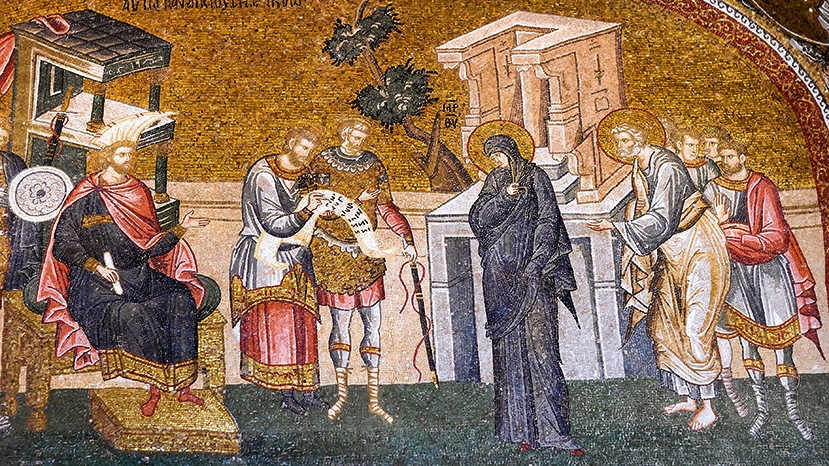
Joseph and pregnant Mary at the census. But what if we got this picture wrong, and Joseph and Mary went to Bethlehem for the census, when Jesus was 10 years old? (credit: Chora Church, Istanbul/Shutterstock)
If this proposal turns out to be correct, it would positively throw perhaps the best argument AGAINST the historical reliability of the Bible into the dumpster…. But to get the idea, you would have to completely rethink how Luke handles chronology. Veracity readers, get out your thinking caps!
One of the thorniest apologetic challenges is trying to fit Luke’s traditional dating for Jesus’ birth to Caesar’s census, during the time when Quirinius was governor, with Matthew’s version, which has Jesus born during the latter years of Herod. The big problem is the timing. Luke’s Quirinian census is typically dated to 6 A.D., largely due to Josephus’ historical record, whereas Matthew’s description of the death of Herod is somewhere around 4-1 B.C.
That is like at least a 7-10 year discrepancy. Whoops.
Skeptics of the Bible often point to this as proof that the Bible has errors in it, and therefore, the Bible can not be trusted for history.
Over the years, Christian apologists have put forward various explanations to account for this discrepancy. Perhaps we are talking about a different census, with Luke’s census happening a few years earlier, but that we simply have no secular or other record for it. Perhaps Josephus was wrong on his dating of events. While these proposals present some thoughtful possibilities, the critics often respond with, “Meh…. There go the Christians again, overreaching for an apologetic.”
But what if the traditional reading of Luke’s story has been misinterpreted? What if it is possible, that about 10 years after Jesus’ birth, after living a few years in Nazareth, the Holy Family returned back to Bethlehem for the census? What if the story about the census is a digression, purposefully inserted by Luke, temporarily jumping ahead in the chronological narrative, before returning back to the main story about Jesus’ birth?
Sure, this rearranged chronology might mess with the familiar nativity scenes, most churches show on Christmas, but it actually might make better sense of the data we have available, both within the Scriptures and outside of the Scriptures.
I argue for a similar literary technique used by Luke in Acts, regarding the number of visits Paul makes to Jerusalem, that attempts to reconcile with Paul’s own story in Galatians. Studies by New Testament scholars, such as Michael Licona, author of Why Are There Differences in the Gospels?, argue that Luke uses such literary techniques more frequently than traditionally known, whether by evangelicals or skeptics!
In fact, Luke unambiguously does this very thing in Luke 3, by sandwiching verses 19-20, detailing John the Baptist’s future imprisonment, in the middle of the narrative regarding Jesus’ baptism. We know from Mark 1:9-11 that John the Baptist baptized Jesus, which must have happened prior to John’s imprisonment. Apparently, Luke is not afraid of reporting events in a non-chronological manner, to suit his own purposes, assuming that his readers would already know the exact historical chronology.
British bible teacher, Andrew Wilson, on the “Think” blog, pointed me to this new research done by David Armitage, and published in 2018, at the British evangelical think tank in Cambridge, Tyndale House. Armitage’s proposal has a number of exegetical and translation steps to make, but the more I think about it, Armitage’s idea is quite persuasive.
Jump on over to the Think blog to get the argument summary, but here below is Armitage’s proposed translation of Luke 1:80-2:7, that puts all of the pieces together. The chronological digression might be hard to pick out, so you may need to wait for the full explanation at the end of this post to get it straight. The main thing to look for is Luke 1:80 to 2:5, where the narrative jumps forward in time, following along the time period of John the Baptist’s upbringing, before resuming in verse 6, which chronologically follows after the narrative of where John the Baptist’s birth ends, described in Luke 1. It starts with the story of the young, John the Baptist, as he was growing up (notice how chapter headings, first introduced in our Bibles by, Stephen Langton, Archbishop of Canterbury, in the 13th century, can be misleading):
- 1:80 The child [John the Baptist] grew and was strengthened in spirit, and he was in the wilderness until the day of his public appearance to Israel. 2:1 As it happens, it was during that time that a decree went out from Caesar Augustus to register all the Roman world 2 (this was the first registration, when Quirinius was governor of Syria), 3 and everyone went – each into their own town – to be registered. 4 Joseph also went up: out of Galilee, away from the town of Nazareth, into Judea, to David’s town (which is called Bethlehem) because he was from the house and family of David; 5 he went to be registered with Mary (she who was his betrothed when she was pregnant).
6 Now, it transpired that the days were completed for her to give birth when they were in that place, 7 and she gave birth to her firstborn son and wrapped him in cloths and laid him in a feeding trough, because there was insufficient space for them in their lodging place.
Compare with the ESV translation, and see what you think:
-
80 And the child grew and became strong in spirit, and he was in the wilderness until the day of his public appearance to Israel.
2:1 In those days a decree went out from Caesar Augustus that all the world should be registered. 2 This was the first registration when Quirinius was governor of Syria. 3 And all went to be registered, each to his own town. 4 And Joseph also went up from Galilee, from the town of Nazareth, to Judea, to the city of David, which is called Bethlehem, because he was of the house and lineage of David, 5 to be registered with Mary, his betrothed, who was with child. 6 And while they were there, the time came for her to give birth. 7 And she gave birth to her firstborn son and wrapped him in swaddling cloths and laid him in a manger, because there was no place for them in the inn.
The most troublesome verse for me is verse 5, as the ESV follows the standard interpretation, by describing the condition Mary was in, during the Quirinian census, that of being pregnant with Jesus. But Armitage argues that the Greek allows for a different translation, with a parenthetical comment, that simply reminds the reader of who Mary was, with no immediate time reference implied. This sets us up to read verse 6 as a transition, implicitly ten years prior, back to the main narrative, emphasizing the place of Jesus’ birth, Bethlehem, and not the timing. I am no Greek scholar, but this is very intriguing! Armitage paraphrases verse 5 like this:
-
Joseph went there to register with Mary – that same Mary, you will recall, who whilst betrothed to him was pregnant.

Objections to Armitage’s reconstruction might focus on the complex number of interpretive steps required. However, the whole solution is actually simpler, if we grant that Luke has a habit of sometimes jumping around chronologically in his narrative, for reasons clear to his original audience, that are not always intuitive to more contemporary readers. One big plus is that Armitage’s reconstruction adequately explains why Matthew’s account never mentions the Quirinian census; that is, Matthew never covers the events of Jesus’ life at age 10.
So, why does Luke insert this whole story about Joseph needing to go back to Bethlehem, some 10 years after Christ’s birth, before jumping back in with the rest of the Christmas birth story? Well, it would have been important for Luke to establish that Joseph was originally from Bethlehem, despite Jesus having grown up in Nazareth. Bethlehem was the city of David, associated with the prophecy in Micah 5:2, that indicates that the promised Messiah would come from Bethlehem.
Luke probably made it a point to mention the Quirinian census, because it would have identified Bethlehem as being place where Joseph had some family property interests. Just as residency or property interest requirements make a difference in our day, as to the cost of college tuition, taxation purposes, etc., it is certainly plausible that Joseph would have felt it necessary to go to Bethlehem, during the Roman occupation of Palestine in the 1st century, to defend his family property interest. Since the Roman census in 6 A.D. would have been a well-known event in 1st century history, it would have reinforced the idea of Jesus coming originally from Bethlehem, being born there a few years earlier.
If Armitage’s proposal holds, and he admits that it is far from being certain, this is what he says his revised chronology looks like. It totally reframes one of the most well-known Bible stories, of all time, but it solves a particularly knotty, chronological problem:
-
- Towards the end of the reign of Herod the Great, Mary – who is from Nazareth – encounters an angel who foretells Jesus’ birth.
- Mary visits Elizabeth in the Judean hill country, then returns home.
- Although already found to be pregnant whilst betrothed, Mary marries Joseph – a man from Bethlehem – who initially takes Mary to his family home.
- Jesus is born in Bethlehem; because of space restrictions in their quarters, Mary and Joseph place the baby in a feeding trough in the main living area.
- The family subsequently relocate to Nazareth, establishing there a home of their own.
- Several years later, when Quirinius is governing Syria, an enrolment is announced, so Joseph and Mary travel to Bethlehem, because this remains the location of Joseph’s family home, and he needs to register in connection with property there.
Pretty cool, huh?
UPDATE December, 2021: I first published this story three years ago. To my knowledge, Armitage’s proposal has not admittedly won over other scholars…. but neither has it met wholesale rejection either. Time will tell if this proposal resolves this long-standing “Bible discrepancy.”
Additional Resources:
I wrote about the Quirinius question five years ago, but David Armitage’s new solution is by far, the most persuasive, in my view…. A couple of other twists to the birth narratives: The traditional story of Jesus’ birth, as told in many Hollywood movies, tries to smash together the events recorded by Matthew and Luke, such that you have Luke’s shepherds together with Matthew’s wise men from the east, gathered around the newborn Jesus. It makes for a tidy story, until you start comparing Matthew and Luke together, a well-known difficulty for students of the Bible. Matthew has no shepherds, and Luke has no wise men! More than likely, the visit with Matthew’s “wise men,” or more specifically, “magi,” was a separate event, happening weeks, if not months, after Jesus’ birth. This places the trip to Egypt, as described in Matthew, at some undetermined time after the birth of Jesus, yet prior to the permanent settlement in Nazareth, an historical detail that Luke simply ignores. As another example, a growing consensus among Bible scholars has pretty much rejected the popular, traditional idea, of Joseph and a pregnant Mary going up and down the streets of Bethlehem, looking for a place to stay, only to be finally turned away at the “inn.” Contemporary scholarship makes the more modest claim that there was no available “guest room” for the family to stay in at relatives in Bethlehem, a correction made explicit in the NIV 2011 translation of Luke 2:7 (The ESV keeps the more traditional “inn,” but puts “guest room” in a footnote; see above, but according to New Testament scholar, Ian Paul, the evidence favors the “guest room” translation).
UPDATE December, 2024:
I decided to look back again at the criticisms of this view proposed by David Armitage. Earlier this year, an exchange on Reddit engaged Armitage’s argument. Interestingly, the most coherent counter-argument acknowledged that linguistically Armitage’s argument “works,” for which which I have admitted that I could not competently make a critique as I am not well-versed in Greek grammar. The counter-argument goes onto say that the revised approach of Armitage’s solution to the chronology does not work:
“It’s an interesting exercise in textual analysis, and it technically works linguistically. But the final result is to produce such a convoluted and confusing series of awkward narrative leaps in time and place that it proposes an author who was barely able to string a coherent thought together. Luke is otherwise not such a writer, and nowhere else in his book does he jump back and forth with such whiplash confusion.”
The problem with this counter-argument is that Luke does “jump back and forth” with his chronology more often than this critic supposes. We see this in Acts 9:26-30, where Luke foretells of Paul’s later visit to Jerusalem, also described in Acts 11:27-30. It is as though Luke is “flash forwarding” to bring Paul’s first post-conversion visit to Jerusalem closer to the time of his conversion along the road to Damascus, to satisfy a theological purpose, to say that Paul and Peter were more in harmony with one another, and not opposed to one another. In other words, in this important part of Acts, Luke is indeed jumping back and forth, and not holding to strict chronology.
But one need not go to Acts to see this, nor even look at the episode mentioned above regarding John the Baptist’s imprisonment. You see it also in the passage just prior to the one about the census. In Luke 1, Luke writes about the birth of John the Baptist, which only happens a few months prior to Jesus’ birth. However, Luke in one verse describes John the Baptist’s upbringing (Luke 1:80):
And the child grew and became strong in spirit, and he was in the wilderness until the day of his public appearance to Israel.
One must consider the last half of this verse, in that Luke concludes by writing about John’s public appearance to Israel in the wilderness. This happens roughly 20-30 years later after John’s birth, well after Jesus’ birth included! In the space of one verse, Luke is jumping forward 20-30 years to then jump back to the time of the census in 6 A.D. in Luke 2, with an excursus to tell of the birth of Jesus roughly 7-to-10 years earlier.
Is this a kind of “whiplash confusion?” In a way, yes, it is “whiplash,” as Luke is ultimately more concerned about communicating his theological message than he is in providing a strict chronological sequence of events throughout his narrative in both Luke and Acts. But the “confusion” aspect has more to do with not fully appreciating the type of literary genre we have with the Gospels. As Michael Licona has argued in his Jesus, Contradicted, reviewed here on Veracity, Luke is using various compositional devices commonly used by other Greco-Roman writers in the bios genre, to communicate the message he wants to give to establish the characters of his narrative.
In a video interview by Patterns of Evidence film producer Timothy Mahoney, with Dr. Fred Baltz, Baltz argues for a worldwide census in 3 BCE that, in his view, fits the Luke 2 data better. But to make that argument, Baltz says that the “census” connected to Quirinius is really a “registration” for an oath of allegiance to Augustus, which does date back to 3 BCE. In other words, Luke’s “census” is about making this oath of allegiance, and not a census for taxation purposes, which is what is behind the 6 A.D. census, which happens after Herod Archelaus is removed by Rome and sent to Gaul, in which Rome then establishes direct Roman rule for the first time in Judea, which is the rationale for the census.
While Baltz’s solution is theoretically possible, it still suffers some problems. For one, the source that Baltz appeals to indicates that “all of Italy” gave their oath of allegiance to Augustus. There is insufficient evidence that this “registration” also extended into Judea in 3 BCE, which for Baltz puts Jesus’ birth in 3 BCE as well. It makes more sense to say that the oath of allegiance was for Roman citizens, whereas the majority of Judea were not Roman citizens.
Furthermore, Baltz’s solution does not explain why Joseph and Mary needed to travel to Bethlehem to register in Joseph’s “hometown” for the “registration.” Why would the entire Roman Empire be subject to undergo a registration for a loyalty oath by requiring everyone to travel to their hometown? It makes more sense to say that a property interest for the basis of establishing taxation better explains the need to go to Bethlehem, as opposed to some oath of allegiance “registration.” For if Bethlehem was indeed Joseph’s hometown, and he still held some property there in that part of Judea, it would make sense for him to make the journey to Bethlehem to protect his property interests, when Jesus was still a child.
To his credit, in the video Baltz makes a reasonable case for re-dating the death of Herod to 1 BCE (See Andrew E. Steinmann, “When Did Herod the Great Reign?” Novum Testamentum 51 (2009) 1-29). The late Old Testament scholar Michael Heiser agrees with Baltz on this point, arguing that if Herod did die in 1 BCE, then it is also reasonable to interpret Revelation 12 as a description of the birth of Jesus on September 11, 3 BCE, within two years prior to Herod’s death.
The scholarly consensus does date Herod’s death at 4 BCE, but there is a significant minority of scholars who date Herod’s death in 1 BCE. However, one advantage of Armitage’s view is that we need not veer away from the scholarly consensus regarding the date of Herod’s death, nor the date of the Census of Quirinius.
While the jury is still out on which solution is the best, in my view, David Armitage’s solution has the greatest explanatory power, with the least amount of difficulties.
Are the Christmas Stories in the Bible Fact or Fiction? (in 4 minutes)
While Christian believers prepare for Christmas, many today wonder if the whole thing was all made up. N.T. Wright responds to the skeptics’ question:
Feel free to share our book…

Join the Conversation
Clarke Morledge on From Genesis to Junia: An Hone… Clarke Morledge on 2 Corinthians 5:21 — The… Clarke Morledge on 2 Corinthians 5:21 — The… Clarke Morledge on Why AI Is Changing Everyt… Lord's Prayer:… on Why Different Christians Recit… Marcenampm on Why AI Is Changing Everyt… Clarke Morledge on Why AI Is Changing Everyt… Marcenampm on Why AI Is Changing Everyt… Clarke Morledge on From Genesis to Junia: An Hone… Clarke Morledge on The Russian Revolution: A New… Clarke Morledge on The Incomparable God, by Brent… Fisher on The Incomparable God, by Brent… Clarke Morledge on From Genesis to Junia: An Hone… Clarke Morledge on Telling the Truth about Same-S… Clarke Morledge on Telling the Truth about Same-S…


 Veracity