Tag Archives: inerrancy

Inerrancy and Infallibility

We cannot explain or resolve all parts of Scripture. However, to surmise that apparent conflicts in the Bible must be ‘errors’ is an arrogant and dangerous supposition. Too many people give up too easily—if it doesn’t make sense they aren’t willing to dig deeper. Or to trust. Bible

A few years ago I listened as wise, godly friends discussed the inerrancy and infallibility of the Bible. All of them are mature Christians. The issue was not the authority of Scripture for faith and practice. The issue was whether it is necessary and/or appropriate to include in our statement of faith that the Bible contains the ‘inerrant’ and ‘infallible’ word of God.

While I try not to get too personal with this blog, the most that I can contribute on this topic is personal. Specifically, the more I study, the more it all makes sense. Not just in a little way, but in one “Oh wow!” realization after another. Many (not all) passages that at one time confused me or caused me to wonder if the text was correct came into sharper focus with deeper study. This detailed-study-leads-to-edification process has happened so many times that my views on the inerrancy and infallibility of the Bible have strengthened considerably.

Just one example—I audited an apologetics course entitled Creation and the Bible by Reasons To Believe. Dr. Hugh Ross, an astrophysicist and the founder of Reasons To Believe states in his testimony that he became a Christian by reading the foundational books of the world’s religions and discarding them one by one based upon scientific errors apparent in their text. When he got to the Bible, however, he found 13 scientifically accurate statements about the creation of the universe in the first chapter of Genesis. If you take the time to dig, the details are amazing and dramatically support the case for ascribing inerrancy and infallibility to the Bible.

There’s no shortage of opinions on the accuracy of the Bible. Our post-modern culture promotes individual opinions and disharmony over conformity and agreement. Fine. Got it. No one wants to give a straightforward yes or no to the question of Biblical inerrancy, and actually that should be the case. What do you do with translation differences, poetry, allegorical statements, the use of Koine (slang) Greek, textual criticism, differing accounts of the same events by different authors, a lack of modern technical precision, observational descriptions of nature, the use of hyperbole and round numbers, variant selections of material in parallel accounts, and so on? It takes a fair amount of clarification before we can get to a yes or no response.

But the concepts behind these adjectives are extremely important, and there are those who have done a very good job building a case for unity on this topic. The Chicago Statement on Biblical Inerrancy is a document worthy of very careful reading. Before I read it, I had my own unfocused views on the subject. After reading it and thinking it through, I’m in. I support the Chicago Statement.

So back to the question of whether it is necessary or appropriate to include that the Bible is inerrant and infallible in our statement of faith. In its constitutional context, the Williamsburg Community Chapel’s statement of faith is reduced to eight points about which we believe so strongly that we would break fellowship with those who would disagree. In this context, personally I believe it is appropriate—but not necessary—to include these terms (see Article XIX of the Chicago Statement). In other words, would I break fellowship with someone who was struggling with the genealogies of Christ in Matthew versus Luke? No. Would I break fellowship with someone who insisted that the differences in these genealogies prove the errancy of the Bible? Absolutely. More importantly, do I believe that the Bible is the inerrant and infallible, inspired word of God? Yes.

______
2015 Personal Discipleship - Week 8
Click on the images inside this file to link to the online resources. (You may need to adjust your browser settings to allow the links to work, or open it in iBooks, or save it to your desktop and open it with Acrobat Reader.)

HT: Dave Rudy


Inerrancy Summits and the Valleys of Interpretation

The saddle between Grays and Torreys Peaks in Colorado.

The saddle between Grays and Torreys Peaks in Colorado. I am the guy in the red jacket.

I love hiking in the Colorado Rockies. In 2006, a buddy of mine and I hiked two of Colorado’s famous “fourteeners,” mountains that rise above 14,000 feet, in one day. In the photo, I am walking up from the saddle connecting these two huge peaks, with Grays Peak to my back and the photo being taken from a few hundred feet below the summit of Torreys Peak. I love this picture because it eerily captures the pure desolation at such heights, with the clouds just crossing this “valley” between the two mountain summits. If you click on the photo for more detail, you can barely make out the dozens of other climbers that day as they made their way between these beautiful peaks.

This camera shot fits well with the topic at hand, the relationship between inerrancy “summits” and the “valleys” of biblical interpretation.
Continue reading


Mustard and Chocolate

Can you find the mustard?

Can you find the mustard?

Communication problems in marriage can give us remarkable theological insight. Here is a great example.

I married a gourmet cook. My wife is the type of person who would rather cook something rather than go out to a restaurant where the chef’s skills are inferior to hers. As for me? I am good with a can of Chef Boyardee.

So imagine what it was like when my wife was out of town unexpectedly for a family crisis and she had promised to fix a dish for a previously scheduled dinner party. Guess who had to step in and cook?

Now that, my friends, is a recipe for disaster.

My wife left me instructions. The recipe called for dry mustard. Unfortunately, I could not find it in the pantry. Where could the mustard be?

Would a culinary defeat be averted?

Was all hope lost?

Read on and find out what happened… and what it might tell us about the challenge of doing biblical interpretation when Christians do not always agree with one another.
Continue reading


Domino Theology

Is your theology built on a difficult to maintain stack of dominos?

Is your theology built on a difficult to maintain stack of dominos?

As a kid, I liked to play with dominos. I would try to arrange them in neat patterns, and even try to stack them in certain ways to build a toy house or a bridge. But the problem with building any structure with dominos is that if you make one slight mess up with any one domino, the whole project would come crashing down.

Some years ago, I put an addition with an extra bedroom on the small house I was living in. But I learned that the most important part was the foundation. Footers supporting the new structure had to be strengthened prior to any further work being done, and I was glad for it! For within a few months after completing the project, a terrible storm came and ripped part of the siding off of the brand new addition. That was a bummer! But the siding was not fundamental to the foundation, so I was able to live in the addition while it was getting repaired. But if something had gone wrong with the foundation, I would have had to abandon the entire structure.

You would never build a real house with dominos.

Dallas Seminary New Testament scholar Daniel B. Wallace recently was reviewing a book and mentioned the problem of domino theology in evangelical Christianity. I think Wallace is sadly correct. It is a real problem in the church.

I have had numerous disturbing conversations with well meaning Christians as to how they view the Bible. Some subscribe to the notion that they believe Christianity is an all-or-nothing proposition regarding the Scriptural text. If they were to find but one error in the Bible, even if it is a small, minor or obscure one, then it threatens the whole substance of their faith. They could never trust any of the Bible or anything in Christianity at all if there was yet but just one small minor problem or discrepancy that they could not solve.

This is domino theology in action. All it takes is one slight move of doubt and the whole thing comes crashing down. Watching all of the dominos fall is great fun for a kid playing a game, but it is a disaster when it comes to trying to build your faith.
Continue reading


A Year of Biblical Doubting #1

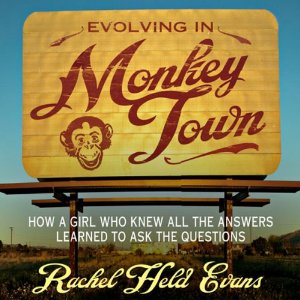
Rachel Held Evans first book.  She's young, church-going.... and not very sure about her faith.   Does she represent the future of "evangelical Christianity"?

Rachel Held Evans first book. She’s young, church-going…. and not very sure about her faith. Does she represent the future of “evangelical Christianity”?

How do you handle doubt? Some want to shove it under the rug. Some, frankly, never really go through serious periods of doubt. Others wallow in their confusion. Some simply rebel as an escape mechanism. Others are driven to God’s Word, study, prayer, and fellowship to find answers. Where do you go when you begin to second guess everything, if you ever do?

Part of what we are trying to do with Veracity is to provide tools to help folks to get into God’s Word so that God’s Word can get into us. What resources are available that can equip us to better understand our faith so that we can better serve the Lord in our worship and witness? However, there are times where doubt can plague us in our spiritual journey and threaten to derail us spiritually. Perhaps an explanation about the Bible we once heard no longer makes sense anymore. Or is there some assumption that we have made about the Christian life that no longer appears to be working? Perhaps we expected God to do something and things did not turn out the way we think it should.

Doubt is an enormous topic to tackle in a single blog posting. So I will be content for now to give you a partial case study.
Continue reading