Tag Archives: Bart Ehrman

Responding to Textual Criticism

VilifyWhen someone confronts us in a particularly offensive manner or strikes at a deeply held conviction or belief, most of us have a natural inclination to fight back. Unfortunately, we have a tendency to let anger and emotions get the better of us.

Like it or not, we live in a world where there is little tolerance for people who think differently. From a purely cultural perspective, we are far less apt to listen and empathize than we are to attack and vilify. To win is to vanquish our enemies. Or is it?

“You have heard that it was said, ‘An eye for an eye and a tooth for a tooth.’ But I tell you not to resist an evil person. But whoever slaps you on your right cheek, turn the other to him also. If anyone wants to sue you and take away your tunic, let him have your cloak also. And whoever compels you to go one mile, go with him two. Give to him who asks you, and from him who wants to borrow from you do not turn away. “You have heard that it was said, ‘You shall love your neighbor and hate your enemy.’ But I say to you, love your enemies, bless those who curse you, do good to those who hate you, and pray for those who spitefully use you and persecute you, that you may be sons of your Father in heaven; for He makes His sun rise on the evil and on the good, and sends rain on the just and on the unjust. For if you love those who love you, what reward have you? Do not even the tax collectors do the same? And if you greet your brethren only, what do you do more than others? Do not even the tax collectors do so?”
Matthew 5:38-47, NKJV

In our Personal Discipleship class we have been studying contemporary challenges to the Christian faith. One of the more prominent challengers is Bart Ehrman, a popular skeptic who calls himself an agnostic, but who more accurately fits the mold of an angry, deconverted Christian. (Ehrman has a big beef with God over the problem of evil and suffering.) His books achieve best-seller status, and he is quoted by atheists and skeptics as an authority on the unreliability of the Bible. He is revered by friend and foe alike for his skill in textual criticism. His research is largely undisputed, but his premises and conclusions are highly biased. Nevertheless, he strikes a chord with those seeking to discredit the trustworthiness of the Bible.

While it’s very difficult for some to listen to abrasive skepticism, it is encouraging to see how rigorous scholarship can turn back the skeptic’s wrath. Well-articulated truth is a powerful antidote to skepticism, particularly when it follows the apologetic ethic of gentleness and respect. Here is a debate you can buy (sorry, there is no good quality video currently being served online) between Ehrman and Dan Wallace on the reliability of the text of the New Testament. It was at the time the largest debate ever held on the reliability of the New Testament text. (For some interesting background, see the video in this post.)
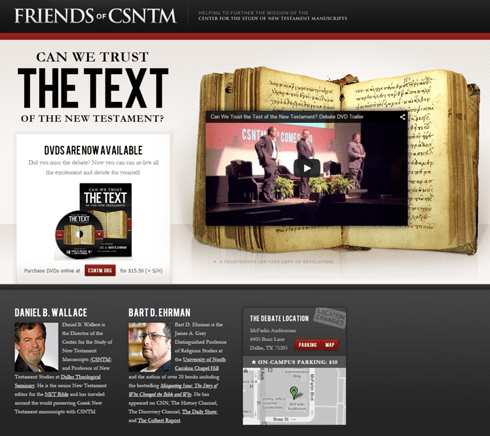
Wallace Ehrman Debate
Dan Wallace is amazing in this debate. He is honest, well-informed, learned, respectful, humorous, and makes a convincing case for the reliability of the New Testament text. His response to Bart Ehrman is a model of what Jesus preached in the Sermon on the Mount (quoted above). Wallace’s response is not angry—although he is deeply concerned about the effects of Bart Ehrman’s influence on our culture. Wallace has the proper response to textual skepticism. He doesn’t vilify Bart Ehrman—he doesn’t need to. It is amazing what we can do when we take the time to study the facts and respond in obedience, with an appreciation of the right ethics.

And finally, for those following our Personal Discipleship class or otherwise interested in Textual Criticism, here are the class notes.
Personal Discipleship Class-Week 7
Click on the images inside this file to link to the online resources. (You may need to adjust your browser settings to allow the links to work, or open it in iBooks, or save it to your desktop and open it with Acrobat Reader.)

HT: Daniel B. Wallace, Marion Paine


Andreas Köstenberger at the College of William and Mary

Andreas Köestenberger. Friday, March 20, 2015. College of William and Mary. Millington 150. Sponsored by InterVarsity Christian Fellowship.

Andreas Köstenberger. Friday, March 20, 2015. College of William and Mary. Millington 150. 7pm. Sponsored by InterVarsity Christian Fellowship.

Does truth really matter? Is the New Testament really reliable, and can I have confidence in what it teaches? The New Testament is under attack, and many people today find it difficult to accept the trustworthiness of the Scriptures. Furthermore, many Christians find themselves unable to defend their faith against this form of skepticism.

Andreas Köstenberger, Senior Research Professor of New Testament and Biblical Theology at Southeastern Baptist Theological Seminary in Wake Forest, North Carolina, will be speaking at the College of William and Mary InterVarsity Christian Fellowship large group meeting, Friday, March 20, 2015, at 7:00 pm. Köstenberger is co-author of a recent book highlighted earlier here on Veracity along with Darrell Bock, Truth Matters: Confident Truth in a Confusing World.  Köstenberger lectures on college campuses addressing issues related to the criticism of the New Testament and the nature of Christian marriage. For people living in the greater Williamsburg, Virginia area, Köstenberger’s talk promises to provoke a wide-ranging discussion of issues that many people, believer and skeptic, struggle with in today’s world. If you wrestle with these type of questions, please come and engage in the conversation.

College of William and Mary:  Millington 150

(Directions to Millington Hall available here)

See you Friday night!!


Has the Bible Really Been Corrupted?

Among the most popular contemporary challenges to Christianity is the notion that our Bible has been corrupted over the millennia by copyists seeking to embellish or rewrite the original text for their self-serving purposes. The idea is nothing new, going back at least as far as 17th-century Dutch philosopher Baruch Spinoza.

CocktailBut modern skepticism has evolved into a new art form. Painstaking textual scholarship is mixed with wild, unfounded theories that have no historical support to make a cocktail that skeptics cannot resist.
The unfortunate part is that most Christians never study the reliability of biblical manuscripts. Most just accept the Bible without fully appreciating what it took to transcribe, transmit, and translate accurate and faithful copies. They don’t fully appreciate what translation committees and publishers go through to produce the book that we hold in our hands as the final authority for our faith and practice—the special revelation of God to us. The really unfortunate part is that they miss the great joy of discovering how miraculously, faithfully, and accurately the Bible has been handed down to us.

Here is a video every Christian should watch. Dr. Daniel B. Wallace, arguably one of the world’s foremost authorities on New Testament manuscripts and textual criticism, lays out the scholarship to refute claims that the Bible has been hopelessly corrupted in its copying and transmission.

For those following our Personal Discipleship class, here are this week’s slides and notes on the topic.

Personal Discipleship Class - Week 6

Click on the images inside this file to link to the online resources. (You may need to adjust your browser settings to allow the links to work, or open it in iBooks, or save it to your desktop and open it with Acrobat Reader.)

HT: Dr. Daniel B. Wallace, Judy Williamson, Spark Church


Stephen Colbert’s Approach to Skepticism

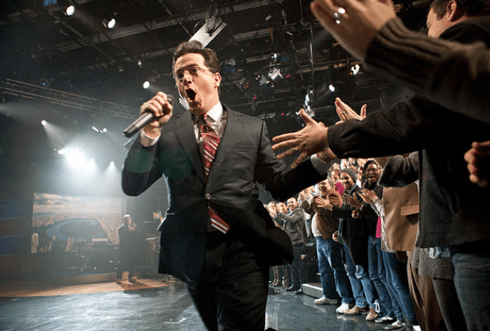
Stephen Colbert

Stephen Colbert (Photo Credit: Todd Heisler/The New York Times)

 In 1974, when Colbert was 10, his father, a doctor, and his brothers Peter and Paul, the two closest to him in age, died in a plane crash while flying to a prep school in New England. “There’s a common explanation that profound sadness leads to someone’s becoming a comedian, but I’m not sure that’s a proven equation in my case,” he told me. “I’m not bitter about what happened to me as a child, and my mother was instrumental in keeping me from being so.” He added, in a tone so humble and sincere that his character would never have used it: “She taught me to be grateful for my life regardless of what that entailed, and that’s directly related to the image of Christ on the cross and the example of sacrifice that he gave us. What she taught me is that the deliverance God offers you from pain is not no pain — it’s that the pain is actually a gift. What’s the option? God doesn’t really give you another choice.”

Charles McGrath, “How Many Stephen Colberts Are There?” (New York Times, January 4, 2012)

In Clarke’s post on today’s most influential skeptics, he listed Richard Dawkins, Bill Nye, Neil deGrasse Tyson, Bart Ehrman and Bill Maher as models of certain types of skepticism. All of them have wide spheres of influence gained through publishing and/or media exposure. Three of them have hosted their own television shows. All of them are intelligent, most are witty, and some have intellectual adversaries. But before we see how Daniel B. Wallace refutes the theories of Bart Ehrman, or how William Lane Craig can give Richard Dawkins a dressing down, let’s see what Stephen Colbert can do with them.

Huh? Stephen Colbert? Really? Okay…cards on the table—I’ve never watched the Colbert Report, probably because sarcasm has never been one of my favorite flavors. But in looking for online material about today’s most influential skeptics, I tripped across several Stephen Colbert video interviews where he took on these very skeptics. Colbert’s comedy can go blue in an instant, and his language at times is inappropriate for genteel company, but his wit is undeniably sharp. And as you may infer from the New York Times excerpt at the beginning of this post, there is a lot more going on with Stephen Colbert than his on-air persona might indicate.

Anyway, here are some cleverly complex interviews where Colbert takes on the skeptics. There is real tradecraft here—he confronts the skeptics boldly without humiliating them. Most of these guests show up for multiple appearances (he interviewed Richard Dawkins and Bart Ehrman twice, and Neil deGrasse Tyson nine times). Some of his quips poke fun at shallow arguments for the very epistemology Colbert seeks to support, while demonstrating an insightful appreciation for apologetic arguments and contemporary skepticism. As W.C. Fields once quipped, “Comedy is serious business.” (Click through to start the video clips, and sensitive ears may want to opt out at this point.)

HT: Stephen Colbert, Clarke Morledge

Richard Dawkins, The God Delusion Interview

Richard Dawkins, The God Delusion Interview

Richard Dawkins, The Greatest Show On Earth

Richard Dawkins, The Greatest Show On Earth Interview

Bart Ehrman, Misquoting Jesus Interview

Bart Ehrman, Misquoting Jesus Interview

Bart Ehrman, yyy

Bart Ehrman, Jesus Interrupted Interview


Who Are the Most Influential Skeptics Today?

Bill Nye, the Science Guy.  Comedian and science educator for a generation of young people.  Now a participant in the culture wars??

What do cultural celebrities like Bill Nye, Richard Dawkins, Neil de Grasse Tyson, Bart Ehrman, and Bill Maher all have in common? In different ways, the represent different forms of skepticism about the Christian faith.

In a recent Sunday School class on “Personal Discipleship,” I was asked this question: Who are the most influential skeptics today? 

How does one go about answering such a question? According to Canadian philosopher Charles Taylor, in his magisterial A Secular Age, a few hundred years ago it was virtually impossible not to believe in God. But nowadays, the shift is remarkable: for many in 21st century Western culture, it is very easy, almost inescapable, to not believe in God. Skepticism defines the current cultural mood, something that would have been mostly unthinkable just a few centuries ago.

Instead of trying to come up with some type of “Top Ten” skeptics list, I think it best to list out some of the more skeptical personalities today, each person representing a different type of skepticism that an evangelical Christian believer might encounter in their conversations with their neighbors, co-workers and even family members. So here we go….
Continue reading