Imprimatur: official approval; approval of a publication under circumstances of official censorship.
Merriam-Webster

Who wrote the Bible?
For those who’ve been following our current series, it’s time to get into the battle for the Bible. (You might need a cup of coffee to get through this one.)
We’re about to give you some information that will help you stand tall at any water cooler, but with two caveats before we check into the debate. First, we’re about discovering the truth—not defending dogma or tradition for tradition’s sake. Second, we fight with gentleness and respect—the objective of apologetics done right is to remove obstacles, not to win an argument. And for those who are new to Veracity, as a matter of ethics, on this blog we don’t tell you what to think.
In our previous posts on the subject, we laid out the traditionally accepted authors of the Bible. As you might imagine, there are those who seek to discredit the Bible as the basis for Christian faith and practice by challenging the authorship of its books. (A forthcoming series will explore how we got our Bible, but for now we’re focusing on authorship—yes, God wrote the Bible, but it came through the inspiration of human authors.)
Let’s start at the beginning. The first five books of the Bible are referred to as the Pentateuch (which ironically is Greek for Five Scrolls), and are taken straight from the Hebrew Bible (or ‘Tanakh’). Often these five books—Genesis, Exodus, Leviticus, Numbers, and Deuteronomy—are referred to as the ‘Torah’, but that word has multiple meanings. Traditionally, both Jewish and Christian scholars credit Moses with writing the Pentateuch. But there have been challenges to the claim of Mosaic authorship going back many centuries, and these challenges have gained traction with modern scholars. This debate is not going away any time soon, so let’s see what the fuss is all about.
First and foremost, why should we care? What difference does it make who wrote the Pentateuch? In short, so much of the Bible—including major parts of the New Testament with direct references from Jesus Christ and the apostles—cite and depend upon the Mosaic provenance of the Pentateuch that if Moses’ imprimatur is not on these books then the entire Bible is a hoax. If Moses did not accurately record what God revealed to him then Christians (and Jews) are living a lie. Do we have your attention now?
The Documentary Hypothesis
The preeminent challenge to the claim of Mosaic authorship of the Pentateuch is “The Documentary Hypothesis” (also called the Graf-Wellhausen Hypothesis or JEDP Theory). Make Documentary Hypothesis your first water cooler term.
Unlike many other challenges to biblical Christianity, the Documentary Hypothesis is based upon reason and logic—or so it might seem. A clear summary may be found in Richard Elliot Friedman’s text Who Wrote the Bible? Dr. Friedman introduces the hypothesis by describing its historical development, and here we’ll do the same.
Challenges to the traditional Mosaic authorship of the Pentateuch go back at least as far as the third century A.D. when people began questioning apparent inconsistencies in the text. Events were related in one order, then in a different part of the Pentateuch the same events appeared to be recounted in a different order. Numbers and people groups didn’t always line up precisely in different historical accounts within the text. Moses apparently went to a tabernacle before the Israelites built the Tabernacle. These apparent inconsistencies were explained by medieval commentators (such as Rashi in France and Nachmanides in Spain), and their explanations were generally accepted into the middle ages.
Then scholars turned their attention to lines of text that were added after Moses was dead. For example, the list of Edomite kings in Genesis 36 includes kings who lived long after Moses. Likewise, they noted that Deuteronomy contains the account of Moses’ death and burial, and post-mortem reflections on his life. At the very least, someone else put a bookend on the biography of Moses in Deuteronomy. A theory began to emerge that Moses wrote the Pentateuch, but that later editors added occasional words and phrases of their own. Contemporary scholarship produced additional arguments, such as noting the occasional use of the phrase “To this day”—typically the phrase of a later writer contextualizing the history recorded in the text.
Dutch philosopher Baruch Spinoza published Tractatus Theologico-Politicus in 1670, a critical analysis in which he rejected in its entirety the view that Moses authored the Pentateuch. Here’s your second water cooler term: Spinoza is the father of “Higher Criticism” of the Bible. When you come across that term in this debate it refers to a very specific branch of literary criticism (it doesn’t mean a ‘true’ or ‘enlightened’ view). Spinoza cited the third-person accounts of Moses in the text, such as Numbers 12:3 which states (parenthetically in several modern translations of the Bible) that Moses was very humble and indeed was the most humble man on the face of the earth. Not a statement likely to have been written by a humble man like Moses. Got it.
Shortly thereafter, French priest Richard Simon put forth the idea that the core of the Pentateuch was Mosaic, but that there were later additions. He proposed that one or more writers had assembled the text from older source documents. Simon’s idea was based on the analysis of doublets in the text—that is places where the same account is told twice. For example, the following accounts appear to be repeated in the Pentateuch: the account of creation; the covenant between God and Abraham; Abraham’s deception about Sarah in Egypt; the naming of Isaac; Jacob’s journey to Mesopotamia; and Moses getting water from a rock at Meribah. Defenders of traditional Mosaic authorship argued that these doublets are complimentary, not contradictory. (Incidentally, the same issues occur in the Gospels where four authors record the same events, but each from their own perspective.)
Then scholars looked at the doublets and began to analyze specific words and linguistic nuances. One observation was that one set of doublets seemed to consistently use the name ‘Yahweh’ and the other set used the name ‘Elohim’. (One might ask who determines which texts are included with which set of doublets—it could be arbitrarily grouped by name, but let’s move on.) French physician Jean Astruc then published a book in 1753 laying out the theory that Moses compiled Genesis from two sources. Minister H.B. Witter and theologian Johann Gottfried Eichhorn also arrived somewhat independently at similar conclusions in Germany.
The Documentary Hypothesis then multiplied. Scholars expanded the theory to three separate source documents, and felt that the book of Deuteronomy was completely different from the other three sources. The source documents were labelled as:
- J – the document associated with the name ‘Yahweh’ (or ‘Jehovah’);
- E – the document associated with the name ‘Elohim’;
- P – (by far the largest of the four) including sections dealing with priestly matters; and
- D – material only found in the book of Deuteronomy.
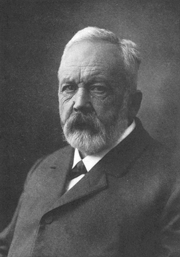
Julius Wellhausen, the father of the modern Documentary Hypothesis
(Ironically there is an analogous theory called Q Source in the New Testament, for which no manuscript evidence has ever been found, but again let’s move on.) Karl Heinrich Graf then put J, E, P and D in chronological order and concluded that the J and E documents preceded D and P. His ordering built upon the work of others, but centered on the idea that there were three distinct periods in the development of Hebrew history, a position that was furthered by the writing of nineteenth century biblical scholar Julius Wellhausen, who is regarded as a pioneer in the development of the Documentary Hypothesis.
The gravitas of Wellhausen’s work lay in his ability to link Hebrew history with J, E, P and D. Specifically he noted that J and E reflected early religious life and practices, that D reflected a spiritual and ethical stage, and that P described a priestly and legal stage. His historical work is well respected, even though it does reflect the anti-Semitism of nineteenth and early twentieth century Germany.
So what we have is a theory that the Pentateuch was not written by Moses, but that it was assembled by a redactor or redactors around 400 B.C. (approximately 1,000 years after Moses) from four or more source documents that were spliced together to obtain the text that has been transmitted to us. Several contemporary scholars, including Friedman, believe that the primary redactor was Ezra the priest.
The Case for Mosaic Authorship of the Pentateuch
Personal discipleship can be complicated. The Documentary Hypothesis sounds pretty convincing, right?
Not so fast.
There is considerable hubris among proponents of the Documentary Hypothesis. It’s a bit like the members of the Jesus Seminar sitting around and dropping marbles into a ballot box to vote on how much they accepted each of the quotations of Jesus. Okay, it’s an exercise, but is it valid? Is there an agenda or bias behind this scholarship? Are they telling themselves what they want to hear? The questions get tougher. Is there any proof? Does the hypothesis fit the facts or are the facts being arranged to fit the hypothesis? Hmmm….
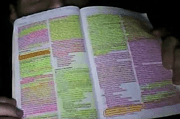
Markup of the Pentateuch according to the Documentary Hypothesis
One of the first criticisms of the Documentary Hypothesis is its fragmentation. As indicated in the color-coded figure on the right, there are many places where it appears the text has been run through a shredder and glued back together. Over time, additional scholarship proposes new, finer fragmentation, devolving to absurd levels of edits (down to single words in some cases). The E source is extremely fragmentary, as are the redactor’s comments.
A second criticism is that, as with Q Source Theory, no manuscript evidence has ever been found. Nothing in the Dead Sea Scrolls, nothing in extra-biblical sources, …nothing.
One defense that proponents of Wellhausen’s hypothesis like to throw up is that consistent patterns appear in the text. But one pattern they overlook is the pattern throughout the Pentateuch (and the Old Testament and the New Testament) where the text acknowledges Moses as the source of the Pentateuch. In other words, the text itself testifies to its authorship. Examples include:
You get the point. While nowhere in the Pentateuch does an author directly identify himself—as was the style of most ancient Semitic writers—there can be no doubt within the biblical text that Moses was accepted as the preeminent source of these books.
In the Gospels alone there are 37 references to Moses and his authority over the Hebrew people, and 79 such references in the New Testament. In the Old Testament, Moses’ name appears 500 times. Moses is big stuff.
How convincing does the Documentary Hypothesis appear now?
So we arrive at the tipping point of the debate. The acceptance of Mosaic authorship of the Pentateuch is inextricably tied to our presuppositions, and particularly our view of the Bible. In the list of additional resources at the end of this post you’ll find some heady, academic reference materials mixed in with some simpler and more straightforward documents that delve further and wider into this debate. The authors range from noted apologist and Old Testament scholar Professor Daniel I. Block to Yale University religious studies Professor Christine Hayes.
Dr. Block is regarded as an expert in this field, and his paper published in the September 2001 Journal of the Evangelical Theological Society is well worth the read, as is his contribution to the Spring 2012 issue of the Areopagus Journal.
Dr. Hayes’ lecture video presents an academic view of Wellhausen’s hypothesis, but comes at the debate from the viewpoint of someone who believes that mythology comprises significant portions of the Pentateuch.
Takeaways
The Documentary Hypothesis is not the hammer blow to Christianity many would make it out to be. Granted, only a very naïve person would argue that Moses wrote the entire Pentateuch as we normally consider ‘writing’, but we can’t have either the Old or New Testament without the imprimatur of Moses on the Pentateuch. Were there later additions and edits? Yes, clearly. Does that mean that the Pentateuch is misrepresented in the Old and New Testaments? Certainly not.
Reading the Bible as less than the inspired Word of God misses the point. It’s like reading or studying music without ever hearing the sounds. Whether you come at it with a skeptical agenda or not, you cannot fully appreciate it until it moves you to the truth—not a derived truth, but the Divine Truth.
If you need to develop an appreciation for the reliability of the Bible, we offer the following Veracity posts:
The last link above deals with the Chicago Statement, which has considerable bearing on this discussion. Put the Chicago Statement in your water cooler lexicon.
For a takeaway to the question of Mosaic authorship, let’s end with the words of Dr. Daniel I. Block, the Gunther H. Knoedler Professor of Old Testament at Wheaton College:
“So who wrote the Pentateuch? In answering this question we need to follow the lead of the Apostles, who were so certain of its Mosaic nature that they can substitute the man’s name for the document itself. In Acts 15:21, James declares, ‘From ancient generations Moses has had in every city those who proclaim him, for he is read every Sabbath in the synagogues’ (ESV). Similarly Paul writes of his fellow Jews, ‘To this day, when they read the old covenant, that same veil remains unlifted, because only through Christ is it taken away. Yes, to this day whenever Moses is read a veil lies over their hearts’ (2 Corinthians 3:14-15, ESV [italics mine]). Here Moses is identified with the ‘old covenant,’ by which he presumably means the Pentateuch. Whether or not they believed Moses put his own signature to the forms of the text they used in worship, they certainly accepted it as coming with Moses’ full authority. In that sense the first five books of the Bible are rightly called The Five Books of Moses.”
Daniel I. Block, “Moses and the Pentateuch: An Investigation Into the Biblical Evidence,” Areopagus Journal, Spring 2012
Additional Resources
 Who Wrote the Bible? The Areopagus Journal of the Apologetics Resource Center (Volume 12 No. 2)
Recovering the Voice of Moses: The Genesis of Deuteronomy (Daniel I. Block)
Who Wrote the Bible? (Richard Elliot Freidman)
Wellhausen’s Documentary Hypothesis (Yale University lecture by Professor Christine Hayes)
Does It Really Matter Who Wrote the Pentateuch? (Eric Lyons)
Defending Biblical Inerrancy… (Harold C. Felder)
A History and Critique of The Documentary Hypothesis and a Defense of Mosaic Authorship of the Pentateuch (Nicholas J. Lutzo)
Debunking the Documentary Hypothesis (Bible Translation Magazine)
HT: Yvonne Brendley, Faith Smagalski


 The Life Line by Winslow Homer, 1884