Who wrote the Bible?
In the first part of our new series entitled “Who wrote the Bible?” we explored the human authors of the Old Testament. With this post let’s turn our attention to the writers of the New Testament.
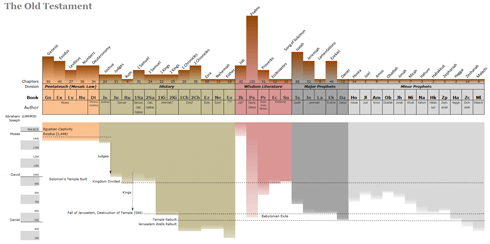
In order to keep everything balanced, we developed an infographic on the composition of the New Testament (similar to the one we developed for the Old Testament), linked to first century history.
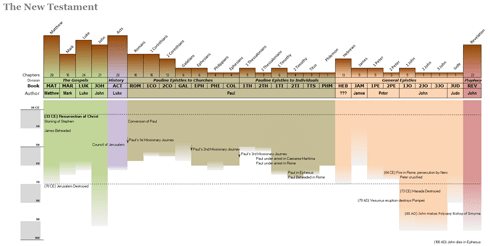
So what do you see in the infographic? There are five divisions in the New Testament: the Gospels, a history book (Acts), Paul’s letters, general letters, and a prophetic book (Revelation). In no particular order, here are some fun facts you can use in water cooler conversations:
- Two of the four Gospels were written by authors who were not firsthand witnesses to the events they recorded (Mark was Peter’s associate, and Luke was an associate of Paul).
- While it may appear as if Paul wrote most of the New Testament, in fact Luke wrote more words than anyone else. (Luke was very thorough in his research and writing, and was always meticulous with the details.)
- As far as historical research can determine, there was a writing gap between the Resurrection and the writing of the New Testament books. Don’t be disarmed by this apparent gap—it’s considerably smaller than the gaps for other ancient manuscripts, and well within the lifetimes of firsthand witnesses. (Don’t believe it? Study this infographic.) The gap is also understandable in terms of the history of the early Christian Church—which was so inept (by its own reporting) that it barely held together in its first years.
- James is arguably the earliest of the New Testament manuscripts (competing with Paul’s earliest epistles). Who was James and why was he important? Keep reading.
- That James would be the first to write is consistent with his leadership of the early Church in Jerusalem.
- There are only eight known authors of the Old Testament (the authorship of Hebrews remains uncertain). In terms of occupations, one was a tax collector, one was a physician, one was a tent maker, two were fishermen, and two were half-brothers of Jesus Christ.
- Only three of the new Testament writers were among Jesus’ 12 Apostles (although Paul clearly had apostolic authority).
- Although precise dating of some of the New Testament Scriptures is not possible (by the way some can be dated very precisely), it took approximately 14 years from Paul’s conversion for him to begin writing his contributions to the Bible. Why so long? Well according to his own writing, he spent years with Jesus Christ learning all that God had to show him.
- John was the youngest of the apostles, some think as young as 13 years old when Jesus was crucified, and he lived much longer than the other Apostles. John’s writing comes later, and with the possible exception of Jude (who only wrote one chapter of the Bible), is the only New Testament author writing after the conquest of Jerusalem in 70 AD.
The precise dating of the New Testament books in the context of first century history is a fascinating subject, well beyond the scope of this post. Two excellent sources are From Abraham to Paul: a Biblical Chronology by Andrew E. Steinmann, and anything by Norman Geisler (here’s a small sample of his work—if you only click one hyperlink in this post, let it be this one so you’ll see how forensic this topic becomes when it is approached with academic integrity).
How important is understanding how these texts fit in history? Hmmm…maybe we could light a fire under Clarke Morledge to start with John in Ephesus in 70 AD and take it forward from there (Clarke has a passion for Christian history). Let me just state for now that it’s important to appreciate how tightly the dots are connected.
So…back to the New Testament authors. Click on the names of the authors in the right-hand column to read their biographies (yes we’re using Wikipedia, which doesn’t have all the facts straight, but does provide mostly useful information with lots of links to rich content).
|
The New Testament |
||
|
The Gospels |
Matthew |
|
|
Mark |
||
|
Luke |
||
|
John |
||
|
History |
Acts |
|
|
Pauline Epistles to Churches |
Romans |
|
|
1 Corinthians |
||
|
2 Corinthians |
||
|
Galatians |
||
|
Ephesians |
||
|
Philippians |
||
|
Colossians |
||
|
Pauline Epistles to Individuals |
1 Thessalonians |
|
|
2 Thessalonians |
||
|
1 Timothy |
||
|
2 Timothy |
||
|
Titus |
||
|
Philemon |
||
|
General Epistles |
Hebrews |
|
|
James |
||
|
1 Peter |
||
|
2 Peter |
||
|
1 John |
||
|
2 John |
||
|
3 John |
||
|
Jude |
||
|
Prophecy |
Revelation |
|
Matthew was a tax collector, clearly among the most despised people in Judea. He would have been a meticulous record keeper, and was probably very good at getting away from mobs—both useful skills for an apostle and Gospel writer.
James and Jude were half-brothers of Jesus Christ. James was the leader of the Jerusalem Church, and was the glue that held it together at the Council of Jerusalem. (The discovery of the James Ossuary has recently touched off a firestorm of controversy in the field of biblical archaeology.)
Peter was an illiterate fisherman (which may explain why Mark is thought to have written Peter’s accounts in his Gospel), with a Galilean accent. Peter’s tomb is arguably the finest grave site in the world.
Paul was a tent maker, and a gifted student of the Hebrew Tanakh. He was a small man with a fiery temper, humble and remarkably fearless. He also had a marvelous sense of humor (he wrote that greeting while chained to two Roman guards.) By the way, speaking of tombs and chains, Paul was honored with a very fine basilica of his own. Click the graphic below to take a 3-D virtual tour. The chains at the center are thought to be the chains that bound him to his Roman captors, with provenance back to the fifth century. In 2009 the Vatican announced that bone fragments collected inside his sarcophagus were indeed from a first century man.
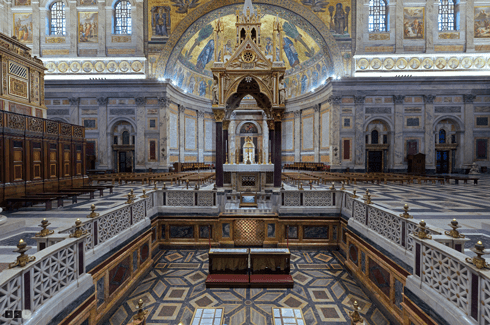
Take a 3-D tour of Paul’s Tomb at the Basilica of St. Paul Outside the Walls (in Rome).
Click away, dig deep, and share the joy of personal discipleship! After you’ve gotten acquainted with the authors, in our next post in this series we will explore the apologetics of defending the claims for traditional authorship of the Bible. Enjoy!