Who Wrote the Bible? (Part 1)

Who Wrote The Bible

Who wrote the Bible?

God…right?  While that may be a profound and direct answer, it’s also overly simplistic. The Bible is God’s special revelation to mankind, delivered through the divine inspiration of human authors. So who were the human authors?

There’s a lot riding on the answer. Not so much in terms of their actual identities, but because many attacks against Christianity are targeted at disproving the reliability of human authorship. What kind of defense can those of us who believe that the Bible is the inspired, inerrant, and infallible word of God offer regarding the trustworthiness of the authors of the Bible?

It’s not essential that we know the names of the human authors (otherwise they would have laid out their identities in the text with certainty), but it is essential that we know that the Scripture is trustworthy. So with this post we begin a series to help readers appreciate the Bible as an accurate, historical, and trustworthy document. In a companion series we will explore how we got the “Holy Bible,” but for now we’ll begin with the authors.

Let’s lay out one precept: we’re about discovering the truth, not defending traditional notions. For example, it is widely believed that Moses wrote the first five books of the Bible. But that cannot be completely true. Why not? Because the fifth book (Deuteronomy) contains the accounts of his death and post-mortem reflections on his life—so at the very least someone else put the ending on his five books. Likewise, some people who haven’t really read the Bible have notions that God’s inspiration constituted divine dictation. But it is obvious in many passages that the Bible is not dictation from the Creator of the universe. How do we know that? Because the human authors state so—point blank in many verses (see this post for one clear example).

Back to the authors. Ezra was a priest, who mourned over his people’s disobedience to God after they were delivered from the Babylonian captivity. He was also a painstaking historian whose detailed historical records are downright anal-retentive (who counts plates, really?!). Jeremiah was called the weeping prophet—and why not?  You’d weep too if you went through what he endured (by the way, there have been some stunning archaeological finds involving Jeremiah in recent months). Gad was the bag man for David’s bad news. Obadiah is said to have been a descendant of Eliphaz, the friend of Job. And on and on…you get the point.  There are a lot of fascinating biographical details to appreciate about these authors.  Our aim in writing this post is to make them readily accessible.

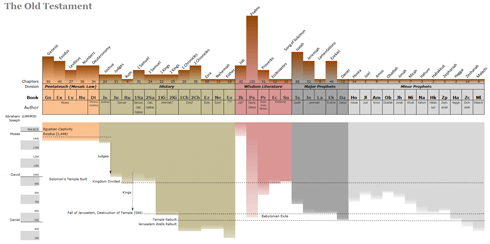
We created the following Bible infographic depicting the grouping of the Old Testament books, the authors, the approximate dates of writing, and how many chapters each book contains. It’s a snapshot of the construction of the Old Testament.
The Old Testament


So…sticking with just the Old Testament for now, here is a new color-coded table keyed to our original infographic with hyperlinks to articles about the inspired authors of the Bible.  As you’ll read in the linked material (click on the author’s name in the right-hand column), some books have considerable contention about authorship.  But the point here is not to resolve that contention—we simply want to expose you to the biographies of the plausible authors.

The Old Testament

Pentateuch (Mosaic Law)

Genesis

Moses

Exodus

Leviticus

Numbers

Deuteronomy

Moses

Joshua

History

Joshua

Joshua

Judges

Samuel

Ruth

1 Samuel

Samuel, Gad, Nathan

2 Samuel

Gad, Nathan

1 Kings

Jeremiah?

2 Kings

1 Chronicles

Ezra?

2 Chronicles

Ezra

Ezra

Nehemiah

Ezra?

Esther

???

Wisdom Literature

Job

Job?

Psalms

David,

Others

Proverbs

Solomon,

Others

Ecclesiastes

Solomon

Song of Solomon

Major Prophets

Isaiah

Isaiah

Jeremiah

Jeremiah

Lamentations

Ezekiel

Ezekiel

Daniel

Daniel

Minor Prophets

Hosea

Hosea

Joel

Joel

Amos

Amos

Obadiah

Obadiah

Jonah

Jonah

Micah

Micah

Nahum

Nahum

Habakkuk

Habakkuk

Zephaniah

Zephaniah

Haggai

Haggai

Zechariah

Zechariah

Malachi

Malachi

In an upcoming post we will give similar treatment to the New Testament  authors, and then review apologetic arguments that defend the trustworthiness of the human authors of the Bible.  Enjoy!

Resources
Areopagus-Journal-Spring-20The spring 2012 issue of the Areopagus Journal is an excellent resource for further study, and we will make use of several articles in our upcoming posts.

HT: Yvonne Brendley, Faith Smagalski

Ken Ham and Bill Nye Debate Recap

My wife and I were still out making our monthly run to CostCo while last night’s debate between Ken Ham and Bill Nye was going on. It was not like the SuperBowl or anything, but somewhere between a half a million to a million people watched the YouTube version online.

I only caught the closing statements near the end and rewinded to the beginning to catch their opening statements. I actually thought the exchange went better than I thought it would, and it did turn out a little different than I expected and predicted here on Veracity.

Instead of focusing on the harm evolution education he reports is causing in our schools, Ken Ham focused more on the distinction he was making between historical science and observational science. His main argument was that he and Bill Nye actually share the same perspective on observational science that gives us things like modern technology today. The disagreement is over historical science. For Bill Nye, historical science gives us genuine knowledge about the past. For Ken Ham, science can not give us reliable knowledge about the past. We must look to the Bible for that.

Likewise, Bill Nye surprised me, too. Though he clearly has an agnostic orientation towards the Christian faith, he made some approving mention that not all Christians share Ken Ham’s Young Earth Creationist views.

If you missed the debate, should you watch it? Mmmm….If you are not terribly familiar with the subject matter, I would encourage you to watch it, but with a strong caveat involved: Take the time to look into what other Christians are saying about the issue. For example, Reasons to Believe, the premier Old Earth Creationist ministry, made a statement about the debate beforehand, and interestingly references a number of the resources we here at Veracity have talked about representing their position. At BioLogos, the most prominent Evolutionary Creationist think-tank, a group of scholars offered their post-debate reflections. Then you might consider this evaluation of the debate from Albert Mohler, president of the Southern Baptist Theological seminary, and a Young Earth Creationist.

From a more secular perspective, a young reporter with Time magazine did some live blogging coverage of the debate. The general take away of this blogger is that last night’s event was a throwback to the “creation culture wars” of the 1990s. She has a point here, but what is different now is that  through the advances of the Internet, you can interact with a variety of perspectives and get access to information (some good, some not so good) easier than ever before, something that simply was not available to me when I had my first crisis of faith experience on this issue some thirty years ago.


Debate Tonight: Bill Nye and the Bible Guy, Ken Ham

Ken Ham and Bill Nye debate tonight. Do not expect a lot of nuance or substance, but there will be a lively discussion.

Ken Ham and Bill Nye debate tonight. Do not expect a lot of nuance or substance, but there will be a lively discussion.

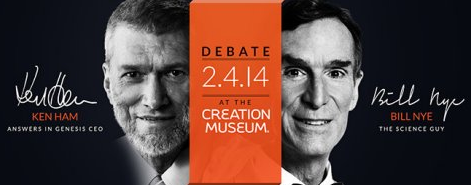
Some of you may know about the debate between Bill Nye and Ken Ham tonight. Ken Ham, the director of Answers In Genesis, has challenged Bill Nye, the Science Guy, to a debate on the following topic: “Is creation a viable model of origins in today’s modern scientific era?” The debate will be held at the Creation Museum in Kentucky at 7 P.M. and will be accessible over the Internet via live streaming.

I sometimes run into Veracity readers who find that some of the content on the blog goes over their heads. I get that. Tonight’s debate will definitely not be that way, as Bill Nye is a very popular science educator for children. Ken Ham is an effective communicator for what is popularly known as “Creationism”.

On the positive side, the debate will give a 10,000 foot overview of the Creation vs. Evolution controversy that has continued to rock American Christianity ever since the spectacular Scopes Monkey Trial in the 1920s. The downside is that it will not really be a “debate” at all. Bill Nye, as an engineer who has a love for science, has a great deal of concern about America’s future ability to compete in an ever expanding technological world. He will be trying to convince his listeners in Kentucky that the belief in “Creationism” is harming our kids, and thus harming America’s future. Ken Ham, on the other hand, will argue that Bill Nye’s approach to science is closed-minded and promotes censorship, and that the modern view of science that Nye is championing is ultimately responsible for the moral decay and spiritual ruin of America and America’s churches.

Unfortunately, the rhetoric on both sides tonight will greatly oversimplify the real fundamental issues at stake. More than a few will boycott the debate out of principle. Others will be relieved that FINALLY someone is standing up for the truth. True, there will be some facts presented, but the emphasis will be on emotional appeal and not very much on genuine substance. This is why John Paine and I are so passionate about what we are trying to do on Veracity. Veracity is about substance. If you do view the debate tonight and find yourself frustrated, exasperated, or bewildered, regardless of what position you take on it, you will know exactly what I am talking about.

John and I have toyed with possibly live blogging the debate, but the current logistics perhaps make that unlikely. If you have a comment on the debate, please add one below. We would like to hear from you.


Which Science Do You Trust?

Who would you trust the most? An astronomer guy who peers into his telescope in the wee hours of the morning? A physicist who draws up mind-blowing math formulas and rambles on about some Higgs Boson thingie? A chemist who mixes up crazy concoctions in her lab? Or a biologist who plays with frogs and fruit flys?

I was listening to the latest podcast from MoodyRadio’s Up For Debate program this week. The topic was “Should Christians Embrace Theistic Evolution? featuring a discussion between Dr. Ard Louis, a scientist at the University of Oxford, and Dr. Paul Nelson, a Fellow of the Discovery Institute. At one point during the program, the host of the show, Julie Roys, played the following clip from Phillip E. Johnson, perhaps the father of the modern Intelligent Design movement. Here Johnson argues that “evolution” as generally understood by the educational and academic community is inherently atheistic in orientation. In other words, theistic evolution is an oxymoron, a contradiction in terms.

I get the impression that according to Phillip Johnson, he would pick and trust the astronomer, the physicist or the chemist over the biologist any day. Sorry frog and fruit fly lover!!

This raises an interesting set of issues and I will tell you why.
Continue reading


Oxymoronic: On How (Not) to be a Moron

Snow falling on the sundial, in front of Swem Library on the campus of William and Mary, early evening, January 28, 2014.

Light snow falling on the sundial, in front of Swem Library on the campus of the College of William and Mary, early evening, January 28, 2014.

It is snowing in Williamsburg, Virginia this evening. We do not get that much snow here, so when it does snow it can be memorable. But some memories can trigger some other embarrassing memories.

It was another rare snowy night last year when I went with some friends to hear Terry Mortenson of Answers In Genesis speak at the College of William and Mary defending his position for Young Earth Creationism. The title of the talk was “Was Darwin Right?” (Check here and here for the YouTube videos recorded elsewhere from an earlier presentation). As the snow was melting down my neck in the auditorium, I was captivated by a back and forth dialogue between Mortensen and a skeptical college student who obviously knew more about genetics than I did. I had read enough of Francis Collins’ The Language of God to follow along in the discussion at a modest level, but it became apparent that after about 15 minutes…. this was the longest engagement during the entire hour-plus Q&A period… that Mortensen was completely out of his league here. Mortensen is a historian of science and theology, but he is not a genetic biologist. Mortensen was gracious and kind… but not very persuasive.

John Paine this morning left a thoughtfully engaging yet brief response to my last, and not-so-brief, Veracity post on “An Evolutionary Creation: Oxymoron? I could not simply respond with a brief comment (John gives me a lot to think about… there goes my lunch break), so with the snow as a tickler to my thoughts, here goes the rest of my rejoinder…..
Continue reading