
Cliff Barrows (1923-2016) ministered alongside evangelist Billy Graham, starting in 1946. Barrows led the music for the Billy Graham Crusades, believing that worship through music would resound with the glory of Christ, and bring many souls to the feet of the Savior. A website in memory of Cliff Barrows tells his story.
Category Archives: Witnesses
Hugh Ross
There are some really gifted people doing great work in ministry these days. Ravi Zacharias, William Lane Craig, Andy Stanley, J. Warner Wallace, Daniel B. Wallace, Darrell Bock, and Craig Blomberg come to mind. And this guy.
I’ve studied Hugh Ross’ material for quite some time. I’ve seen him challenged and attacked, and have been impressed by his ability to respond with love instead of anger. He runs Reasons To Believe with great integrity, and his thought-provoking and original material is always brilliantly researched and lovingly delivered. Here’s a recent interview that gets very personal.
A Remembrance of My Dad

George Alan Morledge (May 28.1930 – March 14, 2016)
My dad died a few weeks ago, of pulmonary fibrosis and chronic heart disease. He died exactly one year later, to the day, from when I posted the eulogy for my mother here on Veracity, who died in 2015. Last week, I had family in from Wisconsin, Texas, Colorado, and across Virginia and North Carolina, to celebrate his life. George Alan Morledge was a very accomplished man, a celebrated architect who specialized in 17th and 18th colonial restoration, including 20 years of service at the Colonial Williamsburg Foundation (check out their recent controversial SuperBowl ad), a significant project to help restore Blandfield Plantation in Essex County, Virginia, and assisting in researching the origins of the Adam Thoroughgood House, in Virginia Beach, Virginia. More about my dad’s life here.
After I dropped off the last of my cousins at the airport to go home, it was a pretty lonely ride back to my house. Some friends, including our Veracity blogger-in-chief, John Paine, suggested that I post “A Remembrance of My Dad” that I gave at his memorial service. My dad left me an important lesson and a treasure, that pretty well defines the orientation that I have towards the Christian faith, that I hope might come through here on the Veracity blog:
Nunc Dimittis, As Sung By Natalie Dessay
Worship the coming Savior…
Simeon, an elderly Jew, had received a promise from the Holy Spirit that he would not die before laying eyes on the Messiah. So when Mary and Joseph bring the child Jesus to the Temple for the purification, specifically the Jewish consecration of the first born male, pidyon haben, Luke 2:22-28, Simeon took Jesus into his arms and uttered the Nunc Dimittis, named after the first phrase in Saint Jerome’s Latin translation of the Bible, the Vulgate (Luke 2:29-32), translated here by the English Standard Version:
“Lord, now you are letting your servant depart in peace,
according to your word;
for my eyes have seen your salvation
that you have prepared in the presence of all peoples,
a light for revelation to the Gentiles,
and for glory to your people Israel.”
Johann Sebastian Bach wrote a cantata, Ich habe genug, meaning in English, “I have enough,“which was first performed in Leipzig in 1727. Bach’s text is only loosely based on Luke’s text, but it conveys the meaning intended by Luke rather well: God had kept His promise to Simeon.
I have enough; I have taken the Savior,
the hope of the Gentiles, into my yearning arms.
I have enough; I have seen him, my faith has held Jesus to my heart;
now I desire but even today to depart with joy from here.
I have enough!
French opera soloist, Natalie Dessay, sings the Aria from Bach’s classic work, from the German:
Ich habe genug.
ich habe den Heiland, das Hoffen der
Frommen, auf meinen begiergen Arme genommen;
ich habe genug!
Ich hab ihn erblickt, mein
Glaube hat Jesum ans Herze
gedrückt, nun wünsch ich noch
heute mit Freuden von hinnen zu scheiden.
Ich habe genug!
Behold, the Messiah, the Savior, has come! Merry Christmas, from your friends at Veracity.
Jesus’ purification in the temple serves as a Scriptural model for the increasingly popular practice of “baby dedication” in many of today’s evangelical churches. Other posts in this blog series, based on the “Gospel in Song” preaching this year during Advent in the local church where I worship, include the Magnificat, the Benedictus, and the Gloria.
Gloria In Excelsis Deo…and Standing Up Against Heresy
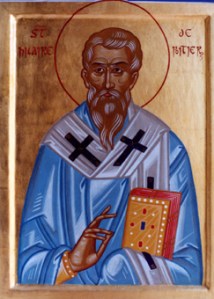
Hilary of Poitiers (about 300 – 367 AD), otherwise known as the “Hammer of the Arians,” for his efforts to defend the doctrine of the Trinity
Unlike the previous posts in this series about the “Gospel in Song,” regarding the Magnificat and the Benedictus, the popular Christmas song inspired by Luke 2:14 does not derive its name from Saint Jerome’s Vulgate translation of the Bible from the late 4th century AD. Jerome’s phrasing is gloria in altissimis Deo, where altissimis is one Latin variation meaning “highest.” Instead, Gloria in Excelsis Deo, or “Glory to God in the highest,” actually has its roots in an “old Latin” hymn from the early 4th century. Tradition suggests that it was Saint Hilary of Poiters (c.300-367 AD), a famous Western bishop of the church, who popularized the text for use in Christian worship.
Hilary of Poitiers grew up in a pagan home, receiving a thoroughly pagan education, before coming to Christ. When Hilary eventually became a leader in the church, he was embroiled in the Arian controversy, a theological movement that swept through Hilary’s Christian community. The Arians did not believe that Jesus, as the Son of God, was truly divine, so they rejected the doctrine of the Trinity, not too much unlike what Jehovah’s Witnesses today believe. When pressure came from the government for Hilary to reject the Trinity as well, Hilary refused to comply and was soon banished. Hilary believed that a denial of the biblical doctrine of the Trinity would trivialize the “glory to God in the highest” that is proclaimed in this old Christian hymn. Hilary’s stand to defend the truth of the Bible encouraged the faithful, and eventually the heresy of Arianism was rooted out of the church. Though Hilary of Poitiers is often forgotten by Christians today, the great hymn Gloria in Excelsis Deo, that is associated with his legacy, continues to be remembered all over the world.
The first movement of Antonia Vivaldi’s Gloria in Excelsis Deo, with a Latin/English translation here, performed in the National Auditorium of Music in Madrid:
Feel free to share our book…

Join the Conversation


