Sixty years ago today, Rosa Parks, a “faithful member of St. Paul’s AME Church in Montgomery,” Alabama, refused to give up her seat to a white man on the bus. Gospel Coalition blogger, Justin Taylor, tells the story in this Washington Post article of how Rosa Parks, through her Christian faith, effectively became the “patron saint” of the American Civil Rights movement on December 1, 1955. Taylor notes five misunderstandings about Parks that have been distorted by popular history. While another woman previous to Parks challenged the bus segregation laws, it was the almost “biblical quality” of Parks that made her an iconic figure. How many of us today have the almost “biblical quality” that set Rosa Parks apart from others on that day in 1955?
Here is an interview with Parks before her death in 2005:
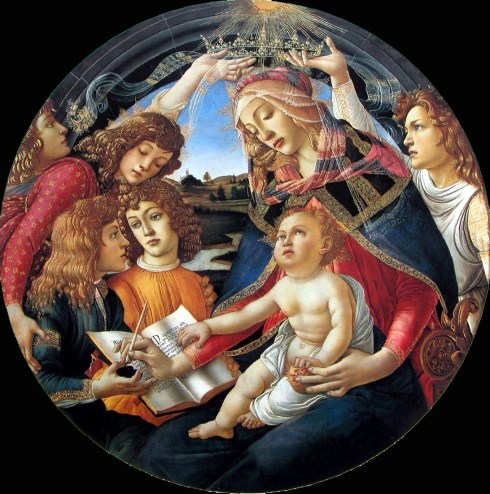
Our church recently began an Advent sermon series on the “Gospel in Song,” introducing the four great songs in the Gospel according to Luke that address the coming of Jesus. Each song, Mary’s Magnificat(Luke 1:46-55); Zechariah’s Benedictus (Luke 1:67-79); the angels’ Gloria (Luke 2:13-14); and Simeon’s Nunc Dimittis (Luke 2:28-32), derives its name from the first word of the respective texts in Saint Jerome’s Vulgate translation of the Bible into Latin. For example, “Magnificat” is Latin for “[My soul] magnifies.” Saturated with references to the Old Testament, Luke’s record of Mary’s (the Mother of Jesus) song continues to draw attention to the radical proclamation of the Gospel.
As the Latin language has become something of a quaint, archaic language of the past in our contemporary, secular society, only to be occasionally revived by classical education programs and home schoolers, the impact of songs like the Magnificat simply sound foreign to the modern ear. However, the Christian church in the West has put the Latin text of the Magnificat to music as part of the worship experience for centuries, and it remains one of the most beautiful expressions of biblical literary genre declaring the Gospel. God, in His wisdom, uses a wide variety of literary genres, including historical narrative, poetry, parables,… and song, in the Bible, to reveal His Truth to us.
J. I. Packer, at 89 years old, is still one of the great statesmen of the Christian faith today. A Christian book publisher, Crossway, has done a series of short, 3-minute interviews with Packer looking back over his substantial career as a theologian for the church, containing much wisdom for any and every Christian, old and new. Topics include, “What is Repentance?” and “What is Faith?”
Now, there is a twenty minute film reviewing his life… “In His Own Words.”
Recently, I was invited to go to a Halloween party this coming weekend. I need your help. What do I dress up as for this party?
Now, I know that a lot of Christians are deeply suspicious of Halloween: Is it not connected, at least remotely, to some kind of Satanic practice?
Well, the question has a point to make. After all, the timing of Halloween goes back to an ancient pagan festival, some say that was originated in Ireland, marking the beginning of winter. Samhain, pronounced “SAW-in,” from what I have learned, also celebrated the end of the harvest season. Since Samhain is at the same time of year as the traditional date for Halloween, the overlap gives the impression that Halloween has a pagan connection…. And since anything that distracts the believer from whole hearted worship of Jesus Christ could be considered “Satanic,” it only makes sense to raise such suspicion.
All Saints Day was celebrated by early medieval Christians to remember those Christian martyrs and other exemplary Christians who had gone on before them. All Saints Day, though originally in May, was moved to November 1st, under Pope Gregory (731-741 A.D.). All Souls Day, a related Christian festival to remember the faithful departed, particularly deceased relatives, was set on November 2nd. During the Reformation, the All Souls Day fell out of favor. But All Saints Day was held on by the English Anglican Church. All Saints Day is otherwise known as “All Hallows Day,” (Hallows=Holy, or Saint), which is how we get “All Hallows Eve,” or “Halloween,” for the night before on October 31st.
Halloween today is basically secularized, as are most holidays now, but as the 21st century merges into what appears to be a “post-Christian” era in the West, the revival of pagan practices associated with the ancient Samhain festival have started to reappear, such as among contemporary Wiccans. But even most honest observers admit that neo-pagan spirituality is in a continued state of flux, morphing and changing quite a bit.
We can have endless debates about how “Satanic” all of this is. Or we can take a tip from this 3-minute video at John Piper’s desiringgod.org ministries. Do you see Halloween as something to be avoided, or do you see it as an opportunity to be a witness for the Gospel?
Here is my spin on that this year: If Christians really want to “take back Halloween,” then we might want to take a few lessons from church history. I suggested to my wife that instead of a ghost, or something like that, she can dress up as a Christian saint at the party, such as Saint Thecla. Early accounts are sketchy, with various elaborations, but Thecla was surely one of the Apostle Paul’s most well-known converts to the faith, first meeting Paul in what is now modern day Turkey. According to this Eastern Orthodox source, Thecla was forbidden by her mother to go out into the street to hear Paul preach. But she was able to listen outside of her bedroom window, where she heard the Gospel. So, if someone asks my wife, “Who are you supposed to be?,” well, then, she has an opportunity to talk about Thecla’s story as she heard the Gospel of Jesus Christ, and had her life set free from the fear of darkness and death.
The point is this: perhaps one of the best ways to celebrate “All Hallows Eve” is to remember the examples of remarkable Christians who have died and gone before us. If you receive an invitation to a Halloween party, perhaps you can read up a bit on church history, dress up as some Christian figure from the past, and then use the opportunity to share the story of that person you came dressed as, with others at the party. Sure, it sounds a bit geeky, but it is a whole lot more interesting than dressing up as some “Superhero.”
For more on the origins of Halloween, New Testament scholar Ben Witherington has some perceptive comments to share in 3 minutes. In the meantime, I need to figure who I should be… and find a costume!
UPDATE: November 3, 2015
I need to make correction to an earlier statement, which suggested that the original All Saints Day spring celebration was moved to November 1st, partly to counteract the Samhain fall festival. A recent post at the Anxious Bench blog, references a work by historian Nicholas Rogers, arguing that while the Irish world, where Samhain came from, originally celebrated a feast for saints in April, the Germanic world, that did not recognize the Irish Samhain, had a feast for saints in November. This undermines the idea that All Saints Day was placed in November in order to try to supplant the Samhain festival. I am glad to be corrected, and so I modified the rest of the blog post. The study of history reveals some interesting surprises and busts a lot of pious fiction.
I went to my first InterVarsity Urbana missions conference some thirty-one years ago, in 1984. It was one of the last times Billy Graham ever spoke at Urbana, where he kept the attention of nearly 18,000 college students, challenging us to consider God’s call to go make disciples among all of the nations (Matthew 28:19-20). I can not think of any better place to gain a global vision of what God is doing in our world.
On December 27 to 31, 2015, InterVarsity Christian Fellowship is sponsoring yet again, another Urbana missions conference in St. Louis, Missouri, having outgrown the facilities at the University of Illinois Champaign/Urbana. Speakers include a worldwide representation of Christian mission leaders, including pastor David Platt, church planter Francis Chan, French Islamic studies professor Evelyne Reisacher, former Muslim Abdu Murray, missionary to the LGBT community Christopher Yuan, missionary trainer Paul Borthwick, and over 180 more. Hundreds of missionary organizations will be represented to give people thinking about a call to missions the perspective they need to understand where God might be calling them.
If you know of someone who should go, particularly a college student, then contact Urbana.org, and pray for God to work in the hearts and minds of these students. What is God doing in our world, and are you where God is at work?