Author Archives: Clarke Morledge

About Clarke Morledge

Unknown's avatar
Clarke Morledge -- Computer Network Engineer, College of William and Mary... I hiked the Mount of the Holy Cross, one of the famous Colorado Fourteeners, with some friends in July, 2012. My buddy, Mike Scott, snapped this photo of me on the summit.

Why Keep the King James Version? (… Or Why the “Thee’s” and “Thou’s” Are More Important Than You Think)

I am a big advocate for modern English Bible translations. However, even though I am not a “King James Only” Bible person, I do think there is a good argument for hanging onto a copy of the King James Version for Bible study.

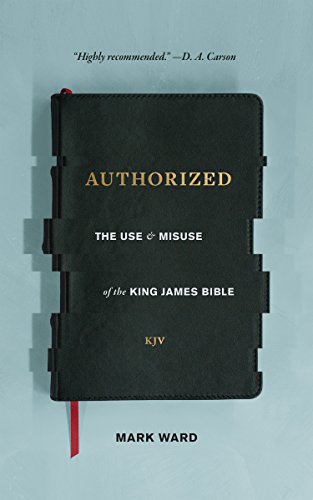
I read Mark Ward’s marvelous Authorized: The Use and Misuse of the King James Bible recently, and he makes a very gentle and persuasive case for using multiple Bible translations when studying the Bible. It is perfectly fine to have one Bible version as your “Go-To” translation of choice. But, if possible, we should make use of several versions when doing in-depth Scriptural study, to give us insight that our favorite translation might be missing.

For example, some might be tempted to ditch the old King James Version, as one among your versions, due to its archaic language. But there is a good case for why you should hold off on doing that.

As noted in my book review of Mark Ward’s book, the use of the “thee’s” and “thou’s” in the King James Version, might lead us to think that such language shows a special reverence for God, but this would be wrong. The problem has been accentuated in recent years, by the decision of those who produced the New American Standard Bible (NASB), back in the 1970s. The NASB kept the “thee’s” and “thou’s” with respect to referring to God, and ditched that language when addressing non-divine characters. Apparently, readers of the NASB liked the traditional language for God, so the NASB committee decided not to buck that tradition.

Unfortunately, traditions can easily confuse people. The NASB folks finally fixed that problem by getting rid of all “thee’s” and “thou’s,” by the time of their 1995 revision, but the stigma associated with “thee’s” and “thou’s,” as being formal and more reverent, was pretty well common knowledge by then, and difficult to uproot. Interestingly however, the original purpose for including the “thee’s” and “thou’s” in the King James Version,  in the first place, has been often missed.  Continue reading


A Fake-News Jesus? Why “Jesus Myth-ers” Should Take a Trip to Rome … (for Christmas)

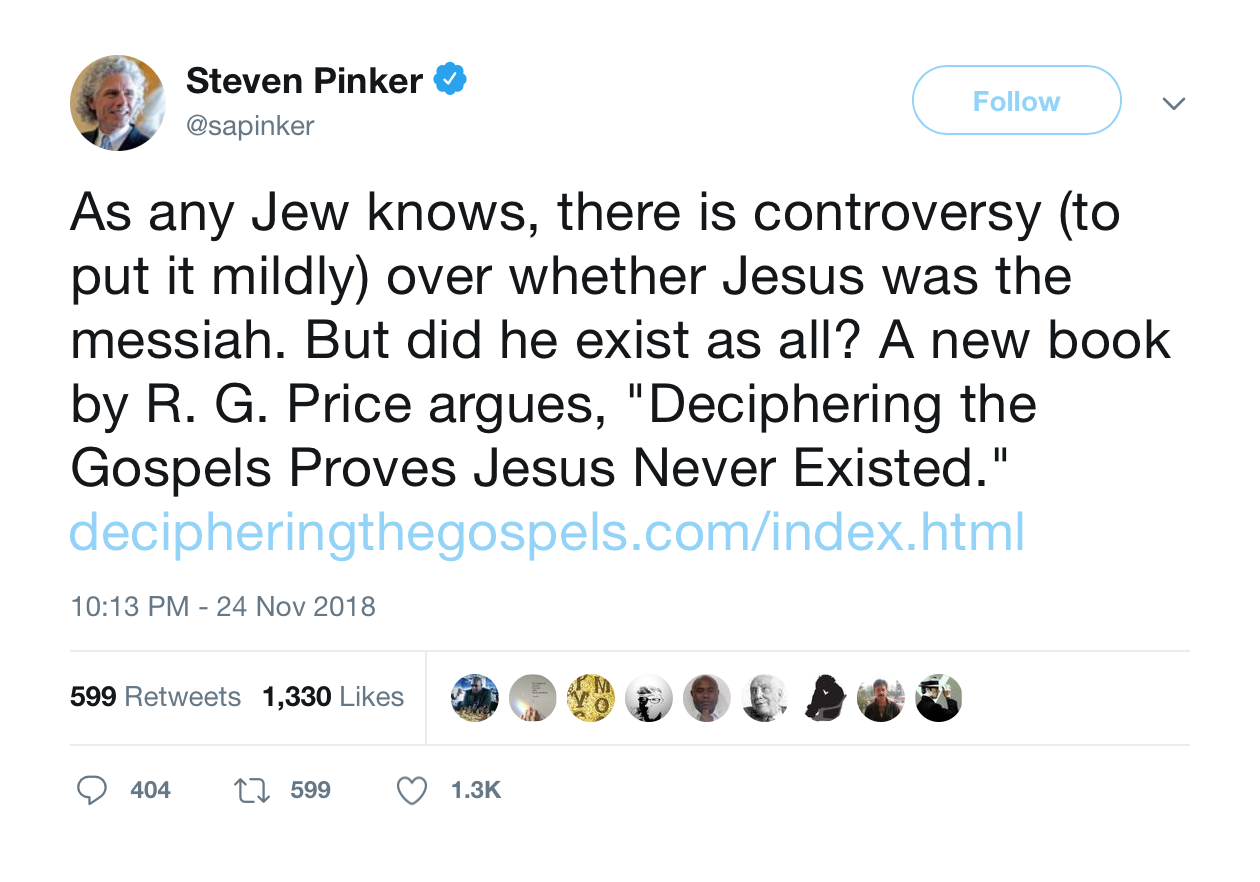
After Thanksgiving, I was greeted by the following Tweet message being passed around from Harvard psychologist, Steven Pinker:

Pinker is a brilliant cognitive psychologist, linguist, and popular science author, but apparently he needs some help with his history. This new book by R. G. Price is hoping to popularize the notion of “Jesus Mythicism,” namely that Jesus of Nazareth never existed. Perhaps such “Jesus Myth-ers” should consider taking a trip to Rome, and dig a little through history.

This idea that Jesus never existed has really taken off over the past few years, picking up a lot of intrigued interest among atheists, that apparently now includes Steven Pinker, even as early as two years ago!  If professor Pinker has no opportunity to go to Rome anytime soon, say in time for Christmas, he might want to consider reading material from Tim O’Neill, a fellow atheist, who gets his history right, as discussed months ago here at Veracity. The details are too much to go into here, but O’Neill’s series on “Jesus Mythicism” is simply fantastic, where he basically argues that “Jesus Mythicism” is roughly the atheist equivalent of the belief in a “Flat Earth,” being promoted by some conservative Christians.

I guess we all have our embarrassing, crazy family members to deal with at holiday family gatherings.

But why is Rome important when it comes to talking about “Jesus Mythicism?” (… and why Christmas?)

Price’s self-published book is a revisionist reading of the Gospels, but “Jesus Myth-ers” more commonly make a different, yet just as historically convoluted, argument. Long time Veracity readers would know that those who promote “Jesus Mythicism” often say that Christianity stole much of its belief system from the Roman cult of worshipping Mithras, popular among Roman soldiers during the first centuries of the Christian era. For example, “Jesus Myth-ers” typically contend that the Christian claim, of Jesus being “born of a virgin,” at Christmas, was actually taken from the Mithraic religion, which supposedly claimed that Mithras was also “born of a virgin,” on December 25th.

Tim O’Neill has a great (yet long) post about the cult of Mithras, that should effectively dismantle such spurious claims (O’Neill has another great post that critiques R. G. Price’s own, even more peculiar version of “Jesus Mythicism,” that does not address the Mithras religion). The evidence to support the claim, that Mithras was “born of a virgin” on December 25th, is either non-existent or terribly “stupid” at best (“stupid” is how Price’s “fellow” atheist, Tim O’Neill, describes it!).

So, when my wife and I had the opportunity to go visit Rome earlier this year, I was determined to find out more about Mithras myself…. just to make sure.

The Mithras cult was a big deal in ancient Rome, and there are several places in Rome where archaeologists have found Mithraic temples buried well below buildings from the later Christian era. The closest modern equivalent to Mithraism might be the Masonic movement. Imagine a fraternity of like-minded, Roman soldiers coming together to perform sacred rituals, with all of their secret handshakes, and whatnot.

It helps to have an idea of what Mithras looked like. I was able to get this snapshot below of Mithras stabbing the cosmic bull, at the Vatican Museums. It was hard to get a good, front-on shot, due to the crowds, but this is what I saw: That is a dagger in his right hand, being thrust into the right shoulder side of the bull:

Mithras slaying the cosmic bull, at the Vatican Museums (from Clarke Morledge’s Android phone)

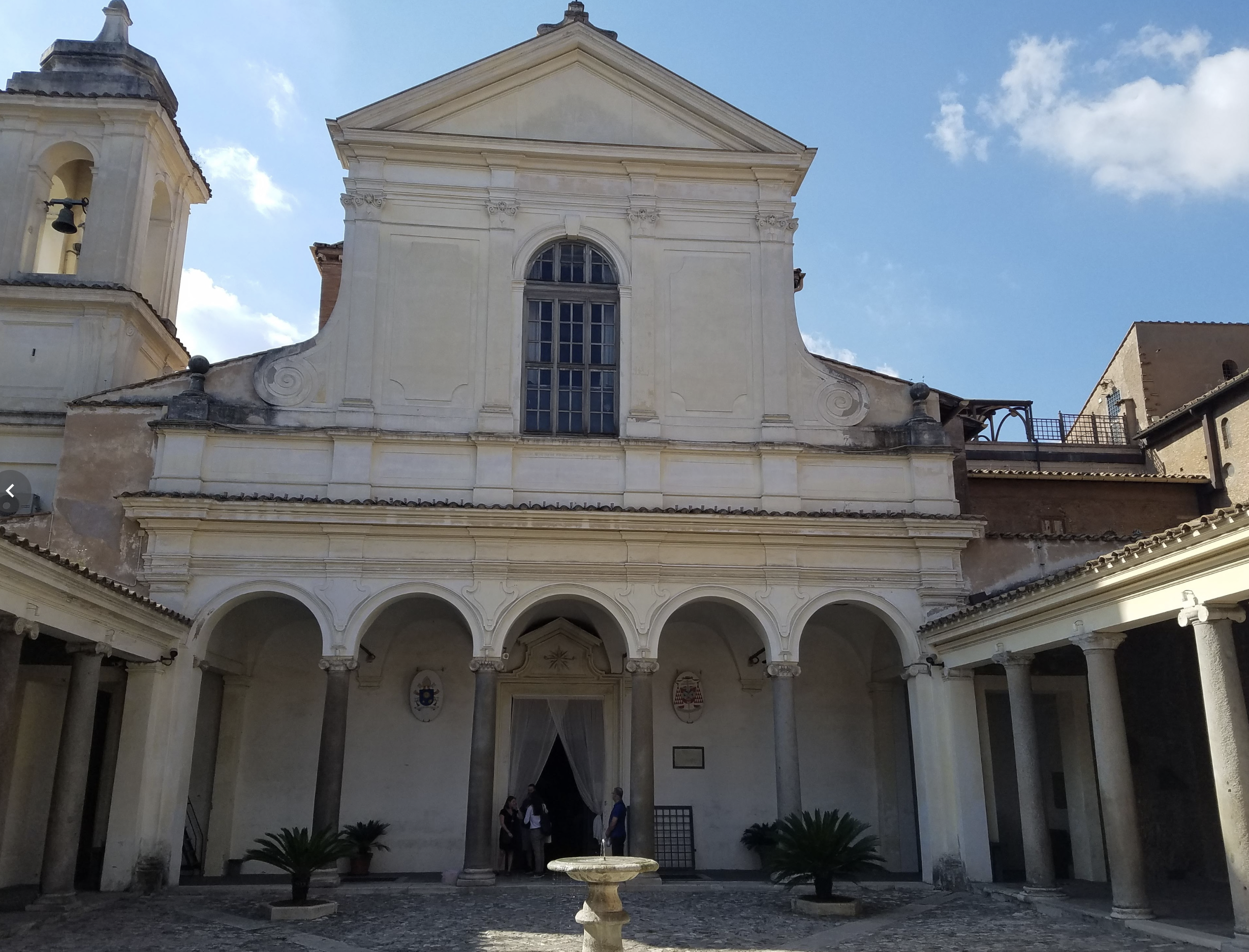
Tours to see the archaeological remains of these Mithraic temples were hard to get, as the spaces to get into these underground areas were pretty tight. Thankfully, we were able to go to the Basilica of San Clemente, a church in the Lateran part of Rome, which has a unique, multi-layered architecture. At the main entrance (see photo below), of the church, you enter the main sanctuary, built in the 11th century.

Entrance to the Basilica of San Clemente, in Rome, Italy (my wife has her back to me, as she is reading the entrance sign to the far right of the door).

From the sanctuary, I was able to walk to the church’s courtyard to get a better outside look, facing the entrance to the sanctuary:

Basilica of San Clemente courtyard, on a beautiful day in Rome (October, 2018)

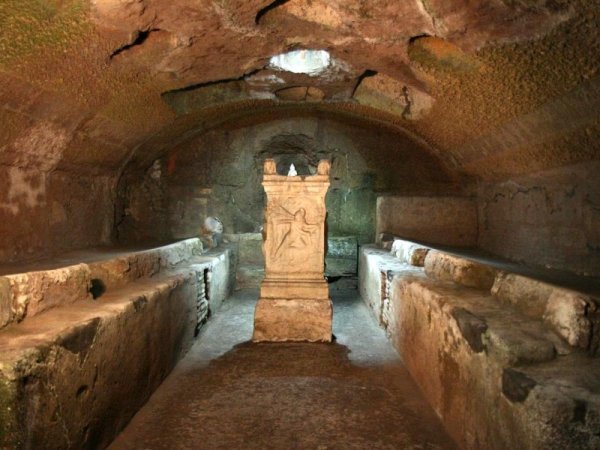
Below that level is a 4th century church, which itself was built out of a home temporarily used for Christian worship, dating back to the 1st century. In the basement of this home, was a Mithraic temple, that was in use briefly in the 2nd century A.D.

Apparently, the Christians were here in this house first, before the Mithras worshippers got to the basement. The docent we had was pursuing graduate studies in Italian history, and she was a wealth of information about all things Mithras. Not one word about the supposed parallels between Christianity and Mithraism came up. We were not allowed to take photographs inside the church or underground, but this photo comes from the guidebook you can buy from the church’s bookstore:

Basement Mithraic temple, underneath the Basilica of San Clemente (from the church guidebook). Note the relief image of Mithras stabbing the cosmic bull, on the altar.

Once you do a little “digging” (pun intended!), you get the idea that far from being a copycat faith that stole from Mithraism, Christianity is actually quite different. Neither Mithraism nor Christianity lines up anything like what the “Jesus Myth-ers” imagine them to be.

Sure, the fact that Mithraism and Christianity are very different, does not necessarily mean that Christianity is true. A strong consensus of scholars is convinced that Jesus indeed did exist, even if many of these scholars reject the idea of God becoming Incarnate at Christmas. There are atheists, like Stephen Pinker, R. G. Price, and the more historically astute, Tim O’Neill, who do not “buy into” the Christian claim of Jesus being risen from the dead. I pray that God might touch their hearts and minds in a manner that they might see the Risen Jesus clearly.

But at the very least, the trip to Rome that my wife and I took helps to confirm that when someone says “Merry Christmas,” it is not just a clever way of saying “Merry Mithras” instead.


Listen to Nick Peters’ Deeper Water’s apologetics podcast, where Nick interviews Tim O’Neill discussing Jesus’ Mythicism. Tim O’Neill wrote a short review of Steven Pinker’s 2011 best-selling book, Better Angels of Our Nature, that should cause any Pinker enthusiast to pause. Steven Pinker and Nick Spencer debate one another, on the Unbelievable podcast, hosted by Justin Brierley, earlier in 2018, on the topic, “Have Science, Reason and Humanism Replaced Faith? (Youtube)” New Testament scholar N.T. Wright responds to Steven Pinker’s claim, that human rights were not derived from Christianity (Youtube).


Is Belief Always a Prerequisite for Baptism?

One of the more contentious issues in the church, for centuries, has been about the nature of baptism. Must baptism be reserved for only believing adults (or older children), or can babies be baptized, too? A targeted study in Acts 16 shows us why this issue can be difficult to resolve.

Two key individuals in Acts 16 become believers, resulting from the Apostle Paul’s preaching: Lydia and the Philippian jailer. But what generates confusion is that for both Lydia and the jailer, not only were they individually baptized, the text tells us that all in each “household” were then baptized as well (Acts 16:15, and Acts 16:30-34, respectively).

Were there infants in the households of each? Unfortunately, the text never tells us, as the original word for “household” is ambiguous.

Advocates for infant baptism look to the broadest interpretation of household, assuming that infants would have been implicitly present in those houses. Advocates of believer’s baptism argue less broadly, saying that without explicit reference to infants being in those houses, we have no warrant to baptize infants.

What really throws a wrench into the whole thing can be seen in the account of the Philippian jailer. Look at what we read in the ESV (English Standard Version translation), and see if you can see the issue:

Then he brought them out and said, “Sirs, what must I do to be saved?” And they said, “Believe in the Lord Jesus, and you will be saved, you and your household.And they spoke the word of the Lord to him and to all who were in his house. And he took them the same hour of the night and washed their wounds; and he was baptized at once, he and all his family. Then he brought them up into his house and set food before them. And he rejoiced along with his entire household that he had believed in God (Acts 16:30-34 ESV).

First, you can see that when the Philippian jailer asked about what he must do, Paul and company instructed that he should believe, in order to be saved. Interestingly, we find that his “household,” is included here. Paul and company preach to the entire household. However, aside from the jailer himself, we know little about the state of belief among the others. Did they believe, along with the jailer?

A question is raised here: Does this mean that the other members of the Philippian jailer’s household would be saved, on the basis of the jailer’s faith, a kind of “salvation by proxy?”

I have heard a similar argument before, but this is hard to square with the rest of Scripture. As Paul teaches elsewhere in the New Testament, salvation comes by believing in the Lord, with no exceptions mentioned, as in Romans 10:10-13. More likely, it means that as the Philippian jailer was head of his household, God would providentially use the Philippian jailer’s influence to bring the others in his household to believe in the Lord Jesus, and experience salvation. This happened quite frequently in the ancient world, when the believing faith of the leader in the home would eventually lead to believing faith among others in that same home, including slaves and servants.

But how long would it take for that to happen? Would the others believe in Jesus right away, or at some future time? Specifically, if there were infants or other small children in the home, does this imply that they would come to faith at a later time, under the instruction of the Philippian jailer? The text is unclear at this point.

What we do know from what follows is that the entire “household” was baptized (the ESV translates “household” here as “family,” as some other translations do, too). But notice how the ESV ends the episode: “He rejoiced along with his entire household that he had believed in God.” The rest of the household rejoices, along with the jailer, that the jailer had believed in Christ. But it is not clear if the others themselves had believed in Christ at this point…. even though they had all been baptized!

A paedobaptist; that is, someone who believes in the validity of infant baptism, might be affirmed in their view. Presumably, this would allow for the practice of infants to be baptized, assuming that as the children grow up in the home, with proper instruction, they might eventually come to believe in Jesus.

A credobaptist; that is, someone who rejects the validity of infant baptism, and insisting that belief is a prerequisite for baptism, would object to this ambiguity. Does this not suggest that the entire household rejoiced for the jailer, because they all themselves believed, as well? The credobaptist might contend that infants would not have been in the position to rejoice for the jailer’s belief. But then, if a young child sees that the parent is rejoicing, would that child not also rejoice together, despite knowing the reason?

This is where looking at another Bible translation might give us some further insight. Here is that last verse again in that passage, from the Kings James Version:

And when he had brought them into his house, he set meat before them, and rejoiced, believing in God with all his house (Acts 16:34 KJV).

Notice how the KJV not only has the household members rejoicing, they had all come to believe, along with the Philippian jailer! This chimes in well with the theme of how baptism was practiced earlier in Acts, as in Acts 2:38, where the order was established, “Repent, and then be baptized.” But before you score a point for the credobaptist, consider what is going on with these different translations.

In the world of Bible translations, some translations are more word-for-word oriented; technically called, formal equivalence, whereas other translations are more thought-for-thought oriented; technically called, dynamic equivalence.  But the relationship between word-for-word and thought-for-thought translations is actually pretty fluid within translations themselves. For example, the KJV has the reputation for being a more word-for-word oriented translation. But here the KJV takes a more thought-for-thought approach, as opposed to the ESV, which follows the original Greek word ordering more tightly.

Looking at another translation, in this case the NET Bible, shows this difficulty more clearly:

At that hour of the night he took them and washed their wounds; then he and all his family were baptized right away. The jailer brought them into his house and set food before them, and he rejoiced greatly that he had come to believe in God, together with his entire household (Acts 16:33-34 NET).

The NET Bible follows the KJV more closely than the ESV, moving a phrase around, and gives the reason in a footnote:

The phrase “together with his entire household” is placed at the end of the English sentence so that it refers to both the rejoicing and the belief. A formal equivalence translation would have “and he rejoiced greatly with his entire household that he had come to believe in God,” but the reference to the entire household being baptized in v. 33 presumes that all in the household believed.

So, is the NET correct in presuming that all in the household believed? As we have seen, making such a presumption is not always made clear by the evidence given in the text.

Back to the main question: Is belief always a prerequisite for baptism? Unfortunately, a targeted look at Acts 16, as we have done here, does not really resolve the issue. Paedobaptists read the text one way. Credobaptists read it another. An examination of Scripture as a whole is necessary to make progress here on this debate.

The question of infant baptism vs. believer’s baptism has been a source of division among Christians for generations. By default, today many evangelical churches that defer to one’s conscience on the matter, publicly celebrate believer’s baptism, for adults and older children. Nevertheless, they offer “baby dedication” for infants, a workable solution that fulfills some of the intentions behind infant baptism, while technically not being “baptism,” and yet where the whole idea of “dedication” is surprisingly lost on most parents. Thankfully, this is not an essential issue that impinges upon one’s salvation. It is a non-essential matter in which different Christians will continue to “agree to disagree” on. Let the conversation continue.


The Bible, Rocks and Time, A Review

The Bible, Rocks and Time. Davis A. Young and Ralph F. Stearley make a definitive and exhaustive case for Old Earth Creationism, from a geologist perspective.

I remember the day I stumbled across Davis A. Young’s, Christianity and the Age of the Earth, tucked away on the “new books” shelf of my college library, in the spring of 1983. Friends had invited me to attend a Wednesday night Bible study, studying the Book of Genesis, in the home of a local pastor. My head was swirling with confusion, as I learned all about the idea that the earth was only 6,000 years old. But in my science classes, ever since falling in love with science as a first-grader, I was learning a quite different story, of the modern scientific consensus, that the earth was 4.54 billion years old.

My college pastor was (and I am sure, still is) one of the sweetest and kindest of men I have ever met, a genuine, sincere and godly person. He did not have much of a science background, but he was passionate about the truthfulness of God’s Word, and I was eager to learn. He just “knew” that the “days” of Genesis were literal 24-hour periods, which for him, implied a Young Earth.

My science professors at college, on the other hand, several of whom told me that they were Christians, had relatively little knowledge of the Bible, as compared to my pastor. But they assured me that the great antiquity of the earth was well established, beyond a reasonable doubt, a reality that I had known at least something about since elementary school.

So, who was right? My pastor? My science professors? How was I to sort this whole thing out?

My questions had landed me into having a full-blown crisis of faith. I had not grown up in an evangelical church, so I had no background in skepticism about radiometric dating methods, that so many kids today in home-schooled families regularly ingest, from their online science curriculums.  But I had also become a follower of Jesus in high school, having realized that my nominal church upbringing was pretty weak when it came to understanding the Bible and its authority. So, here I was in college, confused as to whom to believe. Do I trust my pastor? Do I trust the scientists? Is the truth of Christianity tied to a belief in a 6,000 year old earth, contradicting the modern, scientific consensus? Continue reading


The Flat-Footed Failure of Flat Earth “Christianity”

Many evangelical Bible scholars accept that the ancient Hebrews viewed the world as a disk floating on the waters, supported by pillars. But does this mean that God’s Word is “teaching” us today to believe in a “flat earth?”…. Apparently, some people think so… This is pure crazy talk. (credit: Logos Bible Software, the FaithLife Bible).


I keep hearing about this stuff, so I decided to check it out.  Apparently, there is a tiny yet growing movement of Christians who believe that the earth is flat.

Seriously?

My cringe-worthy meter just went to the red zone.

What really bothers me about this stuff is that these so-called “Flat-Earthers” use much of the same rhetoric I hear used by other Christians to defend their view of the Bible. These overlapping talking points are disturbing, when you translate what those talking points mean to flat earth advocates.

  • If you believe the Bible is inerrant, then you must believe everything it says about scientific matters, such as the [flat earth]” (translation: Scientifically, Christians should believe in a flat earth because the “Bible teaches it”. The “Bible teaches” a flat earth, because we said so. ).
  • To deny the biblical teaching on the [flat earth] is to elevate man’s word over against God’s word.” (translation: God’s special revelation in Scripture contradicts God’s natural revelation in creation, but that is OK!)
  • To compromise on the Bible’s teaching on the [flat earth] is to compromise the authority of the Bible” (translation: the “real” Christians are the ones who accept a flat earth, and everybody else is either inconsistent, deceived, a liberal, or a non-believer. Trust us. Flat-Earthers are the real believers in the Bible. Every other so-called “Christian” is a compromiser.)
  • If Scripture is false about scientific matters, such as the [flat earth], then what Scripture says about salvation falls with it.” (translation: how can you trust what the Bible says about the Resurrection, if you do not believe what it says about the flat earth? In other words, you do not need to examine the evidence for yourself, just trust us Flat-Earthers!)

You can pretty much replace “flat earth” above with just about any supposed “scientific teaching of the Bible,” that rips the Bible out of its historical context, and get the same result.

Folks, we need to set the record straight.

With very, very few exceptions, no Christian through the course of church history believed that the earth is flat. Historian Jeffrey Burton Russell painstakingly has shown the idea that Christians have believed in a flat earth to be an invention of modern thinkers, over the past couple hundred of years.

Christians are not the only ones who have bought into this type of nonsense. As one of my “favorite atheists” Tim O’Neill puts it, a lot of atheists buy into this garbage as well.

Some ancient cultures did subscribe to flat earth cosmologies, arguably including the Hebrew culture. But certainly by the early years of the medieval church, such views had died out. Overwhelmingly, Bible scholars today contend that neither God, nor the human authors of the Bible themselves, were trying to teach science, with respect to a flat earth cosmology, back in the ancient era, nor should we try to apply such logic today to our cosmology. Sadly however, some Christians today think they know better, and perpetuate misinformation.

Columbus was not trying to test the idea that the earth was flat, by trying to sail around the world. Columbus, just like any other medieval European, believed that the earth was spherical. That old canard was an invention in the mind of writers like Washington Irving (ever heard of “The Legend of Sleepy Hollow?”), and propagated by such thinkers as John William Draper and Andrew Dickson White, in the late 19th century. For some strange reason, the Internet has made it possible to revive these ideas, and a growing number of Christians are buying into this.

I would not even bother with “Flat-Earth Christianity,” except that it raises serious questions that Christians should consider. For example, flat earth rhetoric mimics a lot of the talk I hear coming out of the Young Earth Creationist movement. Thankfully, Young-Earth Creationist groups like Answers In Genesis have wisely tried to put the “kabash” on such wild-eyed thinking. Thank goodness! But the “cringe-factor” gets elevated at times when both “Flat Earthers” and Young-Earth Creationists start talking alike.

To be clear, though I am not persuaded myself, I am all for the possibility that the earth is indeed young. God could have created the earth any way He wanted, during any time frame: 6,000 years ago, according to the traditional view, or 4.34 billion years ago, according to the contemporary scientific consensus. But when some Christians resort to a rhetorical style of argumentation, with examples like what I gave above, that equates their own interpretation of Scripture, with the authority of the Bible itself, then that is manipulative at worst, or just plain idiotic at best.

Responsible Young Earth proponents may make the philosophical argument that the character of the Creation story, in history, is such that our current scientific knowledge can not adequately describe what happened in the past. Old Earth Creationists reject this view, arguing in favor of the scientific consensus, that the present indeed is the key to understanding the past. But no matter how one views the past, this is all very different from our ability to make scientific observations here in the present. And this is where flat earth thinking goes completely awry.

The flat-footedness of flat earth thinking has all of the characteristics of a conspiracy theory:

Yup. It is that silly.

OK. It can be really tough for scientifically-trained people to accept a Young Earth, but this “Flat Earth” businesss goes way beyond the age of the earth issue. It is bad enough for some Christians to still argue that Copernicus and Galileo were wrong about the non-stationary characteristic of earth, and favor the older, Ptolemaic view that the earth is a fixed object in space, where the sun, and all of the rest of the stars and planets revolve around the earth. But to claim that the Bible teaches a flat earth, when only an obscure handful of Bible interpreters, mostly within the early years of the church, have ever made such claims, only to be refuted by others long ago, is an example of “the-Bible-says-it–I-believe-it–and-that-settles-it” type of thinking gone off the rails.

Here I am linking to a few videos that readers might find to be helpful. The first is from a YouTube channel, Jubilee, that sponsors dialogue between people who have incredibly conflicting points of view. This particular video pits “Flat Earthers” vs. “Scientists.”  Two of the Flat Earthers also claim to be Christian. Interestingly, the third Flat Earther does NOT claim to be Christian. What bothers me about the “Scientists” on the panel is that none of them claim to be Christian, which in my view, distorts the dialogue. The vast majority of Christians do not embrace the Flat Earth mindset. Still, the video is helpful in outlining the issues involved. What is fascinating is how influential the explosion different voices on Internet platforms, like YouTube itself, has fueled the growth of the Flat Earth movement over the past decade or so:

This second video is from Inspiring Philosophy, a Christian who tries to show how the cultural context of the biblical world, regarding the ancient cosmos, is very different from the cultural context of the 21st century, and why it would be wrong to try to impose a 21st century worldview on an ancient text, like the book of Genesis:

If you are not convinced of Inspiring Philosophy’s reasonings, and analysis of the evidence from the biblical text, you might want to at least consider the following talk by Answers in Genesis’ astronomer, Danny Faulkner, a Young Earth Creationist who does not believe that the Bible teaches that the Earth is flat:

UPDATE: January 18, 2023: It has been about 4 or 5 years since I last reviewed this blog post. When I first published it, I referenced several videos put out by one group of Flat Earth Christians, as found on YouTube. Interestingly, all of the videos from this group have since been removed from YouTube by the authors, and are no longer publicly viewable. I will leave it to the reader to come to their own conclusions as to why these videos were removed from public view. In lieu of this, I have posted the three videos above that have been published within the past three years, that do a much better job of analyzing the concerns that I have about the Flat Earth Christianity movement. I still stand by my original conclusion to this blog post:

Folks, the propagation of such nonsense only casts ill-repute upon the Gospel. It is time to set such bad Bible interpretation aside, and read the Bible responsibly. This type of irresponsible handling of God’s Word really gets my goat.

SaveSave

SaveSave