Clarke Morledge -- Computer Network Engineer, College of William and Mary...
I hiked the Mount of the Holy Cross, one of the famous Colorado Fourteeners, with some friends in July, 2012. My buddy, Mike Scott, snapped this photo of me on the summit.
How do you know if you are truly a Christian? Can you be sure about that?
In our 21st century age, we tend to look down upon Christians of earlier eras, particularly the Puritans. Their world seems so far removed from ours. But such an opinion only reveals our chronological snobbery. A wealth of wisdom lays hidden with the Puritans, that we need to need to hear from today. The assurance of one’s salvation is one area of wisdom we need to recover from those Puritans,
If you ever read the writings of the English Puritans, they often speak of the tension between “legalism” and “antinomianism,” in the Christian life. On one side, is the tendency to reduce Christianity to a set of rules and regulations to follow, a bunch of “do’s and don’ts” (legalism). On the other, is the tendency towards lawlessness, a faith that has no real regard for the commands of God (antinomianism). What Christian does not wrestle with that tension today?
Between these two extremes, it can sometimes be like walking a tightrope, maintaining a sense of balance to keep from falling down one way or the other. We have plenty of controversies in church history that testify as to how difficult it is to maintain that sense of balance.
In all of these controversies, the assurance of one’s salvation has hung in the balance. At the core of this, the relationship between Law and Gospel is something with which every new generation must wrestle.
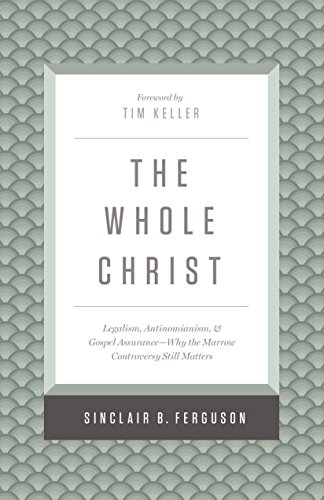
Sinclair Ferguson, in his The Whole Christ: Legalism, Antinomianism, and Gospel Assurance—Why the Marrow Controversy Still Matters, looks at one of these controversies in church history, as a lens on which to try to tease out how this balance might be properly maintained. The “Marrow Controversy” was an otherwise forgotten controversy over an otherwise forgotten book, by Edward Fisher, a Puritan author from the 1640s, entitled The Marrow of Modern Divinity.
The Whole Christ centers around the story of an early 18th century Scottish preacher, Thomas Boston. Early in his preaching career, Boston was frustrated by the lack of positive response to his preaching message, among the callous in his Scottish congregation. Yet Boston took great comfort in reading Edward Fisher’s book, when he stumbled across it one day, while visiting someone else’s home. Fisher’s book sought to find a way between legalism and antinomianism (a term which means, “against the law”). The abbreviated title, “The Marrow,” meant that Fisher was trying to get at the innermost substance of the Gospel. Boston credited The Marrow for correcting his own posture towards the Gospel, and it revolutionized his ministry.
So, when the General Assembly of the Church of Scotland banned the book in 1720, as promoting antinomianism, some 80 years after it was first published, a theological fire erupted. Thomas Boston and his like-minded preacher friends protested the ban. These pastors, known as the “Marrow Men,” did not view the book as dangerous at all, but rather saw its message as liberating with the truth of the Gospel. The censure of the church, which subsequently was never revoked (even to this day!), would not stop the “Marrow Men,” for they sought to republish The Marrow of Modern Divinity, with some notes added by Thomas Boston, in 1726.
Sinclair Ferguson’s The Whole Christ endeavors to explain the “Marrow” debate that engulfed the early 18th century Church of Scotland, as a means to help us today to properly understand the relationship between the Law and the Gospel. There are a couple of added, standout benefits gained from Sinclair Ferguson, from this book:
What is a right understanding of penal substitutionary atonement, a pivotal teaching from Scripture, which is greatly maligned, misunderstood, and mistaught in the church today?
Many Christians wonder about the so-called “New Perspective on Paul,” and Ferguson offers a brief, fair-minded critique.
How can we obtain the assurance of our salvation? Is the assurance of salvation the norm of Christian experience, or a rarity?
The last issue, regarding the assurance of salvation, is something that still needs sharpening in our day. For on one side, it is very easy to have a false assurance of one’s salvation, by presuming upon the grace of God, and thereby leading a life of recklessness, marked by a distinct lack of holy living. If you dwell among Christians who act one way on Sunday, but who act completely different on the other days of the week, you will know exactly what this means.
We may think we have a right standing before God, when in fact, we have merely fooled ourselves, placing our own demands and wishful thinking upon God. On the other side, we can become so restless concerning our final state before God, that we lack confidence in the power of God to save sinners. In our insecurity about “going to hell” we forget about the love of God, which brings us into the joy of God’s presence. People who fret and fret over whether their faith is fully acceptable, in the sight of God, reveals this sense of spiritual insecurity.
Sinclair Ferguson takes us on a trip through church history, that might not be familiar to readers. Ferguson draws connections between the teachings of the medieval church, similar teachings found in contemporary Roman Catholicism, and other crucial theological figures, such as the 16th century French/Swiss Reformer, John Calvin, and the 19th century Scottish “heretic” John McLeod Campbell. But this is not theological history to satisfy certain intellectual curiosities. Instead, Ferguson weaves a theological tale that will assist the reader in avoiding common pitfalls, that can easily derail the life of any Christian.
The forward of The Whole Christ, written by Tim Keller, helps to orient the reader to understand the book’s purpose, regarding how the Law and the Gospel relate to one another. Keller writes that Ferguson “wants to help us understand the character of this perpetual problem—one that bedevils the church today. He does so in the most illuminating and compelling way I’ve seen in recent evangelical literature.” But the book’s audience should not be restricted to pastors, for The Whole Christ seeks to set out a reasoned, biblical approach to how a balance between legalism and license can be lived out.
How can this be done? By preaching the whole Christ. A proper understanding of the Gospel, in its fullness, is the antidote that helps believers to avoid a sense of making the Christian faith into following a list of do’s and don’ts. It also helps us to avoid a faith, where we can fool ourselves to think that we can do whatever we want, with no restraints upon our conscience. The subtle danger, as Ferguson tells us, is that often we can have a very “orthodox” sounding theology, but that on the inside, our hearts’ disposition is completely out of whack. The way the message is presented is just as important as the message itself.
By emphasizing the whole Christ, Ferguson insists that it is all too easy to separate Christ Himself from the benefits He gives to the believer. A proper grounding for the assurance of our salvation is found in loving God for who He is, and not simply for what He gives us.
The last few chapters of The Whole Christ explore the details of what it means to have the assurance of one’s salvation. These chapters make for the densest reading in the book, but it forced me to read slowly and think more carefully. Does one have an unhealthy preoccupation with anxiety about their eternal state? Or does one settle for a kind of presumptive expectation of salvation, when actually, their hearts are far, far from God? Sinclair Ferguson endeavors to find the right balance and nuance, to get at the truth.
Again I ask: What genuine Christian does not struggle with these matters? But notice how easy it is to trick ourselves. If I find myself easily condemning other Christians for their “loose-living,” that might be an indication of legalism in my own heart. On the other hand, if I am quick to dismiss the rigidity of how another Christian seeks to be obedient to God, it might be a good sign of a latent antinomian spirit residing in me.
What is the solution to avoiding these spiritual traps? Knowing the whole Gospel: The Whole Christ. How do we equip ourselves to fully understand and implement this truth?
One way would be reading The Whole Christ, by Sinclair Ferguson. I listened to the audiobook format, but if you like a video teaching format, you should consider the video teaching series, available at Ligonier Ministries. The clarity of doctrinal teaching that Ferguson offers is exceptional. I have read through the entire book once, and several other parts multiple times, and I continue to learn vital Scriptural truths to be applied to my walk with Christ, in every chapter. This is a book to savor, and re-read, so that the Scriptural truths it conveys might become imprinted upon our hearts.
….
UPDATE: September 26, 2019, 10am
This just came in…. a debate between William Lane Craig and Gregory Boyd on penal substitutionary atonement (PSA). Haven’t viewed it yet, but it looks to be very good, and quite relevant to the topics covered in The Whole Christ. I side with William Lane Craig here, but Gregory Boyd is probably one of the most able critics, whose perspective should be taken seriously by other Christians. I see the PSA view as complementing the Christus Victor view of the atonement, and not a contradiction.
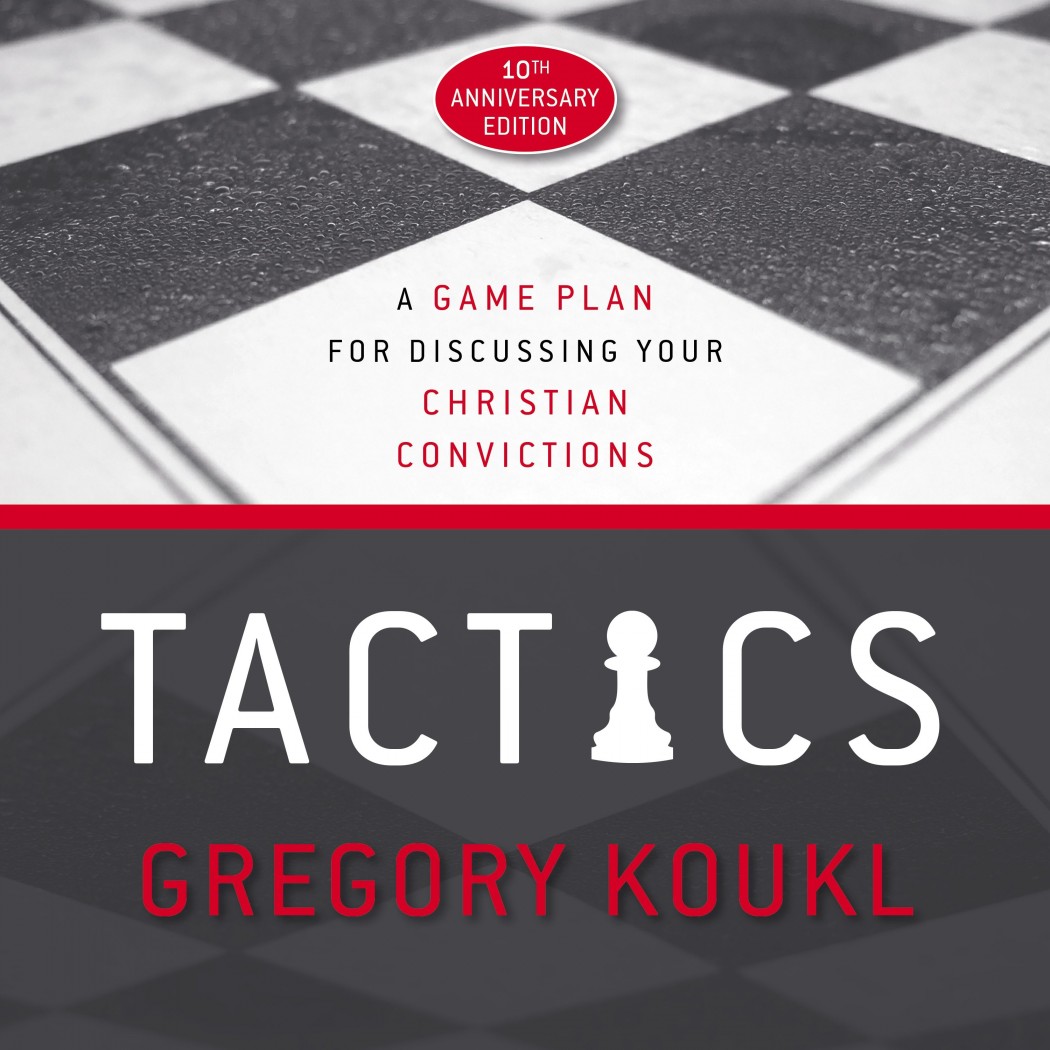
Greg Koukl’s Tactics stands out as the best book that I have read this year, and the year is not even over yet. Koukl, the founder of the apologetics ministry, Stand to Reason, originally wrote this book about ten years ago. A tenth anniversary edition of the book has come out. David Wood, another Christian apologist, say that Tactics is the one apologetics book every Christian needs to read in 2020. So, I decided to take him up on that, and get the audiobook version.
I am so glad that I did. David Wood is right.
Greg Koukl’s book on “tactics” should be required reading for EACH and EVERY CHRISTIAN who struggles with sharing their faith with others.
Greg Koukl’s Tactics is the single most important book in Christian apologetics that you would ever need.
I like to think of myself as an evangelist, but I am not a very good one. I must confess, it just seems like evangelism is getting harder and harder, with every passing year. I find myself continually intimidated, when getting into conversations with others. I never think that I have the most persuasive arguments, when sharing my faith, so I just end up staying quiet most of the time. I even have the same frustration, when trying to discuss a difficult, controversial topic with another fellow Christian, when we have a disagreement. I would rather change the conversation, and avoid the discussion altogether.
“How ’bout them Yankees!! … Nice weather we are having, right?”
Perhaps it goes back to my days as a young believer of doing door-to-door evangelism. I have always envisioned that gospel-oriented conversations need to be about “closing the deal,” and pressing for a decision for Christ.
Not so, according to Greg Koukl. For if we really trust the leading of God, that He might work through the power and presence of the Holy Spirit to change a person’s heart, then it really is not our job to try to “convert” someone. Rather, it is about trying to give someone else something new to think about, and then letting God do the rest of the work.
When you are in a gospel conversation, trying to muster up the best case to win someone over to your point of view, is not the goal, according to Greg Koukl. Rarely is a “debating mode” effective. Rather, one should be about asking good questions, and thus making your interlocutor do the work of having to defend their position, for which they are advancing. If you focus on trying to ask good questions, then you might end up helping the other person to realize that they are believing something, without sufficient justification for that point of view. If the other person begins to suspect that their own position is not as well thought out as they originally thought, it could serve as an opportunity for God to work in the mind and heart of that other person.
Oh…. and just one more thing……
Greg Koukl and the “Columbo Tactic”
Greg Koukl advances basically two questions that can be used to help anyone out, in any conversation, when you feel like you are stuck, and unable to come up with any other reasonable question, that does not make you sound stupid:
(1) What do you mean by that?, and
(2) How did you come to that conclusion?
Koukl calls this the “Columbo Tactic,” named after the 1970s TV detective show, where Peter Falk played the part of a bumbling police detective. But the magic about “Columbo” is that he was always able to sneak in a few strategically placed questions that eventually discloses the killer. Greg Koukl uses this “Columbo Tactic” as a means of “putting a pebble into someone else’s shoe“. It is then up to God to move in that person’s life, to bring about meaningful change. We can then pray that God bring another Christian in the path of the other person, and thereby spark a deeper conversation.
Here are merely a few gems that Koukl lays out for the reader, based on the “Columbo Tactic,” of asking, “What do you mean by that?,” and “How did you come to that conclusion?” Here is what I learned:
If someone gets mad, I lose. In other words, if I get upset, or the other person gets upset and angry, then I lose the opportunity to try to “put a pebble into someone else’s shoe“….. I have made a lot of people mad, or I get really frustrated and upset with myself, so I REALLY need to learn how have better conversations, as Greg Koukl illustrates.
The person making the claim bears the burden of proof. It is always better, when in conversation, to ask questions instead of making claims. You do not need to defend if you are asking questions. But when you make a claim, you bear the burden of proof to defend it. It is always more effective to reverse the burden of proof and place it on the other person, whenever you are being challenged.
Always take the time to ask questions about the other person’s belief, to make sure you properly understand it. If you do not understand the other person’s perspective, then they can easily dismiss you for twisting their words…. and they would be right!!
Ask questions that might help another person see an inconsistency with their belief structure, as a means of giving them something to think about. Many times, people will make assertions that will oddly contradict some other deeply held belief. For example, is the statement, “There is no such thing as absolute truth,” an absolutely true statement? Asking questions is always better than making statements about someone else’s belief. Koukl calls this the “suicide” tactic, as inconsistency in deeply held beliefs leads to a type of intellectual suicide (I just wish Koukl had a better name for this tactic).
Put yourself in the position of taking on someone’s point of view, and examine where such a view might lead. Often the natural conclusion to such viewpoints can be self-undermining. Koukl calls this tactic “taking the roof off” of another person’s argument. This is actually the best use case for what is called “propositional apologetics,” whereby you can follow the train of thought that leads from a person’s presuppositions, to arrive at a conclusion, and then ask whether or not the conclusion is acceptable.
You do not need to allow a steamroller, someone who keeps bombarding you with claims and questions, to get to you. Instead, first stop the person and ask for the time respond. If they keep steamrolling you, point that out, and ask for courtesy. If that does not slow down the conversation, then give the person the last word and walk away.
If you do not know the answer to someone else’s question, simply say “I do not know.”Ask for some time to go research the question, before making a response.
There is a difference between possibility, plausibility, and probability. If someone else makes an assertion, there are basically these three options to explore.
First, is it possible? In some sense, just about anything is possible. However, some assertions are not possible, once that assertion is reasonably and carefully examined. Impossible assertions can be disregarded by the sheer weight of evidence that easily and convincingly works against the assertion.
Secondly, is itplausible? Something might be possible, but not necessarily plausible. In other words, is there actually evidence that might support the assertion? In the absence of other alternatives, is there reliable evidence available that indicates that the assertion is not simply possible, but plausible?
Thirdly, is it probable? Given other plausible alternatives, does the assertion being examined have enough evidence behind it to make it more acceptable than the other available alternatives? One can still acknowledge an assertion as not only possible, but even plausible, as a sign in giving the other person the benefit of the doubt, that they might be correct. But that does not commit you to accept the assertion, if it turns out that there is at least one other, more probable assertion available. We are not obligated to accept assertions that are merely possible, or even if they are merely plausible. Instead, we are to accept assertions that are more probable, as compared to other assertions.
Greg Koukl’s Tactics, and Peter Boghossian’s and James Lindsay’s How to Have Impossible Conversations
Actually, aside from some prodding by others, my interest in reading Tactics was driven by reading/listening to another book, that takes a similar approach, but from a completely different worldview perspective. This book, How To Have Impossible Conversations, was written by a pair of atheists, Peter Boghossian and James Lindsay.
So why would I invest in reading a book written by a pair of atheists, as an aid in helping me as a Christian have better conversations with others, who do not share my Christian convictions? Allow me to explain.
Boghossian and Lindsay are two academics who were behind the embarrassingly silly “Grievance Studies Hoax” (or, for another story about it),that exposed corruption in the academy. Such corruption has led to things like an ideologically-driven mindset regarding Critical Race Theory and the “cancel culture.” Boghossian and Lindsay are on the forefront of trying to educate people about Critical Race Theory, and they oddly make a surprising alliance with evangelical Christians, who are also concerned about free speech on college campuses. Boghossian and Lindsay, though they are not persuaded by the truth claims of evangelical Christianity, have developed a very similar approach to Koukl’s Tactics, that can help people engage in “impossible conversations.” Despite some sharp differences, I thoroughly enjoyed How To Have Impossible Conversations.
Peter Boghossian, in particular, is often credited with founding the idea of “Street Epistemology,” which is essentially an update of the Socratic method, whereby you can enter into casual conversations with people, in order to determine how others have arrived at the beliefs they hold. While Boghossian has in mind steering conversation partners towards atheism, the same type of conversation, handled in a different manner, could also be used to help others to consider Christianity instead.
This is where Greg Koukl’s Tactics comes in. In fact, Koukl addresses some of Peter Boghossian’s “tactics” popularized in Boghossian’s earlier book A Manual for Creating Atheists. As you might guess, as a Christian, I was startled by such an aggressive book title! Since then Boghossian has toned down his atheism rhetoric, resulting in a more fair and nuanced How To Have Impossible Conversations.
For example, Boghossian was heavily criticized in his earlier book, because of his awkward definition of “faith” as “pretending to know things that you don’t know” and “belief without evidence,” a criticism that Greg Koukl highlights in Tactics. Impossible Conversations backs off on that awkward claim and chimes in on more refined themes, just as Koukl refined the arguments in his Tactics book, the 10th anniversary edition that I read.
The main piece of good advice in How To Have Impossible Conversations, that is not clearly presented in Tactics, is regarding the willingness to change one’s view. It really makes no sense to try to ask someone to change their view, if you are not willing to change your own view. Greg Koukl does not really bring this idea out well enough in Tactics, though Koukl does admit that sometimes we can easily misrepresent the views of our interlocutor, which is a good reason why good listening skills are essential for the Christian, that can help us to change our mind, as to where someone else might be coming from.
One practical way to think through having a willingness to change my own beliefs is to consider under what conditions, or what type of evidence would I need to see, in order to change my own beliefs. If we are willing to ask this about ourselves, it would also open up ways to be able to ask this of others. A central point that Peter Boghossian makes in How To Have Impossible Conversations is that just because certain arguments or lines of evidence might convince you, that does not mean that such arguments or lines of evidence will convince someone else. We human beings can be complex creatures (Here is a helpful outline to How To Have Impossible Conversations).
Both How To Have Impossible Conversations and Tactics have proven to be exceptionally helpful to me, as I am pretty terrible when it comes to having such “impossible conversations,” and sharing my faith with others. I am so wanting to “win the argument” intellectually, that I am not-so well-trained in learning how to “win the person.” This point has been driven home to me over the years, since I have been writing for the Veracity blog. It has also come up, when I have had conversations with other Christians, who do not share the same doctrinal convictions that I have.
My concerns have also increased, as a number of my Christian friends seem to be drawn more and more to various conspiracy theories, or other unfalsifiable ways of thinking, both on the right and on the left, that in my view, tend to discredit our Christian witness. My reaction is almost always to lose my cool, and keep insisting on “the facts.” But Greg Koukl in Tactics, and even Peter Boghossian and James Lindsay in How to Have Impossible Conversations, are helping me to better approach these difficult conversations. I am encouraged to focus more on trying to understand how other people come to the conclusions that they arrive at, and less on trying to prove the other person to be wrong. In learning to listen better to what the other person is saying, and figuring out why they are saying it, I actually learn more, even if it means modifying some of my own beliefs.
But it is not easy: I am pretty stubborn at all of this. As Greg Koukl advises, I need to put myself more in “learning mode,” developing a sense of curiosity and wonder, about why other people believe the things they do, instead of becoming a type of “message delivery service” (Peter Boghossian’s term), that mostly puts other people on the defensive. When people become defensive, the likelihood of someone changing their beliefs is drastically reduced. If people feel like they are being attacked, they tend to double-down on their beliefs, instead of being open to change. And nobody wins in that type of environment, neither the other person, and certainly not me.
Added Mini-Tactics in Greg Koukl’s Tactics
The first half of Tactics is really the foundation of the book, a thorough going analysis of the Columbo tactic. Koukl even adds a chapter on how to reframe a conversation, if and when you find yourself having the Columbo tactic applied to you!!
The second half of Tactics is more about analyzing common arguments that you often hear in difficult conversations. While not as strong as the first half of the book, the tactics laid out in the second half of the book serve as a means of putting the Columbo tactic to effective use, in real life situations. For example, Greg Koukl helps the reader to identify intellectually suicidal statements, that do nothing more than to kill a conversation. Some common conversation stoppers include, “All religions are the same” and “There are no absolutes.” But having a way to analyze such arguments, by reading a book like this, while the pressure is off, is very, very helpful for when the pressure is on, and you are engaged in a conversation, where someone might be skeptical to the Christian faith.
I particularly benefitted from a new chapter on “Mini-Tactics,” that was not available in the original edition of Tactics:
“What a Friend We Have in Jesus.” A lot of critics will make an appeal to Jesus in order to try to defeat certain Christian arguments. Instead, we should try to enlist Jesus on “our side,” as a defense. For example, if someone really does not like what the Apostle Paul says, but still likes Jesus, it is good to remind them that the Apostle Paul was personally selected by the Jesus to be his spokesperson to the Gentiles. If Paul was seriously wrong for something he taught, then Jesus was wrong for picking him to be his representative.
“Sticks & Stones.” Others may call you names like “bigot,” “hater,” etc. But a way to turn this around is to argue that even if I were a “bigot” or “hater,” how would that alter the substance of the argument that is found presented in the Bible?
“Moving Toward the Objection.“ Sometimes it is better to embrace the objection, in order to show that it has no force. For example, some argue that Christianity is simply but a crutch for weak people. To respond to that, move toward the objection by saying that people who are in need do need a crutch. What is wrong with that?
“Watch Your Language.” Avoid Christian-ese as much as possible. Find terms and definitions that your interlocutor will accept. For example, instead of always insisting “The Bible says, The Bible says,” it might be better to say “Jesus says,” or “Paul says.” It is still true, but it gets you away from always falling back on overused Christian lingo.
“The Power of SO.” If someone makes a claim that is irrelevant, then a possible response would be to say “so what?” Even if the claim is true, ask why would this have any bearing on the argument at hand?
A Friendly Criticism of Greg Koukl’s Tactics
Alas, despite being my book of the year so far, the book is not perfect. It helps that in Tactics, Koukl provides a number of examples in how he uses Tactics to help better frame a more productive conversation. However, I am not always convinced by every specific example that Koukl uses, and the way he uses them. This is really my primary criticism of the book, but I do feel obligated to point it out, as non-believing critics have noticed this as well. In particular, I am not always persuaded by how well Greg Koukl defines his terms, when engaging in apologetic conversation. In some cases, he even overstates certain “facts.” It is very easy to correctly state certain “facts,” but then make the error of smuggling in other “facts,” that are not so factual.
For example, the term “evolution” means different things to different people. I normally think of “evolution” in purely the sense of a biological scientific theory, whereas I think Greg Koukl generally uses it in a broader sense of a materialistic worldview. The same concern comes from the use of the term “intelligent design,” which means different things to different people as well. For if I were in conversation with Greg Koukl himself, I would be generally inclined, after reading his book, to employ the Columbo tactic with him, and ask Greg, “What do you mean by evolution?,” or “What do you mean by intelligent design?,” and “How did you come to that conclusion regarding evolution?”
Also, as a “pro-life” advocate, Greg Koukl develops very good arguments against abortion. Yet while such arguments are compelling in critiquing the ethics of abortion, applying the same arguments regarding public policy concerning abortion left me still sympathetic, but less convinced. Such arguments regarding the latter may needlessly muddy the waters, making the larger and far more important ethical case less effective. Koukl also tends to overstate his case, with his use of certain “facts” regarding the supposedly orthodox Christian faith of the majority of the individual American “Founding Fathers” (Read this critique of a modified version of Greg Koukl’s view).
The problem here is that once you bring up an argument, with an interlocutor, that really is not very solid, but then you try to make it appear to be really good, you can easily lose your interlocutor. It can have the negative effect of encouraging your interlocutor to ignore the really good arguments that you are trying to make. If they distrust you on a somewhat shaky argument, there is a good chance they will distrust you when you actually make a substantially better argument. Stick with the really good arguments, and avoid the ones that tend towards the shaky side of things.
Nevertheless, there are plenty of ways whereby readers can “agree to disagree” with some of the examples that Greg Koukl uses, and still benefit from the underlying principles. The great exposition of the “Columbo tactic” at work, that Greg Koukl lays out in detail in the book, makes his book worth the effort, despite any other shortcomings, to help any and every Christian become a more effective ambassador for Christ.
Greg Koukl’s Tactics as Your “One Book” on Christian Apologetics
My big takeaway from Tactics is learning how not be silenced when I am in a conversation with someone else, and in learning how to help steer a conversation in a productive direction, whereby both myself and my conversation partner can truly learn something new. The book is perfect for introverts! It can create an opening whereby the Holy Spirit can do his thing, and convict hearts, which is absolutely something that I can NOT do! As Greg Koukl put it, the goal of a Gospel conversation is simply to “put a stone or pebble in someone else’s shoe,” and then let God do the rest.
If you only have money to buy one book on Christian apologetics, buy Tactics!
I rarely go back and re-read parts of a book, even that I enjoy, but in this case, I have found myself going back over several times, and re-listening to how Greg Koukl presents Tactics. I have learned something new every time. If you want to learn how to engage in Gospel conversations, without being intimidated, then please get a copy and read Tactics!
Here is a great interview on Capturing Christianity with Greg Koukl!
Mark Galli receives Communion during Mass at St. Michael Catholic Church early Sept. 8, 2020, in Wheaton, Illinois. RNS photo by Tom Killoran
Mark Galli, formerly editor for the evangelical magazine Christianity Today, has decided to become Roman Catholic. Normally, conversions between Roman Catholicism and Protestant evangelicalism go the other way around: typically, I see a lot of “cradle” Roman Catholics grow up to become Protestant evangelicals. So, why would a Protestant evangelical “cross the Tiber” and make the journey towards Rome?
What makes the Mark Galli story so significant is because Galli was for several years the editor of what many still consider to be the flagship periodical of Protestant evangelicalism, Christianity Today. He also raised a lot of eyebrows in late 2019, when Galli, a moderate conservative who is firmly “pro-life,” with respect to abortion, wrote an editorial calling for the impeachment of President Donald Trump.
It is a good question to consider: Why would someone who once publicly championed the principles of the Protestant Reformation take the Eucharist, with Rome’s understanding of transubstantiation, along with other doctrines of Rome that repel the typical Protestant?
Was it the never-ending fracturing in Protestant evangelicalism, that zapped him of his spiritual energy? Was it the tendency of evangelicals to unite more around politics than solid, Scriptural doctrine? An interview with Galli tells the story.
I am posting this for my wife’s benefit, and others who really like the Amplified Bible. Logos Bible Scholar Mark Ward does a great job in this 13-minute video explaining the pros and cons of using the Amplified Bible. It is sort of like having a Bible with brief commentary embedded right in the text, which can be both a good thing … and a bad thing.
The following might come across as disparaging, but it is often quoted because there is some truth to it: “[The] Amplified [Bible is] for folks who have no idea what translation is but know that if you try enough words one of them will hit pay dirt.” I personally prefer to have a good study Bible instead, so that I do not get confused as to what is the text and what is the commentary.
My local church just finished a one-year survey of the Bible, and the year was ended with a Q&A session, that I am linking to, for your video viewing (follow this link: sorry, I was not able to embed the video itself!), with Pastors Travis Simone, Hunter Ruch, Rich Sylvester, Dale South and Claude Marshall. This was a fantastic example of how pastors with different views can come together in an attitude of humility, and model good conversation with one another.
When pastors preach, typically no one dares to ask a question. So, if you ever get stuck on something, you may or may not be able to get back to your pastor to discuss what concerns you. You may feel intimidated. You might never ask, as you might think you have a stupid question, when it really is not. That is why it is a good idea for pastors to have Q&A sessions like these to tackle sincere questions from the flock.
The times are approximate, but I have tried to mark the time when a question comes up in the discussion, so that you can track this easier. The questions were all really good:
0:00 Music filler intro that you can skip.
11:46 Introduction
17:39 Why did Jesus of Nazareth never clarify to his listeners that he was born in Bethlehem as a fulfillment of prophecy?
26:29 How do we handle the multiple interpretations of the Book of Revelation?
49:06 How important is numerology in the Bible?
1:00:00 How do we interpret the Rapture? How many times does the Bible say that Jesus is coming back?
1:18:40 What is the Apocrypha? Is it important for us to know the Apocrypha?
1:27:00 How are we to understand the Palestinian/Israeli conflict?
1:38:00 What is our responsibility in submitting to civil authority from Romans 13?
A few comments on the questions:
The Nazareth/Bethlehem question is important as skeptic Bart Ehrman says that Jesus was really born in Nazareth, and that the Gospel writers invented the Bethlehem birth story as a way to have a cover for saying that Jesus was the Messiah of Old Testament prophecy. It is helpful for Christians to think about this and have an answer for this claim.
Yes, there are multiple interpretations of the Book of Revelation, as well as different views of the Rapture, and the panel reflects this plurality of views: (1) a progressive dispensationalist, who holds to a pre-tribulational rapture, followed by a premillennial return of Christ; (2) a partial preterist, who believes that much of Revelation was fulfilled in the 1st century A.D. (except for the last few chapters of the book); (3) a post-tribulational rapture proponent, who holds to a non-dispensational, historic premillennialism view; and (4) an amillennialist, who is very wary of speculations regarding futurist views of Revelation. See if you can pick out which is which. Learn more about these different viewpoints here.
Regarding the Apocrypha, Protestants do not consider it as Scripture, but yes, it is important for us to know the basics of the Apocrypha, as it helps us to better understand the New Testament.
For more information about the Palestinian/Israeli conflict, from a Biblical perspective, the video mentions a two-part Romans 9-11 Q&A session that dives into this in great detail (Night #1 & Night #2).
Romans 13. Yes, this is important in the age of COVID-19, where the importance of religious freedom needs to be balanced with public health concerns, and loving your neighbor well.







 Veracity