In the previous blog post in this series, we considered a useful definition of “historical criticism” of the Bible. Put succinctly, historical criticism seeks to understand the origins of ancient texts in order to better get at the world “behind the text.” As the most read book ever written, the Bible qualifies as one of the most studied book, in the field of historical criticism.
But what are the roots of historical criticism, when it comes to the Bible? Where did historical criticism come from? Or to put it another way, what are the habits of mind, associated with historical criticism, that can influence how even Christians today read the Bible, and where did these habits originate?
In this second blog post from this series (the first one is here), we look at the first of two books that explore the history behind “historical criticism,” as seen through the lives of a group of 17th century European philosophers. “Part two” will come out about a week from now. Stick around.
Historical Criticism on the “Historical Criticism” Movement
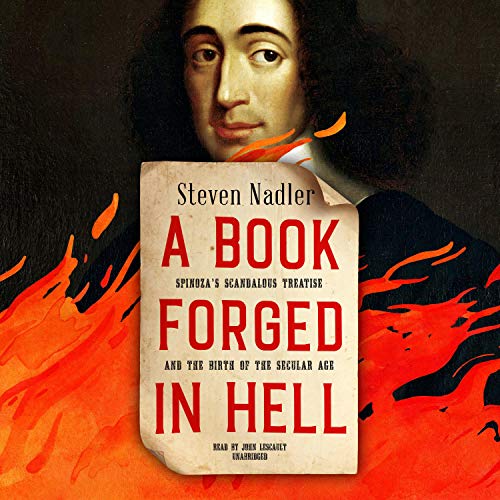
Several books that I have recently read examines the question above in detail, by applying historical criticism to the development of historical criticism itself, by looking at the some of leading early figures of the movement, namely Isaac La Peyrère, Thomas Hobbes, and especially Baruch Spinoza. Steven Nadler, the author of A Book Forged in Hell: Spinoza’s Scandalous Treatise and the Birth of the Secular Age, tells us the story of Baruch Spinoza’s most controversial 17th century book, that really kick started the whole historical criticism movement.
Baruch Spinoza grew up in the Spanish Portuguese Jewish community of Amsterdam, in the Netherlands. Western Europe had been engulfed in a series of religious wars, commonly known as the Thirty Years War, where nearly 1 out of 4 (or 5) Europeans died, prior to the Peace of Westphalia, in 1648, as Roman Catholics and Protestants fought against one another for control of various parts of Europe. The conflagration pretty much ended the medieval social order established by the Holy Roman Empire, resulting in the development of various city-states and regional governments, each one declaring adherence to one form of Roman Catholic or Protestant confession, or another.
Spinoza’s family had been “conversos,” Jews who had been forced to convert to Christianity on the Iberian peninsula. However, such “conversos” were often viewed with suspicion by more established Christians, as to whether they were truly converted. When Spinoza’s family left to go to Amsterdam, to take advantage of the growing religious diversity there in the Netherlands, they were hoping to re-establish their roots in the Jewish faith. However, at age 23, Baruch Spinoza was expelled from the Jewish community in Amsterdam, for expressing theological views at the time that did not agree with the local rabbis. Spinoza had been raised to take over the family import business, but he was able to release himself from these obligations in order to dedicate himself fully to the task of doing philosophy.
He had been left in relative obscurity, until the publication of his Theologico-Political Treatise, in 1670. In his various writings, Spinoza argued that the hotly contested theological conflicts of the day could not be resolved by spiritual authorities alone. Rather, Spinoza argued for a type of “scientific” enterprise that would seek to resolve the conflicts between Roman Catholics, Protestants and Jews on how to interpret the Bible. But the development of his ideas led critics to conclude that Spinoza had become an atheist, and that his book(s) should be banned.
Spinoza the Controversialist
The most well known controversial claim made by Spinoza had to do with the authorship of the Pentateuch, the first five books of the Bible. Like most pious Jews (and Christians) of the time, he was taught in synagogue to believe that Moses wrote everything we find in those five books. Spinoza did note, however, some problems with that entire teaching. But he certainly was not the first to do so.
For example, at the end of the Book of Deuteronomy, the last chapter describes the death of Moses. Scholars for centuries had concluded that Moses simply could not have written about his death, prior to dying himself. The most common solution to this was to suggest that it was Joshua who added in the part about Moses’ death, at a later point in time.
However, what made Spinoza so controversial is that he proposed a far more radical solution to some of the problems found in the Pentateuch. Instead of suggesting that certain parts of the Pentateuch were added in later or edited, by another scribe, Spinoza concluded that very little, if anything, in those five books could be attributed to Moses in the first place. In other words, much of what we read in the Pentateuch was written perhaps centuries after Moses even lived.
But that was just the start for Spinoza. Spinoza went onto say that the Bible was not literally the Word of God, that divine providence and Scriptural prophecy did not work the way most Jews and Christians thought it did, and that the miracles found in the Bible never happened. For most Jews and Christians alike, Spinoza’s views were scandalous. One particular critic of Spinoza’s Theologico-Political Treatise called it “a book forged in hell by the devil himself.”
It would be several centuries before Julius Wellhausen would teach his students about the “documentary hypothesis,” but the ground work for such radical views about the Bible had been laid by Spinoza. Today, such views about the Bible remain standard teaching among the vast majority of departments of religion in secular (and sometimes even in some Christian) universities.
The World After Baruch Spinoza
The 21st century West lives in the shadow of Baruch Spinoza. Some historians speak of the world before Spinoza as “the Age of Faith.” After Spinoza, they say the world entered “the Age of Reason.” What will future historians think of the 21st century remains to be seen. Nevertheless, the impact of Spinoza’s ideas in the wake of the Thirty Years War, and the bitter strife between Roman Catholics and Protestant Reformers, continues to be felt today.
I will have more to say about Spinoza, and Steven Nadler’s analysis of Spinoza’s writings and life, in “part two” of the history behind “historical criticism” coming soon. Plus, I will also include a brief look at Isaac La Peyrère and Thomas Hobbes, two other 17th century philosophers who stimulated the thought of Baruch Spinoza, in reshaping the world we live in today. Stay tuned.
Today we begin a first in a series of occasional posts, looking at the “historical criticism” of the Bible, the good and the bad of modern thinking habits about Scripture…..
A decade or so ago, some popular news magazines would publish eye-catching cover articles around Christmas and Easter, featuring scholars who would challenge traditional Christian doctrines, like the virgin birth and the resurrection of Jesus. Now, in the age of social media, we are bombarded on our cell phones with stories almost all of the time, that tell us that everything we once knew about the Bible is completely wrong.
The intellectual force behind this skepticism has a track record over the last few centuries. It all comes from the rise of “historical criticism” of the Bible. Historical criticism is generally associated with what is taught in nearly every university department of religion today. Ironically however, very few churches, even evangelical ones, talk about it. But with the advent of the Internet, where your typical Sunday sermon can be fact checked in less than a minute with a Google search, the fruits of historical criticism scholarship become readily available to anyone having a SmartPhone in their pocket.
The development of “historical criticism” of the Bible has shifted the way Christians, and the culture at large, has viewed the Bible, in both positive and negative ways. What is “historical criticism” all about?
Defining “Historical Criticism” of the Bible
Yet what exactly is historical criticism of the Bible? Historical criticism seeks to understand the origins of ancient texts in order to better get at the world “behind the text.” Some refer to historical criticism as “higher criticism,” or the “historical critical method,” terms which broadly speaking are synonymous. Some conservative evangelical responses to historical criticism are completely in the negative, as historical criticism is often associated with denying the accuracy of the Bible and rejecting the supernatural character of the Scriptures. But the story with historical criticism is really more complicated than that.
As Baptist New Testament scholar Thomas Schreiner writes in an essay for the CSB Apologetics Study Bible, “Has Historical Criticism Proved the Bible False?,” the rise of historical criticism “has also benefitted the church.” The Christian faith is historically rooted, so we need not fear historical research into the origins of the Bible. For example, the discovery of the Dead Sea Scrolls, archaeological and literary research into the Ancient Near East, and the study of the Greco-Roman world has given us invaluable information that helps us to better appreciate the historical context in which the Bible was written (read Dr. Schreiner’s full essay here).
Historical criticism has also helped to correct some wrong assumptions about how the Bible works. Many Christians have wrongly assumed that the New Testament was somehow mystically downloaded into the brains of New Testament writers in some “special ‘Holy Ghost’ language,” which was then transcribed onto papyrus. The following may sound like a caricature, but it is not too far from how many church-going people think about biblical inspiration:
It is as though the divine inspiration of the Bible means that the Apostle Paul would somehow fall into a trance when he wrote his letters, to find that his hand was moving with pen, without his control, only to wake up later from his trance, and then wonder out loud, “Maybe I should read what I just wrote!”
Biblical inspiration really means that instead of overriding the mental faculties of the Scriptural author, God used the personalities and thought processes of folks like the Apostle Paul to reveal divinely authoritative truth, and historical criticism has helped to confirm this. Furthermore, according to Dr. Schreiner, careful research has given us more accurate English translations of the Bible as newer manuscripts discoveries have brought us closer and closer to the original text of the New Testament.
Some call this particular quest for more accurate Bible translations “lower criticism” of the Bible. This quest uses the basic tools of historical criticism, and the advances we have in this field partly explains why we keep seeing new English translations of the Bible popping up on the book market, every few years or so.
Nevertheless, historical criticism has also sadly introduced certain habits of mind that have caused many to lose confidence in the veracity of Holy Scripture. Despite the above benefits noted by Dr. Schreiner, historical criticism has at times introduced certain ideas that have “threatened the faith of evangelical believers” over the last few centuries.
As Schreiner describes it, “the ‘assured results’ of scholarship in one generation are often vigorously challenged by the next.” So, while the debate among scholars concerning historical criticism continues, the existence of the debate itself continues to have a broader impact on both the culture at large and the church in particular, by implanting certain habits of mind that can distort how we read the Bible. What are these habits of mind, associated with historical criticism, that can influence how even Christians today read the Bible, and where did these habits originally come from?
I will save the answer to that question for the next blog post in this series. In this series, I will be reviewing some books that fill out the story of “historical criticism,” offering ways where misguided historical critical methodologies have led people astray in their approach to the Bible, as well as examples of how historical criticism can actually help people better appreciate the Bible. Along the way, I will include some in-depth case studies that show where a not-so-critical approach to historical criticism (pun intended) can sometimes get people into trouble, without needing to.
Stay tuned. I will post the next installment in about a week or so.
Zombie apocalypse on Good Friday? An exploration into one of the more bizarre passages of the Bible, using historical critical method in order to discern its meaning.
How does the Gospel of Mark really end? I snuck this blog post into the series because of a sermon I heard preached about in earlier this spring. It is brings up a classic issue illustrating why the historical critical study of Scripture actually has some positive, helpful benefits.
A review of Bill Mounce’s Why I Trust the Bible. I offer this book review of an apologetics book written by Bill Mounce, one of the most capable Bible translators we have living today. I highly recommend his book as an historically orthodox alternative to John Barton’s A History of the Bible.
John Shelby Spong, the outspoken Bishop of the Episcopal Church USA, a towering voice of progressive Christianity, died on September 12, 2021, at age 90.
But Spong’s critique of “fundamentalism” went much further than that, going onto undermine some basic tenets of historically orthodox Christian theology. In his Rescuing the Bible from Fundamentalism, along with his other work, Spong repeatedly echoed a series of common themes of progressive Christianity, popular still thirty years later:
Jesus’ work on the Cross, articulated through a doctrine of substitutionary atonement, is to be rejected, as “barbaric.” To say that “Jesus died for my sins” is not only dangerous, it is absurd.
The Bible is full of contradictions.
The concept of theism, of a supernatural power, is meaningless in today’s world.
The Virgin Birth never happened.
Neo-Darwinian evolution dispels any concept of “original sin” as being nonsense.
There was no bodily resurrection of Jesus, nor any ascension of Jesus, after the resurrection.
A lot of the practices of traditional Christianity simply need to give way to a changing new world.
Saint Paul was a repressed homosexual, and Christians should drop any sexual ethics concept of marriage between one man and one woman, for one lifetime, as being relics of the pre-modern era.
In the mid-1900s, I had the opportunity to hear Bishop Spong preach at his former parish in Richmond, Virginia, at Saint Paul’s Episcopal Church. It was a surreal experience, in that his sermon essentially repudiated almost every main point articulated in the liturgy of the Book of Common Prayer, that the congregation had previously recited, just moments before he took to the pulpit lectern.
While Spong’s message appealed to certain persons struggling with how to relate their lived experience with their faith, and though I found in meeting him that he was a congenial and polite fellow, I walked away from my encounter with him wondering why anyone would think that his version of Christian faith would in any way be considered attractive (much less “true”). During his tenure as bishop, church membership in his area of New Jersey Episcopalianism declined by 43 percent.
Bishop John Shelby Spong was like a late 20th century to early 21st century version of the 1963 author of Honest to God, John A. T. Robinson, the English Anglican Bishop of Woolrich, as Robinson argued that a humanist form of religion would likely replace orthodox Christianity. Spong actually developed a correspondence and friendship with Bishop Robinson, before Robinson died of cancer in the 1980s.
It is quite probable that if John Shelby Spong had not been a bishop in the Episcopal Church, few would even know of him today. Robinson, on the other hand, surprised many of his liberal colleagues, when he challenged the broad scope of critical, academic scholarship with his 1976 Redating the New Testament, that argued that much of the New Testament had been written prior to the destruction of the Jerusalem temple, in 70 A.D., a stark contrast with the typical liberal, critical view, that places the dating of all four of the Gospels to having been written after 70 A.D., if not later towards the end of the first century, or even the beginning of the second century.
However, we should be wary of knee-jerk reactions: It is very tempting for an evangelical Christian to overreact to Spong’s in-your-face liberal theology, and embrace a siege mentality, where one tries to circle the wagons, shutting off the rest of the world around them. Instead of hiding the light under a bushel, Christians are called to let the light of Christ shine for all the world to see, even to those who embrace “progressive Christianity.” The “ghost” of John Shelby Spong continues to live on, in the ideas that he popularized, ironically even in some conservative evangelical churches.
There are surely certain critiques that Spong made that needed to be said. At the same time, the precipitous decline of historically orthodox faith, under the tutelage of misguided, at best, teachings propagated by spokespersons like John Shelby Spong serve as a cautionary tale in how not to allow erroneous teachings to gain a foothold among the people of God.
2 Timothy 4:3 is worth quoting here: “For the time is coming when people will not endure sound teaching, but having itching ears they will accumulate for themselves teachers to suit their own passions.” Beware of the ghost of John Shelby Spong.
William Lane Craig debated John Shelby Spong, on the topic, “The Great Resurrection Debate”:
There is a massive shift going on in American Christianity, particularly over the last decade, and it is time we owned up to what is going on. For all practical purposes, the death knell of the “liberal mainline Protestant” church is approaching, and it is approaching fast. Unless something remarkable happens to reverse it, the current trend is that traditionally liberal mainline Protestant churches will effectively cease to exist within the next twenty or thirty years.
This would sadly include the Episcopal Church USA, the denomination that I grew up in as a child (and loved dearly). The decline is not unexpected though.
The cultural influence of those big churches, with big steeples, on main street are fading, being replaced by the resurgence of conservative Evangelical churches. Such Evangelical churches, particularly “mega-church” style congregations, with large campuses out in suburbia, or taking over abandoned shopping malls, are becoming the signature identifying characteristic of American Christianity.
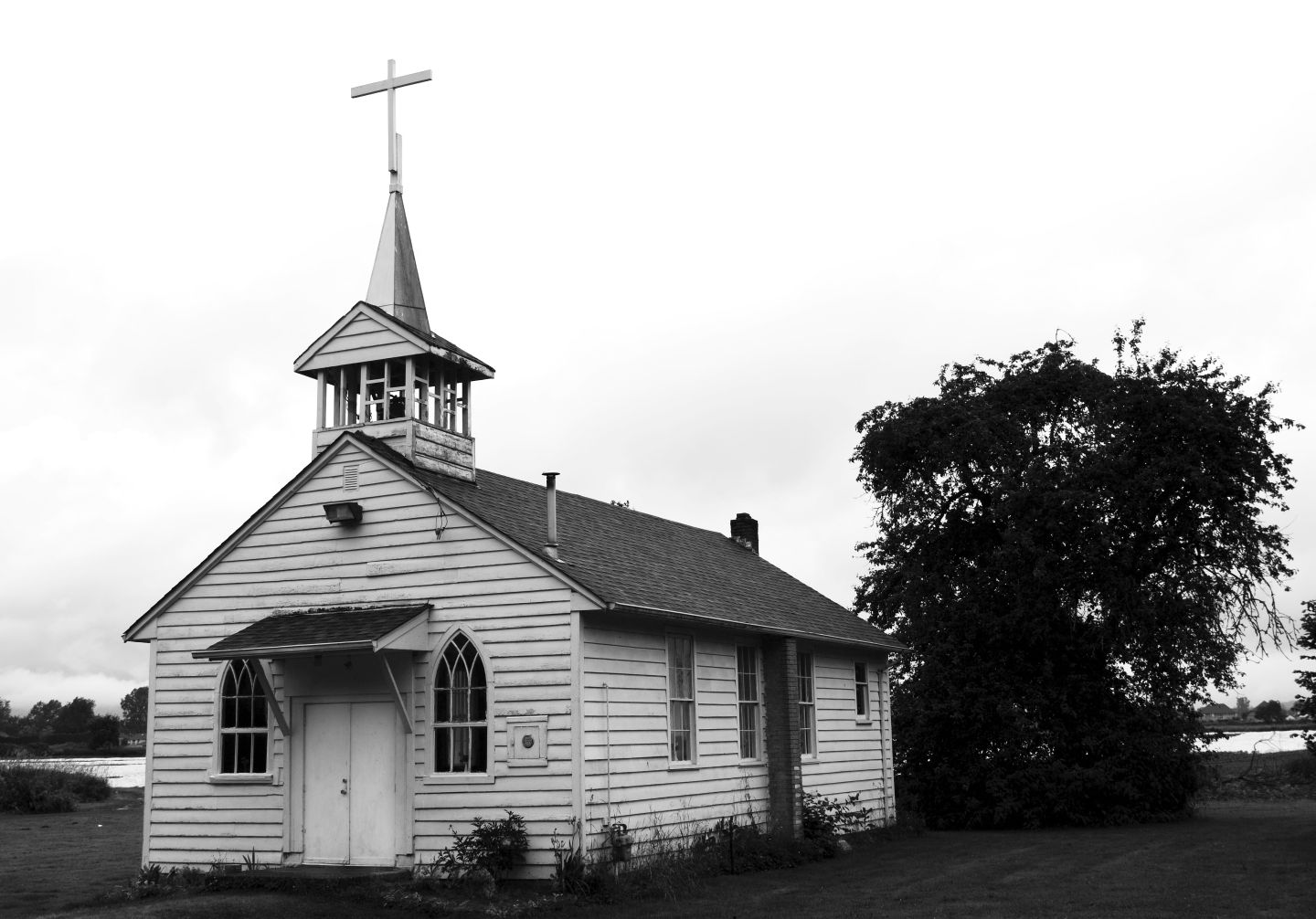
Not your standard picture of the church in the 21st century. We have mostly moved past this. But what are we moving towards?
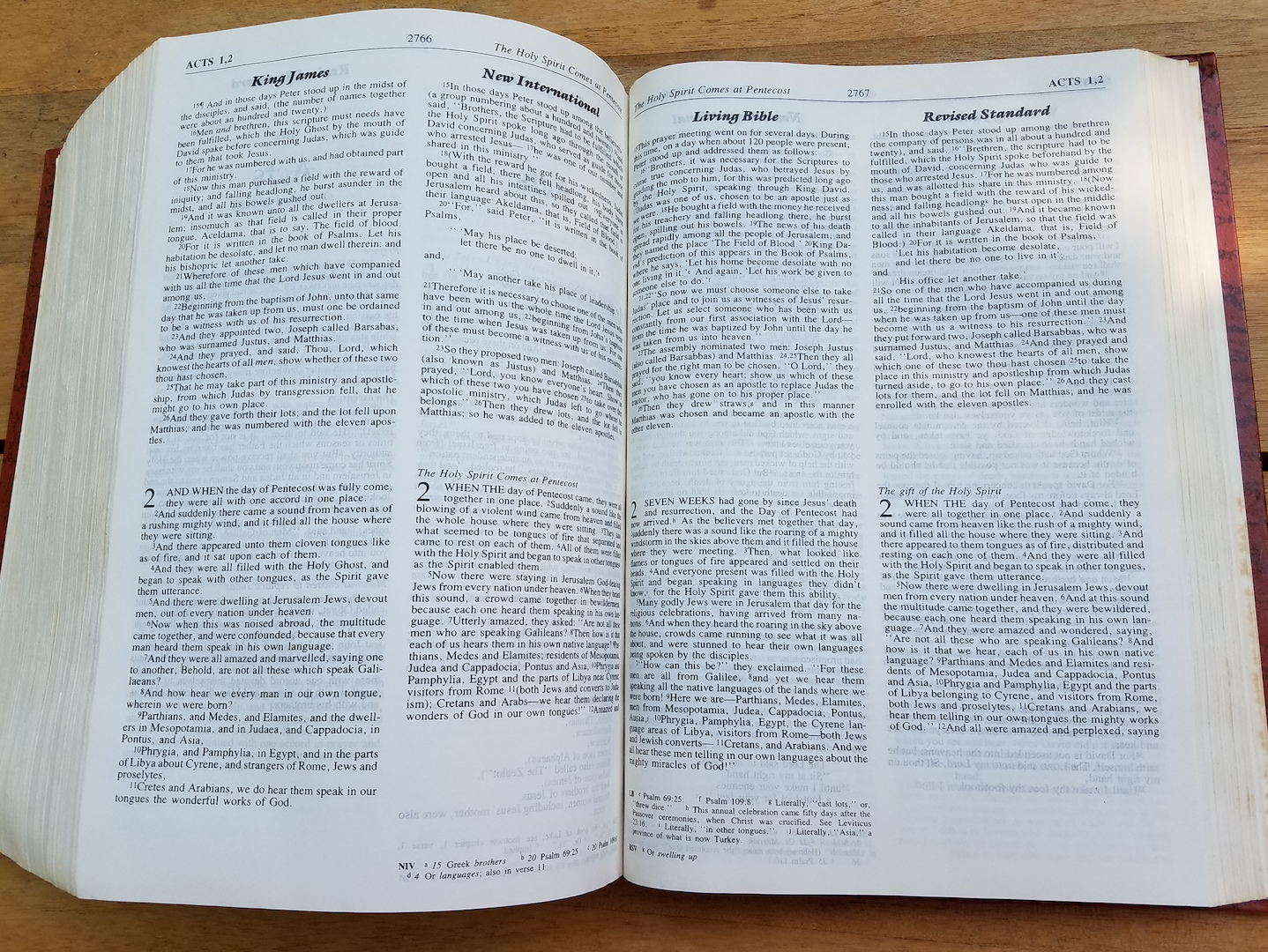
“Mega-church” style churches grew out of the Neo-Evangelical movement of the mid-20th century, most commonly associated with the name of the late-evangelist Billy Graham. While smaller so-called “fundamentalist” churches still proliferate, with the King-James-Only movement being the most pronounced holdouts, the “mega-church” phenomenon dominates the Evangelical landscape today, and they are swiftly overtaking the liberal Protestant mainline.
Granted, there are valiant attempts to try to revive the liberal Protestant mainline. A renewed emphasis on liturgy, an interest in “spirituality,” service to the community, or else latching onto progressive political causes, has sought to try to bring new life into the mainline. But the decline of adherence to historically Christian doctrinal teaching has been working against those efforts to revitalize the church on “main street.”
But we all see the writing on the wall. The mainline is dying. Well-documented research on the “rise of the nones,” tells the story. Children growing up in the liberal Protestant mainline can not tell the difference between what goes on in their church, and what goes on outside of the church. What passes for the liberal Protestant mainline today is often a repackaging of secular America, with religious labels stuck on top.
The liberal Protestant mainline is doing everything it can to try to avoid looking “Christian”, while somehow still trying to be “Christian.” It may convince some people, particularly for those raised in those mainline traditions, who love certain elements of those traditions. But broadly speaking, it just is not working out very well. Newer generations of young people are not buying into it.
And everyone knows it.
The Slow Death of the Protestant Mainline, and the Shift to “Mega-Church” Evangelicalism
In one sense, Protestant Evangelical Christianity has benefitted from this looming implosion of the mainline. More people are gravitating to the world of the Evangelical mega-church. This newer breed of churches are providing the very things that the mainline once did, while largely working to shed the external trappings that felt confining in the mainline.
Less organ and choirs. More guitars and drums. Less ornamentation and a less “church-y” look. More of a sense of being in a plush movie theater, or a big box discount store, or a concert hall, all depending on your tastes. Less ties and more polo shirts.
But the real big differences are less external and more theological. In those Evangelical churches there is a greater sense that these people actually believe what is being taught in the Bible, as opposed to whatever was going on in the Protestant mainline.
Recent data analysis by sociologist/political-scientist Ryan Burge helps to explain what is going on. Those with a Protestant mainline background, who desire to retain their faith, have grown disillusioned with liberal denominations, and are therefore more drawn to conservative, Evangelical churches. Those with conservative Evangelical backgrounds are more likely to stay within their traditions, as compared to cradle-mainliners.
Burge puts it this way: “it’s twice as likely for a mainline Protestant to become an evangelical these days than for an evangelical to leave for a mainline tradition. In raw numbers, for every two evangelicals who became a mainline Protestant, about three mainline Protestants became evangelical.”
Here is one way to observe the mainline to “mega-church” shift: Rarely do you ever hear anymore about a distinguished mainline theologian, harkening back to the 20th century days of a Paul Tillich, Richard or Reinhold Niebuhr, or a Hans Kung (Roman Catholic). Now it is mainly popular Protestant evangelical pastors, like a John Piper, David Jeremiah, Rick Warren, or John MacArthur, with a few more Evangelical academic types thrown in every now and then (an academic class that hardly even existed a few generations ago). Protestant Evangelical Christianity is indeed vibrant and growing in certain parts of America, but there is a catch to it.
According to Ryan Burge again, much of that growth in Evangelicalism comes not from the unchurched, but rather from defections from the Protestant mainline. Essentially, the continued church growth associated with “mega-church” Christianity comes primarily from those disillusioned with the Protestant mainline. The influx of new faces in “mega-church” Evangelical churches is offset by more defections from Evangelicalism itself, where many cradle-Evangelicals are walking away from Christianity altogether …. just as you find in the Protestant mainline.
Trouble is brewing inside Evangelicalism. The decline of the mainline has meant that the problems that once plagued the liberal mainline are now making their way into the sanctuaries of Evangelical churches.
For decades, conservative Evangelical churches could be counted on as “holding the line” when it comes to fending off attacks to the Christian faith, whether they be “in your face” efforts to discredit the Bible, made by skeptical non-believers, or more subtle efforts to weaken Scriptural authority, advocated by Christians who have had a “cafeteria” approach to the faith, picking and choosing those things in the Bible that seemed acceptable to them, and discarding or simply downplaying the rest. If you wanted to find out where someone might be holding onto such a weakened view of the Bible, you would need to look at liberal mainline Christianity for that.
But with the decline of the liberal mainline, that population has begun to shift towards those Evangelical circles, that were once the bastion against theological compromise. For example, it would have been unheard of in Evangelical churches thirty years ago, to hear talk of sanctioning same-sex marriage, as a viable Christian option.
Not so today.
To put it another way, today’s Evangelical movement is becoming the new mainline…. and thus inheriting all of the problems that have come with it.
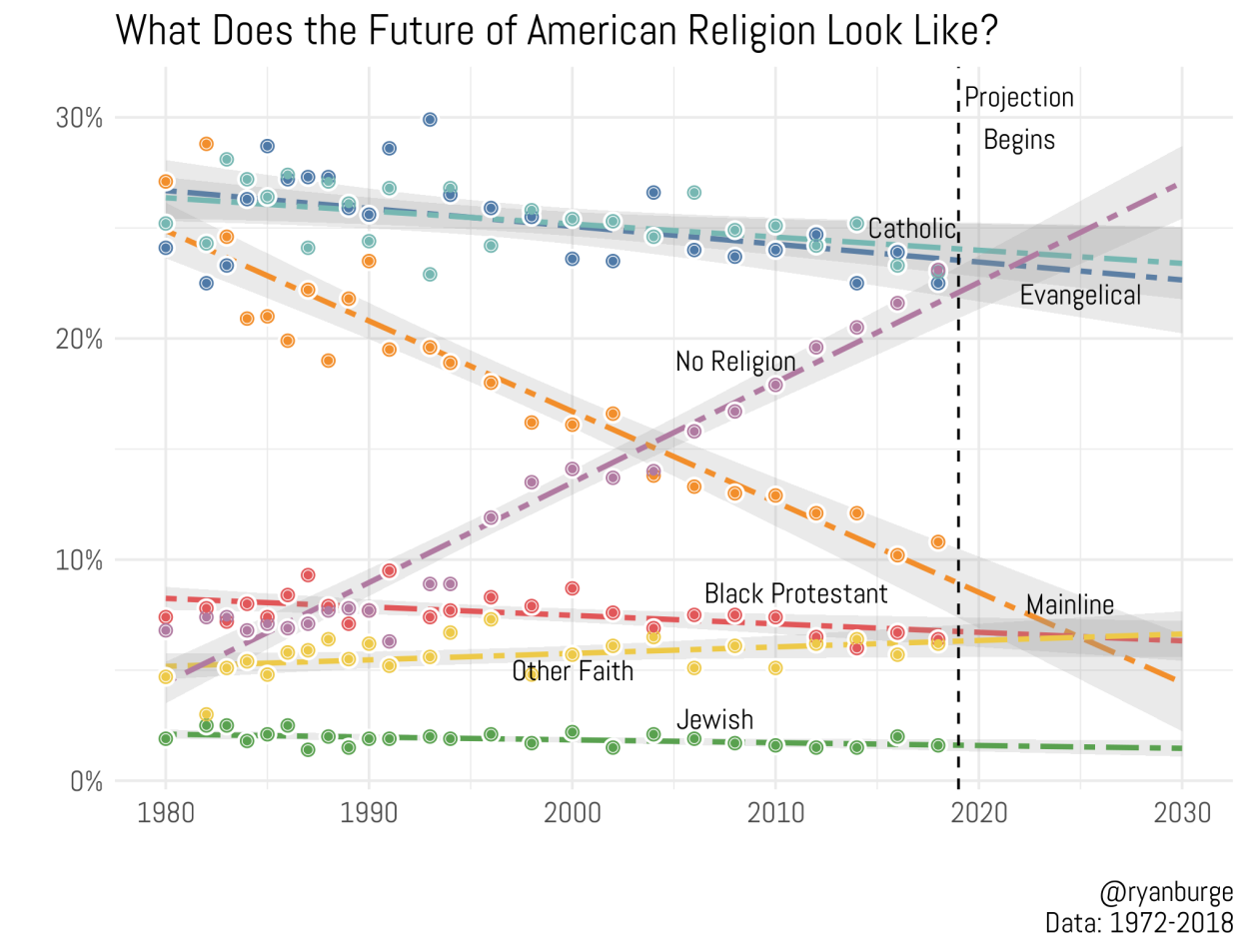
A 2018 study by political scientist Ryan Burge suggests the percentage of both Roman Catholics and Protestant Evangelicals will continue on a slight decline, for the next ten years, with Roman Catholics holding on a little better. But the most dramatic shift is the rapid decline of the liberal Protestant mainline and the rapid increase of the “Nones” or “Dones,” that is those who profess to hold to “No Religion.” Unless a spiritual revival happens, the “Nones” and the “Dones” will eventually quadruple the number of “Mainline” Christians.
Protestant Mainline Stragglers, and Wounded Evangelicals Deconstructing Their Faith
What makes the shift more complicated is the growing presence of wounded Christians, emerging from the more conservative end of Evangelicalism. In generations past, these fallouts from “fundamentalism” eventually found their way into the mainline churches. But with fewer and fewer mainline options available to them these days, these people still remain in historically conservative Evangelical circles, though perhaps they find places to hide out, and stay off the radar… (but sometimes not). Well-intentioned movements that have energized previous generations of conservative Evangelicals (and that still have staying power today), such as Purity Culture, “I Kissed Dating Goodbye,” Young-Earth Creationism, and culturally-white, right wing political causes have left scars felt by many Christians, having grown up buoyed by such movements.
…. side note…. If you do not know what “deconstruction” is regarding faith, the easiest way to explain it is when someone considers that they are at first strong in their Christian faith, but then begins to have a doubt about some particular aspect of that faith. As that person explores that doubt, other doubts are exposed. Then more doubts start to pile up. The prime analogy used by someone undergoing spiritual “deconstruction” is the sensation of pulling on a loose thread on a sweater, but when you keep pulling on it, the whole sweater begins to fall apart. …. That, in a nutshell, is a decent way of describing “deconstruction”… end of side note…
More and more wounded Evangelicals are trying to rebuild their faith, seeking to scrap those pieces of their upbringing that have become barriers to their Christian faith. In some cases, such wounded Evangelicals do find a restoration of faith, with a healthy measure of sobriety and moderation. In others cases, this process of “deconstruction” has sadly led to an all-out deconversion from the faith (see this video interview by Sean McDowell with John Marriott for a 3-minute explanation as to how bad the problem is). In other ways, someone might still call themself a “Christian,” and yet core components of Christian faith may or may not remain after such deconstruction, with certain edgy features poking out every now and then.
In the process of providing a haven for wounded Evangelicals, this leaves Evangelical churches in a precarious state. Reaction to certain excesses in the more conservative wings of the Evangelical movement can lead to overreactions that dismiss too much of the good along with the bad. It is like throwing out the baby with the bathwater.
We see this a lot in the world of online, Internet social media. As I have argued elsewhere, the Internet has made it possible to have easy access, at a click of a mouse, or a TikTok video, to information that was once locked up in libraries and university classrooms. Questions that were once only entertained in religion department seminars, and occasional PBS televised documentaries, are now topics that pop up in coffeehouses and while waiting around in a car repair shop to get your oil changed. Christian parents find it increasingly difficult to keep negative influences away from their children. It is almost impossible to keep this bombardment of information from encouraging doubt and skepticism, even in the most conservative of churches.
Over the past ten years, since devices like the iPhone have taken over the world, just about every cardinal doctrine of historically, orthodox Christian faith has come under fire among so-called “Post Evangelicals,” “Post Conservatives,” “ExEvangelicals,” … you name it. The grievances associated with distorted presentations of such cardinal doctrines, ranging from substitutionary atonement to the authority/inerrancy of Scripture, have triggered knee-jerk reactions from those wounded by such theological misunderstandings. In some cases, those grievances are justified. Irresponsible teaching from the Bible coming from otherwise sound Evangelical pulpits has confused the intended meaning of the original Scriptural authors, as it was inspired by God. But in other cases, such grievances are not justified…. so out with the baby with the bathwater.
Do not throw out the baby with the bathwater! The danger associated with “Progressive Christianity”
“Progressive Christianity”…. and the Temptation to Toss Out the Baby With the Bathwater
This state of affairs then creates a most fascinating mix. Here you have both theologically liberal products of the dying mainline joining up with wounded Evangelicals, all gathering together in certain corners of the Evangelical subculture, sometimes incognito, and sometimes not. This is perhaps the best way of describing what is now becoming known as “progressive Christianity.”
It is important to realize that this mix is not uniform. Not all “progressive Christians” are alike. This is why it is best to leave “progressive Christianity” in quotes, as the definition of that term will be different from person to person. But the key thing to understand is that something broadly called “progressive Christianity” exists, and you will find it today in places you would never expect.
If you are in an Evangelical church, you might even find it right under your nose…. but you may not notice it right away. Furthermore, because it is so subtle, it may trip you up, if you are not careful.
… And this is why this massive shift towards “progressive Christianity” is not so good for the church. Rather, it creates a huge challenge.
Like the fundamentalist/modernist controversy in the late 19th and early 20th centuries, the secularizing cultural pressure to dislodge the moorings of historic, orthodox faith is at the heart of such testing. But unlike that controversy, a century ago, when large Protestant mainline denominations split into a large liberal wing, against multiple, smaller more conservative congregations and groups, today’s “progressive Christianity” is happening largely inside already existing Evangelical churches, that in previous generations were leaning more towards the “fundamentalist” side of the theological divide.
Loving Your “Progressive Christian” Friends… While Still Affirming Historically Orthodox Christian Faith
Now, this does not mean that we should become paranoid, and start looking under the pews in our churches, in an effort to sniff out the heretics in our midst. All you need to do is to take a glance in searching YouTube, and you will quickly find self-proclaimed “heresy-hunters” calling out what they think is false teaching, leavening the Evangelical flock, when all they are really doing is embarrassingly displaying their own ignorance. The problem with “heresy-hunters” is that many times their wounded critics are often correct in certain elements of their criticism, and such critics deserve a fair hearing. In other words, sometimes efforts to supposedly “defend the faith” can become quite misguided and ill-informed.
Therefore, careful and generous listening is in order first and foremost when dealing with folks wrapped up in the orbit of “progressive Christianity.” Taking a “chill pill” might be in order before anyone brings out a pitch fork.
But it does mean that we should be “wise as serpents and innocent as doves” (Matthew 10:16).
It also means that we need to be in prayer now more than ever. We need to pray for the “progressive Christians” in our midst, and ask the Lord for wisdom, that we might be able to engage in conversations with others, with love and grace.
The larger challenge, going forward, will be in the evangelization of those who have deconstructed their way out of the Christian faith altogether (but that is a different story).
I have had to learn the hard way that folks who have left the old liberal mainline, as well as those who have come up wounded in Evangelical circles, who are now seeking refuge in Evangelical churches, are both people for whom Jesus died for, and whom God loves much more than I do. We must be patient, long-suffering, and willing to go the distance to try to genuinely learn from those caught up in “progressive Christianity,” to try to understand what led them into “progressive Christianity,” in an effort to win them back over into the Gospel. This is not easy, and I have failed at this many times. Nevertheless, this is something that we must do.
If you not convinced by this argument, take a listen to Alisa Childers, a former singer for the Christian band ZoeGirl, who almost lost her faith while attending what she thought was a solid Evangelical church. Instead, she was drawn into the orbit of “progressive Christianity” in that very church. It took her years to “deconstruct” and then eventually to “reconstruct” her faith, along historically orthodox lines. She offers some great wisdom here for all of us.
A quote by Saint Augustine, an African Christian and the 5th century great father of the early church, is appropriate here: “If you believe what you like in the Gospel, and reject what you don’t like, it is not the Gospel you believe, but yourself.”






 Veracity