
Huston Smith and the Doctrine of Religious Pluralistic Experimentalism

Huston Smith (1919-2016), pioneering scholar in the field of comparative religious studies, died on December 30, 2016.

Huston Smith (1919-2016), pioneering scholar in the field of comparative religious studies, died on December 30, 2016.

Anyone who has an interest in the “religions of the world” remembers Huston Smith. For well over fifty years, Smith’s The Religions of Man has remained as the standard textbook in secular universities for the study of comparative religions. Republished in the 1990s with the more friendly title, The World’s Religions, Smith’s work has had a profound impact on the religious outlook of millions of Americans, directly and indirectly.

Huston Smith, remembered in this New York Times article, grew up in China, the son of Methodist missionary parents serving in that country. Early on, he hoped to follow in his parents’ footsteps, but his years in college back in the United States redirected him towards the scholarship of world religions, a growing field in the wake of World War II.

Smith had become enamored with the variety of human religious experience, making him a 20th/early-21st century version of the late- 19th/early-20th scholar of the field, William James, the Harvard author of The Varieties of Religious Experience. Smith’s work has indeed proven helpful over the years, particularly for those who have known little about the diversity of global religious expression. But Smith went much further. He was not content in merely obtaining academic knowledge. Rather, he wanted to experience the world’s great religious traditions in all of their profound mysticisms. He studied under a Buddhist Zen master, lived in a Hindu ashram, and sought after the wisdom of Sufi Islam.

Huston Smith befriended British author and mystic, Aldous Huxley, mythologist Joseph Campbell, and Harvard psychologist Ram Dass, among other religious celebrities. As a professor at M.I.T. in Boston, in the early 1960s, Smith met with Timothy Leary to experiment with acid, or L.S.D., for the inducement of mystical experience. He publicly defended the use of peyote as a sacramental drug, for use in Native American religious rituals. He studied Buddhist monastic chanting in Tibet and introduced the Western world to the Dalai Lama. Though hidden in academia for years, journalist Bill Moyers made Smith famous in a popular PBS multipart series in the 1990s, ” The Wisdom of Faith with Huston Smith.”

By his own admission, Huston Smith saw the dangers of spreading oneself religiously too thin:

I liked what a teacher in India once said to me. If you are drilling for water, it’s better to drill one 60-foot well than 10 6-foot wells. And generally speaking, I think a kind of smorgasbord cafeteria, choosing from here and there is not productive (NPR remembrance, an interview with Terry Gross, 1996).

Not “productive?” As cautionary advice, which Smith hardly seemed to have taken himself, this is a vast understatement. For if there was one doctrine that Smith himself clung to tightly, it was the doctrine of religious pluralistic experimentalism. The lure of diversity in world religious mysticism was too difficult for Smith to resist. Huston Smith was the academic, respected face of the New Age Movement.
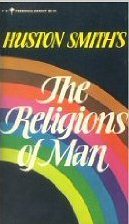
Huston Smith's classic on comparative religion studies: The Religions of Man.

Huston Smith’s classic on comparative religion studies: The Religions of Manfirst published in 1958.

Though Smith said that he had never forsaken his Methodist Christian identity, he rejected any Christian exclusivist claim to truth. Biblical statements such as that of Jesus, “I am the way, and the truth, and the life. No one comes to the Father except through me” (John 14:6), or Peter, “And there is salvation in no one else, for there is no other name under heaven given among men by which we must be saved.” (Acts 4:12), are to be understood in Smith’s mind as merely symbolic metaphors to the extreme. Contrary to the context of these Biblical statements, and the original intent of the New Testament authors, Smith sought to ground any notion of Christian exclusivist truth claims in some alternative, broader truth claim undergirding the whole of human, world religious experience. Smith was strangely optimistic, believing that particular, conflicting religious truth claims can be sidestepped. Smith would also contend that religious mystical experience is not the goal, in and of itself, but rather, it is through such mysticism that the development of character springs forward.

This is a noble aim, but did Huston Smith represent the teaching of the Bible rightly? Upon his recent death, where is his soul now? Can that question even be answered, from the perspective of those who take Smith’s view? After reading Smith’s 2005 book, The Soul of Christianity: Restoring the Great TraditionGospel Coalition blogger, Trevin Wax, responded with this critical observation: I was left wondering if Smith understands Christianity as well as he thinks he does.

These are my thoughts exactly.

According to friends and admirers, Huston Smith was a really nice and likable man. But I also know of other really nice people who believe some rather strange things, masking the presence of darker elements of the human experience. Is it possible that the spiritual diagnosis of the human condition, offered by the prophet Jeremiah, is more profound than we think?

The heart is deceitful above all things, and desperately sick; who can understand it?” (Jeremiah 17:9)

It should also be noted that Smith’s antagonism towards the particularity of evangelical faith is also extended towards disbelief in God, as well. In one of his last works in 2009, Why Religion Matters: The Fate of the Human Spirit in an Age of Disbelief, Smith condemns “scientism,” the elevation of science to the status of a final metaphysical truth claim, a judgment that evangelical Christians can find some agreement with. Attempts to explain the whole of the world scientifically, without talk of God, is rejected as a modern ideology. I sincerely doubt that Huston Smith would find too many friends among disbelieving atheists. Yet despite the differences between Christian faith and atheism, both hold to an objective notion of truth that remains elusive to the religious, pluralistic relativism championed by Smith.

It is as though Biblically-informed, evangelical faith is sandwiched between these two contrasting doctrines: the doctrine of a world without God, promoted by secular atheism, and Huston Smith’s doctrine of religious, pluralistic experimentalism.

However, Huston Smith’s years of teaching do point out a great deficiency in how many people reared in a familiarity of the Bible come up short:

Many of my students, they’re – I have come to call them wounded Christians or wounded Jews, meaning that what came through to them from their traditions was two things – dogmatism – we’ve got the truth, everybody else is going to hell – and moralism – don’t do this, don’t do that (NPR remembrance, an interview with Terry Gross, 1996).

If Christian faith is anything, it is more than a set of dogmatic beliefs or a set of moral rules. Rather, it is about having a relationship with the Creator and Redeemer of the Universe. But unlike the mysticism of the world, that looks to religious experience as a form of human achievement and seeking, authentic Christian faith is instead a response to the advances of a loving God, a God who seeks to heal that which is wounded in every person, regardless of religious background. This “scandal of particularity,” a scandal that Huston Smith sought to transcend through a broadly defined mysticism, lies at the very center of Biblical Christianity.

My greatest concern with Smith is that he set up a false dichotomy: Either embrace the pluralism of world religions as all true, at least the more mystical or friendly elements, or be stuck in your arrogance. Huston Smith rarely addressed the dark side of religion, particularly the problem of religious violence, whether it be Buddhist, Hindu, Muslim, or otherwise. But if we truly follow the example of Jesus, it is possible to cling to the uniqueness of Christ as the only means of salvation… and still not be a jerk to other people.
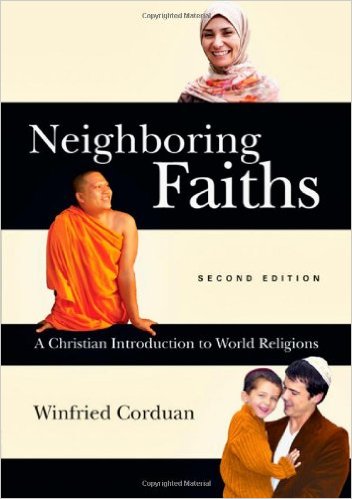
Winfried Corduan's Neighboring Faiths: A Christian Introduction to World Religions, is a great alternative to Huston Smith's textbook, The Religions of Man.

Winfried Corduan’s Neighboring Faiths: A Christian Introduction to World Religions, is a great alternative to Huston Smith’s textbook, The Religions of Man.

My well-worn copy of Huston Smith’s The Religions of Man still serves as a valuable, helpful resource on how not to be jerk when dealing with people who have different religious experiences. Smith’s work remains an invaluable contribution in helping people understand one another, appreciating those aspects of others’ spirituality that seem foreign to us at first, but that are often closer to our own experiences, upon further inspection. However, the cognitive dissonance in The Religions of Man ultimately forces the reader to make choices that are not necessarily helpful. I am more inclined these days to recommend Winfried Corduan’s Neighboring Faiths: A Christian Introduction to World Religions, which presents the same type of accurate, sensitive material that Huston Smith does, but Corduan accomplishes his work in a manner that does not betray the fundamental conviction regarding the uniqueness of Christ, and the imperative to share the Gospel with a hurting and wounded world.

Christian faith, in this respect, ultimately comes down to a commitment to a Person as Truth. To fail to grasp this is to fail to grasp the Christian message. You can still be fully committed to Jesus, and His mission to the world, without being a jerk. Just as it is possible to be married to one person, and still have deep, abiding friendships outside of that marriage, so it is possible for a committed follower of Jesus to love Hindus, Buddhists, Muslims and others for the sake of the Gospel. Let is us not treat our attitude towards the world religions as those who would rather endlessly “date” a myriad of people, seeking after a variety of religious experiences, forever experimenting, without ever making an exclusive commitment to a single person. A Biblical understanding of marriage shows us what this type of genuine commitment looks like. Let the follower of Jesus stay true to Christ, and love others around us with that love that only Jesus Christ can give.

For a more detailed look at the problem of religious pluralism from a Christian perspective, read this Veracity four-part series, #1, #2, #3, and #4.

Clarke’s Books of 2016… and a Quick Year in Review

People To Be Loved: Why Homosexuality is Not Just an Issue, by Preston Sprinkle. Moving past the culture wars to love people with biblical truth.

People To Be Loved: Why Homosexuality is Not Just an Issue, by Preston Sprinkle. My book of the year for 2016.

Christians are people of the “Word,” so it really is a good thing for Christians to practice the discipline of good reading. However, I do not get a chance to read as much as I would like to do. Thankfully, Audible.com and ChristianAudio.com supplement my hunger for good books, as I commute to work or try to knock out my “honey-do” list at home on Saturdays. So, I would like to offer a brief review of some of the books that have helped shape me over the past year (also, I have a quick year in review below):

People to Be Loved: Why Homosexuality is Not Just an Issue, Preston Sprinkle. The best book I have read this year on a controversial topic, and probably the best book ever on this particular topic. Sprinkle has the right combination of pastoral sensitivity to hurting people and an orthodox reading of Scripture, that I simply have not found in other books on same-sex attraction and same-sex marriage. If you care about people who struggle with gay and lesbian questions, or you struggle yourself, you need to read this book. I introduced the book here on Veracity.

When a Jew Rules the World, Joel Richardson. As with the topic of creation, I find that an obsessive preoccupation with the “End Times,” including the topic of national Israel, tends to invite a type of unnecessary dogmatism that preemptively shuts down conversation among Christians, where there is honest, principled disagreement regarding the interpretation of the Bible. Richardson’s book is a spirited defense of premillennialism, written at a popular level, with a definite future for national, ethnic Israel in view.  But Richardson does not fit the caricature of dispensationalism I learned some years ago in college, that sees itself as the one and only way to read the Bible. He shook my categories! Richardson has his convictions, but he seems willing to rethink certain elements of popular prophecy that do not have sufficient Biblical backing in his view. I am not wholly convinced by Richardson, in how he reads certain passages of Scripture, he is more obsessive about the “End Times” than I think is necessary, and he goes a bit over-the-top in linking amillennialism with antisemitism in church history. Nevertheless, I confess that he has given me a lot to think about, and he has encouraged me to keep a more open mind. I will hopefully get back to blogging on the topic of Christian Zionism in 2017. Look here for a detailed review I wrote on Veracity.

We Belong to the Land, Elias Chacour. Chacour is a Palestinian Christian in Israel, and nominee for the Nobel Peace Prize several times, who for the past fifty years has sought for justice and reconciliation between Palestinian Christians and non-Christian Israelis. This is a fairly brief book, composed mostly of short essays chronicling Chacour’s story since the 1960s. But it helps to give a different Christian perspective to the Middle East conflict, that most American Christians know next to nothing about. Chacour was instrumental in building schools for Palestinian Christian children, at a time when many Israelis resisted such efforts. If you are bothered by Joel Richardson, read Elias Chacour for an antidote.

The Fall of the Ottomans: The Great War in the Middle East, Eugene Rogan. I have become friends with some guys from Turkey, and I have wanted to learn more about World War One, and the Middle East. If you want to understand what is going on in that part of the world today, including some of the history behind the Israeli-Palestinian conflict, this British historian, Eugene Rogan, is a fascinating and yet still scholarly story teller, of how that part of the world has gotten into the mess that it is in right now.

NIV Cultural Backgrounds Study Bible: Bringing to Life the Ancient World of Scripture, John Walton and Craig Keener. An excellent resource that I use almost all of the time now in studying the Bible. A lot of popular Bible teaching today fails to properly appreciate the original context of the Biblical writer and the original audience. As John Walton succinctly puts it, “The Bible was written for us but not to us.” If you use this alongside a good study Bible, it will give you a lifetime of insight into understanding God’s Word. It serves as the perfect complement to my ESV Study Bible.

The Grammar of God: A Journey into the Words and Worlds of the Bible, Aviya Kushner. Written by an orthodox Jew, Kushner writes about the fascinating world of Bible translation, from the perspective of someone who grew up reading the Bible in Hebrew. She intersperses her discussion of different passages of the Hebrew Bible with a colorful and personal travelogue of sorts. Though not a Christian, I learned a lot about some of the ambiguities in Bible translation from Kushner, which ironically gave me a greater appreciation for God’s Word, the Bible. Some of Kushner’s family survived the Holocaust, making the story even more compelling.

When God Spoke Greek: The Septuagint and the Making of the Christian Bible, by Timothy Michael Law. In preparing a Bible study in Romans for both a small group Bible study and an Adult Bible class, I soon learned that the Old Testament Scripture quotations Paul makes in his letter do not always match the text we have in our English Old Testament translations. When God Spoke Greek opened my eyes to understanding the crucial role that the Greek Septuagint, that the Apostle used, has in helping us to understand things like Biblical inspiration. They did not teach me this stuff in seminary, but they should have. It was like a mini-revolution in how I looked at the Bible. It also helped me to see why some evangelicals have been drawn towards Eastern Orthodoxy, but that is another subject! See this review on Veracity.

Here I Stand: A Life of Martin Luther, Ronald Bainton. A classic that every Christian should read, particularly since we will celebrate the 500th anniversary of the Protestant Reformation next year

………………………………………………………

And to top things off, here is a quick review of the year 2016 for me. Last year, I put up a “Top Posts of the Year 2015,” but I only have a few things to add for this year, so this is why I focus mainly on the books I have read.

Of course, the biggest story of the year is the 2016 American Presidential election. Many Christians are optimistic, whereas others are apprehensive. I do not think anyone really knows yet for sure what it all means. I guess we will all start to know something within a few months. Here are just a few of the other notable, thoughtful events and Internet postings of 2016 that quickly come to mind:

  • The Andy Stanley preaching controversies. The famous pastor of a megachurch in Atlanta, who is also the son of Charles Stanley, another influential American pastor, has ignited a contentious debate among evangelical leaders: Should preaching be geared primarily towards the believer or the non-believer? But while this is a significant debate here, the discussion also reveals a disturbing, underlying trend in the church: Much of the critique of Stanley has come from selected “soundbites” from his sermons, without sufficient attention paid to “fact checking” the various claims made about Stanley. Have evangelicals succumbed to the temptation of simply passing information on about other Christians, without properly verifying the truth of these claims? What does this tell us about how we treat the Bible? Do we really study the Bible, in context, or do we just rely on Scriptural “soundbites?”
  • The confused evangelical response to LGBTQ concerns. Most Christians I know believe (as I do) that things like gay marriage and transgenderism are not part of God’s original design and purposes, but they are perplexed in knowing how to respond and care for real flesh and blood people who struggle with these issues.


Andy Stanley, and Critics Who Shoot First, and Ask Questions Later

Megachurch pastor Andy Stanley. Promoter of Biblical truth... or compromiser?

Atlanta Megachurch pastor Andy Stanley is in trouble again with a number of his fellow evangelical leader friends… or have his “friends” succumbed to a “Shoot First, Ask Questions Later” approach to evaluating his preaching?

Do you “fact check” what you read on social media, or any other source of news and information, particularly when it involves a controversial matter of grave concern?

I had just come back from a Christmas trip to visit family, when I ran across a Patheos blog article with the alarming title, “Andy Stanley: Please Relent or Step Down from Pastoral Ministry.” Mmmm…. Yet another scandal among God’s people? A megachurch pastor gone astray? What embarrassment for the Christian faith is it this time?

In this article, the author compares Andy Stanley, a megachurch pastor in Atlanta, and son of popular Bible-teacher Charles Stanley, with the mid-20th century liberal minister, Henry Emerson Fosdick, and a modern-day prosperity doctrine guru, Joel Osteen. Wow! If you know anything about evangelical theology, these are serious charges to lay against any evangelical pastor.

Andy Stanley’s preaching faux pas, per the Patheos blogger, was taken from an early December 2016 sermon delivered by Andy Stanley, regarding Christmas and the difficulty that many people in our secularized culture today have believing in the Virgin Birth of Jesus. Our scientific world has tested the credibility of such miracles, and so, many wonder if the Virgin Birth is not some type of man-made fiction. In responding to the doubts of many, Stanley was partially quoted in a Washington Post article as saying, “If somebody can predict their own death and resurrection, I’m not all that concerned about how they got into the world.”

What does that mean?

The Patheos blogger I was reading, along with a wide variety of other Internet bloggers and Christian media outlets, since early December, took this to mean that Stanley believes that the Virgin Birth is not an essential matter of Christian faith. Others interpret this by saying that Stanley was “questioning the significance of the virgin birth.” Even the venerable president of Southern Baptist Theological Seminary, Al Mohler, took exception to Stanley’s statement as quoted by the Washington Post, on a recent “The Briefing” podcast (though it should be noted to Dr. Mohler’s credit that he did not name Stanley directly):

If Jesus was not born of the virgin then the Bible cannot be trusted when it comes to telling us the story of Jesus, and that mistrust cannot be limited to how he came to us in terms of the incarnation. The fact is that biblical Christianity and ultimately the Gospel of Christ cannot survive the denial of the virgin birth. Because without the virgin birth, you end up with a very different Jesus than the fully human, fully divine savior revealed in scripture.

Now, I agree with folks like Al Mohler that the Virgin Birth is an essential doctrine to Christian faith. It is one of the historic, fundamental beliefs of Christianity, not to mention the entire foundation for the Christmas story. But is it accurate to say or imply that pastor Andy Stanley is now denying the essential doctrine of the Virgin Birth?

Upon reading and hearing these things, I harkened back to another controversy that pastor Andy Stanley had earlier in 2016, a story covered here at Veracity (part #1 and part #2).  In that controversy, Stanley was accused of denying Biblical inerrancy. Yet strangely enough, Stanley made his own defense by appealing to one of Stanley’s teachers and mentors, Norman Geisler, who was glad to offer support for Stanley. Norman Geisler was one of the primary architects behind the Chicago Statement of Biblical Inerrancy, articulated in the 1970s. So, it really is strange to imagine that Andy Stanley, an enthusiastic student of Geisler’s, would find himself accused of denying Biblical inerrancy, then defended by Norman Geisler, and then still be accused by some of his fellow evangelical leaders as being “dangerous.”

Strange. Very strange indeed.

It reminds me of something Yogi Berra might have said: It is like “deja vu all over again.” Continue reading


The Incarnation in Three Minutes

Merry Christmas, from your friends at Veracity, and enjoy the following video. If you have a friend who is skeptical about the supernatural aspect of the Christmas miracle, and its implications, encourage them to read this exchange by pastor Tim Keller and an agnostic New York Times journalist, and discuss.


Daniel’s Seventy Weeks #5

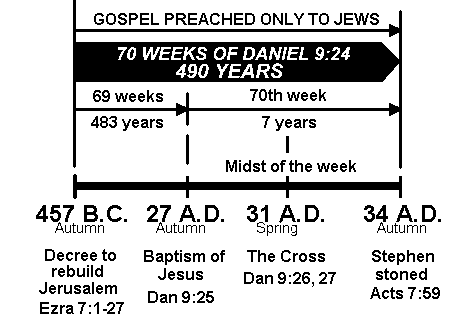
The primary traditional alternative to the more modern, dispensationalist reading of Daniel 9:24-27

A more traditional alternative to the more modern, dispensationalist reading of Daniel 9:24-27.  (Image credit: sdru.org)

If you have been following this series of blog posts (#1, #2, #3, and #4), you will know that the “Seventy Weeks” of Daniel 9:24-27 makes for a very demanding study. So, as we are getting very near to Christmas, I need to wrap this blog series up, even with all of the loose ends still out there.

Thankfully, neither your salvation, nor mine, hangs in the balance with getting Daniel 9:24-27 exactly right. For example, no central doctrine of the faith is at stake, as you ponder the mysterious meaning of Scripture phrases like “the people of the prince who is to come shall destroy the city and the sanctuary” (verse 26). But the study is well worth the effort, as it will spur you on in learning more about Biblical prophecy, just as it has done for me.

At one point in my studies, over the past two years in this passage, I ran into the following statement by Dr. Martyn Lloyd-Jones, one of Britain’s most brilliant and popular expositors of the 20th century. Lloyd-Jones lived in an era when many Christians tended to be very dogmatic in their particular interpretation of Daniel 9. His comments on the debate over Daniel 9’s “Seventy Weeks” are worth savoring:

I am simply trying to put before you some of the various ideas and type of interpretation, while indicating, as anyone who is concerned to teach the Scriptures must do, the interpretation that most commends itself to my mind and to my understanding. I shall continue to repeat this because it seems to me to be the most important point I can make in connection with this whole subject. If I can somehow shake the glibness and the dogmatism that has characterised this matter I shall be most pleased, and I thank God that there are signs and indications that people are prepared to consider this matter anew. It may well betoken a period of blessing in the history of the Church.” (Great Doctrines of the Bible: God the Father, God the Son, God the Holy Spirit, The Church and the Last Things, page 119).

Martyn Lloyd-Jones has the right perspective. We are not talking about the deity of Christ, or salvation alone through Jesus, here. OKAY??? I may hold (and you may hold) to a different interpretation of a difficult passage like Daniel 9. Hopefully, believers can discuss this matter with clarity and charity towards one another, by studying the Scriptures anew. Continue reading