Category Archives: Witnesses

Controversy at Duke University: Islam and Religious Plurality

Duke University is probably best known for its legendary college basketball team, but perhaps now it will be remembered in a different way. Though founded by Methodists and Quakers in Durham, North Carolina, Duke recently announced that the Muslim student group would be allowed to chant their weekly call-to-prayer from the Duke Chapel bell tower on Fridays. Even though the Chapel also rings its church bells for Christian services on Sundays, the controversy over the chanting of the adhan led the University to rethink its decision to allow the Islamic call-to-prayer in such a demonstrably public manner.

The folks at Duke probably should have contacted some folks at the College of William and Mary before making their initial decision. Alas, the intendedly noble desire to promote religious pluralism and stand against discrimination yet again runs afoul of honoring the historically Christian heritage of these now secularized institutions of higher learning.

If you are not familiar with the adhan you might be interested in hearing it and reading an English translation of the Arabic.

I asked a Jewish friend of mine if there was a rough Jewish equivalent to Christian church bells (not as popular as they once were) or the Islamic adhan. The closest thing he could think of was the practice of some orthodox Jews to employ air raid sirens to signal the start of the sabbath.

I recently finished reading Philip Jenkins’ The Lost History of Christianity, and the incident at Duke made me think of Jenkins’ recounting of historically Christian lands in Africa and Asia having church bells ringing for hundreds of years before the Islamic invasions that began in the late 7th century. Over the centuries, the dhimmi status of the Christian population eventually led to the de-Christianization of these areas. The bells that announced the Christian call to worship were becoming less and less while the Islamic adhan soon dominated the soundscape, as formerly Christian communities were converting to Islam.

Is the situation different now? Duke University surely has a relatively small yet active evangelical Christian presence, but officially the school is only nominally connected to its Methodist and Quaker roots. Do that many Duke students, faculty and staff pay attention to the bells that ring on a Sunday morning? What difference would the Islamic call-to-prayer make on a Friday?

UPDATE: Friday, January 16

This was supposed to be the first day that the Islamic call-to-prayer would be made from bell tower of the historic Duke Chapel, but the university announced that the call-to-prayer will be moved to a different part of campus because of the controversy.  Sadly, part of the university’s decision was due to a credible threat of violence.  These type of threats should be greatly troubling to the followers of Jesus.

As an aside, the update news article linked above notes that most students at Duke were supportive of the university’s original policy proposal. Is the student support for the call-to-prayer from the Chapel bell tower primarily an indicator of a commitment to religious plurality in public life, or is it partly due to an ignorance of Christian history? I wonder.


The “Unbroken” Legacy and Billy Graham

Louis Zamperini. Restless young man, U.S. Olympic runner, war hero, and sinner in need of grace who helped to define the era of Billy Graham (early publicity photo)

Louis Zamperini. Restless young man, U.S. Olympic runner, war hero, and sinner in need of grace who helped to define the era of Billy Graham (early publicity photo)

It was 1949 in Los Angeles. The conservative Christian community had pulled together to put on a multi-week revival under a big tent, featuring a then relatively-unknown Billy Graham. By the end of week three, the organizers were unsure if the revival meetings were to continue. Despite a massive publicity campaign with flyers and newspaper ads, attendance had been rather so-so. Graham and the leadership team decided to pray, asking for God’s guidance on what to do. After much prayer, they decided to go ahead and extend the meetings a few more weeks.  But had they done the right thing?

Several weeks later, on week five, a well-known celebrity made his way into the revival tent. Louis Zamperini grew up a restless teenager and became a juvenile delinquent. To give his life some focus and meaning, Zamperini took up running. Eventually, he earned a spot on the United States Olympic team in 1936 in Berlin. World War II dramatically changed his life, where he was shot down over the Pacific and suffered terribly as a Japanese prisoner of war. When Zamperini came back home after the war, his life kept falling apart. After struggling with marriage problems, alcohol abuse, and horrific post-traumatic stress, he entered that revival tent that one evening. He gave his life over to the Lord Jesus Christ, and he spent the rest of his life serving Him.

Zamperini’s conversion to Christ had helped to give Billy Graham and his team a sense of confirmation that extending the revival a few more weeks was the right thing to do. For Graham, the Los Angeles revival gave him international exposure and influence that has continued to last today into Graham’s twilight years.

Louis Zamperini died in 2014, but his story lives on. Laura Hillendbrand’s bestselling book Unbroken is an enthralling story, from friends of mine who have read the book. From what I have been told, even if you are not a Christian, you will be spellbound by Hillendbrand’s telling of the story. Also, according to his son, Luke Zamperini, the 2014 movie Unbroken by Angelina Jolie tells the story of his dad’s life well, particularly with respect to how Jolie presents Louis Zamperini’s Christian faith, though some say that the faith element is downplayed too much.

But what I find even more fascinating is how Zamperini’s story also helps to tell the story of Billy Graham and the generations of believers who have come under his influence. The intersection of Zamperini with Billy Graham was a critical watershed moment for American evangelicalism in the 20th and early 21st centuries. Here is a summary of some correspondence between Graham and Zamperini before Zamperini’s death.

I would be curious to know from other Veracity readers what you have thought of the book and the movie.

HT: John Paine, for the Luke Zamperini story about the Christian faith element in the movie.


Agreeing to Disagree

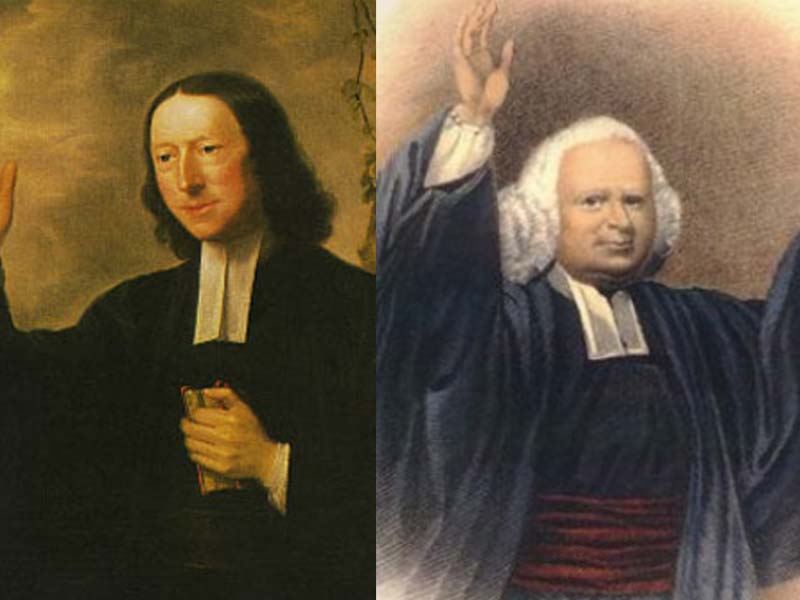
John Wesley (1703-1791) and George Whitefield (1714-1770) were the most well-known Christian leaders in the English-speaking world of the 18th century. Yet they struggled with each other regarding some significant points of Christian doctrine.

John Wesley (1703-1791) and George Whitefield (1714-1770) were the most well-known Christian leaders in the English-speaking world of the 18th century. They struggled with each other regarding some significant points of Christian doctrine, and through their dialogue they introduced the notion of “agreeing to disagree” into Christian discourse.

Sometimes “agreeing to disagree” with fellow believers can be difficult. I know. I have been there. But first, let me give you some historical background…

In 18th century England and America, two of the most celebrated figures were George Whitefield and John Wesley. Whitefield and Wesley would travel up and down the American Eastern seaboard and across the British Isles preaching in the open air. The first “Great Awakening” can largely be attributed to how God used these two men to lead many thousands into a relationship with Jesus Christ, perhaps one of the greatest spiritual revivals in the history of the church.

But Whitefield and Wesley had some rough spots in their relationship with one another. In one important matter, they differed in terms of some significant Christian doctrine. George Whitefield, a Calvinist theologically, believed that when Jesus Christ died on the cross, He died only for the elect who would come to know Christ. If you were not among the predestined elect, Whitefield concluded that the Bible taught that Jesus had not died for you. John Wesley, an Arminian theologically, vehemently rejected this teaching. For Wesley, Jesus Christ died for all of humanity, whether someone received Christ or not. Though these men clearly differed on the extent of Christ’s atoning work on the cross and how that related to predestination, they were united in many more things in terms of doctrine than over that which they were divided.

The prolonged controversy between Whitefield and Wesley was at times very tense. Though I do not recall the reference, my understanding is that John Wesley was the more quarrelsome of the two men. But it is to John Wesley’s credit that eventually when he was asked to deliver a memorial sermon when George Whitefield died, he was extremely charitable to his evangelistic counterpart. In that sermon, Wesley uttered a most memorable phrase:

“There are many doctrines of a less essential nature … In these we may think and let think; we may ‘agree to disagree.’ But, meantime, let us hold fast the essentials…”

Since that remarkable sermon, Christians over the years have recalled Wesley’s words that he at times exchanged with his colleague Whitefield about “agreeing to disagree.” Though these men still had their points of conflict, in the end, they were able to consider each other not as enemies but rather as friends, as brothers in Christ, despite their disputes over some points of doctrine.

It is a lesson that the evangelical church today still needs to hear.
Continue reading


A Layman’s Faith

Religio-Laici

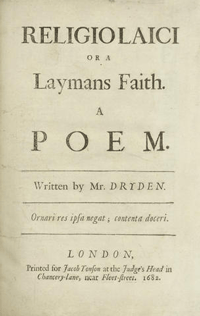
Religio Laici, or A Layman’s Faith. John Dryden’s radical 1682 poem comprises a warrant for personal discipleship.

“For every man is building a several way; impotently conceited of his own model, and his own materials: reason is always striving, and always at a loss; and of necessity it must so come to pass, while it is exercised about that which is not its proper object. Let us be content at last, to know God, by his own methods; at least, so much of him, as he is pleased to reveal to us in the sacred Scriptures; to apprehend them to be the word of God, is all our reason has to do; for all beyond it is the work of faith, which is the seal of heaven impressed upon our human understanding.

“Yet to such as are grounded in the true belief, those explanatory Creeds, the Nicene and this of Athanasius, might perhaps be spared: for what is supernatural will always be a mystery in spite of exposition: and for my own part the plain Apostles Creed, is most suitable to my weak understanding; as the simplest diet is the most easy of digestion.

“But, by asserting the Scripture to be the canon of our faith, I have unavoidably created to myself two sorts of enemies: the papists indeed, more directly, because they have kept the Scripture from us, what they could; and have reserved to themselves a right of interpreting what they have delivered under the pretence of infallibility: and the fanatics more collaterally, because they have assumed what amounts to an infallibility in the private spirit: and have distorted those texts of Scripture, which are not necessary to salvation, to the damnable uses of sedition, disturbance, and destruction of the civil government.

“The florid, elevated, and figurative way is for the passions; for love and hatred, fear and anger, are begotten in the soul by showing their objects out of their true proportion; either greater than the life, or less; but instruction is to be given by showing them what they naturally are. A man is to be cheated into passion, but to be reasoned into Truth.”
John Dryden, Preface to Religio Laici, 1682

(Ed: One of our regular readers complained recently about the length of a typical Veracity post. His complaint was that they are too short. Well…far be it from us to ignore our readers.)
Continue reading


Persecution: Christians in Iraq

The Arabic letter "n" signifying the word "Nasarani."  The sign is being painted on Iraqi homes to mark out where the Christians live.

The Arabic letter “n” signifying the word “Nasrani ” from Surah 5:82 in the Koran, a word for a “Christian” or “Nazarene.”  The sign is being painted on Iraqi homes to mark out where the Christians live.

Let us face it: We simply do not know how good we have it in the United States when it comes to religious freedom. Just ask the Christians fleeing from Northern Iraq.

My wife and I recently attended a family gathering where several people there affirmed having a Christian faith. We enjoyed a good time together, catching up with one another, having a lot of fun, but much of the experience seemed like such a stark contrast with what is going on in the rest of the world. We never once as a family took the time to thank God for all of the blessings that we have when compared to the suffering of believers across the globe, as with Christian families in Iraq.

In our celebrations, we missed a crucial opportunity to stand in solidarity with those who suffer for their faith. Continue reading