Category Archives: Witnesses

A Gideon Exposé

Room 19, Central House Hotel  in Boscobel, Wisconsin. Kept in the style it was in September 1898 when the first Gideon founders, Nicholson and Hill, met here. From the scramped quarters one evening came a ministry that has impacted millions of people around the world for Christ.

Room 19, Central House Hotel in Boscobel, Wisconsin. Kept in the style it was in September 1898 when the first Gideon founders, Nicholson and Hill, met here. From the cramped quarters one evening came a ministry that has impacted millions of people around the world for Christ.

1898. Boscobel, Wisconsin. Two businessmen, John H. Nicholson and Samuel E. Hill, arrived in town looking for a place to spend the night. However, the Central Hotel was so crowded that there was only one room left available. Nicholson and Hill, who had never met one another before, agreed to share that room with a double bed for the night. These men soon discovered that they were Christians. They prayed and read the Bible together. As these men were on their knees, they soon realized an idea that would eventually become the Bible distribution ministry of the Gideons.

If you stay at nearly any hotel these days, pull open the bedside drawer and chances are that you will find a Bible placed there by the Gideons. Over a hundred years after Nicholson and Hill met that evening together, first as strangers, then as brothers in Christ, the Gideons International has placed over 1.9 billion Bibles all over the world, in multiple languages, at an average rate of two copies of the Bible per second. The Gideons record countless stories of changed lives through people picking up a Gideon distributed Bible. Astrophysicist Hugh Ross had grown up in a completely secularized environment until he took the time to read a copy of the Bible given to him by the Gideons in his school, which eventually led him to place his faith in Christ. I myself remember getting my own green copy of the New Testament as a freshman in college.

But have you ever seen a sticker placed by an atheist on a Gideon Bible?
Continue reading


Martin and the Origin of “the Chapel”

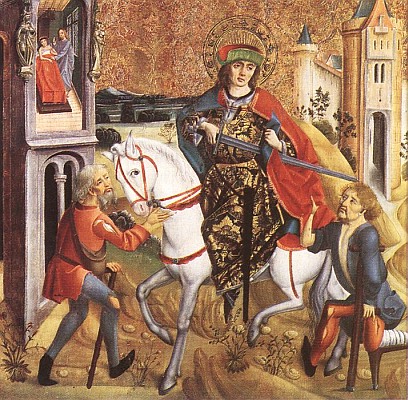
Martin of Tours cutting his cloak in half to give to a poor man. Herein lies the story of the term "the Chapel."

Martin of Tours cutting his cloak in half to give to a poor man. Herein lies the story of the term “the Chapel.”

In the 4th. century A.D., a young solider in the Roman army named Martin encountered a beggar one day in northern France. The beggar’s clothes were terribly worn. Martin was moved with compassion and cut his military cloak in half and gave it to the poor man.

Later that evening, Martin had an incredibly profound dream. According to one account, Martin experienced a vision, seeing Jesus Christ standing before him wearing his half cloak. Harkening back to Matthew 25:31-46, Martin is commended for giving Jesus part of the soldier’s cloak to wear. In response to this vision, Martin presented himself as a candidate for Christian baptism.

Martin had grown up in northern Italy, where Christianity had yet only a small influence in the wake of Emperor Constantine’s only recent acceptance of Christianity as a legal faith within his realm. Nevertheless, at age ten, he attended a local church against the wishes of his parents.

After being baptized as a Christian and serving for several years in military service, Martin laid down his sword and dedicated himself to missionary work and the monastic life. He made his way to the French city of Tours, where the people were so impressed with his devotion to Christ and his character that they tricked him into becoming the bishop of Tours. Martin had been urged to visit a sick person, only to arrive at the home greeted by a crowd demanding that he become their leader. The stunned Martin was not seeking this position, so he fled and hid himself in a barn full of geese. When the crowd found him, he was duly anointed as bishop as he smelled of geese manure.

Martin of Tours went on to become a great evangelist for the Christian faith, challenging the local pagan shrines with the confidence of an Elijah and opposing false teaching within the church, exemplified mostly in his time by the popularity of Arianism, a movement started years earlier by the heretic Arius who denied the full divinity of Jesus as the Son of God coequal with the Father, not too much unlike what modern day Jehovah’s Witnesses believe.

Nevertheless, Martin opposed the popular practice in his day of condemning heretics to death, preferring instead to use the art of persuasion to bring them to repentance. Magistrates dreaded seeing Martin, as they knew that the popular bishop would come and visit them, entreating them to release their religious prisoners. The magistrates felt so bad about possibility disappointing this godly man that they had to let their captives go.

After his death, Martin has been most remembered for the story of the cloak. The other half of the cloak he had kept became a medieval relic that was passed down from generation to generation, eventually in bits and pieces. This half cloak was considered to be a small cape, which was then kept in a small building called a cappella, in Latin. The priest who was in charge of the small cape relic was called a cappellanu. Later, as Saint Martin of Tours was declared to be the patron saint of the military, a cappellani was any priest who served in the military, which is the French root of the English word chaplain.

Parts of Martin’s cape were distributed in cappellas all throughout Europe. Over time, small churches like these were eventually called chapels, though the association with Martin’s cloak was eventually lost, particularly as Protestants began to reject the practice of venerating relics. Nevertheless, “the chapel” terminology has continued to be used, long after the remains of Martin’s cape decayed away.

The next time you go to “the chapel,” you might remember Martin and his famous cloak, part of which he gave to that poor beggar.



In One Short Moment… Heaven

I have had a pretty rough day today. But for some friends of mine grieving in Virginia Beach, Virginia, there is no comparison.

Mark Rodriguez, a 17-year old student at Norfolk Christian school, was a victim of a random shooter on Chesapeake Boulevard.  Mark was driving home from a graduation party when a bullet cut his life short. The shooter went on to kill a police officer, before being killed himself when he resisted arrest.

When Mark was just barely a toddler, his parents, Carlos and Leigh Ellen Rodriguez, lived in Williamsburg, Virginia, where I live. Carlos had come to serve as a missionary to high school kids in our community. It has been a long time, but I remember this little boy around their home, simply adored by their loving parents. I lost touch with the Rodriguez family after they left Williamsburg  in 1999 or so, but I am so grateful that Carlos and Leigh Ellen stood in the gap as they sought to share the Good News of Jesus Christ with teenagers in our community. Little would I know then that their oldest child that I just barely knew would never live beyond those teenage years. You see these senseless acts of violence in the media, but when it happens to a family and friends you know, it simply stuns you. You grieve.

As I watched the story unfold on the local television station today, I was then encouraged by the words that Carlos, now a pastor of a church in Virginia Beach, shared about his son. Though his son’s death appears senseless to us, in God’s perspective, there is a profound and griping vision within God’s economy:

Truly, truly, I say to you, unless a grain of wheat falls into the earth and dies, it remains alone; but if it dies, it bears much fruit (John 12:24 ESV).

Mark Rodriguez knew Jesus. In one short moment, his life on this earth was gone. Mark, an avid photography, kept a blog, but remarkably his last posting was about “Heaven”. You should read it.

At this point in time, it is difficult to know what fruit is being born because this grain of wheat was cut down. But as someone who has hope in Jesus, I am challenged by the immediacy of the task set before us to witness before a hopeless world of the grace and mercy found in Jesus and the hope of resurrection.  As Mark Rodriguez wrote before his death:

God is super good. I can’t wait to be with him forever:)

Do you share that hope?


A Year of Biblical Doubting #2

In verse 23, a "Proverbs 31" woman is described as someone whose husband "is respected at the city gates". Here, blogger and author Rachel Held Evans praises her husband "Dan" at the Dayton, Tennesse welcome sign.

In verse 23, a “Proverbs 31” woman is described as someone whose husband “is respected at the city gates”. Here, blogger and author Rachel Held Evans praises her husband “Dan” at the Dayton, Tennessee welcome sign.

Perhaps I am not qualified to write  about this?   After all, I am a guy, and I have no clue what really goes on with women.  Just ask my wife. But the topic of “biblical womanhood” comes up from time to time, and it concerns all of us in the Body of Christ.

A. J. Jacobs wrote a New York Times best seller a few years ago, The Year of Living Biblically, about his humorous, tongue-in-cheek attempt to follow all of the Bible literally for one year. In like manner, Rachel Held Evans titled her second book, A Year of Biblical Womanhood: How a Liberated Woman Found Herself Sitting on Her Roof, Covering Her Head, and Calling Her Husband “Master”. Here she recounts her story of spending an entire year trying to follow the Bible as literally as possible as a woman in every intricate detail. Along the way, she interviews other women who try to follow a particular pattern of “biblical womanhood”. What you do not find in the book generally winds up on her popular blog. We introduced Rachel Held Evans here on Veracity not too long ago. How well did her one year experiment go? What is Rachel Held Evans wanting to say?
Continue reading


Alone Yet Not Alone, Limited Release

Alone Yet Not Alone is an independent Christian film being released in theaters on June 13, 2014 for a limited run.  Originally released in 2013, the film became controversial due to an Oscar nomination for best original song, sung by Joni Eareckson Tada, that was later rescinded.

Alone Yet Not Alone is based on a novel of the same name written by Tracy Leininger Craven. It is based on the true story about a pair of Craven’s ancestors, German immigrant girls who were captured at the Penn’s Creek Massacre of 1755 by Delaware native Americans during the French and Indian War.  Of the few reviews that I have found, one from the Dove Foundation was a  very positive complimentary review, while the other was very much less receptive,  like this second-hand one from a fairly disillusioned, former Christian reconstructionist home schooler.

The film was a fairly low-budget project, put together outside of Hollywood, which partly explains the very low exposure to theaters nationwide. A lot of great films never make it to the top of the popular culture radar because they lack the budget.  Part of the movie was filmed in Williamsburg, Virginia (check out the shot of Jamestown in the trailer below). Even if the film turns out to be less than spectacular for movie goers, I still think that it is important for Christians to support movies with Christian themes in movie theaters.  Otherwise, you are pretty much stuck with a lot of the relatively uninspiring entertainment we mostly have now. Movie theaters are coin-operated entities, so if the demand for good Christian films is high enough, it will encourage the production of more professional (larger budget), higher quality films with biblically-faithful themes.

If you are interested in supporting these type of Christian films, the best way to show your support and get the film release on June 13 at a theatre near you, you should consult sites like these to reserve tickets.