My mother had been diagnosed with stage IV cancer, a deadly case of glioblastoma, or cancer of the brain. My heart sank when her doctor told me, over the phone, that even with surgery, the cancer had a near 100% probability of return, and it would be fatal. In her eighties, my mother had only a few months to live, at best.
My dad and I opted for the surgery, which would give her as much time as possible, to be with family, before her ultimate death. Radiation and chemotherapy would bring her more misery than healing. After living a full, wonderful, and vibrant life, it was best simply to allow her to say goodbyes to those who mattered most to her.
Yet after the surgery, when I would come by and visit her in the evening, in her skilled-nursing room, she would have the television on. Night after night, she would tune into watching a very popular Pentecostal preacher, out of Houston, Texas, or another similar preacher. The message was subtle, but consistently positive: If my mom had the right thoughts, healing was just around the corner.
It is important to know something about my mom.
She went to church, but she was not someone who was avidly, evangelically minded, let’s just say. So, for her to be mesmerized by a television preacher was completely out of step for her. But these were not normal times.
She was dying of cancer.
If only she had faith, she was told, she would be healed….
…..the prosperity gospel offered her a chance of survival.
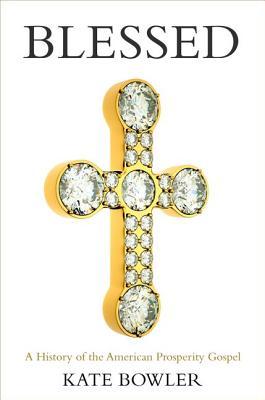
Reading Kate Bowler’s Blessed: A History of the Prosperity Gospel was not like reading a PhD thesis, even though she originally wrote this as her PhD thesis, while a student a Duke University’s graduate program, in religious history. I read; that is, listened to, Kate Bowler as she beautifully read her book to me, via audiobook, while in the midst of “lock down” mode, during the 2020 coronavirus pandemic. Blessed surveys the historical roots of the prosperity gospel, and how it continues to be a multi-billion dollar, church-based industry, filling up many of the largest megachurches, in the United States, and saturating the television airwaves, cable networks, and Internet podcasts. The influence of the prosperity gospel even extends up into halls of political power, in the United States White House.
I learned a couple of new things about the prosperity gospel. First, I realized that, contrary to common belief, the prosperity gospel is not really about learning how to become rich and wealthy, per se. Instead, the prosperity gospel primarily appeals to people who are just trying to survive. Folks in prosperity gospel churches typically do not mind if their pastor drives an expensive car, lives in a massive mansion, or wears outrageously fancy clothes. The pastor’s wealth is evidence, reassuring the faithful, that the prosperity gospel really works.
Adherents do get bothered when pastors embezzle funds, or practice deceit in gaining riches, because that would be a sign that those pastors really do not believe what they are preaching. For the prosperity gospel promises that it is God who will provide, and such provision is not a result of human contriving. Followers of the prosperity gospel look to their pastor’s genuine success as reassuring themselves that they might be able to get that long, lost promised promotion, or that nice, new house, to replace the cramped, rented place they are in now, or …. in the case of my mother…. an extension on a life, with a newly restored body, then currently riddled with cancer.
It helped me to have more compassion on those who are drawn to the prosperity gospel.
Secondly, the prosperity gospel is not always that easy to detect. There are what can be called “hard-sell” prosperity gospel preachers, who are pretty upfront in propagating “name-it-and-claim-it” rhetoric. One of the more popular 20th century prosperity preachers, Oral Roberts, used to talk about this concept of “seed-faith,” where believers need to think of “giving to God as a seed we sow, and not a debt we owe.”
In prosperity theology, God has established a contract with the believer. Prayer is a legal binding act. We can call upon God to enforce the terms of the contract by “demanding” God to act, because the believer is legally entitled to receive healing and wealth.
Early 20th century prosperity teacher E. W. Kenyon even taught that Jesus transferred the “power of attorney to all those who use his name.” By speaking out in “the name of Jesus,” that legal authority is given over to the person, who desires to see God act, through healing and other material well-being. For example, Kenyon replaced the “ask” in “ask, and it will be given to you” (Matthew 7:7), with the word “demand.” We can demand God to do things, because God has contracted himself to do them! Kate Bowler demonstrates that Kenyon’s message was an amalgamation of Christian theology, specifically as derived from the late 19th century Keswick spirituality movement, and the “New Thought Movement,” of the same era, a more loosely religious philosophy of “mind cure” and self-help.
But Kate Bowler shows that there are “soft-sell” prosperity gospel proponents, where the message is a lot more subtle. The prosperity gospel largely grew out of Pentecostal and charismatic movements, but not all Pentecostal/ charismatic churches can be called “prosperity gospel” churches, as such. Nevertheless, Kate Bowler identified a number of Pentecostal/charismatic-based ministries, that I believed were not “prosperity gospel” oriented, that upon closer examination, promoted this more toned down approach to prosperity theology
Even the famed Oral Roberts, left his Pentecostal Holiness background, to become a member of the United Methodist church, a more classically “respectable” denomination. In contrast with other, more “hard sell” prosperity gospel promoters, that sometimes eschewed modern medicine, Oral Roberts campaigned to build a large medical hospital, that would rival medical care given in more secular settings. Today, Oral Roberts University has a large percentage of undergraduates who go into graduate-level medical programs, in some of America’s leading medical schools. In other words, the line between prosperity gospel teachings and non-prosperity gospel teachings gets blurred in such “soft-sell” prosperity movements.
This lesson is all the more important to me, as I have often held a certain grudge against a form of cessationism, an evangelical interpretation of Scripture that teaches that the miraculous gifts of the Holy Spirit, such as a gift of performing miracles, possessed by a particular person, ceased to operate in the era of the 1st century Christian church. Cessationists, generally speaking, believe that while the New Testament was still being written, there was a definite need for miraculous gifts of the Spirit, such as speaking in tongues, to flourish. But once the New Testament was completed, and the last of the original apostles had died off, those miraculous gifts ceased to function. Everything a Christian ever needs now is found in the pages of the Bible. Speaking in tongues today is no longer expected.
Though I am not convinced that such an uncompromising cessationism is really Scripturally founded, I am now more sympathetic towards those who hold to this position, as many such cessationists tend to conflate the distorting influence of the prosperity gospel with nearly all forms of Pentecostalism and the charismatic movement. I would argue that such a categorization is unfair, particularly in light of the fact that a number of Pentecostal and charismatic group explicit reject the prosperity gospel. But the pervasive presence of “soft-sell” prosperity theology so effectively blurs the line, that I can see why so many cessationists hold to the aggressively non-charismatic positions that they do.
The very slippery nature of the prosperity gospel, as it rose within the Pentecostal and charismatic movements, has therefore proven to be a quandary for me. Simply saying that “such-and-such is teaching the prosperity gospel” defies easy categorization.
I am therefore grateful for Kate Bowler’s work, as it helped me to have more empathy for those who are drawn to the prosperity gospel, and to realize that the fine line for drawing where the prosperity gospel really begins and ends, is not always easy to find. Yet what makes Bowler’s work the most poignant is that during the latter stage of her research into the prosperity gospel, she herself was diagnosed with Stage IV cancer, at the relatively young age of 35. Though apparently immunotherapy has extended her life thus far, the interests that originally plunged her into her PhD research, suddenly became deeply personal.
What is missing in Blessed is a clear, Scriptural exposition as to how the prosperity gospel falls short of solid, orthodox Bible teaching. For that, I have found a number of helpful blog posts (such as #1 and #2) written by Costi Hinn, a nephew of hard-sell prosperity Bible teacher, Benni Hinn, who left the prosperity gospel a few years ago. Costi Hinn, now a more Reformed-mind Bible pastor in Arizona, blogs occasionally at The Gospel Coalition. But I was not expecting Bowler’s PhD thesis to be a polemic, anyway. Blessed stands alone as an authoritative treatment on how the prosperity gospel came to be, and continues to flourish.
I eventually persuaded my mother to turn off the television. I read the Bible to her during my every other evening visits, while the cancer slowly took her life away. I knew that she desperately wanted to find healing, and she really wanted to believe that what the prosperity gospel teachers were saying were true. I honestly think that such prosperity preachers meant well. Believe me, I really wanted them to be right, too.
But it really frustrated me that the message she was hearing was promising something that could not be ultimately delivered. It really felt like the prosperity preachers were cheating my mother out of what was vastly more important. In fancy theological language, the prosperity gospel was offering an over-realized eschatology, promising something for her in this life, that only properly and fully belonged in the next. The prosperity gospel was a distraction, that while surely helpful in many ways, was ultimately obscuring the message of the True Gospel.
It was more important that my mom discover what it meant to be reconciled with God. I did pray for my mother that she might be healed. But I also prayed that during those final weeks, that she might have a genuine and rich encounter with the God who Created her, the great Redeemer, who bought her life with a price, that she might find lasting peace with Jesus.
My mother died soon thereafter.
I pray that her soul might be resting in that everlasting peace.
For more Veracity posts on Pentecostalism, the Charismatic movement, and the prosperity gospel, you might want to read the following posts. There is also a multipart blog series on “the baptism of the Holy Spirit.” You can start with a book review that introduces the whole series.