
Lessons from how an oyster makes a pearl can help the Christian church to be positively irritating in a Post Christian World.
In his Positively Irritating, Jon Ritner uses the following analogy to explain the crisis facing American Evangelical Christianity in an increasingly Post-Christian World: The winds of secularism have been blowing against the church for decades and the sandstorm resulting from those winds is only getting worse. The irritant of secularism gets in the eye of the Christian practically on a daily basis. The instinct of most Christians is naturally to try expel the irritant.
However, following Jon Ritner’s analogy, an oyster will take an intruder into its world, like a grain of sand, and instead of rejecting it, it will embrace the sand particle, and transform it into a pearl. So, just as an oyster can transform a speck of sand into a beautiful pearl, Christians have an opportunity to take an intruder, and instead of trying to cast away the irritant, they can embrace the speck and make it into one of God’s precious gifts to the world. In other words, in the Post-Christian West, the American Evangelical church has the opportunity to take the intrusion resulting from the secular sandstorm and transform it into something beautiful, for the glory of God.
It is a powerful analogy. Many American Christians live in a fantasy world, longing for a restoration of America’s glorious Christian past. But that world is long gone in many parts of America, and unless a dramatic spiritual shift happens, it is never coming back. Unfortunately, many American Christians have trouble seeing this.
Is America a “Christian Nation?” Perhaps in the past one could argue that this was indeed true, but while Christians continue to debate the question, the windstorm of secularism appears to be blowing stronger and stronger with each passing year in the 21st century. Sure, we can and should pray for a miracle, for a great spiritual revival in the West. But that will only come as Christians learn how to be better disciple-makers of others, and less obsessed by the culture wars. People are more drawn to Christianity by the sweet fragrance of persuasive love embodied in the lives of believers than they are through being browbeaten by political activism.
After being a pastor in Williamsburg, Virginia, for ten years, Jon Ritner took his family to Brussels, Belgium, to serve as a missionary, and he was able to see what is coming down the pike for American Christians, even if they do not see it yet. Belgium is part of what for centuries could be described as “Christian Europe.” But that has all changed. After two world wars of the 20th century, along with the infusion of liberal theology into European intellectual life, the majority of people in Belgium have shed their “Christian nation” identity, relegating it to the past. Jon Ritner believes that what has happened in Belgium prefigures what is happening and what will continue to happen in America.
This may all sound depressing to some. But not to Jon Ritner. For Jon Ritner, entering the Post Christian World is an opportunity for the church to learn something from the little oyster.
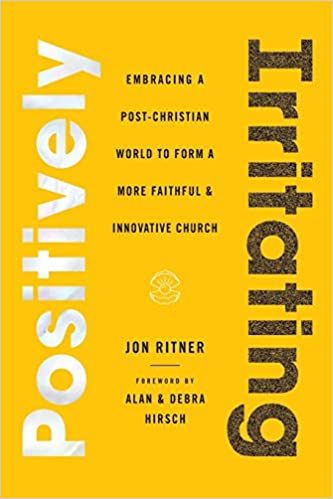
Positively Irritating, by Jon Ritner, takes a forward-looking view of doing church in a Post-Christian World.
We Are Entering a Post-Christian World (Like It or Not).
I totally agree with Jon Ritner here, and after returning to the U.S. to serve as pastor of Ecclesia Hollywood church, in Southern California, Jon has much wisdom to offer in terms of insights from his own experience over the years, as to how the church can get into the “pearl-making” business, to rediscover better ways of doing church. I would highly recommend Jon’s book as useful for any pastor, small group leader, and even as a small group study project. Furthermore, if you get the audiobook, as I did, Jon reads his own book, which is really delightful, as Jon is a gifted communicator. Nevertheless, I will differ with my brother Jon on a few points, that I hope to explain below.
I need to issue a disclaimer as background here, in that Jon Ritner was actually one of my pastors, during that decade when he served in building up our Williamsburg, Virginia church to an effectively “mega-church” status. Though I am roughly ten years older than him, Jon and I share similar stories. We both grew up in the Episcopal Church, exposed primarily to a liberal mainline Protestant approach to faith. We both met Christ in our late teen years, my conversion towards the end of high school, and his conversion in college. We have both experienced serving in full-time Christian ministry, and we both experienced periods of ministry burnout.
But our stories diverge at important points, too. While both of us are married, Jon and his wife have an active family, with two kids. My wife and I have no children, and my wife has suffered for years with a string of chronic illnesses. After my ministry burnout, I left full-time Christian work and continued on with an earlier, non-ministry career as a computer network engineer. I have been working on a secular college campus now for over twenty years, since before Jon became a pastor. Jon served much longer than I in full-time Christian work at our church before personal crisis redirected him towards Brussels, Belgium. Any differences you might detect in our approaches to his thesis should bear the above facts in mind.
A few years ago, after Jon Ritner left for Brussels, my church adopted the following motto for ministry: “Connect, Grow, Serve.” The main idea behind it was to help bring newcomers into the church, by helping them “Connect” through the Sunday morning worship service, or something like a series of big Christmas music concerts, a fantastic outreach that our church has done for well over a decade, through the efforts of a professionally led “Connect” team. Then another professionally led “Grow” team would help such newcomers “Grow” by encouraging them to explore something like joining a small group. Finally, another professionally led “Serve” team would help them become invested in the church by going out on missions trips, or joining other mission efforts in the local community.
It is a proven church growth strategy, particularly successful in parts of the country where the Sunday-morning, church-going experience is the norm. A lot of people have been positively impacted for Christ through “Connect, Grow, Serve,” and many in our church can testify to that. So, I do not want to knock the wonderfully good intentions behind it. Furthermore, not all churches with the “Connect, Grow, Serve” theme are exactly alike. Some have certain distinctive theological emphases that differ from other churches.
But when “Connect, Grow, Serve” was first announced to our congregation, I felt a certain cringe factor about me. It was all I could do to keep hiding my face from others as I rolled my eyes: “Connect, Grow, Serve” just had the look-and-feel of something pulled out of some WillowCreek church growth manual.
Willow Creek Church, a large (at one time) mega-church in the Chicago, Illinois suburbs, pioneered one of the most successful church growth programs in American Evangelicalism, over the past thirty or more years. It had, as its working assumption, “the more a person far from God participates in church activities, the more likely it is those activities will produce a person who loves God and loves others”. Unfortunately, when Willow Creek conducted the REVEAL study in 2007, they concluded that this assumption was invalid. One conclusion from that study provided the shocking answer: “Does increased attendance in ministry programs automatically equate to spiritual growth? To be brutally honest: it does not.” The research showed that while efforts to “Connect” with newcomers were effective in the short run, to get people started on their spiritual journey, further progress towards spiritual maturity failed to achieve what is most desired: mature disciples of Jesus, capable of making other disciples.
After I heard that our church was adopting “Connect, Grow, Serve,” I was conflicted. On the one hand, I really wanted this church growth strategy to work, to make disciples who can in turn make other disciples, despite what the 2007 REVEAL study concluded. But another part of me was unable to dislodge that cringe factor, from the back of my mind. Was this just the latest church growth fad, a well-intended strategy, that would primarily end up shuffling around an already transient, evangelical church-going population, from one church to another? I just decided that it would be best to keep my mouth shut, not rock the boat, and go along with the program… and pray for the best.
Speed up to a few years later: As of this summer, 2021, as churches try to get back to some kind of normal, following the pandemic, I learned that our church has silently abandoned the “Connect, Grow, Serve” mantra. Only a few straggler references to “Connect, Grow, Serve” remain anymore on the church website.
Mmmm. Interesting.
In Positively Irritating, Jon Ritner makes the stark admission about such church growth strategies: Jon calls it “industrial disciple-making.”
Wow.
Industrial Disciple-Making in Today’s Evangelical Church
Jon is not alone in his evaluation. Journalist Julie Roys calls it the “evangelical industrial complex,” a play on the phrase made famous by President Dwight Eisenhower, reflecting on how endless preparation for nuclear war in the 1950s inadvertently created an American consumerist culture that depended on the promotion of war, resulting in the “military industrial complex.” Eisenhower’s point was that the American effort to fight against the growth of 20th century communism, in the name of peace, had the unintended consequence of leaving the country in an almost perpetual state of being ready to go to war, thus undercutting efforts to promote peace.
The connection is simple enough: Do well-intended efforts at growing the church have unintended consequences that need to be re-examined? Or to put it bluntly, with “industrial disciple-making,” do today’s church growth strategies reflect a more consumerist-driven mentality versus a Gospel-driven mentality?
Jon Ritner uses the analogy of how to sell a timeshare, for vacation properties, to explain how programs like “Connect, Grow, Serve” actually work. Someone pulls you in to get you interested in the product, so that someone else, a paid professional, will eventually try to make a pitch for you to “buy in” and join the timeshare network.
The ramifications of the “industrial disciple-making” model parallel a lot of the same problems you find in the business world, that follow the timeshare model. First, it puts an incredible amount of emphasis on performance, mostly centered around trying to make the Sunday worship experience perfect in every way possible, week after week after week after week. I served as a guitar player in the worship team band for many of those years, so I saw first hand what was happening in our church. Unfortunately, such an emphasis on performance could take a terrible toll on the paid, professional staff. Super-human expectations on that staff inevitably led to the downfall of two of the pastoral staff members whom Jon worked with.
The irony of it all was that while the emphasis was on evangelism, Jon himself had very few non-believing friends. Numbers were increasing at the church, but the pressure to make it happen felt like it was all on him. Activity after activity. Officiating wedding after wedding (17 of them in one year alone). This program-centric model of ministry was starting to do damage to Jon’s soul. The unintended consequences of a more consumer-oriented approach to Christian outreach, though well-intended, created a spiritual hazard in Jon’s life. Jon admits that he started feeling like he was a “program director for a cruise ship for Christians.”
Ouch! Jon was starting to burn out, but thankfully, he had enough sense about him. He was able to listen to the Holy Spirit and make the move to Brussels, Belgium, where there were not hundreds of church people, adoring him and watching him perform.
When I read Jon making that admission that such “industrial disciple-making” had such serious downsides to it, I wanted to fly out to California and hug him, and say “Thank you. You are saying what I have been thinking for years, but never had the courage to come out and publicly say it.”

Does your pastor feel like a program director for a cruise ship for Christians? If so, you might want to think about revisiting your “church growth” strategy.
Nuggets of Wisdom, to Help Us Rethink How to Live Out the Church, in a Post-Christian Context
One way of summarizing Jon Ritner’s message in Positively Irritating is to say that we need to rethink the current popular model, of trying to draw people into the Sunday morning worship experience as the endgame, and instead focus on acts of mission to reach a community that could care less about a Sunday morning worship service. Focus less on watching the “professional” Christians performing on Sunday morning, and more on equipping believers as individuals and as small groups to serve their neighbor, through Christ-like actions. In other words, instead of trying to get people to come to church, take the church out to the people.
Jon points out several key ideas that stand out when one thinks about doing ministry in a Post-Christian context. One is that an understanding of the Gospel that focuses on forgiveness and relief from guilt makes a lot of sense in a Christianized society. But it does not translate well to a Post-Christian setting, where people have shed many Judeo-Christian values, thereby lacking any experienced sense of guilt, resulting from a dismissal of those Judeo-Christian values. For example, guilt resulting from not living up to a Christian ideal of marriage makes very little sense to someone for whom having a sexual “partnership” with another person (or persons) seems more morally acceptable to them.
Jon also points out that certain “Christian-ese” can build unnecessary barriers to relationships in a Post-Christian context. Instead of referring to someone as a “non-Christian,” as is often described in my church, Jon finds it better to characterize someone as “not yet a follower of Jesus,” or perhaps someone who is “currently leaning towards Jesus.” The term “non-Christian” can needlessly make someone feel like they are an outsider.
One of the best insights I gained from Jon Ritner’s book is that in missional relationships we should focus more on what a person is longing for, instead of focusing primarily on what is lost. While the problem of sin surely remains, ministry in a Post-Christian context must grapple with the reality that many people think of the Christian message as focused exclusively on how bad a sinner they are, and not so much on what it means to be created in the image of God. Flipping that emphasis around, to focus on our human calling to be image-bearers of God, first, is actually a more Biblical way of thinking about it, anyway. Affirming the hopes and dreams of a person is a better pathway for them to connect with God’s purposes, restoring what God originally purposed to create for humanity begin with.
We do not need to discard a traditional understanding of atonement, as dealing with personal sin and guilt, but we do need a broader vision of atonement, that understands God’s work to defeat the powers of sin, death, and evil. Helping people to connect what they long for with what God longs for concerning God’s creation goes a long way towards giving people a healthy vision of what God is up to in our world. God is about establishing the Kingdom of God in our midst, an invitation to others to join in on what God is already doing to bring about peace and justice in a broken world.
Nuggets of spiritual wisdom and practical insights like these are peppered throughout every chapter of Positively Irritating. Nevertheless, there are a few areas where I would push back some on Jon Ritner’s thesis. It is tough to offer criticism to the written work of someone whom I greatly respect and consider as a friend, like Jon Ritner, but I rarely learn much reading glowing 5-star reviews. So what I offer here will hopefully be taken in the spirit of making Positively Irritating into an even more engaging book.
But Is Positively Irritating Irritating Enough?
The crux of this critique concerns the underlying premise behind why the book was written. A good measure for evaluating the substance of conversations entertained by Christians today comes from examining how the earliest Christians would have handled such topics. Yet it is really hard to imagine early church fathers like Irenaeus, John Chyrsostom, Justin Martyr, and Ignatius of Antioch wringing their hands over how certain methods of Christian outreach were no longer working, thus requiring a change in thinking to make outreach more effective in the Greco-Roman world around them.
To hit closer to home, it would be absurd to think that the Apostle Paul sat down at a table with James and Peter at the Jerusalem Council in Acts 15 saying, “Guys, you know, this whole circumcision thing just is not working. It is creating an unnecessary barrier for allowing Jesus’ message to spread across the Roman Empire. In our current Pre-Christian World context, the old ways of synagogue worship are turning people off to Jesus. We need to come up with more creative ways to establish missional communities to bring Gentiles into our movement, instead of trying to make Gentiles become Jews through adopting circumcision and certain dietary restrictions.”
To imagine that type of conversation happening would be bizarre. Instead, it is more probable to believe that what turned the pagan Roman Empire upside down for Christ was the strength of Paul’s conviction, that he had met the Risen Jesus, that Jesus had personally revealed to him certain beliefs that were completely true, namely the centrality of faith in Jesus as the Risen Lord, and not strict adherence to the Law through circumcision. Paul never abandoned his Judaism, while simultaneously following how certain elements of his Jewish background were paving the way for his apostolic ministry to the Gentiles. Though Paul and the other apostles wrestled with exactly how to bridge the Jewish and Gentile worlds together, Paul’s convictions did not spring from pragmatism. Rather, Paul saw them as direct revelation from God, through the Holy Spirit, and thus binding on the heart and mind of every orthodox Christian.
Since the age of the First Great Awakening, with the revivalistic preaching on George Whitefield and John Wesley, evangelicalism has always had a certain theological trend focused on pragmatism, in terms of coming up with creative ways to “get the job done,” to fulfill the Great Commission. To a certain degree, I get that, but I do find it difficult to conceive that the Apostle Paul sat around discussing missional strategies with synagogue leaders, while on his missionary journeys across Asia Minor. Paul was clearly conscious that having faith in the Risen Jesus as God’s promised Messiah was a weird claim, that would prove to be a stumbling block to both Jew and Greek. Nevertheless, Paul believed the Christian story to be true, and that settled the matter for him, and the other writers in the New Testament. The Christian story was believed by those earliest Christians to be the fundamental, all-encompassing narrative that made sense of reality. It was the proclamation of that story that changed the world forever.
In many ways, I really hope that Jon is right about how churches might implement change, that can reorient a congregation towards a new approach to ministry in a Post-Christian World. To his credit, Jon is cautious as to what is involved in presenting a vision for missional and cultural change in a local church. There will always be “innovators” and “early adopters” who will latch onto positive efforts for change, as well as “laggards” who will resist change for as long as possible. But it is hard to imagine folks like the Apostles Paul and Peter having the patience to sit around and ponder how to institute cultural change. They probably would have cared less. They were more focused simply on proclaiming the Gospel, and doing so faithfully and accurately.
In an ever-so gentle way, I do wonder if Jon has thought deeply enough about some of most spiritually threatening hazards entailed by his thesis.
For example, Jon rightly argues that the key to having a missionary witness in a Post-Christian World is in making disciples of the people you already have, and then equipping them to enter into mission in small ways, by serving in the local community with no strings attached. The ultimate aim would be for encouraging those outside of the church to begin to ask provocative questions like, “What is it about this Christian small group that makes them so different?”
But how does one go about adequately equipping current disciples to be mission leaders, without having them become so strung out, that they begin to allow the outside world to influence them more than the church itself? I have seen far too many innovators, early adopters, and other followers of mission-oriented ministry development strategies flame out spiritually over the years. Efforts to break out of traditional church molds can easily lead to resentment of other Christians who are hesitant to follow along. Spiritual pride among innovator types can easily set in, or in other cases, disillusion with Evangelical Christianity can lead to a process of spiritual deconstruction. While some might survive such deconstruction, others will deconvert out of the faith altogether. Without being sufficiently rooted in a mature Christian theological framework, it is easy for mission-oriented disciple-makers to get blown over by the secular sandstorm that awaits them, before having the chance to develop their oyster-made pearls.
Journalist Walter Lippmann wrote back in 1929 that the “acids of modernity” have eaten away at traditional Christian belief. As culture continues to change rapidly in a Post Christian era, Christians have indeed been forced to adapt to those acidic pressures. But not every adaptation has been for the better. My twenty years working at Jon Ritner’s alma mater, and observing those acidic pressures applied to both Christian faculty and students, from a non-faculty vantage point, reinforces my concerns. Jon Ritner is surely correct to suggest that Christians need to act creatively, in the face of the windstorm of secularism. But the seductively corrosive effects of secularism should neither be underestimated nor ignored. I have seen far too many pastors, other Christian leaders, and even soccer moms and dads lead out with experimenting with new ways of outreach, only to get themselves caught within the sandstorm, and knocked out of commission.
Jon upholds acts of mission as being more important than having an “academic” knowledge of Christian truth. It is not clear in my mind, as to what “academic” knowledge means in Positively Irritating. True knowledge of Christian truth should stimulate us to be more active in fulfilling Christ’s Great Commission. At the risk of misunderstanding what Jon means by “academic,” I believe he misses, or at best, underemphasizes an important fact: A Christian community on mission always enters a spiritual battle, and the struggle that takes place is primarily a battle for the mind. Jude tells us that we are to “contend for the faith that was once for all delivered to the saints” (Jude 1:3). Paul reminds us: “Do not be conformed to this world, but be transformed by the renewal of your mind, that by testing you may discern what is the will of God, what is good and acceptable and perfect” (Romans 12:2). These earliest Christians were driven by the majestic framework and drama of the whole history of salvation, as revealed over the centuries through the Hebrew Scriptures, and culminating in the God-man from Nazareth teaching and living out the truth of the coming Kingdom of God.
Sadly, we have far too many Christians today who do not know the Bible very well, much less who are able to articulate a robust theological vision, that can sustain them through the challenges in facing a Post-Christian World. But by far, the biggest issue is that many Christians have a hard time developing a Christian imagination big enough to tell a compelling Biblical story, that others might find winsome. Jon Ritner rightly makes a case for developing such a Christian imagination, but does not go far enough with it to explain how that development is formed.
Still a Need for Catechesis: Training Up the Body to Reach Out to Others
If anything, we need more Christian instruction in the church, not less. If the focus should be less on trying to get non-believers to visit a Sunday morning worship experience, as Jon Ritner suggests, it might be worth re-focusing more of the Sunday morning experience on doctrinal training, and making it overall a more interactive experience with the congregation, so that folks will be more adequately equipped to reach out to others on the other days of the week, primarily through their small groups. Since the early church, Christians have historically called such instruction, “catechesis,” from the New Testament Greek word, “katecheo,” or “to instruct.”
In more contemporary terms, “catechesis” reminds me of what coach Vince Lombardi did to secure Super Bowl victories in the 1960s, by teaching his seasoned football team the basics, “block and tackling.” Too often, Christians can put an out-of-balanced emphasis on practical ways of fulfilling the Great Commission, thereby neglecting an emphasis on a solid understanding of doctrinal fundamentals of the faith.
Over the past 25 years of teaching Adult Bible Classes, I have seen how small groups have effectively displaced regular Christian instruction, as opposed to having periods of dedicated Christian instruction supplementing the development of small groups. Furthermore, the development of small groups is not always even. Some groups do well with in-depth study of the Scriptures, whereas other groups are more social in nature. As a small group leader myself, I have seen how difficult it can be to encourage others to study the Bible in a small group context. Various attempts have been made to try reading a popular Christian book together, or watch a DVD, as a means of a springboard into the study of the Bible. Sadly, there have been many times where group participants spend far too much time talking about the book or the DVD, as opposed to actually studying Scripture, thus undercutting the whole reason why we started to use the book or DVD in the first place.
Too often, small group leaders are left ill-equipped to lead Bible-centered discussions. I personally know of folks who shy away from calling themselves “small group leaders,” but rather consider themselves to be “small group facilitators.” But for disciple-making to succeed in small groups, you need more leaders and less facilitators.
That development of leaders generally only comes through participation in dedicated Christian instruction periods, whether that be one-on-one mentoring, or in a group setting, where there is some give-and-take between teachers and students, with an emphasis on discussion, without a sacrifice in the quality of teaching content. Furthermore, without such adequate Christian instruction, following a more discussion-oriented format, this typically leaves the average church attender to receive their primary Christian instruction through the Sunday morning sermon alone. Yet Sunday morning sermons do not allow for the congregation to interact with the preacher/teacher, on a give-and-take basis.
Listening to podcasts, and other Internet-based educational alternatives, can sometimes help to make up for the loss of “Sunday School.” But such isolated acquisitions of knowledge are a poor substitute for actually sitting together with a group of people, or even one-on-one, and interacting with one another, exchanging questions and answers. Whether it be sitting in a circle or a traditional classroom format, the main opportunity is to learn how to process together, what we learn from our study of the Bible.
Rethinking Church Membership?
I wish Jon Ritner had done more to adequately address this issue in Positively Irritating, particularly as it applies to thinking about church membership. While not dismissing the concept of church membership entirely, Jon rightly observes that church membership can easily devolve into just becoming another club membership, that separates insiders from outsiders. But what if church membership was more about making sure that people adequately understand the beliefs, covenants and missionary vision of the community?
Another lesson from church history is warranted here. Jon Ritner rightly observes that the early centuries of the church experienced the most dramatic church growth of any time in the Christian movement’s history. Jon cites that by the end of the 1st century A.D., Christians numbered about 25,000. A little over 200 years later, that number had increased to roughly 20 million!
But the way Christians overwhelmed the Roman Empire is completely counter-intuitive to most church growth models today, even though the cultural pressures of the Post-Christian World today largely mirror the problems faced in the pagan Roman Empire, where the pagan cultural elite despised the Christian faith. Strangely, Jon Ritner took an insufficient look at this. Early church Christians faced pluralism. We face pluralism today. Early church Christians faced injustice. We face injustice today. On and on, the similarities mount up.
Today, a typical process to become a member of a Protestant Evangelical church is focused on getting folks into church membership as soon as possible. In more than one church that I know, you might be expected to attend one class meeting, that gives you an overview of the church’s statement of faith, membership covenant, etc. Then you have one follow-up meeting with some pastors/elders, where you can share your testimony and give your assent to the church governing documents, and then you are in! This typically assumes that the prospective church member has read and studied those church governing documents, but this is often not the case.
Now, compare that to how new believers in the earliest centuries of the church were integrated into the Christian community. Candidates for Christian baptism were typically required to spend three years going through Christian instruction, otherwise known as “catechesis.” That is THREE YEARS folks! Baptism candidates were generally assigned a mentor or sponsor, who would help the candidate understand basic Christian teachings, as well as having a good, thorough understanding of the Scriptures. This was not about keeping outsiders on the fringe. Instead, it was about making sure that potential baptismal candidates were fully informed as to what they were signing themselves up for. Too often, many people will join a church community today, in a formal sense, without having an adequate grasp of what those church members actually believe and their commitments, and what they are getting themselves into. The late J.I. Packer observed, that after many decades he had in ministry, that a robust Christian catechesis is the most undervalued component for making disciples in the evangelical movement today.
While a three year initiation period might be too much today, in our fast-paced, mobile society, we would do well to pay careful attention to how the early church did “church growth,” in a cultural context that was largely hostile to the Christian faith. It would have improved Positively Irritating if Jon had more effectively addressed the whole topic of Christian catechesis, and its role in disciple-making.

The church is not doing “not yet followers of Christ” a favor by hiding away from the “fine print” found in the Bible’s message. Avoiding some of the more difficult things in the Bible can come across as a “bait and switch” tactic to a “not yet follower of Christ.” (Credit: The Naked Pastor)
Reversing the Pearl Analogy
Another gentle pushback for Positively Irritating is the critique that the analogy of the sand, and the oyster creating a pearl, works in another way as well. Not only can the winds of secularism blow sand into an oyster, the winds of the Bible message itself can blow sand into the Christian. In other words, there are a number of things in the Bible that can create a lot of embarrassment for the Christian, unless the Christian can creatively and theologically reframe particular difficulties in the Bible, that speak into a Post-Christian context.
Instead, I would suggest that these difficulties, or sand particles, coming from the Bible itself serve as an opportunity for the Christian to make another kind of pearl, and share that with others. Jon Ritner conceded that there are indeed “weird” things in the Christian faith that we need to somehow embody, but I wish he would have explicitly explored this reframing of his pearl analogy from this angle.
Let us face some facts of a Post-Christian World: Ross Douthat, a Christian who is a columnist for the New York Times, in an April, 2021, essay, “Can the Meritocracy Find God?”, concludes that “the secularization of America probably won’t reverse unless the intelligentsia gets religion.” However, the cultural elite sees several obstacles embedded in their narrative of the Bible, that keeps this from happening.
First, today’s secularists find the Christian moral vision as deficient. They decry bigotry in the form of Christian opposition to same-sex marriage, and the failure of Christianity to adequately address the historical problem of slavery, the misogynistic degradation of women, and persistent attitudes of racism. Many of the cultural elite believe Christians to be hopelessly far behind on the “diversity, inclusivity, and equity” bandwagon.
Secondly, today’s secularists find the supernaturalism of the Bible to be far from compelling. They find “strong religious belief [to be] fundamentally anti-rational, miracles as superstition, [and] the idea of a personal God as so much wishful thinking.” This is all a pretty uphill battle for Evangelical Christians to overcome in a Post-Christian World. Pragmatic strategizing only goes so far in facing such an uphill climb. Instead, what we really need to recover is the firmness of conviction that the Gospel message is indeed really true.
Let us focus for a moment on just one of these prime stumbling blocks. Take for example the doctrine of hell. In most growing mega-churches today, the topic of hell rarely comes up during the preaching cycle. One of the biggest complaints I hear is that too many Evangelical churches simply avoid difficult topics, like hell, lest an offense is created to the newcomer. But if Jon Ritner is right, and crafting Sunday morning worship and teaching in an inviting, consumerist manner is not the best entryway into the church in a Post-Christian setting, it might serve the ministry of the church to tackle such difficult topics head on, and not try to sweep them under the rug, as though pretending they are not there.
To borrow from Jon’s timeshare analogy, it is like today’s “church growth” methods fail to tell you all about the “fine print” in the timeshare contract. Sure, you can buy into this wonderful condo for your vacations, but then you spot that there is something that looks like a leak in the roof. But hey, you are told not to worry about it. Nothing to see here. Just move along. That is just a small detail that we can safely ignore for now. Please go ahead and sign up anyway!
Framing it like that, suddenly participating in that timeshare becomes less appealing. When church outsiders get the sense that Christians are side-stepping issues that they can read in the Bible for themselves, that raises a specter of incredulity in their mind. It can easily come across as a bait-n-switch tactic.
In his generation, the Oxford don C.S. Lewis understood the problem that the doctrine of hell made for people. No Christian with love in their heart really wants anyone to perish eternally, but we would be foolish to think that the Bible does not address the topic with the utmost seriousness. Lewis’ approach was to use his imagination to write a story that took Scriptural teaching seriously but that also sought to reframe how people in his day thought about hell. Lewis’ book The Great Divorce, where Lewis describes a bus ride journey to hell, remains a classic to this day.
C.S. Lewis was perhaps the greatest English-speaking apologist of his generation, but in a Post-Christian context, we need more C.S. Lewis’s. Christian philosopher William Lane Craig has said that we simply can not do evangelism in our world today without a healthy dose of apologetics with it.
It is this type of theological imagination that is needed in a Post-Christian context, that is both faithful to the Scriptures and that communicates well, to help us in our conversations with our Post-Christian neighbors. Catechetical instruction should be formed with a goal like this in mind. Sadly, too many Christians simply shy away from topics like “hell“, for fear of disclosing the “fine print” we have in our Bibles. The sandstorm coming from the Bible itself can cause Christians to tragically try to expel such sand, and weaken our witness. Instead, we need to develop a more Scripturally formed imagination and face such tough issues head on.

Particularly for large churches, attending to the business matters of the church is an unavoidable task. But is it pushing aside the more important spiritual matters of encouraging believers to be brothers and sisters, fathers and mothers, in Christ, together as a family?
Re-envisioning the Church More as a Family, and Less as a Business
My last gentle pushback for Jon is that in some places he did not go far enough to critique the drawbacks behind the trend towards “mega-church,” which he himself helped to create where I am in Williamsburg, Virginia. This is not to say that “mega-churches” are all bad in the least. I, for one, still love the mega-church that Jon helped to build.
There are just some things that mega-churches can do that small groups alone, and even smaller churches, simply can not do. For example, a mega-church can pool resources together to provide support opportunities for families with children who have special needs. A mega-church can provide a bigger atmosphere for helping people connect with others, such as social opportunities for unmarried singles having trouble fitting in with smaller church environments, and providing a wider range of activities for families with children at different life stages of their development. Plus, mega-churches have much more awesome facilities than smaller churches, meeting in a strip mall or even someone’s living room. So, we should not throw all things “mega-church” under the bus. But the central critique is more fundamental.
The biggest problem with typical “Connect, Grow, Serve” models for discipleship is that that they tend towards seeing the church as a business rather than as a family. Sure, churches that follow such models would like to say that they are about building a spiritual family. But patterns of thinking centered around “industrial disciple-making” often result in unintended practices, that resemble the dynamics of a corporate institution, rather than the organic emergence of a family.
This can happen in multiple ways, but to stir it up a bit, take for example how churches drawn to “church growth” models often think about church eldership. As churches grow in size numerically, the intimacy between elders and the sheep they shepherd typically decreases. Elders eventually become preoccupied by the tasks of administrating an ever growing set of programs, increases in church staff, etc. that can easily cut in and disrupt their shepherding tasks, mainly to protect their flock from spiritual harm.
The early church had this problem as well (see Acts 6). Like any large organization, the elder board will often morph into becoming something more akin to a corporate “board of directors.” The ministry function of elders slowly gets transferred over to professional staff, where the senior pastor begins to function more like a corporation “CEO”, with other pastoral staff serving as “Vice-Presidents,” professionally overseeing various departments of church activities. The intimacy of conversations around the kitchen table gets replaced by gatherings around the water cooler.
Before you know it, the church that probably started out in someone’s living room, having the feel of a tight-knit family, begins to take on the look of a Fortune 500 company in the making. In other words, the church tends towards becoming a business, struggling to figure out how to keep that sense of “family” about it.
Or put it this way: As a church grows in size, the business details are simply unavoidable to deal with. When that happens, something like a “board of directors,” with lots of input from all corners of the church, is certainly appropriate, if not indeed necessary. But is that primarily what church eldership should be about? Are the financial and business oversight functions of an elder board crowding out the spiritual oversight responsibilities of those elders? Are those spiritual oversight functions instead being handed off to the professional staff to be taken care of?
At the risk of weighing into the middle of the complementarian/egalitarian debate that has succeeded to blow up churches and divide American Evangelicalism pretty much in half over the past thirty-plus years, (needlessly in many cases), a good reason to consider why the church eldership should be reserved for qualified men, aside from exegetical concerns regarding 1 Timothy 2 & 3, is that Paul might be implicitly teaching that qualified men should be called out to serve as spiritual fathers, sacramentally modeling what spiritual fatherhood looks like within a body made up of brothers and sisters in Christ. Properly practiced, this should subsequently encourage the emergence of spiritual mothers of the church as well, where women are honored and their gifts highly esteemed, through the function of an active deaconate, made up of qualified men and women.
It is no historical accident that presbyters (the Greek word for “elders,” typically regarded as interchangeable with the New Testament word for “overseers“) have been called “fathers” in the Christian traditions that date themselves back to the early church, namely Roman Catholicism and Eastern Orthodoxy. St. Ignatius of Antioch, within living memory of the last original Apostles of Jesus, wrote in his Letter to the Smyrnaeans, “You must follow the bishop [or overseer] as Jesus Christ follows the Father, and the presbytery as you would the Apostles.” The historic functionality of the presbyter was focused on preserving the spiritual authority in the church.
However, in a growing church fellowship, it is nearly impossible for church elders to attend to all of the affairs that put pressure on maintaining a sense of family. Why not hand off the lion-share of church decisions on more practical matters to a designated “board of directors,” or “board of deacons?” Such a board can be where different voices, including both men and women, can participate, thus freeing up the church elders to focus on more spiritual authority oriented tasks, to encourage the growth of healthy family dynamics in a vibrant church.
To not take a step like this can create a whole cascade of problems. One obvious pressure is that women can often feel excluded from important decisions being made by a male-led eldership, or feel like their ministry gifts are being ignored, if that group of elders loses sight of their primary function. If and when that happens, this is a good sign indicating that the family nature of the church has been eclipsed by a corporate business culture. For if you are going to call out qualified men to serve as spiritual fathers in a Christian community, a good measure of how effective that body of elders is functioning is in determining how well those fathers of the church honor, esteem, and listen to the voices of mature women in the church, and empower them. As British pastor/teacher Andrew Wilson puts it, a church made up of brothers and sisters in Jesus needs spiritual fathers and mothers in order to faithfully express what it means to be part of God’s family.
I mean, what could be more “positively irritating” than having a body of all-male elders, in a world where businesses are increasingly looking for as much diversity, inclusion and equity as possible to run their organizations? Why not have churches leave those matters with a “board of directors,” instead? Perhaps such practice concerning elders might serve as a sacramental reminder that at its core, the Christian community is not a business, but rather an organic display of God’s wonderful mystery of brothers and sister, fathers and mothers, together as part of God’s family.
Jon Ritner may or may not agree with how I have specifically characterized the nature of church eldership. I do not know. But my primary point is to illustrate how the introduction of certain practices, as Jon himself recommends, what I would call “sacramental practices,” are needed to embody and express Christian truth in ways that can not be adequately articulated simply through speech. Theologically speaking, for this particular example, we must resist the tendency to corporatize the church, and instead institute such sacramental practices that can remind us that men and women, while equal in Christ, are nevertheless non-interchangeable.
There is just something about being created in the image of God, as male and female, which serves as the basis for the family, that requires us as Christians to structure our church life together, that reflects that sense of family beyond the borders of a biological family. Otherwise, we risk falling back on a more secular model of church life that looks more like a corporate business, as opposed to a Scriptural model that makes room for all people to have an experience of real family, as brothers and sisters, even if they are not currently experiencing a biological form of it.
This becomes especially important for those single persons, who are not yet married, as well as offering an empathetic, alternative response to a Post-Christian society that believes that it is unfair for Christians to oppose same-sex marriage, and thus deny the love that two same-sex persons have for one another. A church then that models what being brothers and sisters in Christ, along with fathers and mothers, actually looks like, can go a long way towards showing that while sexual relations between persons of the same sex is not permissible for the Christian, having deep, abiding friendships among members of God’s family is not optional. Rather, all brothers and sisters in Christ’s body should experience family-deep friendships, as an essential part of human well-being.
To Be Positively Irritating
Jon Ritner is absolutely correct to insist that certain practices are needed to help us to express Christian truth in ways that can easily get lost in translation to a Post-Christian context. In other words, what we do speaks a whole lot louder than what we actually say. Jon rounds off roughly the last half of Positively Irritating with a sampling of how his current church, Ecclesia Hollywood, has been trying to implement some of these ideas and strategies described in Jon’s book.
I was particularly drawn to Jon’s description of traditional church growth models resembling a restaurant, versus the idea of the church being like a fleet of food trucks. In the restaurant model, a church outreach ministry tries to spiritually feed people, much like how a local restaurant competes to gain marketshare of restaurant-goers in that community. Yet we often mistake such a vibrant church as outgoing, when transfer growth from other churches is really is what bringing people to that church. Like a popular restaurant chef, the professional pastor can become a celebrity in that community, but that makes the church vulnerable to promoting cults of personality. However, a church that operates like a fleet of food trucks, disrupts this predictable model. Food trucks are small and mobile, and churches like these can penetrate into the community in a nimble fashion, offering variety of ways to meet people outside of the typical Sunday morning setting. Ideas like these, in Positively Irritating, give much food for thought.
The specific type of practices that believers in a local church, with a vision towards ministry in a Post-Christian context, will probably vary from church-to-church, small-group-to-small-group, and person-to-person. Despite whatever relatively smaller differences Jon and I might have, I thank Jon Ritner immensely for writing Positively Irritating. Jon Ritner’s book will surely help Christian leaders, who lie awake at night thinking about these things, gain a wealth of insight into how they can prepare for the coming Post-Christian World, and the secular sandstorm that this world continues to stir up. Might we all be like those oysters, that instead of expelling the sand speck, will embrace the intruder and fashion it into a glorious pearl, as a gift to an unbelieving world, for the purposes of God. May we all be Positively Irritating!