Author Archives: John Paine

About John Paine

Unknown's avatar
This blog is topical and devotional--we post whatever interests us, whenever. If you want to follow in an orderly fashion, please see our Kaqexeß page.

Accessible Theology

The Lord Is My Shepherd

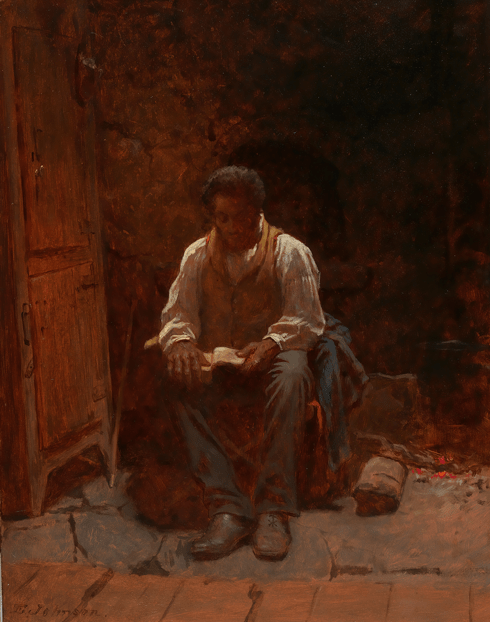
“The Lord Is My Shepherd” by Eastman Johnson, 1863

We enjoy sharing art on Veracity. Art inspires thinking in a way that connects with the soul.

After several months of workaday grind and spending way too much time in front of computers, Marion and I took an Easter weekend trip to DC for some rest and relaxation. We toured the Smithsonian museums and attended the Nationals opening day game. A particular highlight of the trip was our visit to the Smithsonian American Art Museum.

Among the wondrous paintings on permanent display is Eastman Johnson’s masterpiece, The Lord Is My Shepherd, painted just after the announcement of the Emancipation Proclamation. Historians and art students have spent considerable energy interpreting this painting in the context of the struggle to abolish slavery in 19th century America. They cite Johnson’s sympathetic portrayal of slaves and Native Americans in many of his paintings, his abolitionist views, and his artistic, social, political, and Transcendentalist influences.

Regardless of the analysis, The Lord Is My Shepherd is an evocative portrayal of personal discipleship. However you interpret the historical and societal context, the painting depicts a man quietly reading the Bible. He is not reading the 23rd Psalm, as the title may suggest. He is at the beginning of the Bible—some have suggested in Exodus, given the theme of slavery. He is searching the Scriptures on his own. The title hints at his emotional frame of mind as he does so. Perhaps he is looking for comfort or reassurance in a time of great difficulty. Maybe there’s more to it than that. Maybe not. Either way, it’s personal discipleship.

In historical context, it used to be very difficult to study the Bible—even if you were among the privileged few who could read.

Accessible Theology

We have come a long way since 1863. Access to top-notch seminary classes is freely available—instantly. While a degree or certification may be out of reach for those who cannot afford the time or tuition costs, new Internet tools are available to help you if you just want to learn. For free.

Dallas Theological Seminary records an impressive volume of classroom teaching sessions by some of today’s best instructors and theologians. They serve the videos and transcripts of these classes in a large, online catalog that can be accessed from their mobile app. Entire courses on a wide variety of topics from Old and New Testament surveys, to Jewish history, to the Reformation, to just about every kind of doctrine and theological topic you can imagine. Want to study heaven or hell? How about inerrancy, the reliability of the manuscript documents and translations, eschatology, development of the canon of Scripture, apologetics, religious pluralism, world religions, and so forth? What are your thoughts on cessationism, annihilationism, creationism, evolution, Arminianism, Calvinism, sacramentalism, eschatology, covenant theology, dispensationalism, and Eastern Orthodoxy? How well formed are your doctrinal beliefs? Maybe you just have a simple but deep question, like “How did we get the Bible?” Thanks to Dallas Theological Seminary, you can now freely audit courses that will inspire and help shape your beliefs and thinking.

To get the app, click on the image below and follow the instructions. Play around with the menu and find some courses or presentations that interest you. This app is a prerequisite for our next post on how we got the Bible. There is a particularly good session from Darrell Bock, a Veracity Top Scorer Award winner, on the New Testament canon that I would like to share with you. But you’ll need this app first. Enjoy!


Dallas Theological Seminary App


World Religions: The Buddha and the Christ

Ken Samples is producing a series of posts on world religions as he writes a new book on the topic. This post compares Buddha to Christ. Read to the end to find links to related posts comparing other founders of world religions to Jesus Christ.

Kenneth's avatarReflections

Among the world’s great religious leaders, only two had such a profound impact that contemporaries inquired as to the very nature of their being.1 People wondered whether Siddhartha Gautama (the Buddha) and Jesus of Nazareth (the Christ) were more than mere human beings. While both are known as great teachers and profound souls, the identity, mission, and message of these two men couldn’t be more different.

The Buddha

Like Christianity, the religion of Buddhism is traced to a single individual. That person is Siddhartha Gautama (c. 563–480 BC). While mixtures of myth and legend make it impossible to completely reconstruct the life of the Buddha, there is a historical core of information known about him.2

Siddhartha was born into the Indian Sakyas clan in the sixth century BC in Nepal, near its border with India. Siddhartha’s father was the feudal lord of the Sakyas people and created a…

View original post 852 more words


Discipleship Sandwich

SandwichIt’s easy to approach our spiritual lives like a sandwich. We just add the ingredients we like and leave out those that we don’t. We eat until we are satisfied—then we are done. We can fall into pretty humdrum routines where we eat the same sandwich over and over.

For the past nine weeks, I have had the privilege of sharing some thoughts and resources for personal discipleship with an amazing adult Sunday school class. They are ‘amazing’ because most of them have studied the Bible thoroughly and devotionally, and it shows in the way they think and live their lives. They have inspired me for years.

In putting this class together, I had several goals. First, to share the incredible resources that are instantly available to us now through the Internet and other technologies. We are spoiled with an embarrassment of riches for personal discipleship and Bible study. A modern toolbox can include: videos from the greatest pastors, theologians, apologists, and philosophers; apps that read the Bible and books to us while we drive or go for a walk; multimedia Bibles that help us see the context of Scripture; podcasts to challenge our thinking; websites that contain enormous volumes of theological and devotional material; online research sites that go well beyond simple biblical commentaries; apps for journaling and note-taking that help us retain what we have studied; electronic books and magazines (that are electronically searchable); free online seminary courses; map-based websites that can fly us into ancient archaeological sites; and digital videos that inspire our souls and challenge our minds.

Secondly, to expose mature Christians to contemporary (and not so contemporary) challenges to the Christian faith, and give them a flavor for how well our faith stands up to scrutiny and attack. Many of us tend to shake a bit when some intelligent-sounding pundit (or coworker at the water cooler) attacks our beliefs. What I really want to share with people is that these attacks are in the mainstream culture, and there is nothing to fear if we know the appropriate responses.

Thirdly, I wanted to expose the class to apologists, researchers, theologians, and philosophers on the front lines who are blazing trails with their debating, research, and publishing. People like J. Warner Wallace, Daniel Wallace, and William Lane Craig. (During the course, Clarke Morledge and I updated our Top 10 Scorers list to make these people and their resources easily accessible.)

Granted, all of the material presented leans heavily towards the intellectual. Unapologetically. One of the great wonders of Christianity is that it succeeds both on very simple and very complex levels. You don’t need to know a lot to be saved, but diving deep can produce great appreciation for Christianity as an objective truth.

A Baptist preacher friend says, “Not everybody needs that (intellectual rigor).” While I completely agree, there’s more to it than that. Several other friends make statements to the effect that they believe the claims of Christianity, and they don’t need all the navel gazing and logic chopping. Got it. But here’s the deal—it’s not about us. While deeper study will produce deeper appreciation for the reality of our beliefs, and that is a VERY good thing, it’s about being good disciples.

Personal Discipleship is all about making the best sandwich you can. Not for yourself, but for somebody else.

Week-9

Click on the images inside this file to link to the online resources. (You may need to adjust your browser settings to allow the links to work, or open it in iBooks, or save it to your desktop and open it with Acrobat Reader.)


HT: Ken Petzinger, Clarke Morledge, Joe Webers, Judy Williamson, Marion Paine, Dave Rudy, CommunityTable.com (sandwich image)


Inerrancy and Infallibility

We cannot explain or resolve all parts of Scripture. However, to surmise that apparent conflicts in the Bible must be ‘errors’ is an arrogant and dangerous supposition. Too many people give up too easily—if it doesn’t make sense they aren’t willing to dig deeper. Or to trust. Bible

A few years ago I listened as wise, godly friends discussed the inerrancy and infallibility of the Bible. All of them are mature Christians. The issue was not the authority of Scripture for faith and practice. The issue was whether it is necessary and/or appropriate to include in our statement of faith that the Bible contains the ‘inerrant’ and ‘infallible’ word of God.

While I try not to get too personal with this blog, the most that I can contribute on this topic is personal. Specifically, the more I study, the more it all makes sense. Not just in a little way, but in one “Oh wow!” realization after another. Many (not all) passages that at one time confused me or caused me to wonder if the text was correct came into sharper focus with deeper study. This detailed-study-leads-to-edification process has happened so many times that my views on the inerrancy and infallibility of the Bible have strengthened considerably.

Just one example—I audited an apologetics course entitled Creation and the Bible by Reasons To Believe. Dr. Hugh Ross, an astrophysicist and the founder of Reasons To Believe states in his testimony that he became a Christian by reading the foundational books of the world’s religions and discarding them one by one based upon scientific errors apparent in their text. When he got to the Bible, however, he found 13 scientifically accurate statements about the creation of the universe in the first chapter of Genesis. If you take the time to dig, the details are amazing and dramatically support the case for ascribing inerrancy and infallibility to the Bible.

There’s no shortage of opinions on the accuracy of the Bible. Our post-modern culture promotes individual opinions and disharmony over conformity and agreement. Fine. Got it. No one wants to give a straightforward yes or no to the question of Biblical inerrancy, and actually that should be the case. What do you do with translation differences, poetry, allegorical statements, the use of Koine (slang) Greek, textual criticism, differing accounts of the same events by different authors, a lack of modern technical precision, observational descriptions of nature, the use of hyperbole and round numbers, variant selections of material in parallel accounts, and so on? It takes a fair amount of clarification before we can get to a yes or no response.

But the concepts behind these adjectives are extremely important, and there are those who have done a very good job building a case for unity on this topic. The Chicago Statement on Biblical Inerrancy is a document worthy of very careful reading. Before I read it, I had my own unfocused views on the subject. After reading it and thinking it through, I’m in. I support the Chicago Statement.

So back to the question of whether it is necessary or appropriate to include that the Bible is inerrant and infallible in our statement of faith. In its constitutional context, the Williamsburg Community Chapel’s statement of faith is reduced to eight points about which we believe so strongly that we would break fellowship with those who would disagree. In this context, personally I believe it is appropriate—but not necessary—to include these terms (see Article XIX of the Chicago Statement). In other words, would I break fellowship with someone who was struggling with the genealogies of Christ in Matthew versus Luke? No. Would I break fellowship with someone who insisted that the differences in these genealogies prove the errancy of the Bible? Absolutely. More importantly, do I believe that the Bible is the inerrant and infallible, inspired word of God? Yes.

______

2015 Personal Discipleship - Week 8
Click on the images inside this file to link to the online resources. (You may need to adjust your browser settings to allow the links to work, or open it in iBooks, or save it to your desktop and open it with Acrobat Reader.)

HT: Dave Rudy


Responding to Textual Criticism

VilifyWhen someone confronts us in a particularly offensive manner or strikes at a deeply held conviction or belief, most of us have a natural inclination to fight back. Unfortunately, we have a tendency to let anger and emotions get the better of us.

Like it or not, we live in a world where there is little tolerance for people who think differently. From a purely cultural perspective, we are far less apt to listen and empathize than we are to attack and vilify. To win is to vanquish our enemies. Or is it?

“You have heard that it was said, ‘An eye for an eye and a tooth for a tooth.’ But I tell you not to resist an evil person. But whoever slaps you on your right cheek, turn the other to him also. If anyone wants to sue you and take away your tunic, let him have your cloak also. And whoever compels you to go one mile, go with him two. Give to him who asks you, and from him who wants to borrow from you do not turn away. “You have heard that it was said, ‘You shall love your neighbor and hate your enemy.’ But I say to you, love your enemies, bless those who curse you, do good to those who hate you, and pray for those who spitefully use you and persecute you, that you may be sons of your Father in heaven; for He makes His sun rise on the evil and on the good, and sends rain on the just and on the unjust. For if you love those who love you, what reward have you? Do not even the tax collectors do the same? And if you greet your brethren only, what do you do more than others? Do not even the tax collectors do so?”
Matthew 5:38-47, NKJV

In our Personal Discipleship class we have been studying contemporary challenges to the Christian faith. One of the more prominent challengers is Bart Ehrman, a popular skeptic who calls himself an agnostic, but who more accurately fits the mold of an angry, deconverted Christian. (Ehrman has a big beef with God over the problem of evil and suffering.) His books achieve best-seller status, and he is quoted by atheists and skeptics as an authority on the unreliability of the Bible. He is revered by friend and foe alike for his skill in textual criticism. His research is largely undisputed, but his premises and conclusions are highly biased. Nevertheless, he strikes a chord with those seeking to discredit the trustworthiness of the Bible.

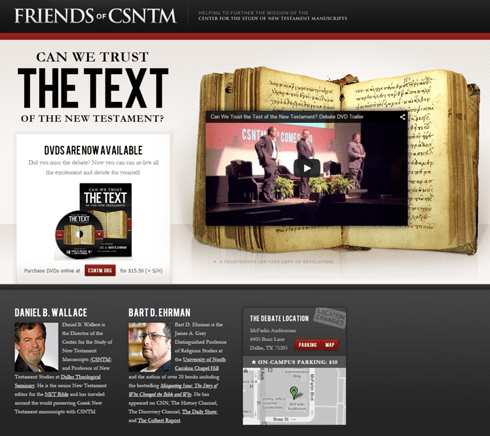
While it’s very difficult for some to listen to abrasive skepticism, it is encouraging to see how rigorous scholarship can turn back the skeptic’s wrath. Well-articulated truth is a powerful antidote to skepticism, particularly when it follows the apologetic ethic of gentleness and respect. Here is a debate you can buy (sorry, there is no good quality video currently being served online) between Ehrman and Dan Wallace on the reliability of the text of the New Testament. It was at the time the largest debate ever held on the reliability of the New Testament text. (For some interesting background, see the video in this post.)

Wallace Ehrman Debate
Dan Wallace is amazing in this debate. He is honest, well-informed, learned, respectful, humorous, and makes a convincing case for the reliability of the New Testament text. His response to Bart Ehrman is a model of what Jesus preached in the Sermon on the Mount (quoted above). Wallace’s response is not angry—although he is deeply concerned about the effects of Bart Ehrman’s influence on our culture. Wallace has the proper response to textual skepticism. He doesn’t vilify Bart Ehrman—he doesn’t need to. It is amazing what we can do when we take the time to study the facts and respond in obedience, with an appreciation of the right ethics.

And finally, for those following our Personal Discipleship class or otherwise interested in Textual Criticism, here are the class notes.

Personal Discipleship Class-Week 7
Click on the images inside this file to link to the online resources. (You may need to adjust your browser settings to allow the links to work, or open it in iBooks, or save it to your desktop and open it with Acrobat Reader.)

HT: Daniel B. Wallace, Marion Paine