Tag Archives: theology

Respecting Disagreement

Now we see but a poor reflection as in a mirror; then we shall see face to face. Now I know in part; then I shall know fully, even as I am fully known.
1 Corinthians 13:12 (NIV)
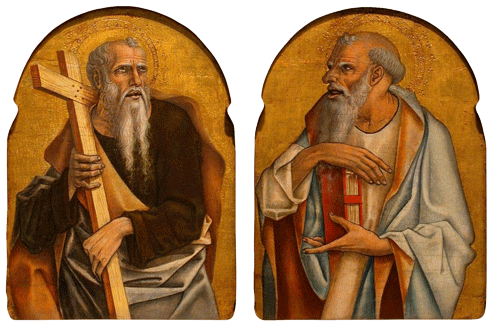
Two Apostles

Two Apostles by Carlo Crivelli, 1475

The apostles Peter and Paul had some famous disagreements.  Ultimately however, it was their shared, unswerving love for Christ that propelled their ministries.

I recently attended a lecture by Dr. Ian Hutchinson, a scientist with impressive technical credentials—and a Christian.  His topic addressed science-faith issues, and concluded with his belief that a Christian worldview is consistent with, and complimentary to, a scientific worldview.  I agree and am thankful that there are scientists of Dr. Hutchinson’s caliber who are willing to share their faith in public forums.  (Let’s be real—who am I to disagree?)

The first question from the audience at the end of the lecture involved the age of the earth and the six ‘days’ of creation.  Dr. Hutchinson’s response was along the lines that the universe is very old (13.7 billion years, again I agree), and that he believes we should not take the creation account in Genesis too literally—that the text is ‘figurative’.  And here we have a fork in the road.  I think it is somewhat dangerous to give up on the text in Genesis too easily, and to ascribe a figurative intent on the part of the author (Moses) when in fact there may be more to the inspired text than meets the eye.

In addition to his work at MIT, Dr. Hutchinson is also a lecturer for the BioLogos Foundation, founded in 2007 by another prominent Christian, Dr. Francis Collins.  These brothers and sisters in Christ adhere to the idea of theistic evolution, which—rather than have my take on this topic—you can read about directly from the BioLogos website.  There are many wonderful Christians who ascribe to the ideas of theistic evolution.

I’m just not one of them.  After studying the matter in detail, I have a different understanding.  I ascribe to old-earth creationism.

Hugh RossDr. Hugh Ross and his colleagues at Reasons To Believe have a great deal to share on this topic.  First, Moses never wrote that the universe was created in six days.  Excuse my provocative statement, but I did it to make a point— ‘day’ is an English word.  Moses did not write in English (which has a million or more words), he wrote in Biblical Hebrew (which only had a few thousand words), and the word that was written was ‘Yom’, which clearly has multiple meanings including the idea of an epoch or age. Continue reading

Why Does God Allow Evil and Suffering?

When God gave us His Word, He was not in denial regarding the suffering of His people. Have you discovered the Bible is filled with Scriptures that answer the ‘why’ questions the people of God ask when they are hurting? I have been in a wheelchair since 1983 and have been totally paralyzed for many years. What I have written here is not unproven theory from passages in the Bible. I have personally needed to search the Scriptures and find these “Thirty Biblical Reasons Why God’s People Suffer.” If you are suffering, or you know someone who is, join me as I explore thirty biblical responses of God to people with hurting hearts.
Dick Woodward, 30 Biblical Reasons Why God’s People Suffer

30 Biblical Reasons Why God's People SufferHow can an all-powerful and good god allow evil and suffering?  As William Lane Craig points out, the problem of evil and suffering is the primary argument against the existence of God.  In this presentation he argues that “Christian theism is man’s last, best hope for a solution to the problem of evil,” distinguishing between the intellectual and emotional versions of the problem of evil.

But the question is so profound that it can be particularly difficult to separate emotions from intellect.  It can gnaw at our soul. Even those who accept the existence of God can have a hard time resolving evil and suffering. Continue reading


Veracity’s Top 10 Scorers

Veracity's Top Scorer Award

Do you ever wish there was a blacklist we could use to avoid being blindsided by bad doctrine or theology?  After all, there is so much material out there—who has the time to sort through it all?

When you think about it, a blacklist is a pretty ridiculous idea isn’t it? Not that there aren’t all kinds of names—from the famous to the infamous—that deserve to be called out, but there is a much better way for thinking men and women to attack this problem.  Study the good guys.

Welcome to Veracity’s Top 10 Scorers list. These are the players who consistently “put the puck in the net.” No deking and skating around—just on-target discipleship.

The list includes pastors, philosophers, professors, a historian, theologians, apologists, an astrophysicist, several world-class scholars, and some exceptionally gifted teachers.  (Actually there are 12 winners on our Top 10 Scorers list, because they all deserve the award.) Continue reading


Can We Trust the Bible?

“The Bible says it, I believe it, that settles it.”  Really?!

Many theologians and pastors strongly disagree.  If there was such a thing as a fantasy theology team, my top (living) draft picks would include: Dick Woodward, William Lane Craig, Hugh Ross, Ravi Zacharias, Matt Slick, Tim Keller, John Yates, Michael Card, Ray Vander Laan, Andy Stanley, Lee Strobel—and Daniel Wallace.

Here’s a slightly irreverent, very funny, and spot-on lecture by Dr. Wallace given at Dallas Theological Seminary about the “worst Christian slogan ever concocted” (my apologies in advance to people from Arkansas).

Seriously, how much research is there to corroborate Dr. Wallace’s observations and conclusions?  How reliable are the Bibles we have today?

Continue reading


Who Is Jesus?

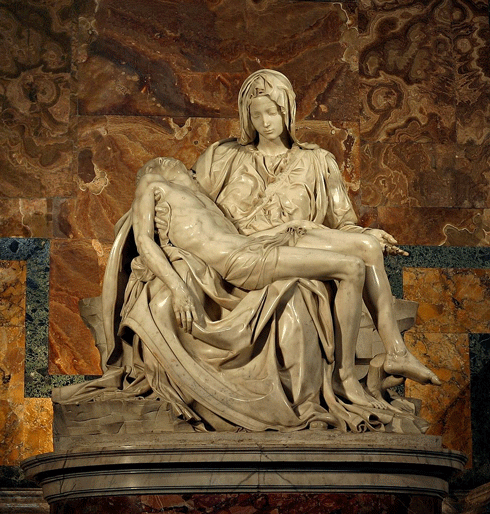
Michelangelo's Pietà

Pietà by Michelangelo, 1499

Who is Jesus?  Wow, talk about a profoundly important question!

There are a lot more people who “believe in Jesus” than there are those who know what Jesus actually claimed about himself.  Many think he was a great moral teacher, a prophet, or a wise Rabbi.  Some think a legend, a myth, or a contrivance.  Still others that he was one of many gods, or one of many roads to God.  That Jesus straightforwardly and clearly attacked these notions is of little consequence to those who will not invest the time to read the Gospels and weigh the evidence for his claims.

Jesus had to fulfill hundreds of Old Testament prophecies written centuries before he appeared on earth, and live within the Mosaic law of the Torah.  He had to submit to the cruelest punishment mankind could dish out, and to top it all off he had to rise from the dead.  No small feat.  When you think about it, he had to color between some extremely tight lines.  Lee Strobel calls this framework the “unmistakable fingerprint of the Christ.”  Only Jesus was man enough for the job—that was the whole point. Continue reading
