Tag Archives: racism

Nat Turner’s Virginia Slave Rebellion, Hollywood, and How We Read the Bible

In August, 1831, a literate slave and Bible preacher, Nat Turner, led a rebellion against his white masters, in rural Southampton County, about a one hour drive south of where I live in Williamsburg, Virginia. After the 48-hour mass killing of 55 whites ended, Turner’s insurrection was eventually crushed, and tougher laws were enacted to try to prevent such slave uprisings in the future.

Nate Parker’s new film, The Birth of a Nation, is a fictionalized retelling of this tragic and violent story (deserving of the R-rating)…and just to think, the events depicted only happened less than two hundred years ago, practically in my own backyard. The film’s director is enveloped in controversy, and early reviews of the film are mixed. Intended to subplant the legacy of the 1915 silent film of the same name, a cinematic apology for the Ku Klux Klan, Parker raises a number of important issues, but one wonders what the film will actually accomplish.

Gospel Coalition blogger, Justin Taylor, summarizes some of the most significant elements regarding the history behind the film’s story. For more details on the history, you can start with the Nat Turner Project. Some historians are disappointed with the inaccuracies of the film, which frustrates me, as I am more interested in the actual history than I am in Hollywood’s fantasies. Does the film tell us about what really happened, or does it tell us more about the mind and state of contemporary pop-culture? How much of the film is about Nat Turner, and how much of it is about the film’s director, Nate Parker?

In the film trailer below, the Nat Turner character recites 1 Peter 2:18, in an effort to encourage his fellow slaves to keep in line. I confess that I, as do so many other evangelicals, tend to water this passage down:

Servants, be subject to your masters with all respect, not only to the good and gentle but also to the unjust (1 Peter 2:18 ESV).

I have euphemistically tried to replace “servants” with “workers,” and “masters” with “supervisors,” but does that really get at the original context? I am afraid not.

Slavery during the New Testament period is difficult to comprehend in modern terms, and it was very different from how many Americans viewed slavery prior to the Civil War. As I have argued elsewhere (here and here), many of my southern, Virginia evangelical forefathers did not properly understand passages like this either. Instead, they read things into the Bible that were not there.

If any Veracity readers end up seeing the film, I would like to know your thoughts.


Racism, Police Authority, and the Misinterpretation of the Bible

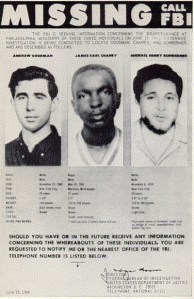
FBI posted looking for three civil rights workers in Neshoba County, Mississippi, June 21, 1964.

FBI poster looking for three missing civil rights workers in Neshoba County, Mississippi, June 21, 1964.

Ferguson, Missouri. Baltimore. Minneapolis. Baton Rouge. Dallas. Black Lives Matter.

America is caught in the middle of racial conflict, as tensions between law enforcement and African American communities have erupted in violence. However, the problem has deep roots in history. An understanding of these roots will go a long way towards healing and reconciliation. Some of these roots go back to misinterpretation of the Bible.

In June, 2016, the Mississippi attorney general officially closed a 52-year old case involving the murders of three civil rights workers, in the summer of 1964. Members of the Ku Klux Klan in Neshoba County had killed two white men and one African American who had traveled to Mississippi to help segregated African Americans register to vote. The Klansmen feared that the efforts of these three men would lead to the “mixing of the races,” so they sought to teach the civil rights workers “a lesson.”

The Klansmen were aided by one of their number, a local deputy sheriff, Cecil Price, who arranged for the abduction of the three men after a supposed traffic stop and afternoon in jail. The three were taken to an earthen dam, where they were shot and buried, one of them still breathing as the bulldozer shoveled the dirt over them.

Deputy Cecil Price was never convicted of murder, but he was tried and sentenced to six years in prison on civil rights violations, in 1967. The ringleader of the Klan group, Edgar Ray Killen, was finally convicted of manslaughter and put in jail thirty-six years later in 2005, as part of this infamous “Mississippi Burning” case.1

Edgar Ray Killen was a part-time Baptist preacher. Killen had been put on trial back in the 1960s, but he escaped conviction back then due to a hung jury. One of the jurors in that early case claimed that they could have never convicted a preacher.

Price was the “law man,” and Killen had the Bible. Thankfully, men like Price and Killen are an exception, and do not represent in any way all law enforcement authorities or Christian preachers. Yet I sincerely doubt that Price would have been able to self-justify his actions if Killen, the preacher, had not somehow signaled that the terrible actions they ended up all taking were somehow, “Okay with God.”

So, what goes through the mind of someone, like “Preacher” Killen, who can justify such brutality, a man who claims to be guided by the Word of God? How can a law enforcement official, like Cecil Price, go along with such actions? Where do people get the idea, that the “mixing of the races” is something contrary to the Bible, to begin with? Continue reading


The Civil War as a Theological Crisis

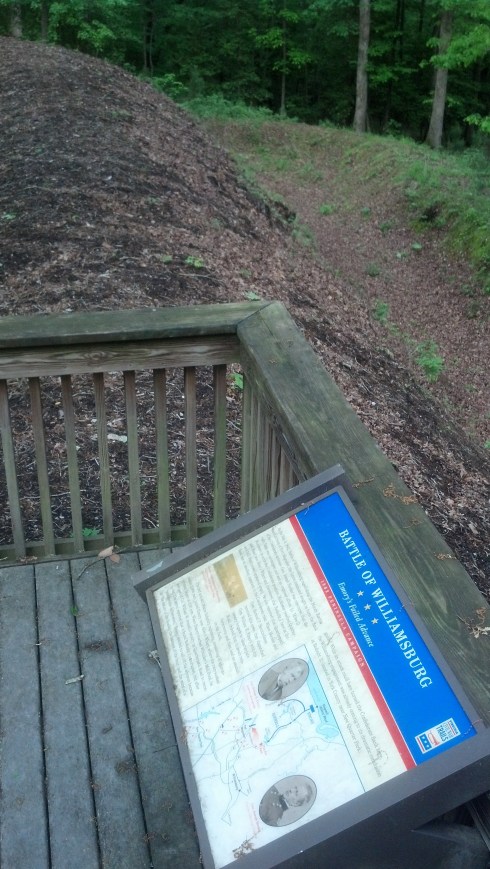
A steep, dugout embankment defending Redoubt #1, off of Quarterpath Road, where Confederate troops waited for advancing Federal soldiers to attack from Tutter's Mill Pond below, during the Battle of Williamsburg. Sadly, relatively very few of my fellow Williamsburg neighbors even know that this place even exists.

A steep, dugout embankment defending Redoubt #1, off of Quarterpath Road, where Confederate troops waited for advancing Federal soldiers to attack from Tutter’s Mill Pond below, during the Battle of Williamsburg. Sadly, relatively very few of my fellow Williamsburg neighbors even know that this place even exists.

Does the American national tragedy over the Civil War have something to teach us about how we are to read the Bible?

As a kid, I grew up near the remains of an oft-forgotten, Civil War battlefield. Whenever I ran among the dugout, redoubt embankments, I always kept in mind the warnings of neighbors to be careful, as there was likely to be found unexploded ordinance somewhere underneath my feet.

On the same day, hundreds of miles away, when Mexico was resisting the French on May 5, 1862, remembered now as Cinco de Mayo, Federal forces met Confederate forces just east of my town, for the Battle of Williamsburg, with nearly 4,000 casualties among both sides. Within a couple of years, the significance of that battle faded, displaced in memory by placenames like Antietam and Gettysburg.

Efforts to preserve the battlefield from being run over by suburban housing developments have been somewhat, moderately successful, though the land, as well as the intellectual debates that the led up to the war, have sometimes been forgotten. I often wonder myself, if such a national crisis could have been averted, without such terrible bloodshed.
Continue reading


Noah’s Curse

Noah curses his son Ham, a 19th-century painting by Ivan Stepanovitch Ksenofontov. Ham looks pretty white to me here, but for thousands of Christians in the American South from at least the 19th century to recent times, thought Ham had black skin.

Noah curses his son Ham, a 19th-century painting by Ivan Stepanovitch Ksenofontov. Ham looks pretty white to me here, but thousands of Christians in the American South, from at least the 19th century to even fairly recent times, thought Ham had black skin (photo credit: Wikipedia).

When Noah awoke from his wine and knew what his youngest son had done to him, he said,

“Cursed be Canaan;
a servant of servants shall he be to his brothers.”
He also said,

“Blessed be the Lord, the God of Shem;
and let Canaan be his servant.
May God enlarge Japheth,
and let him dwell in the tents of Shem,
and let Canaan be his servant.” (Genesis 9:24-27 ESV)

It was my first Christian retreat in college. I met another student just a few years older than me the first night of the weekend, and we struck up a friendship. But the next day, we had a conversation that has stuck with me for years. I have no idea how it got started, but it was about whether or not the Bible allows interracial marriage. My new friend, growing up in a rural part of southern Virginia, insisted that God absolutely forbids white people from marrying black people.

Where is that in the Bible?,” I asked with curiosity and amazement. I had only recently started reading  the Bible, so perhaps there was something in there that I had not seen yet. His response bothered me:

Well, I am not exactly sure where it is. But I know it is in there.”

Later that weekend, I asked him again if he could show me the verse.

He never was able to find it.

Let me rewind a few more years. I was a mere toddler when the famous Loving v. Virginia case was resolved in 1967, overturning Virginia’s statute forbidding “miscegenation.”  The Lovings, a black and white couple, from Caroline County, about an hour away from where I grew up, had driven up to Washington, D.C., to get a marriage license, where interracial unions were permitted. Upon returning to Caroline County, Virginia police raided their home, but the couple responded to their arrest by going all the way to the Supreme Court to defend their case … and they won.

Such action to change the law that had been embedded in the culture of the so-called “Bible Belt” was not a concern to my new college Christian friend in the early 1980s. In his mind, the Bible still forbade mixed marriages between people of different skin colors, and that was all he needed to know. He had no animosity towards African-Americans. He was really a nice guy, and a devout believer. It was simply and clearly taught in the Bible that God does not allow interracial marriage, according to him.

The problem was… and still is…. he had no verse from the Bible to back up his belief.

So, where did this whole thing about the Bible forbidding interracial marriage come from?
Continue reading


Selma, 1965: Where Were the Followers of Jesus?

It was March 7, 1965, a day remembered in the civil rights movement as “Bloody Sunday.” A group of African Americans were planning to march from Selma to Montgomery, Alabama to demand that they be given the legal right to vote without any unnecessary encumbrances. Six hundred men and women began their march across the Edmund Pettus Bridge, only to be greeted by a line of state troopers waiting for them with billy clubs and gas masks, and members of an all-white county posse, composed of men who had been deputized to participate only the night before. The non-violent marchers were told to go back home or “go to your church.”  Television cameras, such as these scenes from CBS, were broadcast around the world showing how the marchers were run over and beaten by “law enforcement.”

In the 2014 film by Ava DuVernay , Selma, the general outline of the story is depicted, showing how the marchers were eventually able to complete their march to Montgomery, which resulted in President Lyndon Johnson urging Congress to pass the Voters Rights Act of 1965. Critics have made much of DuVernay’s negative portrayal of President Johnson as being directly antagonistic towards the efforts of Martin Luther King, Jr., so one might complain of the tendency to oversimplify the narrative regarding what happened in Selma, and King himself was far from perfect.

Nevertheless, as I was watching the film, I kept thinking to myself, where were the followers of Jesus on that “Bloody Sunday” morning? As the state troopers were putting on their gas masks, they acknowledged that among the marchers were many Christians. And yet, I wonder where were the white Christians? Were the white Christians of Selma all in their churches that morning worshipping God? Upon hearing the television reports, did they come out and lend a hand to their African American brothers and sisters in the Lord as they were bleeding in the streets?

There were many who saw the events of “Bloody Sunday” unfold before them on their television sets across the world, and some responded by traveling to Alabama to participate in a future attempted march. One of these was a Unitarian Univeralist minister from Boston, James Reeb. Much like the Samaritans in first century Palestine, who were viewed in John 4:19-25 as theologically suspect with their call to worship on Mount Gerizim instead of the correct place, Jerusalem, Unitarian Univeralists fifty years ago as well as today are viewed as being theologically suspect among evangelicals. Yet why was it that someone like James Reeb became a martyr for the civil rights movement when he was beaten to death by white supremacists in Selma, and not a more theologically-sound born again Christian? Is it fair to say as in the story of the Good Samaritan in Luke 10:25-37, that James Reeb was like a modern day “Samaritan?”

Much has changed in fifty years, but it is the silence of the predominantly white, evangelical church during those tumultuous years that most disturbs me. In light of the teaching of Scripture, the silence is deafening. How was it that the evangelical church had became so complicit in the sin of racism, compromising their witness for the Gospel?

They had their Bibles. They had the message of truth and reconciliation.

Where were these “followers of Jesus?”