Cameron is in many ways a popular evangelical Christian influencer, an evangelist and a spokesperson on conservative political issues as well. He admittedly acknowledges that he is not a scholar, and some of his amateur misunderstandings of things have come out in at least one filmed “prayer meeting” a few years ago, and on an historical documentary he produced on American history, which I have critiqued.
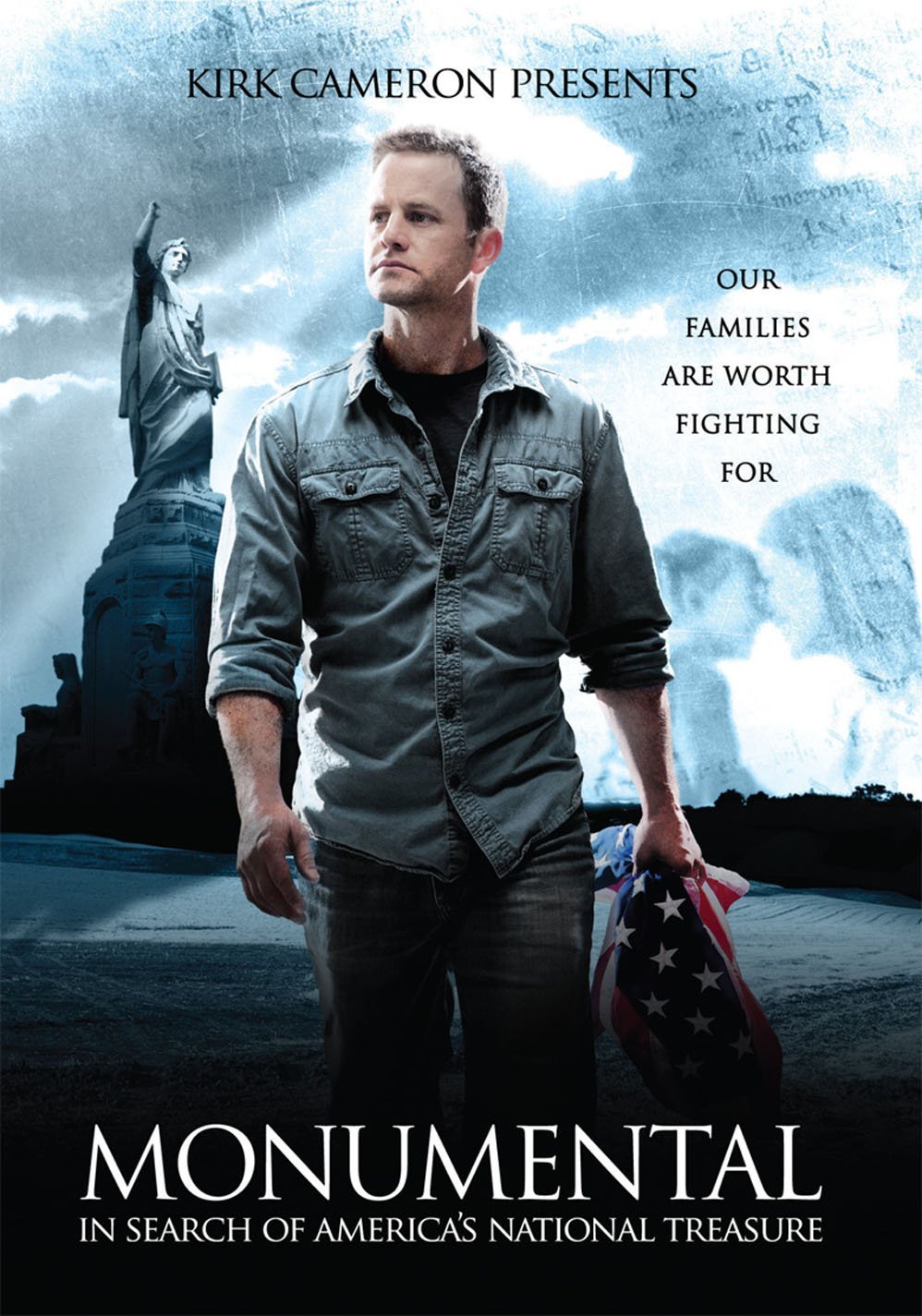
Kirk Cameron made a historical documentary film Monumental back in 2012, among his many other projects. Cameron has become a trustworthy and influential popular spokesperson among many evangelical Christians. But some now are concerned that Kirk has gone off the deep end…. or has he?
Is Kirk Cameron Now a “Heretic,” or Is He Simply Thinking Through Some Really Important Questions, and Wants to Talk About It?
Alas, Kirk Cameron means well, and to many in his audience, he seems trustworthy. So it really shocked some people, myself included, when he announced that he has shifted towards upholding a doctrine of conditional immortality.
The doctrine of conditional immortality differs from the traditional doctrine of eternal conscious torment. In the latter view, those who are eternally separated from God will undergo a never-ending experience of divine punishment resulting from their sin. However, the doctrine of conditional immortality, otherwise known as annihilationism, argues that those eternally separated from God will be punished, but that the punishment will have a terminus. To use a common expression, the punishment (of God) will fit the crime (of the sinner). Once the punishment, as rightly determined by God’s judgment, is rightly finished, the person will be annihilated. That person, separated from God, will no longer exist, eternally.
So, to answer the question posed by the title of this post: No, Kirk Cameron is not denying the doctrine of hell. But he is framing the way to think about hell in a category that might be unfamiliar and unsettling to others.
The debate of the exact nature of hell has been going on since the days of the early church. There are three main views on the topic: (1) the doctrine of eternal conscious torment, (2) the doctrine of conditional immortality, and (3) the doctrine of universalism. Universalism, which in its most popular form in Christians circles, as suggested by those like theologian David Bentley Hart, or William Paul Young, the author of The Shack, teaches that hell is really a kind of purgatory, whereby God will purge sin from the non-believer and eventually win that person to salvation, eventually, in the next life. In other words, hell is primarily restorative and redemptive, as opposed to being punitive.
While Christian universalism has had its proponents, even in the early church era, the doctrine was rejected as veering away from historic Christian orthodoxy. Names like Origen, and possibly Gregory of Nyssa, on up to more recent times, as with C.S. Lewis’ intellectual hero, the 19th century author George MacDonald, have espoused some form of universalism. But the orthodoxy of universalism has been rightly questioned.
It was really Saint Augustine of Hippo, an avid proponent of the doctrine of conscious eternal torment in the 5th century, who effectively put the nail in the coffin on general acceptance of conditional immortality…. at least for many Christians. Augustine’s massive influence pretty much made conscious eternal torment the traditional view of hell for centuries. But every now and then, conditional immortality makes a comeback, at least among a few Christians, in nearly every age of the church. So, Kirk Cameron’s musings on the doctrine of hell are far from new.
I take an agnostic view on the debate between these two perspectives at the present time. Dr. Mohler cites Matthew 25:46 as the main “go-to” verse to favor the doctrine of eternal conscious torment: “And these will go away into eternal punishment, but the righteous into eternal life.” But then there is Paul’s statement in 1 Thessalonians 2:9: “They will suffer the punishment of eternal destruction, away from the presence of the Lord and from the glory of his might.”
Eternal destruction sounds a lot like annihilation, at least to me. But I get Dr. Mohler’s point about Matthew 25:46. I am concerned about slippery slope tendencies on controversial topics, like Mohler, but these can be complex issues where different people will come to varying conclusions based on different ways of thinking. What matters more to me is how people arrive at their conclusion, as opposed to not just the exact conclusion they land on.
This is one of those doctrinal disputes which I have wanted to study, but I have not done a thorough enough job to make any firm, informed conclusion. About thirteen years ago, I read Robert A. Peterson’s Hell on Trial: The Case For Eternal Punishment, a 272 page articulate text which I highly recommend. Peterson makes a strong argument for eternal conscious torment, while acknowledging that some verses in the New Testament do lean towards conditional immortality. I have not yet read thoroughly any counter-perspective from the conditional immortality side of the discussion. I simply have not yet had the mental bandwidth to take on such a project, and I doubt I will get to it anytime soon (though I have wanted to).
An Appeal to Have More Charitable Dialogue on Controversial Topics Among Christians
But what concerns me the most about the controversy concerning Kirk Cameron are some of the outlandish comments, which have called into question Cameron’s spiritual integrity. Some have claimed that Kirk Cameron is embracing “heresy” now with his views on hell. That simply is not true. Kirk Cameron might indeed be wrong about conditional immortality, but that does not make him a “heretic.”
“With @KirkCameron announcing his position on conditionalism I’m seeing a lot of people attempting to critique it. I hold to ECT, but I do understand the topic of conditional immortality and I have yet to see anyone actually give a rebuttal that shows me they’ve interacted with the arguments and biblical reasoning from the other side. To condemn conditionalism/annihilationism as heresy is to say that John Stott, Edward Fudge, F. F. Bruce, potentially even Athanasius of Alexandria, are all heretics. This is, with all due respect, ridiculous. While the position might be unorthodox it is not heresy. If you actually want to interact with someone who knows the topic reach out to my friends @datechris and/or @DanPaterson7. Both are solid, fair minded, well educated and articulate holders of conditionalism.”
Gavin Ortlund, another theologian who holds to the traditional doctrine of conscious eternal torment, has a video which echoes Wesley Huff’s call for more charitable discussion. In Gavin’s four-layered model for how to go about “theological triage,” when Christians disagree with one another, from his book Finding the Right Hills To Die On, Gavin does not place this debate about the nature of hell as a “Tier 1,” top-level issue. It is an important issue to consider, a “Tier 3” issue, but Christians of good faith may come to different conclusions regarding the nature of hell. This is a good reminder that we should all strive for more charity in having discussions with one another on controversial topics.
I mean, if Kirk Cameron is no longer “safe,” then is anybody really “safe” anymore?
I have a couple more blogposts to put out before the end of the year, but this topic was too important not to pass up!
All Christians believe that Jesus died for our sins. But what exactly does that mean? Christians disagree as to how Jesus died for our sin. Getting our theology right about the meaning of the cross tells us a lot about how we view the Gospel.
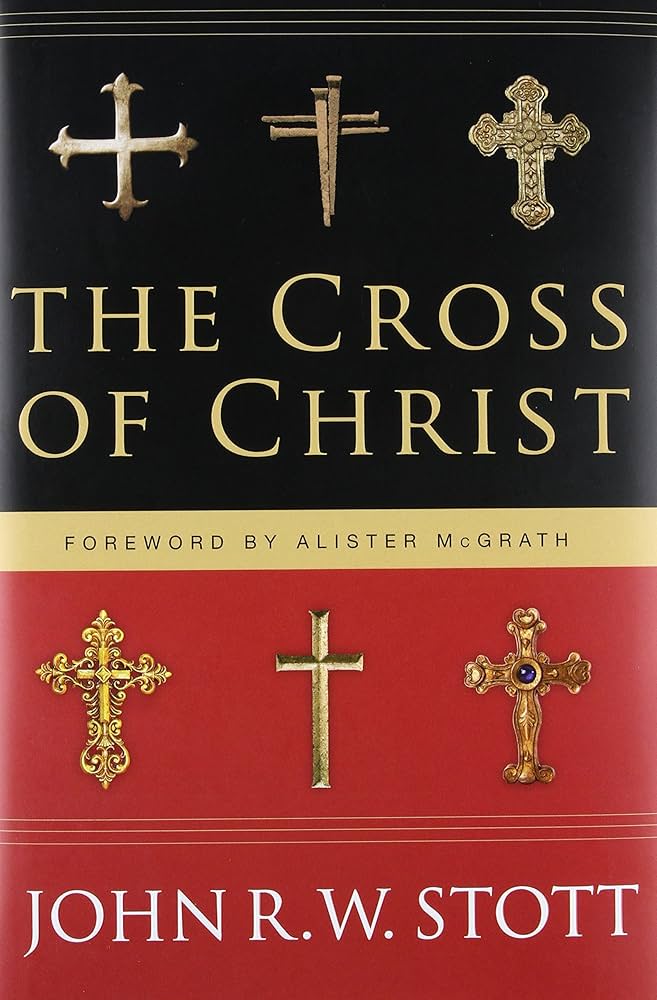
I first read John R. W. Stott’s The Cross of Christ some thirty years ago. Stott, one of the most respected evangelical leaders of the late 20th century, died fifteen years ago in 2010, having been one of the U.K.’s finest and most influential preachers. Stott teamed up to support evangelist Billy Graham for crusades across the United Kingdom in the 1950s, to pioneer the Lausanne movement which championed world missions. But Stott was also a prolific author, and in my view, The Cross of Christ stands as his finest book, giving us a mature, robust understanding of what it means to say that “Jesus died for our sins,” defending in irenic fashion the doctrine of penal substitutionary atonement against various critics.
The Cross of Christ has a message that is needed today. There are very good reasons why The Cross of Christ is a classic, and why Christians should continue to read it.
John R. W. Stott’s The Cross of Christ remains a classic defense of an evangelical view of the atoning work of Christ on the cross, offering a nuanced perspective on penal substitutionary atonement theory.
The Controversy Over Penal Substitutionary Atonement
The idea of “penal substitutionary atonement” is controversial today, even in evangelical circles. Google’s AI engine tells us that penal substitutionary atonement, abbreviated here as “PSA,” is a “theological concept explaining Jesus Christ’s death on the cross as a substitutionary punishment for humanity’s sins. It posits that Christ bore the penalty (punishment) that humanity deserved for sin, satisfying God’s justice and allowing for forgiveness and reconciliation.” To talk about “penal substitutionary atonement” (PSA) is a mouthful, and as result, can be a bit confusing to figure out.
For example, Missouri pastor Brian Zahnd acknowledges the atonement work of Christ on the cross, but he rejects the concept of “penal substitution.” Jesus died for our sins, but not in a PSA way. Zahnd believes that the concept of “penal substitution” makes God into a monster, a monster who would kill even his own Son:
“Some theories [of atonement] are merely inadequate, while others are repellent. Especially odious are those theories that ultimately portray God as sharing the petty attributes of the primitive and pagan deities who can only be placated by the barbarism of child sacrifice….. The cross is many things, but it is not a quid pro quo to mollify an angry God….
…. The cross is not a picture of payment — the cross is a picture of forgiveness. Good Friday is not about divine wrath — Good Friday is about divine love. Calvary is not where we see how violent God is — Calvary is where we see how violent our civilization is. The cross is not where God finds a whipping boy to vent his rage upon — the cross is where God saves the world through self-sacrificing love…
…. When the cross is viewed through the theological lens of punishment, God is seen as an inherently violent being who can only be appeased by a violent ritual sacrifice.”
Is PSA about finding a “whipping boy” to vent God’s rage upon? Zahnd rejects the penal language about atonement, such as “the theological lens of punishment,” and the language of substitution does not fare much better. If all you heard or read about PSA was from Brian Zahnd, you might think that he is right, and that PSA is not a good way to think about the cross of Christ.
Christians Singing About Penal Substitutionary Atonement
And yet, Christians sing about it all the time. All of the buzzwords which Zahnd finds as “odious” are embedded in dozens of worship songs sung nearly every week in evangelical churches.
“It is done, it is finished, no more dеbt I owe Paid in full, all-sufficient merit now my own”
Reach back into 18th century for this classic from Charles Wesley, “And Can It Be?”
And can it be that I should gain An int’rest in the Savior’s blood? Died He for me, who caused His pain? For me, who Him to death pursued? Amazing love! how can it be That Thou, my God, should die for me?
Lots of substitution language in Wesley’s famous hymn. Too much for Brian Zahnd?
You would have to purge hymnals and Powerpoint slides of projected screen lyrics of a lot of standard worship song phrases to remove the references which Zahnd finds objectionable.
Will The Real “Penal Substitutionary Atonement” Please Stand Up?
But is Zahnd somehow onto something? Much of the controversy comes down to how key terms like “penal” and “substitutionary” are defined which makes the difference.
“In the mind of Caiaphas, the substitution was this: We kill Jesus so the Romans won’t kill us. We substitute Jesus for ourselves. In the mind of God, the substitution was this: I will kill my Son so I don’t have to kill you. God substitutes Jesus for his enemies.”
Did God really kill Jesus?Did the Father really kill his Son? Zahnd would probably interpret Piper as saying yes, that God, the Father, killed the Son, in order to satisfy the wrath of the Father against sinful humanity. For Zahnd, Piper’s explanation makes Jesus, as the Son, into “a whipping boy to vent [God’s, the Father’s] rage upon,” the very idea which Zahnd rejects as being the core of PSA.
This is where Stott’s chapter on “The Self-Substitution of God” is alone worth the price of the book. Take note of what John Stott says about certain well-intended defenders of PSA, who end up delivering a caricature of what the work of Christ is really about on the cross:
“In the one [caricatured] case Christ is pictured as intervening in order to pacify an angry God and wrest from him a grudging salvation. In the other [caricature], the intervention is ascribed to God, who proceeds to punish the innocent Jesus in place of us the guilty sinners who had deserved the punishment. In both cases God and Christ are sundered from one another: either Christ persuades God or God punishes Christ. What is characteristic of both presentations is they denigrate the Father. Reluctant to suffer himself, he victimizes Christ instead. Reluctant to forgive, he is prevailed on by Christ to do so. He is seen as a pitiless ogre whose wrath has to be assuaged, whose disinclination to act has to be overcome, by the loving self-sacrifice of Jesus.
Such crude interpretations of the cross still emerge in some of our evangelical illustrations, as when we describe Christ as coming to rescue us from the judgment of God, or when we portray him as a whipping-boy who is punished instead of the real culprit, or as the lightning conductor to which the lethal electrical charge is deflected.” (Stott, The Cross of Christ, p. 149-50)
Ah, here we see Zahnd’s despised “whipping-boy” complaint against PSA. However, in contrast, Stott sees certain “whipping-boy” illustrations as indicative of caricatures which distorts a genuine understanding of PSA. It makes the casual observer wonder what PSA really is all about.
It Is Possible to Misread the Bible in Support of PSA
Furthermore, Stott is careful not to overstate his case. For example, it is quite common in evangelical circles to say that Jesus paid the debt for our sin in full on the cross, as many worship songs declare. In support of this view, Jesus’ last words on the cross as recorded in John 19:30, as “it is finished,” is translated from the single Greek word tetelestai.
Many bible teachers have been taught, and pass onto their congregations, particularly over the past hundred years, that this word tetelestai in an economic context means “paid in full,” which fits in nicely with the motif of penal substitutionary atonement. In the early 20th century, it was commonly thought that tetelestai was found on ancient papyri receipts in Egypt denoting a paid off debt or taxes.
Thankfully, John Stott does not lead the reader down that rabbit hole, which is actually a dead end. Stott goes along with the majority of English translations today of John 19:30 to argue that tetelestai simply means “it has been and will for ever remain finished” (Stott, p. 82). Like previous interpreters such as Leo the Great in the 5th century and Martin Luther in the 16th has suggested, for Jesus to have said “it is finished” would sufficiently mean that the work of Christ, however it would be understood, was finished, and that Scripture was indeed fulfilled.
We may still conclude that Jesus paid off our sin debt in full, after deeper reflection. But it would be overstating the case to argue that Jesus’ last statement on the cross specifically says this.
Self-Substitution On God’s Part Regarding the Cross
The key to grasping how John Stott can defend penal substitutionary atonement, while rejecting well-intended yet misguided caricatures, is in Stott’s concept of self-substitution, whereby God the Father through his Son offers himself as the very substitute to satisfy his own wrath against human sin. In Stott’s framework, there is no need to pit the wrath of the Father against the love and mercy of the Son. The Son and the Father are not working at cross purposes against one another. The Son shares in the wrath of the Father against sin. Likewise, the Father shares in the love and mercy of the Son on behalf of sinful humanity.
As Stott would go onto say:
“We must not, then, speak of God punishing Jesus or of Jesus persuading God, for to do so is to set them over against each other as if they acted independently of each other or were even in conflict with each other. We must never make Christ the object of God’s punishment or God the object of Christ’s persuasion, for both God and Christ were subjects not objects, taking the initiative together to save sinners. Whatever happened on the cross in terms of “God-forsakenness” was voluntarily accepted by both in the same holy love that made atonement necessary…There was no unwillingness in either. On the contrary, their wills coincided in the perfect self-sacrifice of love.” (Stott, p. 151)
In a certain broad sense, John Piper might be correct to say that out of respect to God’s sovereignty and his providential activity in the world that “God killed Jesus.” But the saying is misleading. Saying that “God killed Jesus” is not that much different from saying that when your dear grandmother dies of cancer that “God killed your grandmother.” Really? With all due respect to John Piper, Piper’s comments are highly problematic.
The danger in making such an assessment is that it invites the kind of caricatures which critics of PSA, such as Brian Zahnd , will make against the PSA position as a whole. Honoring the sovereignty of God as part of a theodicy, which says that even in the face of evil, God’s will remains supreme, arguably means well. But if it leaves the impression that God is somehow a capricious monster, whose anger must be placated in a manner no different than the pagan gods, then the assessment is counterproductive at best, a horrific scandal at worst.
Rumors of that scandal only encourages preachers like Brian Zahnd to double-down on their critique of PSA, as a corruption of pure Christian doctrine.
Thankfully, John Stott’s position avoids the pitfalls exposed by both misguided attempts to rescue the pure atoning work of Christ away from the supposedly painful grip of “penal substitution,” on the one hand, and overzealous apologetics which say that “God killed Jesus,” on the other. I have had to re-read these sentences from John Stott several times to let it all sink in, as Stott sprinkles in quotes from P. T. Forsyth, the late 19th and 20th century Scottish theologian:
“[God] was unwilling to act in love at the expense of his holiness or in holiness at the expense of his love. So we may say that he satisfied his holy love by himself dying the death and so bearing the judgment which sinners deserved. He both exacted and accepted the penalty of human sin. And he did it ‘so as to be just and the one who justifies the man who has faith in Jesus’ (Rom. 3:26). There is no question now either of the Father inflicting punishment on the Son or of the Son intervening on our behalf with the Father, for it is the Father himself who takes the initiative in his love, bears the penalty of sin himself, and so dies. Thus the priority is neither ‘man’s demand on God’ nor ‘God’s demand on men’, but supremely ‘God’s demand on God, God’s meeting his own demand’ “(Stott, p. 152).
Does Stott’s characterization of God’s “self-substitution” regarding the cross of Christ go against any traditional sense of penal substitutionary theory? Is Stott redefining terms like “penal,” “substitution,” or even “atonement” to make PSA as traditionally understood unrecognizable? To my knowledge, Stott stands firmly within the traditional camp while rightfully rejecting extreme, excessive expressions of the traditional PSA view. I find it curious that contemporary critics of PSA, including those acting in good faith who are not merely throwing stones at PSA with overworn tropes (like saying that Jesus’ death on the cross was an act of “cosmic child abuse”), rarely interact with Stott’s classic work on the topic. If I am wrong about this, I would like to be corrected.
Applying the Doctrine of the Cross of Christ
While Stott’s careful discussion about God’s self-substitutionary act of atonement through the work of Christ on the cross is the most valuable contribution of Stott’s book, The Cross of Christ has many other benefits. Stott finds that the language of penal and substitutionary atonement is complemented by other biblical ideas that flesh out the doctrine in full.
Stott reminds Christians of the oft forgotten aspect of Christ’s defeat over the powers of sin, death, and evil, which was recovered for Western Christians by the early-to-mid 20th century Swedish theologian, Gustav Aulen, through his influential 1930 work Christus Victor. The Christus Victor motif puts emphasis on Christ’s victory over the powers of darkness, a feature long held prominent in Eastern Orthodoxy (Stott, p. 228ff).
Stott also finds value in certain aspects of Peter Abelard’s “moral influence” theory of the atonement. In the “moral influence” view, Christ’s death on the cross is an expression of the love of God, in which Christians are called to emulate that same kind of love, in our relationships with God and others. Jesus laid down his life for us out of love, therefore we are to lay down our lives for others. Abelard was reacting against his contemporary fellow 12th century theologian colleague Anselm, who pioneered the language of “satisfaction,” for describing the work of Christ, with respect to uphold God’s honor (Stott, p. 217ff). Stott finds some fault with Anselm, who “should have laid more emphasis on God’s love” (Stott, p. 221).
However, Stott finds some fault with those critics like Abelard and Aulen, for their focus on their respective efforts to emphasize the subjective aspect of atonement at the expense of the objective aspect of atonement, championed by Anselm. It is the objective character of the atonement that enables the subjective aspect. In other words, penal substitution is not at odds with either Christus Victor or moral influence motifs, but complement each other. Yet Stott suggests that penal substitution makes Christus Victor and moral influence possible. As Stott says, “the cross can be seen as a proof of God’s love [the subjective element] only when it is at the same time seen as a proof of his justice [the objective element]” (Stott, p. 220).
The last portion of The Cross of Christ focuses on the application of the doctrine of the cross for Christian practice. Because of the cross of Christ, Christians are called to sacrificially love others just as Christ has shown his love towards us. It is through meditation on the cross of Christ where we are enabled to love even our enemies. When we partake of the Lord’s Supper, we are reminded of the suffering of Christ which helps the believer to find support when we experience times of suffering for Christ’s sake.
Some have criticized that the doctrine of penal substitutionary atonement has led Christians to not “take up our cross and follow him.” A careful read of Stott’s pastorally rewarding last portion of the book should alleviate such concerns. A full appreciation of Christ’s work on the cross will lead the believer to follow in Christ’s footsteps, as opposed to walking the other way. A whole host of other practical nuggets show that the doctrine of atonement is not merely an abstract set of concepts.
Some Critique of Stott’s Exposition of the Cross of the Christ
Despite its strengths, The Cross of Christ has missteps in a few places. In analyzing the 1856 century Scottish work The Nature of the Atonement, by John McLeod Campbell, Stott acknowledges that Campbell upholds the substitutionary aspect of the cross while saying that Campbell dismisses the penal aspect of the cross. Stott claims that for Campbell, substitution dissolves “into vicarious penitence, instead of vicarious punishment.” As a result, Stott dismisses Campbell’s effort to “retain the language of substitution and sin-bearing, while changing its meaning.” Such effort “must be pronounced a failure. It creates more confusion than clarity.” (Stott, pp. 141-143).
Stott’s critique is not entirely fair. While the substitutionary aspect of Campbell’s approach remains sound, the penal aspect of atonement we should admit is harder to defend, primarily because it is so easily misunderstood. Is God’s wrath concerning sinful humanity directed towards sinful humans or sin itself? While it might seem more pious to say that God’s wrath is directed towards sinful humans, this is only because sin has become so regretfully intertwined in humanity that it becomes exceedingly difficult to separate our sin from our core human identity. Yet a more proper way is to say that God mainly focuses his wrath against sin itself, and not the people for whom Christ has died.
Stott also has very little discussion, if any, analyzing the difference between ritual purity and moral impurity, two fundamental concepts standing behind the sacrificial system described in the Book of Leviticus. Any genuine New Testament theology of cross is indebted to the Book of Leviticus. But the concept of atonement as described in Leviticus is quite complex and nuanced, and Stott only makes scattered references to it. More recent research shows that Christian interpreters have tended to overlook or minimize Jewish views regarding atonement and the Levitical ritual impurity system when articulating the doctrine of the cross. For example, numerous scholars today hail the work of the Jewish scholar Jacob Milgrom on Leviticus as transformative, most of Milgrom’s work on Leviticus having been published after Stott published The Cross of Christ in 1986. In other words, while Stott’s description of the atoning work of Christ is robust, it is still not as robust as it could have been.
Despite these few shortcomings, John R. W. Stott’s The Cross of Christ remains a trustworthy and helpful guide for understanding and applying the truths behind the death of Christ for our sins. The various motifs surrounding the work of Christ, including penal substitution, Christus Victor, and the moral influence of Christ, all contribute to a rich theology that can nourish the church down through the ages. If I could name one contemporary book, even though it was first written back in 1986, which adequately defends PSA thoroughly against a wide variety of critics, Stott’s The Cross of Christ would be my go-to recommended resource.
One Final Thought:
Christian opponents of penal substitutionary atonement (PSA) undoubtedly mean well. They are not all “woke,” progressive Christians, as some strict defenders of PSA over-enthusiastically claim, though undoubtedly some very much are.
As evidenced by John Stott’s The Cross of Christ, much of the critique of PSA depends on all-too-common caricatures which Stott effectively dismantles. Just because someone props up a caricature of PSA as a defense of PSA does not mean that they understand what PSA really is.
Here is something to keep in mind: Some have suggested that the Eastern church never accepted any kind of doctrine of penal substitutionary atonement, and continues to reject penal substitution as a theological innovation of the Western church. But one should not be too hasty in drawing such a conclusion.
Saint Athanasius, surely a hero in Eastern Orthodoxy, wrote this in a letter to Marcellinus:
“He suffered for us, and bore in himself the wrath that was the penalty of our transgression, even as Isaiah says, Himself bore our weaknesses.”
Saint Cyril of Alexandria in his commentary on John’s Gospel wrote this:
“We were, then, accursed and condemned, by the sense of God, through Adam’s transgression, and through breach of the Law laid down after him; but the Savior wiped out the hand-writing against us, by nailing the title to his cross…For our sake he paid the penalty for our sins.”
More recently, Saint Philaret of Moscow, wrote in a catechism for Eastern Orthodoxy:
“Jesus Christ, the Son of God … endured all the penalties due to all the sins of men, and death itself, in order to deliver us from sin and death….. His voluntary suffering and death on the cross for us, being of infinite value and merit, as the death of one sinless, God and man in one Person, is…a perfect satisfaction to the justice of God, which had condemned us for sin to death…to give us sinners pardon of our sins…”
All of the typical theological trigger words which opponents of penal substitution find to be so odious find their affirmation in the writings of these Eastern Orthodox leaders: Athanasius wrote of “wrath” and “penalty.” Cyril wrote of Christ as the one who “paid” the “penalty” for our sins. Philaret approved of the language of “satisfaction” to describe the work of Christ on the cross. So, before someone wants to rewrite many of our worship songs, we should reckon with the words of these highly respected church fathers of the East.
We can preserve the best of the tradition that gave us a theology of penal substitutionary atonement, while also embracing other themes and motifs that fill in the colors of the portrait of Christ on the cross, such as Christus Victor and moral influence. John R. W. Stott’s The Cross of Christ helps us to do just that.
An Addendum: A Timely Debate When I Post This Book Review!…..
I have been in the middle of reading Jared Ortiz and Daniel Keating’s book, The Nicene Creed : A Scriptural, Historical, and Theological Commentary, in honor of the 1700th anniversary of the Nicene Creed, and I ran across the following insight from Saint Augustine about his rationale for infant baptism. A lot of Christians have thought that Augustine encouraged infant baptism merely as a means of trying to save a baby from original sin. But his actual comments on baptism are more thoughtful than that, and are worth quoting in full:
To believe, however, is nothing else than to have faith. And for this reason when the answer is given that the little one believes, though he does not yet have the disposition of faith, the answer is given that he has faith on account of the sacrament of the faith and that he is converted to the Lord on account of the sacramentof conversion, because the response itself also pertains to the celebration of the sacrament. In the same way the apostle says of baptism, We were buried together with Christ through baptism into death (Rom. 6:4). He did not say, “We signified burial,” but, “We were buried.” He, therefore, called the sacrament of so great a reality by the word for the same reality.
And so, even if that faith that is found in the will of believers does not make a little one a believer, the sacrament of the faith itself, nonetheless, now does so. For, just as the response is given that the little one believes, he is also in that sense called a believer, not because he assents to the reality with his mind, but because he receives the sacrament of that reality. But when a human being begins to think, he will not repeat the sacrament, but will understand it and will also conform himself to its truth by the agreement of his will. As long as he cannot do this, the sacrament will serve for his protection against the enemy powers, and it will be so effective that, if he leaves this life before attaining the use of reason, he will by this help for Christians be set free from that condemnation which entered the world through one man, since the love of the Church commends him through the sacrament itself (Augustine, Letter 98.9–10, in Letters 1–99, ed. Roland Teske, WSA II/1 (Hyde Park, NY: New City, 2001), 431–32).
I have had to meditate on it, but I think this best explains what this great African bishop of the late 4th / early 5th century was trying to communicate: There is no such things as “self-baptism” in the Bible. No one baptizes themselves. You must be baptized by someone else.
The same can be said about salvation. We can not save ourselves. Only God can save. God saves by the gift of his grace, and we can not save ourselves by our religious works.
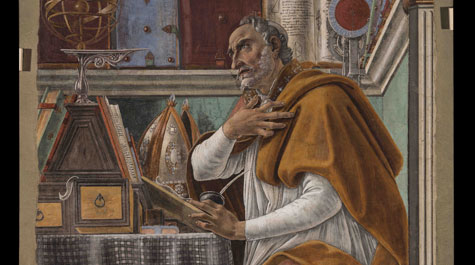
Sandro Botticelli, Sant’ Agostino nello studio (Saint Augustine in the studio), Fresco, Chiesa di San Salvatore in Ognissanti, Florence.
The Sacrament of Baptism: What Baptism Does Is a Mystery
Augustine sees in this the mystery of what makes the notion of sacrament so powerful in Christian theology. As Augustine reads Paul in Romans 6:4, baptism actually does something, despite the fact that Paul does not go into extensive detail about it. Baptism is not merely a symbol. It pertains to a reality that goes beyond what our feeble minds can grasp.
There is no prooftext that says “baptism is a sacrament,” but historically this is how those like Augustine understood baptism. The English word “sacrament” is derived from the Latin sacramentum, which is a translation of the Greek word mysterion, from which we get the English word mystery. There are several concepts, like baptism, which Christian theologians have described as a mystery, explaining why those like Augustine thought of baptism as a sacrament.
Like many other advocates of infant baptism, Augustine considered baptism to be the New Testament counterpart to the Old Testament’s insistence on circumcision as the primary identity marker for being an Israelite. As male infants were circumcised in ancient Israel, so are male and now female infants baptized as Christians. See Galatians 3:27-28:
For as many of you as were baptized into Christ have put on Christ.There is neither Jew nor Greek, there is neither slave nor free, there is no male and female, for you are all one in Christ Jesus.
A sacrament like baptism enacts reality for us. I got this idea of enactment from a book by Thomas Howard, the brother of the famous missionary Elisabeth Elliot, On Being Catholic. But the point is that the sacrament of baptism enacts the reality that only God can save the human being, and it is Augustine’s contention that baptism can in this sense “save” the infant, when they are not yet at the stage whereby they can exercise reason, and rationally comprehend ideas like “salvation by grace,” etc. Instead the infant can experience it through the act of baptism.
It is hard for us modern people living in the West to appreciate the impact Augustine’s theology has had over the long history of the Christian movement. Throughout most of human history, the infant mortality rate has been extremely high as compared to what the typical American family experiences in the 21st century. Even if you lived in the early 19th century in the United States, and in many parts of the world developing world today, there was/is a high probability that your child would not survive infancy. Yet today in much of the West, due to the benefits of modern medicine, the opposite is the case. Now, it is relatively rare for a child to die in infancy (though, obviously, it still happens tragically).
The Augustinian idea that baptism is connected to the salvation of the infant can bring great comfort to a mother and father grieved to the loss of a child, knowing that their deceased child is with the Lord. The same can be said for a family with a child (or even a young adult) that is mentally and/or emotionally challenged in some way, where the young person lacks the cognitive abilities to adequately grasp even basic concepts of Christian theology.
Augustine has not been without his critics. Many proponents of credobaptism; that is, the teaching that only a believer’s baptism is a valid form of baptism, and that infant baptism (otherwise known as paedobaptism) is not to be practiced, typically reject Augustine on this point. In other words, someone needs to demonstrate that they have genuinely come to know and believe in Jesus before they would be eligible for baptism, not after. They would generally argue that Augustine’s belief that infant baptism can wash away the taint of original sin makes baptism into a kind of work which actually undermines the theology of grace.
Instead, many credobaptists adopt the practice of “baby dedication” (some call it “family dedication,” “parent dedication,” “baby thanksgiving,” or something along those lines), whereby a pastor of the local church will publicly pray with a family that comes forward with their newborn, dedicating themselves to raise the child in a Christian home, and asking the congregation to join the parents in helping to raise the child in a discipling, Christian community, in the hope that when that child is old enough to exercise human reason the child might come to confess faith in Jesus, and then at some point become baptized (believer’s baptism) as an act of Christian obedience.
This has become standard practice in much of the world of American megachurch evangelical Christianity. It has become like a half-way mediating solution between credobaptism and paedobaptism, with respect to infant children. It has only become a common feature in American evangelical Christianity for about a hundred years or so (though how far back the practice actually goes is highly debated).
The problem is that such “baby dedication” is not the same as infant baptism. For if a child who has been a part of a “baby dedication” and not infant baptism then dies still in infancy, this could create (and indeed has created) a theological crisis for the parents in their grief. For what comfort would such parents have about the eternal destiny of their child?
Perhaps such parents could reimagine “baby dedication” to be somehow efficacious in the same way as infant baptism, but that would probably take a lot of theological creativity on the part of the parents, and probably more that one session of grief meeting with a church pastor to work things out.
Some hold to a doctrine of baptismal regeneration, which suggests that infant baptism actually saves the infant, and that this act of baptism somehow suggests an irrevocable salvation status regarding baptism. There are bunch of good debates on YouTube about baptismal regeneration, though I would recommend this conversation between Baptist apologist Gavin Ortlund and Roman Catholic apologist to be among one of the more helpful discussions.
Confusion About Infant Baptism
Most evangelical Christians reject such a theology of baptismal regeneration, as it can confuse a person, leading someone who has been baptized as an infant to wrongly believe that since they were baptized as an infant, this somehow gives them an irrevocable ticket to heaven. Some then rationalize that they can live a life completely contrary to any Christian commitment, and still be somehow “OK” with God. Again, this makes the sacrament of baptism into a kind of work, an example of “works-righteousness” which is completely contrary to a right-minded understanding of the Gospel.
“Saint Paul goes to great pains in 1 Corinthians 10 to argue that baptism does not necessarily entail salvation (1 Cor. 10:1–6)” (De Young, p. 163).
This passage talks about Old Testament Israelites being “baptized into Moses,” through the passing through the Red Sea, and the experience under the cloud in the Wilderness, but that most of them did not survive to make it into the Promised Land, due to disobedience.
In other words, infant baptism is not an irrevocable indication of someone’s status regarding salvation. For a person baptized as an infant, that person must still reason through and reflect on the meaning of their baptism, in order to make good on it, which appears to be consistent with what Augustine says as quoted above.
Augustine would reject the idea of getting re-baptized, something that a lot of evangelical Christians tend to do; that is, despite having been baptized as an infant (if they were), they go on and go through a “believer’s baptism” now that they finally understand what it means to be a real Christian. For Augustine, such re-baptism would be a needless attempt to “repeat the sacrament,” and completely miss the reality of what the sacrament is in the first place.
Needless to say, sacramental theology is still very much highly controversial in our churches today, whether it be about baptism, or the Lord’s Supper, or other matters related to the concept of sacrament. Some churches reject the language of “sacrament” altogether, preferring to categorize baptism as an “ordinance,” as opposed to being a “sacrament.” Some local churches try to take an “agree-to-disagree” posture regarding the credobaptism versus paedobaptism controversy, but they do so with mixed success.
Navigating Baptism as a Second-Rank Doctrine
However, most Protestant evangelical churches either go one way or the other, either they baptize infants or they do not. There is no middle ground, but rarely do churches split over the baptism issue nowadays. Many just try to muddle through the controversy somehow. But at least someone visiting the church will eventually figure out where that church lands on the issue. In his wonderful book, Finding the Right Hills to Die On, theologian Gavin Ortlund, reviewed here on Veracity a few years ago, argues that when navigating theological issues which divide churches, one must do what he calls “theological triage,” ranking different issues into four distinct categories:
first-rank issues: some doctrines are essential to properly defend and proclaim the Gospel. Ortlund puts something like the doctrine of the Virgin Birth in this category. For without a belief in the Virgin Birth of Jesus, our understanding of the Gospel is at stake.
second-rank issues: some doctrines are not essential to the Gospel, but they are urgent issues, in that they can and often do have an impact in how a church practices its mission. For these doctrines can lead to “divisiveness, confusion, and violations of conscience” (Ortlund, p. 95). Two common examples include (1) whether to allow certain charismatic gifts, like speaking in tongues and prophecy, to be publicly displayed during a worship service, and (2) whether to have women serve as elders in a local church (the so-called “complementarian” verse “egalitarian” issue).
third-rank issues: some doctrines are not essential to the Gospel, but are nevertheless still important issues to resolve. Nevertheless, Christians with different convictions in good faith can still participate in such a local church, while taking an “agree to disagree” posture. Two common examples include (1) different understandings of the age of the earth, and (2) different understandings of the “End Times” regarding the millennium and the rapture of the church.
fourth-rank issues: some doctrines are not essential to the Gospel, and they not important in terms of how Christians in a local church can work together to accomplish Gospel mission.
My classic example of a fourth-rank issue comes from a conversation I have had with a pastor friend of mine. He is convinced that the Apostle Paul wrote the so-called “prison letters”, like Ephesians, Colossians, and Philemon from a jail in Rome. I believe Paul wrote these letters from a prison cell in Ephesus.
How many people really care about where Paul wrote these letters from? Aside from a few Bible nerds like me, basically no one!!
Interestingly, Gavin Ortlund adds the doctrine of baptism as a common third example of a second-rank issue. Ortlund himself grew up in a church that practiced infant baptism, but when he took to studying the issue in-depth, he came to the conclusion that infant baptism was an improper form of baptism, and thus became a credo-baptist. Nevertheless, Ortlund looks to Saint Augustine, perhaps the most influential proponent of infant baptism in the history of Christianity, as one of his greatest theological heroes!!
Augustine has surely been the most influential Christian theologian in the Christian West, outside of the Bible itself, but Christians will still chafe against some of the theological positions he took hundreds of years ago. One may still reject the validity of infant baptism, as many evangelical Christians emphatically still do, but the purpose of this blog post has been to aid in having a more informed understanding of what infant baptism, as classically understood by Saint Augustine, actually is, and what it is not.
As we head into the summer of 2023, I wanted to list out some of best video/audio that I have dabbled in so far this year. Most of these talks and videos I have only started, only wanting come back to them later. It seems like everybody has a podcast or YouTube channel theses days, but I mainly want to highlight some of the best stuff out there…. and there is some really good stuff!
These deaths fall on the heals of a few notable deaths in late 2022, including Gordon Fee and E. P. Sanders. Gordon Fee was one of the most well-regarded evangelical New Testament scholars of that last quarter century, a curious mix of a keen intellect that produced some of the most outstanding commentaries of various New Testament books that thousands of pastors weekly consult for their sermons, and controversially having a strongly charismatic, Pentecostal background, with egalitarian convictions regarding women in ministry. Here is an 8-minute interview with Dr. Fee a few years before he died:
Yet I was also struck by the death of Atlanta Baptist pastor Charles Stanley. My first encounter with Charles Stanley’s ministry some 25 years ago was unfortunately not very positive (sorry Charles Stanley fans, but that is the truth). I had never heard of Charles Stanley before, and I was taken aback when one of Charles Stanley’s fans got really annoyed in one of my church history classes that I was teaching at my church. This woman rebuked me in front of the whole class, and sent me a stack of Charles Stanley tapes the next week, hoping that by listening to them they would straighten me out. She had somehow gotten the odd impression that I believed that the study of church history was more important than studying the Bible. The teaching on the tapes was actually pretty good. But I was still so bothered as to why this woman in my class felt that I needed to listen to Stanley, that I became pretty suspicious of him. Fast forward to about ten years later, I gained a more favorable appreciation of Charles Stanley when I went to hear him preach at the First Baptist Church of Atlanta.
After his recent death, I learned more about Charles Stanley’s life story, learning that he had a very difficult childhood, growing up for time with a single mom, and then enduring abuse from a step-father. I had no idea that his early life was so difficult, and how his relationship with Christ got him through very troubling times. His life story is worth listening to:
After the death of Queen Elizabeth, we now have a new King of England. Charles III was recently coronated as King of the United Kingdom. The ever delightful, contrarian, and indeed quirky atheist historian David Starkey remarks that the UK coronation ceremony is deeply rooted in Christian ritual. Starkey has a couple of videos that tell the history about the coronation down through the centuries, if you like that kind of stuff:
Probably some of the best listens I have had so far this year come from the Rest is History podcast. Everyone has probably heard about Dan Brown’s blockbuster novel, The Da Vinci Code, which became a Ron Howard movie starring Tom Hanks in 2006. In 2023, we stand at the 20th anniversary of when The Da Vinci Code was first written and took the world by storm. Brown’s book popularized a conspiracy theory that began in certain academic circles in the late 1970s, suggesting that Jesus Christ never went to the Cross, contrary to what you hear week after week in most church services across the globe. Instead, Jesus and Mary Magdalene got married, scuttled off to the other side of the Roman Empire, and their progeny had been living in Southern France for centuries, much to the consternation of the Roman Catholic Church who wanted to supposedly suppress the “truth.” If you could possibly pinpoint a date where “fake news” really began to take off in the 21st century, this might be the best candidate.
The Rest is History podcast creators, historians Tom Holland and Dominic Sandbrook, tell the story behind The Da Vinci Code, in Episode 301. But the tale is actually much bigger and more interesting than the narrative which filled Dan Brown’s pockets with a lot of money.
YouTube apologist Gavin Ortlund has some absolutely fantastic content that I need to listen to over again, just because it so rich. Ortlund has an interview with author Christopher Watkin, about his book Biblical Critical Theory, which is probably one of the most talked about books in the past year in evangelical circles. Watkin offers a biblical critique of the so-called “critical race theory.” I already have too many books on my “to be read” list, but this interview with Watkins sure entices my interest:
The Pints with Aquinas channel has great debate featuring Gavin Ortlund defending the Protestant doctrine of sola scriptura with Roman Catholic apologist Trent Horn criticizing sola scriptura. This is an excellent example of how charitable debates should be held with believers who strongly disagree with one another.
Baptist preacher and YouTuber Matt Whitman has an informative video interviewing Ligonier Ministries’ Dr. Stephen Nichols about “What Was the Great Schism and Why Did It Happen?,” talking about when Western and Eastern Christianity parted ways with one another about 1,000 years ago:
Along those same lines about “deconstruction,” Lutheran YouTuber Dr. Jordan B. Cooper, host of the Just and Sinner podcast, has a talk about Jacques Derrida, one of the foundational thinkers of postmodernism. Derrida popularized the terminology of “deconstruction”:
A lot of great documentaries/films are showing up on YouTube now, that once belonged behind a paywall. One of them is Fragments of Truth, where New Testament scholar Dr. Craig Evan’s talks about the discoveries of the New Testament documents we have found over the past few centuries which bolster our confidence in the historical reliability of the Christian faith. This gives Christians good answers to those who have read Bart Ehrman’s New York Times bestseller Misquoting Jesus:
A book by Collin Hansen is out now discussing the life and thought of the late Timothy Keller: His Spiritual and Intellectual Formation, interviewed by Gavin Ortlund:
…and FINALLY….. something a little fun, in honor of the late Tim Keller. How about “Carpool Karaoke with Tim Keller!”
ONE QUICK ADMINISTRATIVE NOTE: WordPress is no longer distributing blog post announcements via Twitter, so be sure to sign up via email by clicking the black “Follow” button on the right hand side of the Veracity page, if you want to receive announcements of new blog posts from Veracity, and stop using the “Follow” button for Twitter, which no longer works.
William Lane Craig is often regarded as the most prominent living Christian philosopher on the planet defending the Christian faith today. However, a recent article that Craig wrote for the magazine First Things has resulted in a firestorm of controversy.
Craig, the founder of the apologetics ministry, Reasonable Faith, and Professor of Philosophy at Houston Baptist University and Research Professor of Philosophy at Talbot School of Theology, has recently published a book regarding the historicity of Adam and Eve, and the literary genre of Genesis 1-11 more broadly: In Quest of the Historical Adam: A Biblical and Scientific Exploration. His essay at First Things summarizes his thesis, and Craig concludes that the Adam and Eve of Genesis are both historical and mythological figures in the Bible, and Craig also concludes that Genesis 1-11 is an example of the literary genre of mytho-history found in the Bible. Furthermore, Craig argues that Adam and Eve go back to a common ancestor shared between modern humans and Neanderthals, between 750,000 to 1,000,000 years ago. Craig’s view can be quickly summarized in this 4-minute linked YouTube video.
Some Christians, such as Reformed apologist James White, of Alpha Omega Ministries, and one of the most capable Christian debaters today, hold largely to a presuppositionalist approach to Christian apologetics, where one begins one’s apologetic method with an assumption, or presupposition, that exists as revelation that can not be refuted. This is different from an evidentialist approach to Christian apologetics, that William Lane Craig tends to follow, urging Christians and non-Christians to “follow the evidence wherever it leads” towards the discovery of truth. Interestingly, White is not consistent with his own apologetic method, as White comes across as holding an evidentialist position when defending the reliability of modern Bible translations, in contrast with the presuppositionalist approach taken by KJV-Onlyists (see the comments in this linked Veracity article), who only view the King James Version of the Bible as being THE one-and-only divinely preserved version of the Bible. Nevertheless, James White gives his own broadly framed critique of William Lane Craig in this linked YouTube video, selected from one of his Dividing Line podcast programs. White’s critique here is a bit “off-the-cuff” but it can give you a flavor as to how different Christians approach apologetics differently.
Many Christians are convinced that the truthfulness of the Christian faith hangs and falls on the historical narrative of Adam and Eve. Others view Adam and Eve as merely metaphorical symbols representative of the story of humanity more broadly. Is there a common ground solution to be had here?
What makes this issue so challenging to navigate is that while many Young Earth Creationists, and even some Old Earth Creationists, will make an appeal to the beliefs of the earliest Christians among the early church fathers, in support of their views, the question of relating history and metaphor together is far from simple even among the early church fathers, when it comes to interpreting Genesis 1-11.
In the following YouTube video, Protestant theologian Gavin Ortlund offers a friendly rebuttal to Owen Strachan’s critique of William Lane Craig, by focusing on the complex views of Saint Augustine, the most influential Christian theologian in the Western church, dating back to the early 5th century. After that, I have linked to a YouTube interview by apologist Sean McDowell with William Lane Craig about his new book. The Ortlund video is 15-minutes long. The Craig interview with McDowell is an hour long.





 Veracity