Tag Archives: Christianity

Killing Jesus: I Guess It All Evens Out?

First, there was Reza Aslan's Jesus the Zealot.  Now, there is Bill O'Reilly's Killing Jesus.   Both books have their merits, but I would suggest sticking with books written by less politicized New Testament biblical scholars....and if you do not have time for that, just stick with the Bible.

First, there was Reza Aslan’s Jesus the Zealot. Now, there is Bill O’Reilly’s Killing Jesus. Both books have their merits, but I would suggest sticking with books written by less politicized New Testament biblical scholars….and if you do not have time for that… just stick with the Bible, please.

Several months ago, I reported on Veracity about Reza Aslan’s controversial yet popular book, Jesus the Zealot. Several waves of biblical scholars mostly panned the book, citing that despite a few thoughtful ideas here and there and some very engaging storytelling, Aslan fails to contribute anything substantially new to the discussion regarding our understanding of the historical Jesus. Now, just a few months later, conservative news commentator Bill O’Reilly has made his stab at writing a biography of Jesus of Nazareth, Killing Jesus.

Over at Anthony Le Donne’s scholarly Jesus Blog, we find an initial take on O’Reilly’s (with co-author Martin Dugard) latest blockbuster, following on the heels of other popular subjects, such as Killing Kennedy and Killing Lincoln. Sadly, Le Donne is not impressed so far. At best, Le Donne finds O’Reilly’s use of biblical and historical sources to be inconsistent. But here, Le Donne quotes one of O’Reilly’s leading statements at the beginning of the book:

Jesus was executed. But the incredible story behind the lethal struggle between good and evil has not been fully told. Until now. At least, that is the goal of this book.” (page 4)

Wow. Such hubris. Despite the thousands and thousands of pages already printed investigating the historical identity of Jesus of Nazareth, O’Reilly is telling us that only now will he begin to tell us the full story.

That is simply incredible.

Just think about this for a moment. Here are two books by Aslan and O’Reilly that have rocketed to the top of the New York Times best seller lists. The folks at the apologetics website Stand to Reason appear to be some of the few Christians who generously find O’Reilly to be somewhat helpful, but even they stop short of a full endorsement. Furthermore, even Ken Ham at Answers in Genesis finds something to disapprove of regarding Killing Jesus. In some cases, O’Reilly takes the New Testament accounts at face value for being historical. At other times, he dismisses key aspects of the Gospels as historically valid. In the reviews I have seen, it does not seem at all clear what O’Reilly’s method is for making his historical judgments.

I wonder why you do not see books by top-notch evangelical New Testament scholars like N.T. Wright, Craig Blomberg, Ben Witherington, Craig Evans, Gregory Boyd, Mike Licona, Gary Habermas, D. A. Carson, Gregory Beale or Darrell Bock at the top of the New York Times Best Seller lists? On the positive side, both Aslan and O’Reilly show that people are still fascinated with the person of Jesus Christ, which provides a very natural opportunity for the believer to start up spiritual conversations with their neighbor.  However, it is difficult to restrain myself from thinking that politics might be part of the reason for Aslan’s and O’Reilly’s success with their books.  I do not mean to step on anyone’s toes, but it would concern me if the story of Jesus is getting manipulated here to support some different agendas.  I suppose that if Reza Aslan writes something that appeals to so-called “liberals” that O’Reilly feels compelled to write something appealing to so-called “conservatives”. I guess it all evens out perhaps?

Just a Few Weeks Away!!

Facts & FaithCome join the Veracity community at the Facts & Faith Symposium, to be held at the Williamsburg Community Chapel, on several Sundays in November, 2013 (the 10th, 17th and 24th) at 6:30pm.

Life After Death (Part 2)

“Just as we are now like the earthly man, we will someday be like the heavenly man.”
1 Corinthians 15:49 (see Dick Woodward’s post)

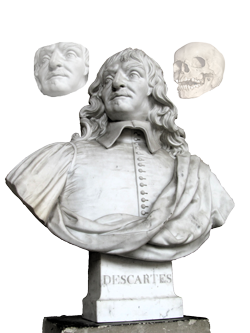
Rene DescartesHave you ever thought about your thoughts? This may seem like a ridiculous question, but it turns out there is a powerful apologetic argument for life after death that derives from simply understanding that humans have a body and a soul, and that the immaterial element (the soul) is spectacularly different from the material element (the body).

Continuing our review of the Areopagus Journal issue dedicated to Life After Death (Fall 2011), in this post we will explore what apologetics can bring to bear on the subject using philosophy, logic, and history.

The blog text below in italics is entirely the writing of Chad V. Meister.  I have edited out quite a bit of material to fit this format, without (I hope) misrepresenting his beliefs and positions.

Mind, Body, and the Possibility of Life After Death

Various conceptions of the human self have been held in the West, the two foremost being dualism and materialism.  Historically, dualism has been the more prominent of the two.  There are different conceptions of dualism as well, but on one main account the human person consists of two substances, one material (the body) and the other immaterial or mental (the soul or mind).  Rene Descartes (1596-1650) is perhaps the most widely recognized defender of substance dualism.  On his account, sometimes called the Cartesian view of the soul, the soul is an unextended, non-spatial substance, and it is contrasted with the body, an extended, spatial substance.  The soul and body are (somehow) connected to one another, but how an immaterial substance can connect to and interact with a physical substance is a bit of a mystery—a mystery which has often been castigated as the problem of the “ghost in the machine.” Continue reading


Christians in Assad’s Syria

Maaloula, St. Takla Convent, Syria.   Refugees from the Syrian civil war are hiding here as of early, September, 2013.  Residents of this village still speak a dialect derived from the ancient Aramaic, the language that Jesus spoke.

Maaloula, St. Takla Convent, Syria. Refugees from the Syrian civil war are hiding here as of early, September, 2013. Residents of this village still speak a dialect derived from the ancient Aramaic, the language that Jesus spoke.

As of early September, 2013, the world has been shocked by reports of chemical weapons being used in the civil war in Syria.   Numerous reports in the media argue that President Bashar al-Assad was behind these attacks. This horrible tragedy surely deserves at least some response.   But what kind of response?

Philip Jenkins is a renowned evangelical historian at Baylor University.   He has studied extensively the history of Christianity in the Middle East and the rest of the Mediterranean region.    Jenkins recently wrote an editorial piece giving his view that the lessons of church history should give American leaders caution in their response to the situation in Syria.  In particular, will a military intervention in Syria help or hurt the existing Christian community in Syria?

Jenkins’ position is that military intervention in Syria will not only hurt the Christians, it could ultimately lead to the annihilation of the Christian community in that country.  Pretty strong words.

Sadly, many American Christians are largely ignorant about the history of Christianity in this part of the world.  As I have tried to show with the recent situation in Egypt, the issues are exceedingly complex.   Frankly, I am not sure what the clear answer is on what to do.   But what I do know is that most Christians in the Middle East and particularly in Syria itself oppose outside intervention into Syria’s internal problems.   Assad is not the nicest guy in the world.  That much is over-abundantly clear.  But Christians in the region have looked to Assad and his family for many years for at least some protection from Islamic extremists.   What will happen to an already persecuted church if the country is further destabilized?

Perhaps you might have a completely different view.   Perhaps Jenkins is mistaken. There is much that I do not know.  Nevertheless, as a Christian in America what I do know that it is my duty and responsibility to listen to my brothers and sisters in Christ in Syria and make a better effort to fully understand their history and appreciate their situation today in view of the present crisis.


Unwinding with Alvin Plantinga

“Be merciful to those who doubt;”
Jude 22 (NIV84)

Alvin Plantinga

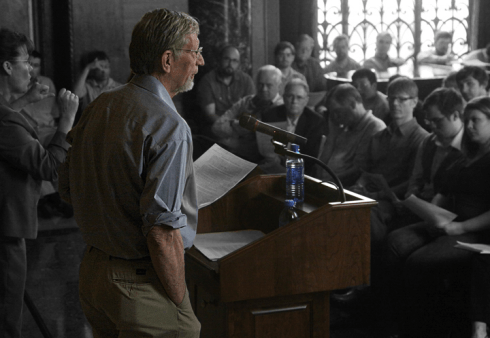
Alvin Plantinga speaking to students and faculty at Baylor University on April 26th, 2012 (photo credit: Chris Derrett).

Have you ever heard a presentation of the Gospel that goes something like this: “Hell is hot, death is certain, Jesus saves, turn or burn”? This is the Ripley’s (Believe It or Not) version of the Gospel. While this presentation may work—if only pragmatically—on a theological level, it’s a complete mess on a personal, relational level. It falls so short of the mark. Unfortunately, there are a lot of people who hear the message of Jesus Christ just this way.

I came across a common theme in atheists’ objections to Christianity three times last week—specifically that Christians are misguided. You know: the Bible is a bunch of fairy tales and legends, a loving god wouldn’t allow evil and suffering, there is no god, hell is an invention, science disproves Christianity, and so forth. (If you’re not running into these objections might you be playing it a little too safe in sharing your faith?) One atheist posted a rant in which the sophomoric level of his uninformed statements exposed his unwillingness to think rationally about theism and Christianity. They also pointed to a long line of Believe-It-or-Not presentations that left negative impressions. (His argument denying the plausibility of God was solely based upon his personal conviction that there can be no such thing as hell.) Who ‘shared’ their faith with him, and how? Too much truth and not enough grace? Continue reading


Rhetoric That Still Matters: “I Have a Dream”

Martin Luther King, Jr.

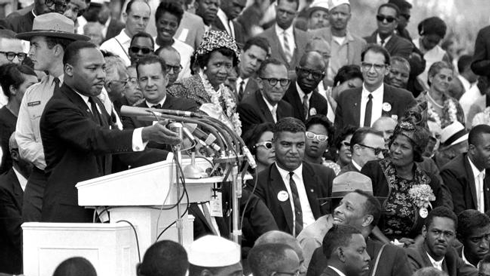
Dr. Martin Luther King, Jr. delivering his “I Have a Dream” speech—50 years ago today.


I still get emotional reading this speech. This is how you start a revolution. This is rhetoric that still matters.