Tag Archives: Christianity

Can We Trust the Bible?

“The Bible says it, I believe it, that settles it.”  Really?!

Many theologians and pastors strongly disagree.  If there was such a thing as a fantasy theology team, my top (living) draft picks would include: Dick Woodward, William Lane Craig, Hugh Ross, Ravi Zacharias, Matt Slick, Tim Keller, John Yates, Michael Card, Ray Vander Laan, Andy Stanley, Lee Strobel—and Daniel Wallace.

Here’s a slightly irreverent, very funny, and spot-on lecture by Dr. Wallace given at Dallas Theological Seminary about the “worst Christian slogan ever concocted” (my apologies in advance to people from Arkansas).

Seriously, how much research is there to corroborate Dr. Wallace’s observations and conclusions?  How reliable are the Bibles we have today?

Continue reading


The Resurrection

The resurrection of Jesus is the basis for the Christian faith.  No resurrection, no Christian faith—it’s that simple according to the Apostle Paul, who wrote half the New Testament.  But how well does the resurrection stand up to historical scrutiny?

The Gospel accounts of Jesus’ burial and resurrection are found in:

Matthew 27:27 – 28:15,
Mark 15:42 – 16:8,
Luke 23:50 – 24:12, and
John 19:38 -20:18.

Here’s a presentation on the historical reliability of these accounts by Dr. William Lane Craig, in which he uses analytic philosophy to get at the truth of the resurrection.  If this sounds a bit intellectually over the top, check out our recent Apologetics 101 post where he explains the process—using logic, clear definition, and the careful enunciation of arguments, with an emphasis on the derivations of conclusions from premises.  It’s a lengthy video, packed full of sound reasoning, and well worth the time it takes to watch.

Backstory

So how did William Lane Craig, one of the greatest deep thinkers of our time, come to faith in Christ?  It must have been in response to the writings of someone like C.S. Lewis or Søren Kierkegaard, right?  Maybe he read classical theologians like Augustine of Hippo, or reformists like Martin Luther, John Calvin, or Thomas Aquinas?  Or maybe he read the Bible and found some special truth that appealed to his intellect?

Here’s Dr. Craig’s surprising answer (you just can’t make this stuff up).

He was “hit like a ton of bricks” by an annoyingly happy girl named Sandy.  Go figure.


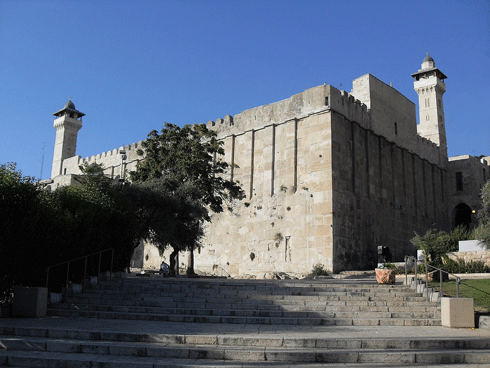
Cave of the Patriarchs

Cave of the Patriarchs

Cave of the Patriarchs, Hebron, Israel

“Then Abraham breathed his last and died at a good old age, an old man and full of years; and he was gathered to his people. His sons Isaac and Ishmael buried him in the cave of Machpelah near Mamre, in the field of Ephron son of Zohar the Hittite, the field Abraham had bought from the Hittites. There Abraham was buried with his wife Sarah.”
Genesis 25:8-10, NIV

There are so many strange names and places in the Bible it’s easy to just keep reading without digging into the details.  But the details contain evidence for the historicity of the Scriptures, even if we don’t appreciate them.  Just because we’re dealing with “long ago and far away” doesn’t mean we’re reading fairy tales.

For all their pratfalls and controversies, archaeology and history have a lot to offer in terms of making sense of obscure names and places.  Take the “cave of Machpelah near Mamre” in Genesis 25 for instance.  It turns out that this cave is a well-known place, also known as the “Cave of the Patriarchs.”  The cave is memorialized in Judaism underneath the only fully surviving Herodian structure from the first century.  According to the biblical accounts in Genesis, Abraham, Isaac, Jacob, Sarah, Rebecca, and Leah—the Patriarchs and Matriarchs of the Jewish people—were all buried in this cave.  We are also told in Genesis 23 that Abraham paid Ephron the Hittite 400 Shekels of silver for the cave, the field, and all the trees in the field.  Pretty detailed information. Continue reading


The Dalai Lama is Coming!

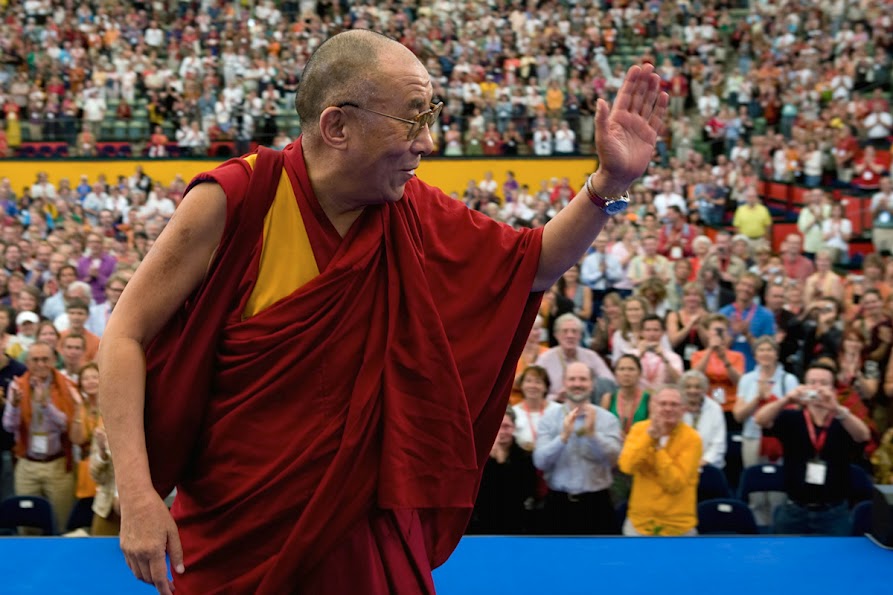
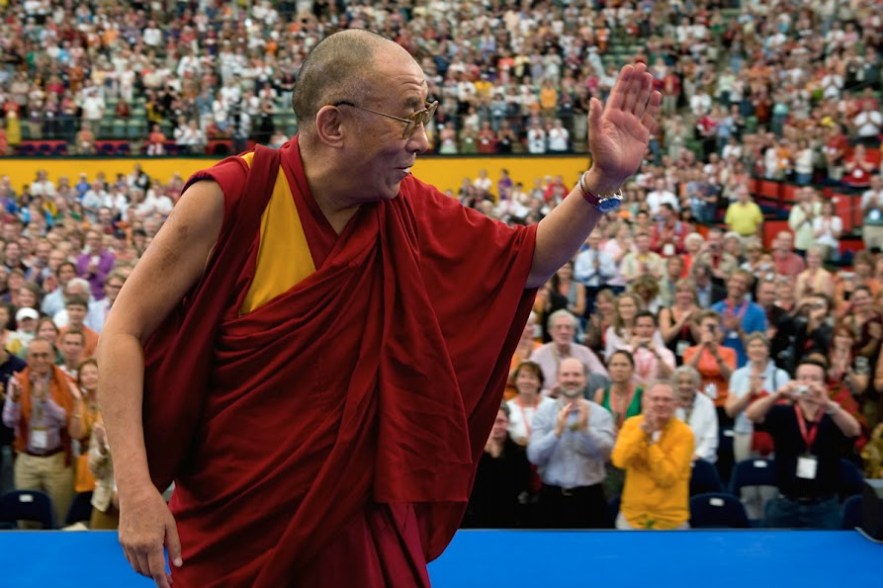
I play soccer with a group of friends at the College of William and Mary, where I work as an IT staff person.  At the end of one of our games, we were talking about the upcoming visit by the Dalai Lama to speak at William and Mary Hall, on Wednesday, October 10.   There were several jokes about strange Eastern religious customs and how hot it would be to wear a monk robe all day long.  One made a sly remark about attaining “enlightenment” from the marijuana fumes rising up from the crowded Kaplan Arena this coming Wednesday from smuggled-in contraband.   This is a big deal event for the College, with several thousand tickets sold out within minutes to hear the venerable representative of international Buddhism.  So what is the big deal about the Dalai Lama?
Image

The 14th Dalai Lama

Actually, Tenzin Gyatso is the 14th reincarnation of the Dalai Lama, according to Tibetan Buddhist tradition.   For hundreds of years, an unbroken line of spiritual teachers in Tibet have instructed the Buddhist faithful.  But the Dalai Lama is more than a religious leader position, it is also a  political role, unifying all of the Tibetan region north of the Himalayan mountains in Asia.  So when Communist China invaded Tibet in 1950, it put the current Dalai Lama into a difficult situation.   After a failed uprising against the Chinese in 1959, the 14th Dalai Lama fled and established a government in exile in India.  The United States government has at times given support to the Dalai Lama’s efforts on behalf of the Tibetan people during the past fifty years.

Over those years, the exiled Dalai Lama has served as an international ambassador  in the West for Buddhism.  There are Four Noble Truths of Buddhism:  (1) all of life is suffering, (2) all human desire leads to suffering, (3) the annihilation of desire releases us from suffering, which is enlightenment, and (4) there is an Eightfold path  to that enlightenment; that is, right view, right intention, right speech, right action, right livelihood, right effort, right mindfulness, and right concentration.  Buddhism, however, is not a monolithic movement.   The Dalai Lama represents part of the  Mahāyāna tradition.  But the most popular form of Buddhism in the West is a more concentrated variant, Zen Buddhism, first propagated largely by the famous Japanese philosopher,  D. T. Suzuki, in the early to mid-20th century.  Oddly enough, Buddhism is considered by many to be a “religion” but the more philosophical traditions are  technically atheistic.   Even so, there are syncretic flavors that combine animistic beliefs with traditional Buddhist philosophy.    The study of Buddhism can get very complicated very quickly. Continue reading


Does God Exist?

Believe it or not, formal debates on the existence of God regularly turn out thousands of ticket-buying intellectuals to hear atheists and theists go at it. Although it may seem silly to give out medals for something every kindergartener should know, there is much to appreciate in well-turned arguments that support the affirmative.

Setting personal style biases aside, how do the best theists make their case for the existence of God? For a sampling of how heady this question can get, check out William Lane Craig, Research Professor of Philosophy at Talbot School of Theology. Sam Harris, one of today’s most prominent atheists, recently described Dr. Craig as “the one Christian apologist who seems to have put the fear of God into many of my fellow atheists.” Continue reading