
Yesterday, Halloween, we also recognize (or “should recognize,” more importantly) that this year marks the 499th year after Martin Luther nailed his 95 theses to the door of the Castle Church, in Wittenberg, Germany. Does the Reformation that Luther’s hammer triggered all those years ago still matter today? Pastor/teachers Don Carson, John Piper and Tim Keller answer that question.
Jack Chick and the Real Halloween Scare
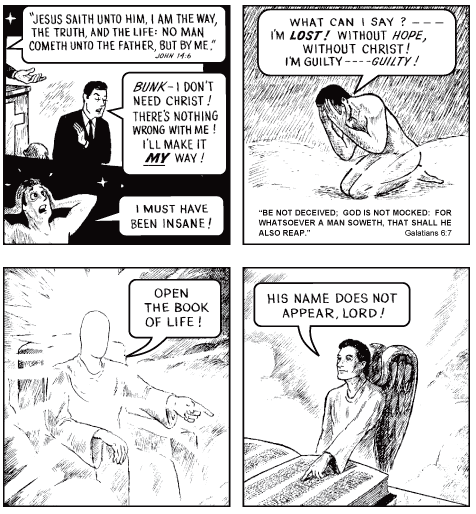
Jack Chick, fundamentalist cartoonist, died at age 92, on October 23, 2016. His most popular comic book tract was This Was Your Life, viewable in full at www.chick.com, though I have included a few pages here. Jack Chick and the popular obsession with fear at Halloween have a lot in common .
I read my first “Chick tract” at a highway rest stop on Interstate 95 as a teenager. A middle-aged gentleman handed me this small comic book, spoke a few words, and before I could glance at what he gave me, the man quickly walked away. It was Jack Chick’s tract, This Was Your Life. I was already a follower of Christ, but what I read disturbed me, in more ways than one.
In one sense, Jack Chick was right. Before the scene shown above, a man who lived his life indifferent to the things of God, dies. Then this dead man was brought before the judgment seat, having his entire life exposed before the Lord, like on a theatre screen display. The hidden things were brought to light, demonstrating that his life, lived apart from Christ, had negative eternal consequences. He thought he could “get away with” sinful thoughts and actions in his life, thinking no one would notice, when in reality, nothing escapes the notice of God.
It is a terrifying thought. Continue reading
Jonah’s Nineveh and Modern-Day Mosul

In July, 2014, militants of the Islamic State blew up the Tomb of Jonah, a memorial site with significance for both Muslims and Christians, as it honored the famous Old Testament prophet, called to preach in the city of Nineveh, now part of modern-day Mosul, in northern Iraq.
Much of the attention surrounding the Book of Jonah focuses on the story of Jonah being swallowed for three days and three nights by a “whale.” There is a lot of confusion about this. For one thing, the actual Bible text calls it a “great fish,” and not a “whale” (Jonah 1:17). But in this post, I want to focus briefly on the city where Jonah was called to preach: Nineveh.
Nineveh was the capital of the ancient Assyrian empire. The Bible talks quite a bit about the threat that the dreaded Assyrians posed for the Israelites, a threat that was eventually realized by the destruction of the Northern Kingdom of Israel, in the 8th century before the birth of Christ. So, you only imagine the horror experienced by the prophet Jonah, first mentioned in 2 Kings 14:25, when he was called by God to urge the citizens of Nineveh to repent, and come to know the God of Israel.
Nineveh was the last place Jonah wanted to be.
The city of Nineveh is in the news quite a bit these days. Nineveh is part of the greater city of Mosul, in Iraq, where a coalition of military forces have been trying to force the Islamic State out of the city. Many skeptics may dismiss the story of Jonah as a “fairy tale,” but the story of what has happened in today’s Mosul is tragically real. For example, thousands of Christians have had to flee the city from the Islamic State, and surely, some remain, fearful for their lives. We should pray for them. Given what we know about Nineveh/Mosul today, I can relate a bit to Jonah’s desire not to go the Nineveh. I would not want to be there either! Continue reading
One Reason Why John Stott’s Stand Against Martyn Lloyd-Jones Mattered
Fifty years ago this week, the great British evangelical independent preacher, Martyn Lloyd-Jones, clashed with Anglican, John R.W. Stott, another great British pastor, over the future of the evangelical movement in the United Kingdom. Jones was urging evangelicals to leave corrupt institutions, whereas Stott pushed back, reminding fellow evangelicals of the importance of maintaining a Christian witness. Stott’s argument won the day, yet Puritan historian, Iain H. Murray, believes that the acceptance of Stott’s efforts led to evangelical compromise. However, the following blog post, by British blogger Alastair Roberts, offers a different perspective, that I find helpful to think about.

 A couple of days ago, Justin Taylor published an interview with the Rev Dr Andrew Atherstone, upon the fiftieth anniversary of a pivotal event in English evangelical history. At the National Assembly of Evangelicals on October 18, 1966, two of the biggest figures among British evangelicals in the day, the Welsh minister of Westminster Chapel in London, Martyn Lloyd-Jones, and John Stott, rector of All Souls Church, had an important dispute about the future of evangelicals within the Church of England.
Lloyd-Jones gave an address calling for evangelicals to pursue visible unity with other evangelicals, accusing Anglican evangelicals of schism for their failure to unite with evangelicals outside of the Church of England, and of serious compromise for their continued involvement in a mixed denomination alongside doctrinally and spiritually unfaithful persons. Although he was the chairman, Stott publicly responded to Lloyd-Jones’ remarks, resisting his claims and appeal to Anglican evangelicals.
View original post 1,180 more words
Feel free to share our book…

Join the Conversation
Clarke Morledge on The Stain of Antisemitism in… Clarke Morledge on The Septuagint: What It Is and… Did God Crush His On… on Did God Kill Jesus? The Cross… Did God Crush His On… on Authorized: The Use and Misuse… Did God Crush His On… on Reviewing Bart Ehrman’s… Did God Crush His On… on The Septuagint and the Origina… Did God Crush His On… on The Septuagint: What It Is and… Clarke Morledge on Does Science Make the Biblical… Clarke Morledge on From Genesis to Junia: An Hone… Clarke Morledge on What About Those “Lost S… jdelias on Did Kirk Cameron Just Deny the… Clarke Morledge on “Inconceivable” Fa… 
Document everything… on Paul, A Biography, by N.T. Wri… Clarke Morledge on Christianity Along the Rhine:… Build A Hooper on Christianity Along the Rhine:…


 Veracity