The Southern writer Flannery O’Connor wrote: “While the South is hardly Christ-centered, it is most certainly Christ-haunted. The Southerner, who isn’t convinced of it, is very much afraid that he may have been formed in the image and likeness of God.”
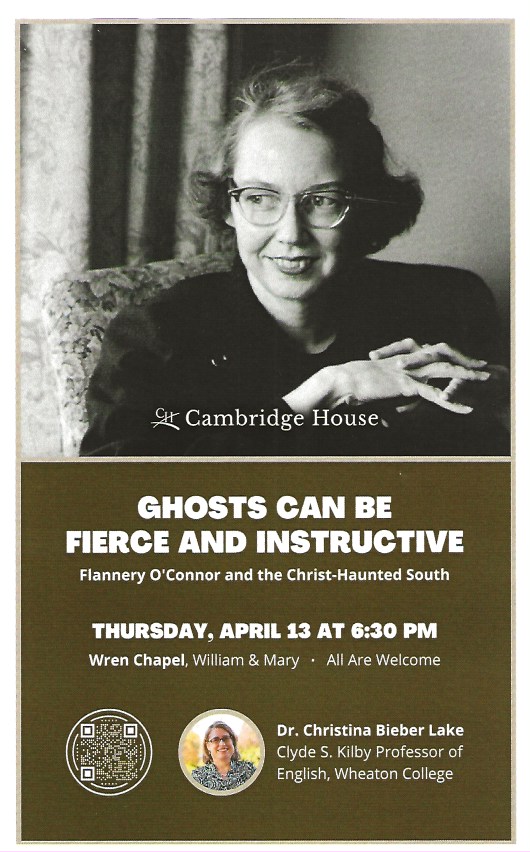
On Thursday, April 13th, at 6:30pm, at the Wren Chapel, on the campus of William and Mary, the Cambridge House at the College of William and Mary will sponsor its first public lecture, a talk given by Dr. Christina Bieber Lake, professor of English, at Wheaton College entitled “Ghosts Can Be Fierce and Instructive: Flannery O’Connor and the Christ-Haunted South.”
Flannery O’Connor is widely regarded as one of America’s greatest fiction writers of the 20th century. O’Connor, who died at age 39 after a long, debilitating battle with lupus, was not simply a master of her literary craft, she was a devout Roman Catholic, living in the predominantly Protestant Deep South, in Georgia. For you diehard Protestants, do not let Flannery O’Connor’s confessional loyalty dissuade you. O’Connor wrote dark yet funny stories about Southerners, where she was able to communicate a subtle Christian theological vision of what it means to be human, in a way that still fascinates secular critics decades later. Her short-stories, such as the 1955 gothic tale “A Good Man is Hard to Find,” have become classics of American literature.
Dr. Lake specializes in the area of Flannery O’Connor scholarship. A brief reception at the Wren Chapel will follow her lecture. All members of the William and Mary community, students, faculty, staff, and friends and neighbors of the College are welcome to attend, to find out what the work of the Cambridge House is all about.
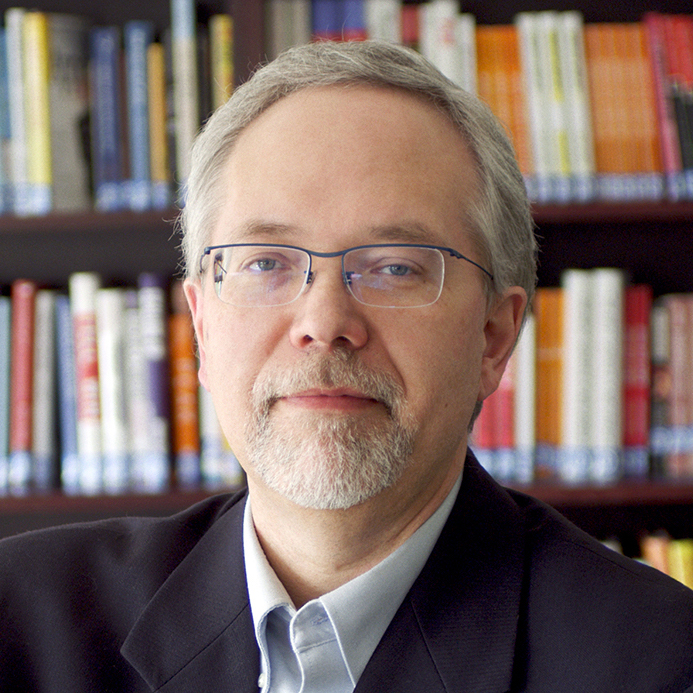
After about a year and a half battle with cancer, Dr. Michael S. Heiser has died. If I had to pick one evangelical biblical scholar who has impacted me the most over the past twenty years, it would be Michael Heiser.
Michael Heiser. Semitic languages and Old Testament scholar.
I first heard of Dr. Michael Heiser through a podcast that was recommended to me some eight or nine years ago, where Heiser went chapter-by-chapter through a book of the Bible, not quite verse-by-verse, but close enough, bringing his scholarly acumen to bear on the passage under discussion. This was before I ever sat down and read his mind-changing book, The Unseen Realm, that I finally got around to read just a few years ago. The Unseen Realm, along with the shortened, less academic version of the same, Supernatural, are books that have forever changed the way that many Christians have read their Bibles for the better. I am one of them.
In The Unseen Realm(read my review), Dr. Heiser tells the story of how as a graduate student in ancient history, Semitic languages, and the Hebrew Bible, while earning advanced degrees at the University of Pennsylvania and the University of Wisconsin-Madison, he stumbled on a different way of reading Psalm 82, that changed the way he read the whole of the Bible. To his amazement, after spending years in academic study, he had previously missed the Bible’s teaching about the “Divine Council” of God. This teaching was known among the ancient Israelites and Second Temple Jews of the Old Testament, but it had somehow become obscured or even lost among many Christian thinkers. As Christianity spread in the Gentile world within the first few centuries of the church, fewer and fewer believers adequately understood the uniquely Jewish context behind the Second Temple and early Ancient Near East cultural world of the Hebrew Scriptures.
As Mike, as he liked to be called, often said about the Old Testament: “Our contexts are foreign. They derive from church tradition that is thousands of years removed from the people who wrote Scripture and the audience to whom those people wrote.”
This supernatural world of the Bible explored by Dr. Heiser opened the door for me to understand a number of confusing Bible passages, that remained nothing more than mysteries to me. To summarize one of Dr. Heiser’s main ideas behind doing Bible study: “If it is weird, it is important.” Everything from the Nephilim of Genesis 6 to the head coverings passage of 1 Corinthians 11, Dr. Heiser was able take a lot of the best evangelical scholarly research on the Bible, and put it on the lower shelf, to help explain some of the stranger parts of God’s Word.
Furthermore, Michael Heiser has probably been one of the best apologists for the Old Testament, combining evangelical faith with academic rigor. Unlike many other scholars like him, Dr. Heiser was not raised in an evangelical church home. He was pretty much as unchurched as they can be when he finally gave his life to Jesus as a teenager. Yet unlike many other young teenagers who became believers, he nerded out quickly. He would take biblical commentaries with him to high school, in order to squeeze every minute he could to try to gain a better understanding of the text of Scripture. He never settled for accepting everything that was said from a church pulpit. Instead, he plowed deep into scholarship, avoiding pat answers to difficult questions, in an effort to fact check what he was being taught in various church settings. This nerdy love for the Bible would serve him well as a first rate Bible scholar later in life.
Like almost any scholar, I have not always agreed with Dr. Heiser on every point he was trying to make, or else he simply was not able to convince me. His primary interest in the biblical theology of the Divine Council often led him to ignore or sidestep other important issues in the interpretation of Scripture. At times, Dr. Heiser tended to shortchange or be overly dismissive of the tradition of the early church and certain elements in Reformation theology, and he even promoted a kind of despair that we can know anything about eschatology with any level of confidence: that is, regarding how believers should think about the specifics of the Second Coming of Christ (my basic answer can be found here).
But such criticisms should not take away from the valuable contribution he has made to reinvigorate my love for Scripture, as well as encourage others to dive deeper into God’s Word. Dr. Heiser’s insights into the “Unseen Realm” excited him more about the deep truths taught within Scripture, and in his passion and confidence in that teaching he was adamant not to get bogged down in other never-ending debates among believers that might distract from the core principles of Bible study he was trying to instill within his readers and podcast listeners. I really can not fault him for that.
His death will leave a big hole in the world of taking the best of evangelical scholarship and putting it down on the bottom shelf, making it accessible to mere mortals. Yet thankfully, Dr. Heiser has given the church a great gift through his teaching ministry, and his influence will continue, and hopefully encouraging other gifted scholars to serve God’s people with exceptionally powerfully and helpful content. If you are new to Dr. Heiser, check out his YouTube channel, the MIQLAT.org website (geared primarily towards newer Christians and non-believers), or the “Live in Context” video curriculum, the first video which begins below:
Over the past week, I have been thinking about the death of the United Kingdom’s sovereign, Queen Elizabeth II. There might be some lessons for Christians in this time of mourning.
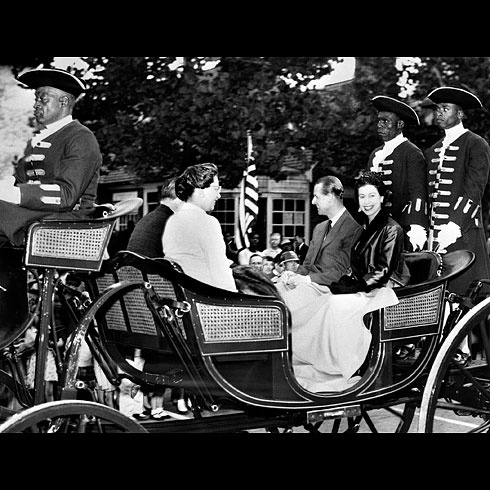
First, a quick and curiously fun anecdote: The right-most carriage attendant, in a tricorne hat, in the above photograph was a dear friend of my parents. His son works in my building, where I work at the College of William and Mary today. This man had the opportunity to accompany the carriage that carried Queen Elizabeth II through Colonial Williamsburg some 65 years ago. Elizabeth is seated, smiling and facing the camera. Her husband, Prince Philip, is seated to her right.
At age 31, in 1957, just five years after she was declared as Queen of the British Empire (1952), Elizabeth II made this visit to Williamsburg, Virginia, to commemorate the 350th anniversary of the founding of the English colony at Jamestown. My parents’ friend years later told me that it was quite a spectacle to be with the Queen, and ride down Duke of Gloucestor Street, through the center of town.
During those years, Elizabeth II had begun to oversee the dissolution of the British Empire, as one-by-one, former colonies declared their independence from the English island. This led to the modern creation of the United Kingdom, with its associated British Commonwealth of Nations. Some today still protest that the British monarchy has not done enough to apologize for the injustices inflicted during those centuries of British colonial rule. After all, the monarchy is not very democratic. The whole idea of having a “king” or a “queen” seems really quirky to some, even unfair…. even unjust!
Perhaps this will pigeon-hole me, and typecast me as a hopeless traditionalist, but I have been profoundly moved by the Queen’s death. Elizabeth’s first prime minister, Winston Churchill, was born during the Victorian era in 1874. Elizabeth’s last prime minister, the current Liz Truss, was born in 1975, just over a hundred years later. The span of time that Elizabeth II has served has been breath-taking. The events during her lifetime, from her service as a driver and mechanic for the Auxiliary Territorial Service, during the crisis of World War II, to the 2020 Coronavirus pandemic have been world changing.
Her life encompassed 30% of the entire history of the United States.
Staggering.
She even parachuted into the London 2012 Olympics with James Bond…. well, sort of...
But as an American, Queen Elizabeth was not my sovereign. So, I am left trying to figure out why I have been so emotionally struck by her death. Why have I been so choked up about her? I have a few thoughts, so I await your comments in the comment section of the blog.
What strikes me the most about Queen Elizabeth II was that she served out of a profound, even sacred sense of duty, even in the most spiritual way. She assumed her role in the most sacramental manner, in the best sense of the word. She was a type of guardian of traditional values over a long period of time, during a period of great cultural upheaval. For 70 years as chief monarch, she was able to rise above partisan politics, surviving many prime ministers and political shifts. But there she stood, resolute in her duty, and in every Christmas message, she was quite explicit in making her Christian faith known.
I found her testimony comforting. Was this sense of comfort completely rational? Probably not. Does the idea of a monarch in a democratic society makes sense today? Not really. But intuitively, I believed that the Queen was right. I believed that she carried with her a strange sense of moral authority…. kind of weird, if I think about it. But the sacramentality of it all is indeed real.
We Americans have something to learn from our former overlords in the U.K. In many ways, the institution of the monarchy today in the U.K. is merely a figurehead type of reality. Most of the real work that gets done in the U.K. is in Parliament. Nevertheless, the role that Elizabeth II served reminds us that we need something, or someone, to help lift us out of our never-ending political scandals, squabbling, and social media frenzies.
We Americans on the other hand have responded differently. We scrapped the monarchy, but what have we gained from it? Instead of Kings and Queens, we have Presidents. But each and every President has appeared to be captured by some form of partisan politics.
I am not saying that we should go back to a monarchy. I like my baseball and American apple pie, thank you very much. But sadly, we have tried to substitute the notion of duty, that Elizabeth II so ably embodied, with a kind of celebrity culture that continues to disappoint. Elizabeth II, on the other hand, managed to rise above it all.
OK. She was not perfect. No one is. No one, but Jesus, that is. But for most of her time as the United Kingdom’s Queen, she was held above reproach.
Sadly even more still, Christianity particularly in America suffers from the same type of celebrity culture, that knocks us down when Christian leaders fail us. Unfortunately, the celebrity culture system in our churches has created a crisis where many have left Christianity, not because they no longer really believe in the Christian faith to be true, but rather, because they no longer trust that our churches are being led by godly, loving people.
The democratic ethos that drove the Great Awakenings in America’s Christian history has not been without its faults. The celebrity culture system, especially in Protestant evangelical circles of Christianity, has and continues to put enormous pressures on pastors of churches and ministry leaders. They are expected to be superhuman, when they are not. So, when we read about yet another megachurch pastor or evangelist falling from grace, or find out about yet more reports of spiritual or other abuse perpetrated by burned out Christian leaders, it demoralizes us.
For years now, I have been puzzled as to why the New Testament teaches that local Christian churches should have elders. Upon reflection of the Queen’s death, I think I have a better idea as to why the New Testament insists that churches need elders.
See what you think.
Elders exist out of a sense of duty, to make sure that the teachings of the Christian faith are being passed down from one generation to the next, rising above the challenges posed to us by celebrity culture. Elders, or to use the New Testament Greek term, presbyters, are there to act as guardians of sacred tradition. It is a sacramental duty that they perform. It has been that way since the days of the early church.
Sadly, we have forgotten or obscured this aspect of Christian teaching and practice in our day. Too many elder church boards have adopted the mentality that they are first and foremost like a board of directors for a corporation, where the head pastor is like the CEO. The local church looks more like a business than a spiritual family.
Now, every institution does need a board of directors. Every organization needs something like a CEO. Administrative decisions still need to be made. It is still a noble and crucial calling to serve in that capacity. But when this administrative aspect of being an elder crowds out the New Testament requirement that an elder be above reproach, to be that spiritual guardian of the faith that was once handed down to the saints, to make sure that the traditions of historically, orthodox faith are properly being passed down to a new generation, then we risk missing out on why the New Testament teaches that local churches need to have elders to begin with.
It is not about power. It is not about exerting control. It is about being a spiritual example. Perhaps the New Testament understands something about how human psychology and sociology really works, at a deeply mysteriously spiritual level.
Evangelical Christians are divided as to whether or not women should serve as elders in a local church. To think that only qualified men should serve as elders seems really quirky to some, even unfair…. even unjust! But perhaps our biggest problem is that we view the notion of being an elder as a matter of competence, when really it is about something else entirely.
Being a Queen of a Commonwealth is not the same as being an elder of a local church, as the New Testament teaches. Far from it. But there is some overlap of ideas here.
What the U.K. has been able to figure out is something Christians churches need to figure out. We need spiritual “Queens” that offer stability in a rapidly changing world. Perhaps this is partly why the New Testament teaches that a local church needs elders.
Just something to think about. Let the comments section below be filled the voices of those decrying me as a hopeless traditionalist!
Queen Elizabeth II, the longest reigning British monarch, for 70 years, died today at the age of 96. She was a devout Christian believer.
U.K. pastor Andrew Wilson describes her as an “oak of righteousness, a planting of the Lord for the display of his splendour. What a life. Now the Queen meets her King. Well done, good and faithful servant.”
Most evangelical Protestants, particularly in the United States, know very little about the Eastern Orthodox faith. What they do know is often jumbled together with their understanding of Roman Catholicism. Likewise, many Eastern Orthodox remain unfamiliar with Protestant beliefs.
A lot of that is changing as Eastern Orthodoxy grows in America, with high profile conversions from evangelical Protestantism to Orthodoxy, ranging from apologist Hank Hanegraaff to Christian author Frederica Mathewes-Green. Other well known Eastern Orthodox Christians (or those with appreciative Eastern Orthodox backgrounds) include columnist Rod Dreher and the controversial radio personality Eric Metaxas.
Unlike the Christian West, where Protestantism split from the Roman Catholic Church, about 500 years ago, Eastern Orthodoxy has no exact equivalence of a Protestant Reformation in its history. Essentially, Roman Catholicism and Eastern Orthodoxy constituted one unified church for basically a thousand years, until these movements both split from one another officially in 1054 C.E. But, what exactly makes Eastern Orthodoxy different from evangelical Protestantism?
Father Josiah Trenham shows how Eastern Orthodoxy and Protestant evangelicalism differ from one another, offering a look at what Protestants can learn from Eastern Orthodox Christianity.
A Church Built on Rock… or Sand?
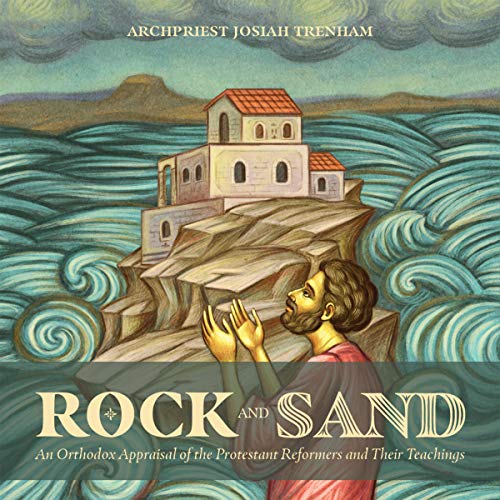
Father Josiah Trenham, an Antiochian Eastern Orthodox priest in California, has written a book, Rock and Sand: An Orthodox Appraisal of the Protestant Reformers and Their Teachings, that helps readers answer this very question. Trenham was raised in a conservative Presbyterian church, eventually following the teachings of Ligonier Ministries founder, R.C. Sproul. But partway through his seminary training, Trenham came to see what he saw were weaknesses in the evangelical Protestant tradition, and he was received into the Antiochian Eastern Orthodox church and eventually became a priest there in 1993. Today, he runs a popular YouTube channel, Patristic Nectar.
Rock and Sand: An Orthodox Appraisal of the Protestant Reformers and Their Teachings was written primarily to help Eastern Orthodox believers understand the roots of Protestantism, but I found it a helpful guide, as an evangelical Protestant myself, to understand the differences between the two traditions. As indicated by the title, the aim of Rock and Sand is to show that Eastern Orthodoxy is built on rock whereas Protestantism is built on sand. It is worth exploring how Father Trenham makes the case for Eastern Orthodoxy.
Trenham recalls a quote made by Martin Luther, when he was first publicly challenged by the papal legate Cardinal Cajetan in 1519, “The truth lies with the Greeks,” meaning the Eastern Orthodox. Trenham acknowledges that Luther had the most Eastern Orthodox-ish view of sanctification among the early Reformers, grounding the Christian life in our union with Christ, thus aligning towards the Eastern Orthodox understanding of theosis. Trenham warmly accepts Calvin’s measured view of the End Times, that avoids endless speculation derived from the Book of Revelation, and judges that Calvin “maintained a brilliant Christocentric hermeneutic” of Scripture. Very few Protestants today even know that Luther, Zwingli, and Calvin positively affirmed the perpetual virginity of Mary, which agrees with Eastern Orthodox teachings.
Yet in other ways, Father Trenham does not shy away from showing where the Protestant Reformers fell short in comparison to the Eastern Orthodox. At various points, he focuses on certain details that expose the more odd and embarrassing side of the Reformers. Little did I know that Martin Luther argued against certain traditional views of incest, by allowing for Christians to marry their first cousins. Trenham uses Luther’s, Melancthon’s and Martin Bucer’s awkward approval of Philip of Hesse’s bigamy as an unflattering illustration of the Protestant Reformers willingness to compromise with the political powers of the day, in order to gain the favor of the state.
Father Trenham also zeroes in on some of the more idiosyncratic views of certain Reformers, to illustrate the failure of sola scriptura as a coherent doctrine, from his perspective. He blasts the Reformers, like Martin Luther and Ulrich Zwingli, for their failure to agree upon the nature of the Lord’s Supper, the central act of worship throughout the entire history of the Christian church. Both Luther and Zwingli believed that the “plain reading of the text” clearly taught their respective views, despite the fact that they contradicted one another. This argument supports Trenham’s contention that only a church guided by the light of tradition, upheld by a college of bishops, apostolic succession, and ecumenical councils can prevent a Christian community from falling prey to idiosyncratic interpretations of the Bible, that will inevitably cause church splits, an endemic feature of nearly all Protestant churches.
Father Trenham illustrates that the evangelical Protestant prejudice against church tradition is even reflected in some popular Bible translations. For example, the Greek word paradosis is used in the Bible regarding “tradition” in two senses. In the negative sense, “tradition” refers to the man-made traditions of the Pharisees, which Jesus exposed as hypocrisy, as in Matthew 15:3. But it also has the positive sense of “tradition” in other contexts, where “tradition” is in reference to what Christians are to pass down from one generation to the next generation, as in 2 Thessalonians 2:15. Unfortunately, the popular NIV translation for years has translated this positive sense of paradosis very differently as “teachings,” instead of “traditions.” Thankfully, more recent translations, such as the ESV and the CSB, correctly translate this as “traditions”: “So then, brothers, stand firm and hold to the traditions that you were taught by us, either by our spoken word or by our letter.” At least the NIV does mention “traditions” as a possible translation, in a footnote, for those who bother to notice. Nevertheless, among many Protestant evangelicals, some reading habits are hard to break.
An Eastern Orthodox Appreciation for Infant Baptism
In his argument against the Anabaptists, Father Trenham gives a very coherent defense of infant baptism, against all forms of “credobaptism”; otherwise known as “Believer’s Baptism.” He demonstrates that the practice of baptizing infants is in continuity with the Old Testament practice of male infant circumcision. However, whereas circumcision was the primary marker for membership in the Old Covenant of the Jews, it has now been replaced by the practice of baptism in the New Covenant. In other words, baptism carries forward the original Old Testament concept of covenant membership to include Jew and Gentile, male and female, and slave and free, as grounded in the New Testament (Galatians 3:25-28).
Interestingly, Father Trenham argues against the Protestant insistence that salvation is primarily an individual act, and his case for infant baptism is used to buttress his more communal understanding of salvation. The repeated experience that entire households were baptized in the New Testament, even though only one member of the household professed faith initially, calls into question the claim that “Believer’s Baptism” is the clear teaching of Scripture. In the case of the conversion of Lydia (Acts 16:11-15), the passage tells only of Lydia’s conversion and no one else in her household. Nevertheless, everyone in Lydia’s household was baptized. In the case of the conversion of the Philippian jailer (Acts 16:25-34), the passage tells only of the jailer’s conversion and no one else in his household. Nevertheless, everyone in the Philippian jailer’s household was baptized.
Is it possible that the other members of Lydia’s household had become believers at that time, and the text never tells us? Yes, but it is also possible that there were infants in Lydia’s household, who were baptized. Is it possible that the rejoicing of the Philippian household in the jailor’s conversion signaled their own faith in Christ? Yes, but it is also just as likely, if not more so, that they all became believers after their baptism, and not before. The Bible’s silence on this issue, in these two cases, is profound. The argument presented by Father Trenham is something that most Protestant proponents of “Believer’s Baptism” rarely address.
On occasion, Father Trenham makes some rather suspect claims about the Protestant Reformers, but these are very rare. He states that John Calvin taught a very clear doctrine of double predestination, but that some of his closest followers after him did not, such as Theodore Beza. This is highly problematic as many Protestant students of Calvin suggest that Theodore Beza developed Calvin’s doctrine of predestination in greater detail and force than did Calvin himself, who relegated the doctrine of predestination to a lesser position in his Institutes of the Christian Religion.
One of the more interesting features of Father Trenham’s book is a summary retelling of the history of dialogue between the Protestant Reformers and the Eastern Orthodox, a topic often completely ignored among historians of the Reformation. Lines of communication between the early Lutherans and the Eastern Orthodox led to a fruitful dialogue between both sides, despite their ultimate disagreements. Cyril Lucaris, an Eastern Orthodox patriarch and theologian in the late 16th and early 17th centuries, urged other Eastern Orthodox theologians to study in Western Europe at Protestant universities, in hopes of stimulating a reunion of the churches. Lucaris was even rumored to have written a confession of faith along Calvinist lines, yet Father Trenham vigorously denies that Lucaris was the real author of such work.
The Achilles Heel of the Protestant Evangelical Movement
The most stinging critique of Protestantism comes in Father Trenham’s chapter on “Evangelicalism”:
Many modern Protestants do not even recognize themselves as the heirs of the Protestant Reformation. The most vibrant and demographically explosive forms of Protestantism are so ahistorical, so radically detached from the historic Christian ethos that an organic association even with their own Protestant lineage is too much of a chronological and dogmatic commitment. For many of these Protestant Christians the only relevant history of Christianity began with the history of their own particular congregation or even the history of their particular preacher and no tangible connection to the Christian past is considered essential. What matters to them is that their spiritual experience is real, not that their spiritual experience is in harmony with that of their forebears.
Ouch. That really hurt. That paragraph alone was the most griping of Rock and Sand.
It pretty much explains my own encounter with evangelicalism, particularly that of the megachurch variety. The relatively ahistorical character of evangelicalism is responsible for the absurd notion that those who wish to defend any 2,000 year old teaching of the church bears the burden of proof for its defense, as though a Bible believer today can simply read something in the Scriptures and declare such tradition to be false, with very little evidence to show for it. This is nothing more than Protestant hubris that devalues the importance of church history.
Evangelicalism brings in the numbers, and reaches a lot of people for Jesus, something that I celebrate (as does Father Trenham), but it does so at the cost of producing a relatively shallow form of faith, that does not always weather well when the storms of doubt trouble the soul. The contemporary “ExEvangelical” deconstruction trend in some circles serves as evidence for that deficiency within Protestant evangelical subculture. Eastern Orthodoxy has its own skeletons in the closet, but that paragraph above from Father Trenham about my own tradition hit me like a two-by-four across the skull.
Alas, Some Hesitations Regarding Eastern Orthodoxy
Rock and Sand does not address this, but it would have been helpful to touch on some of the problems internal to Eastern Orthodoxy, as a means of self-critique. Ongoing disputes concerning the Protestant doctrines of sola scripture, sola fide, and sola gratia, not withstanding, there are other reasons why many Protestants still wrestle the Eastern Orthodox tradition. Despite the enumerated strengths of the book, and Protestants wrestling with the implications of sola scriptura, the Eastern Orthodox have their own struggles with schism, mostly along ethnic, even nationalistic lines.
Perhaps the primary deficiency of Rock and Sand is the underlying polemical nature of the book, casting serious doubt on the possibility of the reunification of the East and the West. An appendix in the book includes the records of several attempts towards Eastern Orthodox and Protestant reconciliation, including the 1672 Confession of Patriarch Dositheos, at the Synod of Jerusalem, and the more recent 1912 effort by American Episcopalians and Saint Raphael of Brooklyn, the first Eastern Orthodox bishop to be consecrated on American soil. to dialogue with one another. Sadly, none of these efforts have born lasting fruit in favor of ecumenism.
Rock and Sand: An Excellent Resource for Understanding the Differences Between Protestantism and Easter Orthodoxy
However, in his defense, Father Trenham does seek to be charitable, broadly throughout the book, and frankly his critique of Protestantism is not that far off the mark. In an age where evangelical Protestants have the unceasing propensity towards the division of churches, while simultaneously making awkward pleas for “unity,” it is quite understandable why Eastern Orthodoxy offers a refreshing appeal towards disaffected Protestants who desire to take the best of their Protestant evangelical background and make the move towards of Eastern Orthodoxy, with its extraordinary reverence, and holistic integration of worship and theology, which is so often absent in many Protestant circles today.
My own interest in Eastern Orthodoxy comes from a growing sense that the “agree to disagree” posture of popular evangelicalism, that dominates the greatest segment of megachurch American Protestant Christianity, is extremely difficult to sustain over the long term. Many evangelical churches adopt a very broad concept of handling “disputable matters” in the church, but there is not always a very cohesive understanding as to what the New Testament’s teaching on “disputable matters” even means. Many evangelical churches are extremely weak in catechizing (or teaching) their members about the basics of the faith. Then, when certain persons growing up in evangelical churches later fall away from their faith upbringing, those who remain lament the fact, but they often do not know what to do about it, because they lack the historical perspective offered by older traditions like Eastern Orthodoxy, or even Roman Catholicism.
Eastern Orthodoxy, on the other hand, finds no attraction to this kind of evangelical populism, that ignores the lessons of church history, particularly of the early church. A worship experience in an Eastern Orthodox church is wonderfully awe-inspiring, rich in symbolism and mystery, rooted in centuries of tradition, whereas the typical evangelical megachurch formula of singing a bunch of songs, followed by a TED-talk-style sermon, often lacks depth. Eastern Orthodoxy is not perfect, and some Eastern Orthodox doctrines and practices may have a quirky feel to them, but Protestant evangelicals have a lot to learn from our Christian friends in the East. Protestant evangelicals would do well to read Rock and Sand, even if they are not completely won over by all of Father Trenham’s arguments.
The Bosphorus is the body of water that divides Europe from Asia in modern day Turkey, near Istanbul. But for centuries Istanbul was known as the central home for Eastern Orthodoxy. The slogan of “crossing the Bosphorus” is today commonly used as a metaphor to describe one’s conversion from Protestant or Roman Catholic brands of Western Christianity to embrace Eastern Orthodoxy. A read through Father Josiah Trenham’s Rock and Sand will help Protestants like myself to rethink their own faith experience, and it even might provide the impetus for some to make that journey to “cross the Bosphorus.”





 Veracity