Williamsburg Community Chapel Men’s Breakfast
Saturday, February 15th, 2014
7:30 am
3899 John Tyler Highway
Williamsburg, Virginia 23185
Cost: $8, (bring a friend)
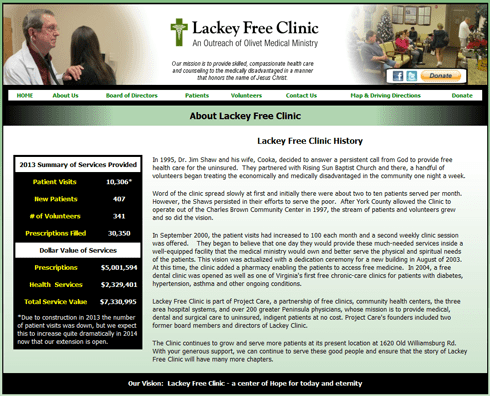
Dr. Jim Shaw has won numeroushumanitarian awards for his work in founding and leading the Lackey Free Clinic. He has had a wonderful career as a pulmonary specialist, and has made a real difference in our community and in the lives many people who had nowhere else to turn for medical help. The Lackey Free Clinic successfully provides skilled, compassionate health care and counselling to the medically disadvantaged in a manner that honors the name of Jesus Christ.
But Jim has not had an easy ride. This will not be a boring success story. I won’t give away the details, but will offer that Jim’s presentation will be a true encouragement to all who attend. Hope you can make it Saturday morning (bring a friend).
A friend of mine asked me today if I knew someone doing evangelical work by the name of Nabeel Qureshi. I vaguely recalled the name, and doing a little digging on the Internet discovered that Nabeel Qureshi had grown up in his high school years in Virginia Beach, Virginia in a Muslim family. My friend’s older brother was at one time very good friends with Nabeel. Nabeel would come over and visit and play video games. My friend recalls Nabeel leaving the house terribly frustrated because he kept losing all of the time.
Nabeel’s father was a member of a persecuted Islamic sect in Pakistan who brought his family to America for the purposes of religious freedom. In gratitude to the opportunities given to him in the United States, Nabeel’s father joined the Navy, eventually bringing his son and the rest of the family with him to the Virginia Beach area. According to his story,Nabeel described himself as being a very devout Muslim.
An aside: I would like to know if his religious parents had let him play video games or if he just snuck out some nights to play on an Xbox or whatever (rather badly) at his friend’s house, but that will be something to talk about if I ever meet Nabeel…
Anyway, by the time Nabeel entered his freshman year at Old Dominion University (ODU) in Norfolk, Virginia, he thought of himself as a fairly competent Muslim evangelist. Sincere Christians would come up to him and ask him if he knew that Jesus was God. Nabeel was well equipped to respond and demonstrated that the average Christian had absolutely no clue how to respond to his logical argument that Christian belief was nonsensical and could not even be supported by the Bible. No Christian he ever met could provide a satisfactory explanation of the Trinity. It all sounded ridiculous to him.
Christians simply could not answer his questions…
That is, until he met a sophomore named David Wood. Unlike most Christians he had met, Nabeel found David at one point reading his Bible in his free time. Furthermore, David had actually studied apologetics. So when Nabeel tried to stump David with how corrupt the Bible really was, David responded with much of the same arguments that my fellow co-blogger John Paine knows about regarding the reliability of the Bible.
Nabeel had met his match. He and David became fast friends and they looked at the claims of the Bible and the Qu’ran together. Through their debates with one another, it was their friendship that kept things in check as they learned and shared a lot of hard things with each other. Eventually, Nabeel’s mind was opened to Christianity, but he was fearful about the cost. After experiencing a vision and several incredible dreams, Nabeel finally gave himself over to Jesus Christ as his Lord and Savior.
Some ten years later, despite the terrible costs to him and his family, Nabeel Qureshi has dedicated himself to the ministry of Christian apologetics, particularly engaging in debates with Islamic apologists. Apparently, Muslims who are motivated by their own missionary interests love debates. These debates can get testy at times, but I find that the interchange of ideas and arguments have challenged me to dig deeper in the Bible myself so that I might be better prepared to answer the type of questions that Nabeel had back in his college days at ODU. As Nabeel has matured in recent years, he has also done some teaching with some introductory videos on Islam and at Biola University, where he received his masters in Christian apologetics.
In his testimony, Nabeel tells about witnessing a debate between Mike Licona and Shabir Ally about the resurrection of Jesus Christ, held about ten years ago at Regent University. This debate helped convince Nabeel of the intellectual integrity of the Gospel message. Shabir Ally is one of the most engaging Islamic debaters today, very well liked by his Christian counterparts, despite their differences. Mike Licona is probably one of my favorite Christian apologists today, ably defending the Gospel of Jesus Christ in a winsome way. If you live in or near Williamsburg, Virginia, we hope that there might be a great opportunity to see Mike Licona in action with Lee Strobel and Mark Mittelburg within a few months (stay tuned for that). I highly recommend Mike.
Doctrine that’s right in our wheelhouse! Want to see what systematized theology looks like in person? Here’s an example of the power of the “Fifth Gospel.” HT: Bobby Conway
“… ‘Then say, ‘Shibboleth’!’ And he would say, ‘Sibboleth,’ for he could not pronounce it right. Then they would take him and kill him at the fords of the Jordan. There fell at that time forty-two thousand Ephraimites.” (Judges 12:6)
Although we Americans have a common language we all have accents that show our origins to a discerning ear. The above incident demonstrates how thousands of years ago different regional accents caused the death of 42,000 people.
There had been a civil war among people of the same ethnicity. As the victors captured survivors, the only way to tell if they were the enemy was to force them to say “Shiboleth.” When prisoners could not pronounce the “sh” sound because of their regional accents, 42,000 of them were executed.
What does all this have to do with us today? Metaphorically speaking, when we meet people we often have a…
Thanks to the remarkable vision of Kenneth Curtis (died 2011), Christian history comes alive. Enjoy the feast.
I am a total Christian history fanatic now. Even though I grew up in Williamsburg, “History Town”, Virginia, I had a so-so interest in history for many years. But Ken Curtis changed all of that.
I met Ken Curtis in the early 1990s when I was working on my seminary degree. I thought the class would be a dull recitation of dates and names. Boy, was I wrong. Here comes this heavyset man with a thick Bostonian accent walking into class with great passion. He lived and breathed the great moments of church history. From the Early Church to the Reformation, Ken’s zeal was contagious.
And he had films.
Ken Curtis got his big start in the film business in 1972 with the story of David Wilkerson, a young pastor working in the tough gang ghettos of New York City, titled The Cross and the Switchblade. But Ken’s real heart was for church history. Sometimes we get so focused on our own problems and our own little world that we forget that God has been in the Kingdom building business for centuries. When we get overwhelmed with life’s challenges, it really helps to take a step back to figure out where we in our current circumstances fit within God’s long term plan. Ken Curtis knew that the church needs to remember the past for the sake of understanding the present and even guiding us for the future. With this vision, Ken Curtis was able to scrounge up enough money to put together a series of classic Christian history films, including several available here at Ken’s Gateway Film’s Vision Video.
I was hooked. Ken Curtis made the history of the church come alive on film. I have used Ken’s stuff several times over the years in Sunday School classes to help fellow Christians remember the faithfulness of God over the centuries. But Ken’s work was not limited to film. Ken’s family and friends have continued to publish a weekly church bulletin insert, Glimpses. But perhaps Ken’s greatest legacy is the Christian History magazine he founded. With over one hundred issues, Ken and his group have been able to publish high quality issues on almost every subject imaginable. While I throw out most magazines after awhile, I have never thrown out an issue of Christian History.
The magazine floundered in the late 1990s with the advent of the Internet, and Christianity Today picked up the magazine, only to kill it a few years later due to poor sales, yet another casualty of the demise of print journalism these days. However, just before Ken Curtis died of cancer a few years ago, his group at the Christian History Institute resurrected the magazine. There are print editions still available, but now they also publish full-color PDF versions on-line. They ain’t got much money, but they are committed to providing the PDF versions free of charge to folks who can not afford it. In honor of Ken’s legacy, the Christian History Institute wants to help the church to remember with high-quality photos and artwork, very accessible reading and interviews with the top scholars of the world.
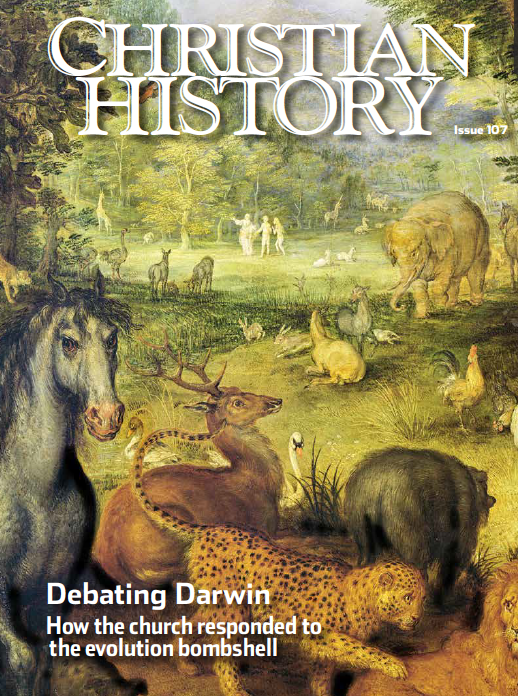
At our recent Facts and Faith Symposium, many of the evaluations indicated a real interest in learning more about church history. The timing could not be better. The Christian History Institute has published a recently new issue, Debating Darwin. If you have an interest in how the church responded to the challenge of Charles Darwin in the 19th century, one of the topics that came up during the Symposium, you can find no better place to do your research than to start by downloading the PDF or getting the full print edition delivered to your door.
And if we ever have a future Symposium on Christian History, there stands a great chance of viewing some of Ken’s amazing films. Enjoy!