Category Archives: Topics

An Evolutionary Creation: Oxymoron?

How good a pool player is the The Lord of all Creation?   Does God sink all of the balls in one shot, or does He take multiple shots to demonstrate His Glory?

How good a pool player is the The Lord of all Creation? Does God sink all of the balls in one shot, or does He take multiple shots to demonstrate His Glory?

When most Christians think about “evolution” and “creation”, they think of things that simply do not mix: Oil and water. Vinegar and milk. The Red Sox and the Yankees. Dallas Cowboys and Washington Redskins. Me and mornings. Forget it.

When I was a young Christian studying science in college, I was repeatedly told that I had to choose between what evolutionary scientists have to say with what the Bible says about creation. Now, if the choice was between what atheists like Richard Dawkins have to say and what the Scriptures teach, well OK then, I would have to clearly agree that there is a serious conflict here.  Atheism masquerading as science is clearly incompatible with the Bible.

The problem is that while outspoken atheists like Richard Dawkins tend to hijack the public discourse on evolution, they represent only a small slice of the debate. Most practicing biologists are not terribly interested in atheistic ideologies (at least in my experience). They just want to study plants and animals and they happen to do it within the context of Darwinian evolutionary theory.

So, the question remains:  is modern evolutionary science today completely opposed to the God of the Bible?
Continue reading


End of the Beginning

“You intended to harm me, but God intended it for good to accomplish what is now being done, the saving of many lives.”
Genesis 50:20
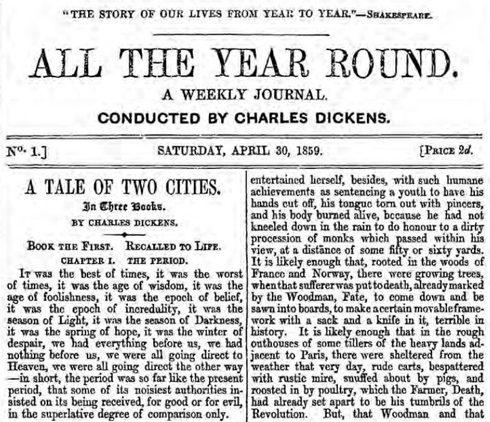
Tale Of Two Cities


“It was the best of times, it was the worst of times, it was the age of wisdom, it was the age of foolishness….” Charles Dickens’ famous opening line, from the top-selling fictional work of all time, is about dualism.


Have you ever thought about how Joseph (the son of Jacob, the son of Isaac, the son of Abraham) could have just given up and succumbed to his circumstances? Times when he must have felt he was at the end of his rope? Times when everything and everyone seemed to be working against him? Times when his story could have been told and that would have been the end of it?

The beginning of the Bible—the book of Genesis—ends with the biography of Joseph. More than one-third of Genesis is devoted to telling his story (so it’s important), and it’s full of the kind of details a family would prefer to forget. If you don’t remember the story of Joseph, give it a read here, or get this app and listen on your mobile device.

Joseph was sold into slavery by his brothers (who debated whether to kill or sell him). He became the servant over an Egyptian household. He was framed and sent to prison. He became the inmate-overseer of the Egyptian prison. He was left behind in a dungeon and forgotten for two years after correctly interpreting the dreams of Egyptian officials. But eventually Joseph was brought before Pharaoh and put in charge of Egypt—where he was able to save many lives. His descendants (Joshua, Gideon, and Samuel among others) became leaders of the Hebrew people, writing significant portions of the Old Testament.

There’s a tremendous amount of dualism in Joseph’s life. That dualism gives us a clear picture of the providence (and sovereignty) of God. God can and does use bad situations and circumstances to accomplish good.

In case you haven’t noticed, lately on Veracity we’ve been paddling a bit around Calvinism and what goes with it. I’ve had more than a dozen offline (and very interesting) discussions with friends and readers, and received several emails on the topic. But this isn’t a post about Calvinism.

Our home church has been through a tumultuous year.

If it were solely up to me everything would work out well for everybody, all of the time. No controversy, just happy faces in the pews, all singing in perfect harmony. But that’s not how life works. As Jim Davis notes, “Sometimes it’s going to hurt.” God has a plan for our lives, and that plan includes having to deal with trouble—to accomplish God’s purposes (there’s that Calvinism thing again). Ultimately we can trust God or not.

So…as wearisome as discussions about our tumult have become, we clearly have quite a lot to be thankful for. God cares for and about us. God has blessed us richly.

Our church has a mission statement that says, in part, we are “called to make disciples of Jesus Christ by meeting people where they are on their spiritual journey.” We are all on a spiritual journey. Truth be told, we often can’t tell the beginning of the end from the end of the beginning. The biblical pattern is not to dwell in the difficulties, but to overcome them just as Joseph did by trusting that God is in control.

Joseph’s Tomb

Here’s an aside for those who are interested in seeing how the Bible fits on the ground.  We’ve written previously about the Cave of the Patriarchs, the second-most venerated site in Judaism, which has indisputable historical ties to the text of the Bible and to Joseph’s family (drill deep into the hyperlinks contained in that post and you’ll see how Old Testament Scripture about the Hebrew patriarchs and matriarchs fits in Hebron).

Joseph's Tomb in Shechem

Joseph’s Tomb in Shechem (photo credit: Ferrell Jenkins)

The Bible tells us that Joseph was not buried with Abraham, Isaac, and Jacob, but that his bones were buried at Shechem in the tract of land that Jacob bought for a hundred pieces of silver from the sons of Hamor, the father of Shechem.

Shechem has a violent history, and violence continues to plague the site of Joseph’s tomb.  Here’s a 2009 video that documents recent events at the site from a Jewish perspective, and another from 2013 inside the tomb featuring Joel Kramer, a well-known tour guide and videographer (who’s not a Mormon).


Four Views on the Historical Adam

How are we to understand the teaching of Genesis regarding Adam as an historical person? What is your view?

Want to know more about the debate? Get a copy of Four Views on the Historical Adam, part of the Zondervan Counterpoint series of debates within the Christian community among scientists, Old Testament scholars, New Testament scholars, Ancient Near East literary scholars, church leaders/pastors and others in-between about how we are understand the message of the Bible.

Introduction #1 — Matthew Barrett, California Baptist University:

Introduction #2 — Ardel Caneday, Northwestern College:

Young-Earth — William D. Barrick, The Master’s Seminary:

Ancient Near East Literature/Archetypal View — John Walton, Wheaton College:

UPDATE: For a summary of each view discussed in the book, BibleGateway has a succinct description of each perspective. Extended audio talks given by each one of the four main contributors from the 2013 Evangelical Theological Society have just been made available.


The Calvinist: A Poem by John Piper

In the popular mind, the thought of a “Calvinist” conjures up thoughts of “predestination”, “horrible decree”, “hellfire and brimstone”, “condemnation”, and “rigid”. Basically, what you get is a sourpuss. Not a lot of fun and happy thoughts here, as “Calvinism” for a number of folks today gives Christianity a bad name.

I never thought that the power of a poem on video could viably challenge such as assessment. But I think I have found something that might do just that.

John Piper served as pastor of Bethlehem Baptist Church in Minneapolis, Minnesota for 33 years, and he is currently the chancellor for Bethlehem College and Seminary, and founder of DesiringGod.org. John’s theological hero is the 18th century colonial preacher, Jonathan Edwards, probably the greatest American philosopher ever…. and a Calvinist.

What gets me about Jonathan Edwards is that he was able to have this awesome, even terrifying, view of God’s majestic sovereignty on the one hand, as well as a tender, joyous fondness for the “sweetness” of God on the other. How was he able to put these two things together?

John Piper’s most popular book is Desiring God, Meditations of a Christian Hedonist, which is nothing more than a contemporary exploration of Jonathan Edward’s faith and thought. John wrote a poem recently, and he invited a few friends to add their voices to help him read the poem: D.A. Carson, R.C. Sproul, Alistair Begg, Thabiti Anyabwile, Matt Chandler, and Sinclair Ferguson.

This really surprised me. It may not change your view of a “Calvinist”, but it might give you some pause to ponder. I would like to know what you think.

Additional Resources:

Just in case you thought that Calvinism was on the periphery of the evangelical church these days, you might want to rethink that and look into the recent CrossCon student missions conference, held in Louisville, Kentucky, the last week of 2013. The Gospel Coalition posted a number of videos from this new missions conference, an event designed to mobilize a new generation of young college students. I recently talked to one of the 4,000 students who attended. It was quite an experience from the report I received.


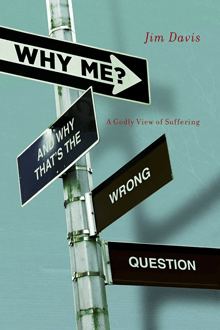
Why Me? (And Why That’s the Wrong Question)

“We live between Eden and Heaven. Sometimes, it’s going to hurt.”
Jim Davis, author of Why Me? (And Why That’s the Wrong Question)

One of the things I enjoy most about blogging is all the reading that goes with the job—particularly when I find a new blogger who has something original and insightful to say. There are a lot of bloggers who are curators of other people’s material, and there are the big-blog guys everybody reads (many of them are a team rather than an individual behind the keyboard), but if you’re willing to look a little deeper you can find some really wonderful voices in the blogosphere.

Why Me?Jim Davis is one of those voices (others include Dick Woodward, David Work, Walter Bright, Jason Ladd, Sandra Dimas and Maureen Moser, and our own Clarke Morledge).

Jim is a constitutional attorney from Birmingham, Alabama, a Bible study teacher, and a writer—he’s not associated with the Garfield comic strip (penned by another Jim Davis). What I appreciate most about his writing is that he always puts it on a level playing field. Like Clarke, he can see more than one side to an issue, and he keeps his eye on the big picture when others tend to let their emotions slant their thinking.

Jim has a new book, Why Me? (And Why That’s the Wrong Question), just released by Leafwood Publishers and available on Amazon. Jim asked me to review the final draft for his publisher, and I was happy to oblige with this review:

If knowledge is knowing the answers to questions, wisdom is knowing which questions are important and why.  Jim Davis brings a refreshing perspective to the topic of pain and suffering in Why Me? (And Why That’s the Wrong Question).  This book is packed full of wisdom and reality, and the topic is treated honestly—with biblical integrity, and with respect.  We should be preparing ourselves for pain and suffering now because it is inevitable.  Instead of focusing on answers (that only God can give), Jim focuses on the questions.  Readers will appreciate Jim’s voice; he has a gift for applying the Bible to a hurting world in a way that is insightful, comforting, and helpful.  I wholeheartedly recommend this book, both as a group study and for personal discipleship.  In Jim’s words, “We live between Eden and Heaven. Sometimes, it’s going to hurt.”

I told Jim when he asked for the review that I am no expert on pain and suffering.  I’ve been blessed with an exceedingly pain-free life. Exceedingly. But what I didn’t tell him is that the title of his book is an echo from a sad chapter of my family’s otherwise benign history. It was decades ago, but I can still hear my mother’s voice, saying those words (more than once). It was an honest question for her, as it is for so many people, but it was not the right question. This is an honest, insightful, comforting, and helpful book.