Category Archives: Topics

He is Risen!… (in the East)

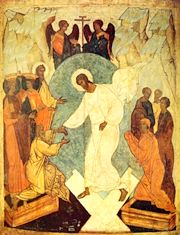
The Resurrection of Christ, by St. Isaac of Syria Skete (Boscobel, Wisconsin), credits the Orthodox Wiki.

He is Risen! The Resurrection of Christ, by St. Isaac of Syria Skete (Boscobel, Wisconsin), credit: the Orthodox Wiki.

To all of my Eastern Orthodox friends, I say “He is Risen!” on this day when you celebrate Pascha.

For those evangelical friends who have no idea what I am talking about, Pascha is the original name for Easter. Pascha is essentially a transliteration of the Hebrew word for “passover,” or pesach. Way back at the Council of Nicea in 325 A.D., the famous church council that resolved the dispute over the deity of Christ, which made way for the mature formulation of the doctrine of the Trinity, the council also established a uniform method for calculating the date for celebrating the Resurrection of Jesus.

However, the church in those days used the Julian calendar, which proved to be flawed in its ability to keep track of the solar year. The Western churches later fixed this by going to the current Gregorian calendar. However, the Eastern churches still have retained the old, Julian calendar method of calculation for Pascha. Hence, this year, the celebration of Pascha falls on May 1st, instead of March 27.

There are some who reject Easter because of its supposed connection to Germanic paganism. But since Pascha is really the earlier name, maybe Christians in the West can drop “Easter” and adopt “Pascha” instead, for now on, and be rid of this fringe complaint.

How about this? I have an idea. Next year, Western Easter and Eastern Pascha will fall on the same date, April 16. How about if the West adopts the “Pascha” name and the East adopts the updated Gregorian calendar calculation system, so that we can all celebrate the Resurrection of our Lord on the same day, in future years? Would this not move us a step towards Christian unity?

Do I have any takers?

…………………

I blogged about this before in 2014.


Bono and Eugene Peterson on the Psalms

What do you get when you cross an Irish rock star with a Bible scholar/pastor? An interesting conversation between Bono and Eugene Peterson, the author of the English paraphrase translation of the Bible, The Message.


Are Baby Dedications Biblical?

Is the contemporary practice of baby dedication taught within the Bible?

Is the contemporary practice of baby dedication taught within the Bible?

Of the few people I follow on Twitter, British evangelical writer, Andrew Wilson, is right there at the top. He has the mind of a scholar and the heart of a pastor, young enough to be conversant about postmodernity, and yet wise enough to challenge me to be more humble before Scripture. In his latest blog post at Think, Wilson challenges me to consider if baby dedications, as practiced in many interdenominational churches today, are really Biblical.  His answer: They are not, but services of thanksgiving and prayers for newborns are still good ideas.

I worship in a community of faith where such baby dedications are practiced. Who is not moved when the pastor prays over a miniature human in their arms?

But it really is rather odd, if you think about it.

Consider this: Until the last thirty or forty years or so, baby dedications were rarely, if ever, practiced in any evangelical church. Why has such a novelty, with the slimmest of Biblical backing, taken off in interdenominational churches today? What Wilson does not dive into that much is summarized by his Tweet from a few months ago, “baby dedications are perhaps the most obvious symbol of credobaptist cultic deprivation.”

What I think Andrew Wilson means by that is this: Modern evangelical churches are drawn to baby dedications because they serve as a compromise solution to the long-standing baptism debate: infant baptism (paedobaptism) vs. believer’s baptism (credobaptism).  With baby dedication, it is not to be confused with baptism, while it still symbolizes the notion of bringing a child into the community, passing on the faith to the next generation (or so we hope). So, while baby dedication steps around the controversy (which is understandable), it nevertheless fails to engage the Christian to fully think through how the covenants of God work within Scripture, and how baptism is related (I stand guilty myself). So, we get a workable solution that makes peace between the differing viewpoints, but at the expense of shallowing the theological depth of our Biblical thinking in our churches.

As a first step, it might be better to rename “baby dedications” as “parent dedications” instead, as these events are more about the parents dedicating themselves to present the Gospel to their children, along with the help of the surrounding church community, and about praying to God that He would touch the hearts of those children, over the coming years, with His Word of Truth and Life. Any thoughts?


When is a Gentile Not a Gentile (or Pagan or Heathen)?

The purple wildflower, heather, covers much of rural Scotland. In early medieval times, a person living among these heather fields, was considered to be a "heathen," or "from the countryside." However, in Christian usage, the term has taken on a number of meanings, sometimes controversial.

The purple wildflower, heather, covers much of rural Scotland. In early medieval times, a person living among these heather fields, was considered to be a “heathen,” or “from the countryside,” or “from the heath.” However, in Christian usage, the term has taken on a number of meanings, sometimes controversial.

A question came up the other night in a Bible study. When we read Matthew 18:15-17, Jesus is describing the principles of church discipline. If someone who claims to be a Christian, but who acts in a non-Christian manner and will not change their behavior, what is the rest of the community supposed to do?

If your brother sins against you, go and tell him his fault, between you and him alone. If he listens to you, you have gained your brother. But if he does not listen, take one or two others along with you, that every charge may be established by the evidence of two or three witnesses. If he refuses to listen to them, tell it to the church. And if he refuses to listen even to the church, let him be to you as a Gentile and a tax collector (Matt 18:15-17 ESV)

Jesus’ use of the description “Gentile” for someone who is making up their own rules for Christian behavior sounds confusing. Are there not “Gentiles” who are genuine Christians? If someone is already a “Gentile,” that is a non-Jewish person, how can you then be disciplined and treated as a “Gentile?” How do we make sense of this?
Continue reading


The Fear of Death

Bruton Parish Church courtyard... where my parents remains are buried.

Bruton Parish Church courtyard… where my parents remains are buried.

There is …a time to weep, and a time to laugh, a time to mourn, and a time to dance (from Ecclesiastes 1:1-8).

Over the past year, I have lost both of my parents to death. Less than a month ago, my dad died. It has been very interesting, watching the reactions of people who hear the news. Cordially, everyone is sorry for my loss. But it is astonishing how many folks will then gloss over the reality of death in their efforts to be nice to me.

For example, I am quite frank in saying that my father died. But most people I run into would rather talk euphemistically about someone’s passing instead. I am sure it is a desire to be polite and not offend a grieving person, but when someone passes, what does that really mean? Does that really tell the truth about death?

Here is a list of some sentiments that have been expressed to me over the past month:

“At least there is an end to your dad’s suffering. There is too much suffering in the world.”

“Your dad is in a better place. He is with your mother now.”

“Your dad is looking down upon you now… and smiling!”

All of these are quite bold statements, if you think about them. How do we know there is no suffering after death? How do we know that a loved-one is in a happier, better place, with others that are also loved… and smiling? Are any of these assertions true?

A curious one is that both my mom and dad are together now, implying that they are still married in the afterlife. But according to classic Bible teaching in Matthew 22:23-33, the bonds of matrimony are terminated upon death. Mormons, however, do believe that marriage goes on into eternity, but my parents were never Mormons, though we did have some Mormon missionaries knock on our door once back in 1978. I think they gave my mom some kind of pamphlet while my dad snuck out the back door to go cut the grass.

So, what then is the basis for the truthfulness of any of these assertions? Is scientific substantiation possible? Is it through some sort of revelation from a divine being, an intervention into human history? Or is it through the speculation offered by one’s own wishful thinking? How reliable is that? Could it be, that such sentimentality is a type of coping mechanism designed to take our minds off of what we fear the most?
Continue reading