Category Archives: Topics

Jen Hatmaker and the Frustrated Evangelical Response to LGBTQ

The Babylon Bee, a Christian satire website, unloaded a clever piece on Jen Hatmaker today, expressing the type of dismay that many evangelical Christians are thinking. But are we really hearing the message underneath Jen Hatmaker's public pronouncement?

The Babylon Bee, a Christian satire website, unveiled a clever piece on Jen Hatmaker recently, expressing the type of dismay that many evangelical Christians are thinking. But are we really hearing the message underneath Jen Hatmaker’s public pronouncement?

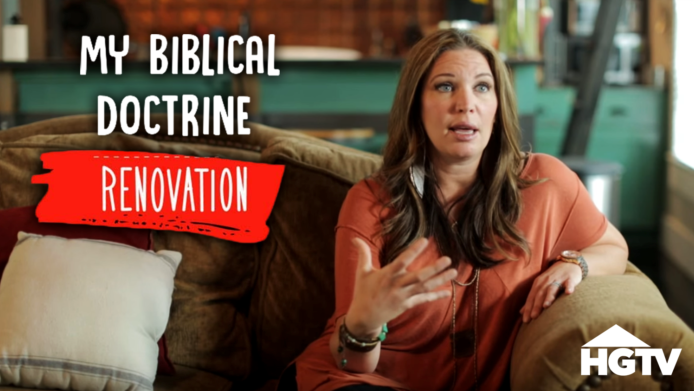
Over the past week or so, Jen Hatmaker, the funny and vivacious reality TV star of the HGTV show, “My Big Family Renovation,” rocked the social-media world of evangelicalism asunder. Jen Hatmaker, a favorite in MOPS circles (that is, Mothers Of PreSchoolers, a very active group in our church), and popular speaker at various Christian women’s conferences, in an interview, publicly stated her affirmation of gay and lesbian marriages as potentially holy.

Well, this probably had the same effect as setting a stack of Bibles on fire.

Jen Hatmaker is but one in a steady stream of high-profile, evangelical celebrities and leaders to jump ship from supporting a traditional, evangelical view of human sexuality, to supporting gay and lesbian marriage in the church, over the past few years. Just off the top of my head, I can think of Rob Bell, Tony Campolo, and singer songwriter Jennifer Knapp, too. What was unthinkable ten or twenty years ago, is now becoming more common, as otherwise traditional “Bible-believers” are willing to discard 2,000 years of Christian teaching, particularly in the wake of the June, 2015 Supreme Court decision in Obergefell v. Hodges.

What makes Jen Hatmaker a bit different is because she is not a pastor, or a theologian, or a super-talented singer. She comes across as a very down-to-earth, spunky, disarmingly honest and homespun happy mother, who has the same type of problems all of us have… and she has 109 thousand Twitter followers. That means that there are probably at least a handful of busy MOPS women in your conservative, evangelical church, who are probably a bit bewildered as to why Jen Hatmaker is making such a public stand on this topic.

These are not folks out there in liberal, mainline churches, who long ago dropped their commitment to biblical authority. Rather, they could be sitting next to you at your Bible-believing fellowship.

There is confusion in our churches.

What are we to make of this trend? How does someone with a high view of Scripture respond?  Continue reading


Why the Reformation (Still) Matters

Yesterday, Halloween, we also recognize (or “should recognize,” more importantly) that this year marks the 499th year after Martin Luther nailed his 95 theses to the door of the Castle Church, in Wittenberg, Germany. Does the Reformation that Luther’s hammer triggered all those years ago still matter today? Pastor/teachers Don Carson, John Piper and Tim Keller answer that question.


Kirk Cameron’s Revive Us National Family Meeting

Last night, I went with members of our small group to a local movie theatre, to view Kirk Cameron’s Revive Us, a film urging Christians to pray for America, and be involved in the political process. Along with former Presidential candidate and brain surgeon, Dr. Ben Carson; public intellectual and Charles Colson BreakPoint radio commentator, Eric Metaxas; and inspirational author/speaker, Jennifer Rothschild, who has been physically blind since a child; Cameron led what he called a “national family meeting.”

I had some mixed thoughts about the movie event. It was actually better than I thought it would be. But let me tell you about why what Kirk Cameron is doing is significant, then speak to the difficulties I had with the film, and then close by telling you what I thought was really good about Kirk Cameron’s Revive Us.

Unless you have been disconnected from the power grid for the past year or so, you have probably heard something about the 2016 Presidential campaign, perhaps one of the most …. errrh ….. uuhmmm…. “interesting” cultural events I can ever recall in my American life. Lurking underneath the present national discussion is a very profound cultural shift going on in American culture, that has been having repercussions in evangelical Christian communities. Christian leadership has been undergoing great change, as elder statesmen, like Billy Graham, are no longer providing the type of glue needed to keep evangelical Christians together. Denominational barriers are breaking down, but with the fast pace of information exchange brought on by the Internet and 24×7 social and news media, Christians are finding it difficult to figure out what really brings us together. If doctrine is not able to unite us, then what does?

Most of the news we hear in these media outlets is bad news. Christians are anxious about the nation’s future, as the presence of some critical, assumed Christian values in the culture at large appears to be rapidly disappearing. For many, the voting process is about deciding over the lesser of two evils. “Where is our culture going, and why does it look like God is not doing much about it,?” as many of my Christian friends might put it.

Into the breach steps in Kirk Cameron, an outspoken, Christian movie actor. Frankly, I was a bit nervous about what Cameron might do. Though I will have to give him credit. He admits that he is not the smartest guy in the world, and he has a lot of passion about what he cares about, and I share many of his concerns. But I was a bit embarrassed by some of the factual and interpretive missteps in his 2012 cinematic attempt to “correct” popular errors in American history, Monumental. When we attempt to fix false understandings of history by passing on further misinformation, where key facts and ideas are misrepresented, it only leads to further confusion.

So, I really had a rough start, in the first twenty minutes or so, of Revive Us. Dr. Ben Carson suggested to Kirk Cameron that Americans need to learn the “real history” about America. Carson is a brilliant brain surgeon, but “real history?” I can give him some leeway here, but this is coming from a man who believes that the pyramids of Egypt were built to store grain, from the days of the Biblical Joseph, instead of accepting the well-known archaeological research, showing that the pyramids were actually burial tombs.

But when Cameron interviewed Eric Metaxas in Independence Hall, in Philadelphia, Pennsylvania, there were moments I wanted to crawl under my seat. Yes, the importance of religious freedom as being essential to the American experiment, and that only a virtuous people can keep democracy, are two basic ideas that we are losing in an age when the knowledge of America’s past is being forgotten, as many young people seem more interested in their iPhones than they do in learning about history. As I have noted before, Metaxas is to be commended on this account, but he injudiciously passes on half-truths to an eager Kirk Cameron, according to historian Robert Tracy McKenzie, a Christian scholar teaching at Wheaton College. Metaxas misled the audience when he recalled that Benjamin Franklin, hardly an orthodox Christian, called for prayer at the Constitutional Convention in the late 18th century. Metaxas conveniently does not tell Cameron that Franklin’s call to prayer was ignored by most of the other participants at the Convention. Franklin later wrote, “The Convention, except three or four persons, thought Prayers unnecessary” (Eric Metaxas: That is kind of an important detail to leave out, do you not think?).

Furthermore, Metaxas wrongly attributes the aphorism, “America is great, because America is good,” a phrase currently serving as a motto for the 2016 Democratic Presidential candidate (who also gets it wrong as well), to Alexis de Tocqueville, the famous French observer of American culture in the early 19th century.

Thankfully, pastor Francis Chan finally got the evening back on track. Chan reminded Kirk Cameron that the central issue regarding the plight of the American nation is ultimately a problem with the American church. Pray for the nation, yes, but the real battle is to pray for revival in our churches. For too long, Christians have looked to the state to provide assistance in promoting Christian values. Instead, we as the church, as Christ’s body, are to  lift up His name. Then and only then, can we expect God to move among our secular neighbors and institutions, throughout our nation.

So, by the time, we got this idea straight…. at least, I hope we got this straight… I felt much, much better about Cameron’s “national family meeting.”  Sure, it was a bit weird to think of going to the movie theatre, watching a film recorded from the week before (apparently, this was a second showing… presumably the first showing was a live event), and trying to maintain a sense of worship. For those Christians who treasure the classic hymns, you might have stumbled a bit with the contemporary worship music Cameron had lined up, nearly all played in U2-style, with lots of drums, guitars, and acoustic delay.

Furthermore, Cameron’s urging that all Christians should get out and vote on November 7, referring audiences to lookup MyFaithVotes.org, failed to account for the theological reasons why some Anabaptists would conscientiously object to voting. But the nuances required to address issues like these were not in Cameron’s purview. Cameron’s goal has been to encourage Christians, who do not think too much about wider issues in the culture, to start thinking more about these things, and engage these issues instead of waiting on the sideline.

Thankfully, neither name of the main Presidential contenders were mentioned during the nearly two-hour film. No flashpoint issues of public policy distracted from the main theme. In this way, I was glad that this was not a “political” event, despite the undercurrent of American election controversies that are difficult to ignore. To the extent that Cameron was able to encourage Christians to view the question of America’s future as really a question about the condition of evangelical churches, and the need for revival in our homes and churches, I would then say that Cameron did well to call this “national family meeting.”

Who is the AntiChrist?

Luca Signorelli. The Deeds of the Antichrist (1499-1504). Signorelli portrays the devil counseling the Antichrist. With an American Presidential election coming around the corner, I wonder who so-called "prophecy experts" might be pick as the one and only Antichrist?

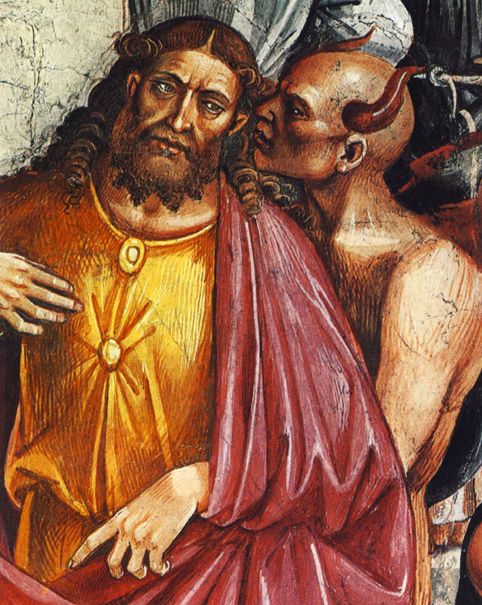
Luca Signorelli. The Deeds of the Antichrist (1499-1504). Signorelli portrays the devil counseling the Antichrist. With an American Presidential election coming around the corner, I wonder who so-called “prophecy experts” might pick as the one and only Antichrist in our day?

So, who exactly is “the” antichrist?

Back in high school, I knew someone who was convinced that President Jimmy Carter was the antichrist. Carter was a very convincing orator in the 1970s, connecting extremely well with voters frustrated with the then current political situation. Carter even said that he was a “born again” Christian. But by negotiating a peace treaty in the Middle East between Israel and her enemies, was Carter fulfilling the prophecy of Daniel 9:27, the antichrist who would “confirm the covenant with many?”

Okay, let us fast-forward some 35 plus years. He may not have been the best President we have ever had…. but the antichrist?

A lot of people speculate on who this antichrist might be. From military dictators to American presidents, the list of possible candidates seems about as endless as the human imagination (some folks even vote for their favorite picks). Most people get their information about the antichrist from books, movies, late-night cable TV, neighbors and friends.

But how many people know what the Bible actually teaches about the antichrist?  You might be surprised to discover that a lot of popular ideas about antichrist owe more to overly fertile imaginations than the clear teaching of Scripture.
Continue reading


Nat Turner’s Virginia Slave Rebellion, Hollywood, and How We Read the Bible

In August, 1831, a literate slave and Bible preacher, Nat Turner, led a rebellion against his white masters, in rural Southampton County, about a one hour drive south of where I live in Williamsburg, Virginia. After the 48-hour mass killing of 55 whites ended, Turner’s insurrection was eventually crushed, and tougher laws were enacted to try to prevent such slave uprisings in the future.

Nate Parker’s new film, The Birth of a Nation, is a fictionalized retelling of this tragic and violent story (deserving of the R-rating)…and just to think, the events depicted only happened less than two hundred years ago, practically in my own backyard. The film’s director is enveloped in controversy, and early reviews of the film are mixed. Intended to subplant the legacy of the 1915 silent film of the same name, a cinematic apology for the Ku Klux Klan, Parker raises a number of important issues, but one wonders what the film will actually accomplish.

Gospel Coalition blogger, Justin Taylor, summarizes some of the most significant elements regarding the history behind the film’s story. For more details on the history, you can start with the Nat Turner Project. Some historians are disappointed with the inaccuracies of the film, which frustrates me, as I am more interested in the actual history than I am in Hollywood’s fantasies. Does the film tell us about what really happened, or does it tell us more about the mind and state of contemporary pop-culture? How much of the film is about Nat Turner, and how much of it is about the film’s director, Nate Parker?

In the film trailer below, the Nat Turner character recites 1 Peter 2:18, in an effort to encourage his fellow slaves to keep in line. I confess that I, as do so many other evangelicals, tend to water this passage down:

Servants, be subject to your masters with all respect, not only to the good and gentle but also to the unjust (1 Peter 2:18 ESV).

I have euphemistically tried to replace “servants” with “workers,” and “masters” with “supervisors,” but does that really get at the original context? I am afraid not.

Slavery during the New Testament period is difficult to comprehend in modern terms, and it was very different from how many Americans viewed slavery prior to the Civil War. As I have argued elsewhere (here and here), many of my southern, Virginia evangelical forefathers did not properly understand passages like this either. Instead, they read things into the Bible that were not there.

If any Veracity readers end up seeing the film, I would like to know your thoughts.
