Category Archives: Topics

Was the Coronavirus Bio-Engineered in a Chinese Lab?

As it turns out, it is not just anti-vaccine Christians who buy into conspiracy theories.

UPDATE June 4, 2024: Please read all the way through to the end of this post for an important update.  I finally had an opportunity to revise what I wrote here four years ago, in the early stages of the pandemic, but I wanted to keep the original content preserved as much as possible, aside from some grammatical errors I spotted within a few weeks after originally posting this. PLEASE READ ON….

Conspiracy theories have long fascinated people, particularly when there are a large set of unknowns involved. Sadly, many Christians tend to get taken in by such conspiracy theories, and even some popular preachers use their pulpits to promote interest in such talk.

The 2020 coronavirus pandemic, caused by a tiny virus, COVID-19, provides fertile ground for growing conspiracy theories. The conspiracy theory I hear the most these days is the idea that the virus was bioengineered in a Chinese lab, located at Wuhan, where the outbreak started, in late 2019.

As with all conspiracy theories, there is always a grain of truth. Yes, there is a biomedical lab in Wuhan. Yes, the Chinese authorities did not immediately address the crisis, when it first started, thus allowing COVID-19 infections to spread rapidly. But was the virus somehow leaked out of a biomedical lab, either accidentally, or even worse, intentionally?

Francis Collins, the director of the National Institutes of Health, and an outspoken follower of Jesus Christ, wrote a blog recently, outlining research that demonstrates that COVID-19 was not an intentional product of bioengineering. Rather, COVID-19 arose naturally. Here is a snippet from Collins’ blog, describing some of the results from the research:

“Existing computer models predicted that the new coronavirus would not bind to ACE2 as well as the SARS virus. However, to their surprise, the researchers found that the spike protein of the new coronavirus actually bound far better than computer predictions, likely because of natural selection on ACE2 that enabled the virus to take advantage of a previously unidentified alternate binding site. Researchers said this provides strong evidence that that new virus was not the product of purposeful manipulation in a lab. In fact, any bioengineer trying to design a coronavirus that threatened human health probably would never have chosen this particular conformation for a spike protein……
…..this study leaves little room to refute a natural origin for COVID-19. And that’s a good thing because it helps us keep focused on what really matters: observing good hygiene, practicing social distancing, and supporting the efforts of all the dedicated health-care professionals and researchers who are working so hard to address this major public health challenge.” 

Read the whole blog article for more details.

… and while you are at it, encourage your fellow Christians to show a little more skepticism when it comes to propagating conspiracy theories. In the meantime, wash your hands, continue your “social distancing,” and pray that a safe, reliable vaccine becomes available soon.

UPDATE June 4, 2024:

This is an important update from four years ago. We know a lot more about the origins of the COVID pandemic than we did in the early stages back in April, 2020. Back then, the reigning hypothesis of the COVID origins was that it had a natural origin, not coming from a lab in Wuhan. What has emerged since then is very disconcerting:

  • Unlike the original SARS virus back in the early 2000s, where a positive link to a natural source for SARS was found in relatively short time, we have yet to find a positive link for a natural source for the COVID-19 pandemic. Four years is long enough to go without some clearly identifiable source for COVID.
  • More scientists have come forward believing that the weight of the evidence has shifted to suggest that COVID had its origins in the Wuhan Lab.  If this lab leak hypothesis is correct, then it is most probably a result of an accident, not some on-purpose leak by the Chinese government intent on trying to kill their own people, which was the most common conspiracy theory being promoted back in early April, 2020.
  • Efforts by other scientists to call into question the natural-origins hypothesis in the early days of the pandemic apparently were rather forceful.  This should not have happened. Freedom of scientific inquiry demands that scientific analysis be done without fear of repercussions from others.
  • Since April, 2020, we have learned that the Wuhan lab received funding for research from the U.S government, but that the safeguards to keep that research from morphing into gain-of-function research were not well established.

When I originally wrote this blog post back in April, 2020, I was not aware of the above pieces of information.  Part of this was simply that we were too early in the growth of the pandemic to know much more than what we already knew.  Time needed to pass, with more eyes on the situation, in order to make an adequate judgment.

Unfortunately, we may never be able to determine if the lab leak hypothesis (by accident, NOT intentional) is correct. In order to determine this, we would need cooperation among all parties involved, including the United States and Chinese governments, and trust seems to be very low right now.

My main concern in writing this earlier version of this blog post was to cast doubt on the conspiracy theory about an INTENTIONAL lab leak, which still seems preposterous to me. It makes no sense for the Chinese government to try to purposely kill thousands and thousands of their own people, when they have a population crisis emerging, due to their one-child birth policies of the recent decades, which has severely limited their future growth as a nation.  This is the reason why I linked to the James White video within the body of the post, which suggests an INTENTIONAL lab leak.

But I should have been more direct in bringing this out, as in looking back over what I wrote it might have given the impression that I was somehow ideologically opposed to an ACCIDENTAL lab leak.  I simply was not sure about the accidental lab leak hypothesis, and I believed that what Francis Collins said at the time was a reasonable judgment at that stage of the pandemic, a judgment that could easily change over time. Looking back, it is reasonable to think that Dr. Collins might have been premature in his assessment.

What I will say is that I trusted our leading scientific authorities at the time, when I should have been more cautious myself.  Sometimes, conspiracy theories can indeed be true.  How all of this conspiracy thinking plays out with COVID-19 still remains to be seen.
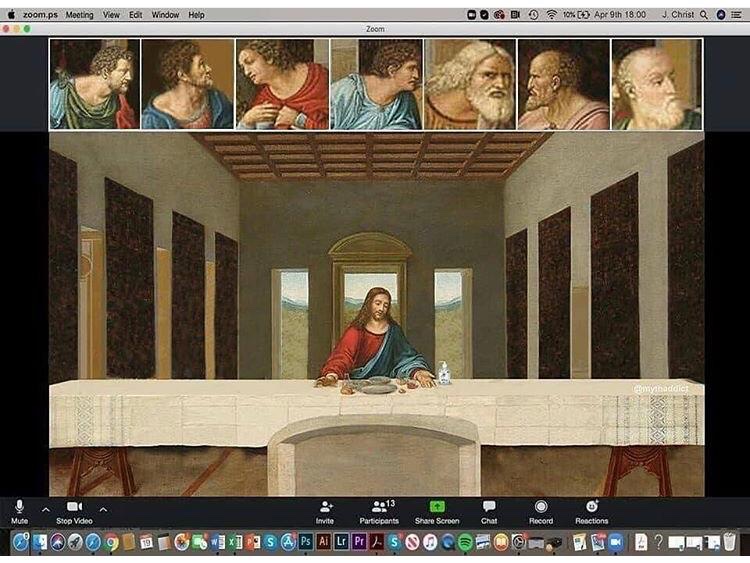


The Last Supper in Lockdown

This is the most profound, humorous, and theologically disturbing thing you will see during this year’s Holy Week:


Does the Bible Teach That Women Should Never Wear Braided Hair or Jewelry?

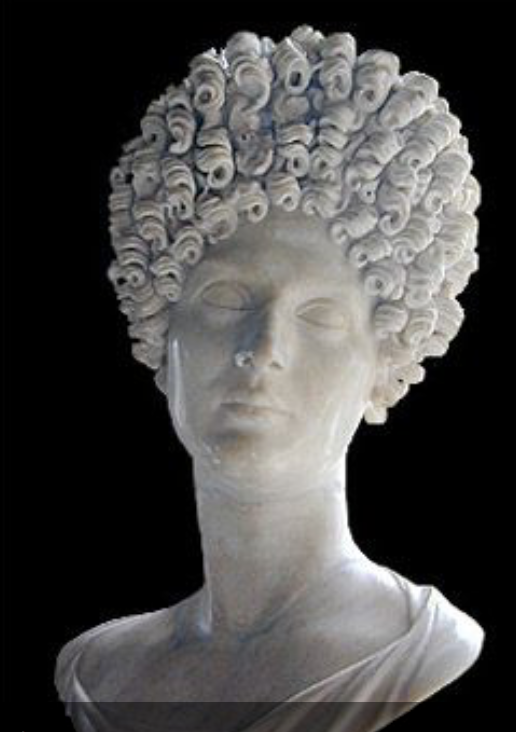
Hairstyling among Rome’s cultural elite, during the mid-1st century.

Many readers of the Bible are puzzled, or even embarrassed, by a statement made by the Apostle Paul in 1 Timothy, that suggests that women should never wear braided hair, or jewelry. But is this flat prohibition against the wearing of braided hair or jewelry something that the Bible actually proscribes? Let us take a closer look, reading Scripture in context.

In 1 Timothy 2:8-10 we read:

I desire then that in every place the men should pray, lifting holy hands without anger or quarreling; likewise also that women should adorn themselves in respectable apparel, with modesty and self-control, not with braided hair and gold or pearls or costly attire, but with what is proper for women who profess godliness—with good works.” (ESV).

A similar passage comes from the words of Peter, at 1 Peter 3:3-4. At first glance, the negative, specific references to “braided hair” and “gold or pearls” would appear that the Apostles Paul and Peter sound like legalists at best, or even, misogynists at worst!

When we read puzzling passages like this, it is important to look at what the whole of Scripture teaches on the matter, and not focus on one or two isolated verses. Since both Paul and Peter were Jewish, and looked to their Hebrew Scriptures, as their written authority, it might help to look at what the Old Testament has to say about the wearing of jewelry, etc.

There are occasions when the Old Testament takes a negative view towards the wearing of jewelry, but such instances are within the context of accenting a woman’s sexual attractiveness for the purposes of manipulation, as when the wicked queen Jezebel “painted her eyes and adorned her head,” when Jehu came to confront her of her sin (2 Kings 9:30).

However, the Old Testament does not dismiss the wearing of jewelry outright:

Like a gold ring or an ornament of gold
    is a wise reprover to a listening ear.
 (Proverbs 25:12 ESV).

Here in Proverbs, jewelry has a positive value, being directly compared to the situation when someone gives wise counsel or correction to someone else, and that someone else receives such counsel or correction willingly.

When the Song of Solomon extolls the beauty of a woman, such beauty is positively related to the value of jewelry:

How beautiful are your feet in sandals,
    O noble daughter!
Your rounded thighs are like jewels,
    the work of a master hand.
 (Song of Solomon 7:1 ESV).

As Jews, both Paul and Peter would have taken similar views towards the wearing of jewelry. They would have accepted the modest display of jewelry as perfectly acceptable, but would find the extravagant display of jewelry to be inappropriate and inconsistent with the godly behavior of a Christian woman.

Focusing on the 1 Timothy passage, carefully notice how the Apostle Paul specifically finds a modest level of jewelry wearing to be wholly appropriate: “women should adorn themselves in respectable apparel.” Rather, Paul is contending against the flaunting of a woman’s beauty, by the excessive use of make up and jewelry, as this would distract others from seeing the real, inward beauty of a Christian woman, her “godliness.”

It is important not to confuse the principle of modesty, with respect to jewelry wearing, with the specific cultural application in Paul’s first century, Roman empire context. For example, some might be troubled by Paul’s restriction regarding the wearing of “braided hair.” So, does Paul really have some type of weird hangup regarding “braided hair?”

Again, a careful reading of the text shows that it is the combination of “braided hair and gold or pearls or costly attire,” not “braided hair” by itself. The inclusion of “costly attire” should be evidence that there is a big difference between a modest set of ear rings, versus showing up at church with a $25,000 necklace, combined with some over-the-top hairstyling.

New Testament scholar Steven Baugh notes that by the mid-first-century, “women’s hairstyles had developed into elaborate curls, braids, high wigs, pins, and hair ornaments that were quickly copied by the well-to-do throughout the empire.” The historical evidence shows that wealthy women were following the same fashionable trends of the Roman cultural elite, as a means of flaunting their wealth. Paul would have been consistently applying the Scriptural principle of modest dress, by condemning such flaunting of wealth, in Timothy’s church in Ephesus. The flaunting of wealth inevitably shames those believers, who do not possess great wealth, the type of messaging that the Apostle Paul strongly sought to discourage. Baugh concludes: “Today, it is the equivalent of warning Christians away from imitating styles set by promiscuous pop singers or actresses. How one dresses can convey rebellious or ungodly messages whether intended or not.1

Remember this, too: The focus should be on how we ourselves understand what makes someone beautiful. This is not an excuse to cast a condescending eye on others.

Far from being a psychologically prudish hangup, on the part of the Apostle Paul, Paul’s instructions to Timothy, advocating the modesty of women’s external appearance, is a specific application of a timeless Scripture principle. Should Christians today be embarrassed by what Scripture says here? Absolutely not. While a 21st century Christian might apply the principle differently, according to the fashions of our day, the principle remains the same. The Bible consistently seeks to accentuate the inward beauty of a believer, while warning against the display of external extravagance, designed to shame others or to be inappropriately sexually provocative.2

Notes:

1. Steven Baugh, “A Foreign World: Ephesus in the First Century,” p. 54-55, in Women and the Church, 3rd Edition

2. For more detail, please consult chapter 36, of David A. Croteau, Urban Legends of the New Testament: 40 Common Misconceptions, on “Women Should Not Wear Jewelry,” p. 210-214.. 


Christians and the Coronavirus: Lessons From Church History

What did Martin Luther and Charles Spurgeon have in common? Both Christian leaders dealt with the challenge of plagues and pestilence, in their day. Luther, the 16th century German Reformer, and his wife, Kate, ministered to the sick when the Black Death descended upon their city of Wittenberg. Spurgeon, one of England’s finest preachers of the 19th century, was a 20-year-old young pastor, when a cholera epidemic swept through London.

The mortality rate for COVID-19 is high, but the rate was even far worse for the Black Death (up to 1 out of 4 people died) and London’s cholera (around 5.5 percent).

I recently read a great article by UK author Glen Scrivener, that briefly chronicles these and several other examples of how Christians faced plagues, pestilence, and pandemics in the past. Today’s coronavirus pandemic is new to many of us, but we have much to learn from believers who lived before us, who can show us examples of how followers of Jesus sought to love others, in difficult and scary times, and how the church was able to survive such challenges.

Along those same lines, I also read a great article by C.S. Lewis, whereby you can substitute the word “atomic bomb” with “coronavirus” and gain some of the Oxford don’s encouraging insight. Below is a video podcast featuring Glen Scrivener expanding upon the themes in his article.


Who Are the 144,000? — A Case Study in Understanding the Book of Revelation

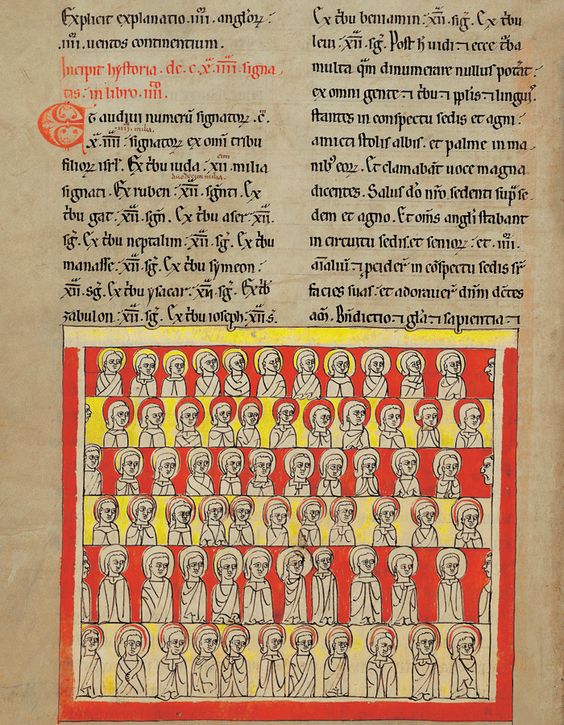
From a 12th century commentary on Revelation 7, by Saint John of Lorvao, Portugal, depicting the 144,000. The variety of existing interpretations that attempt to decipher the 144,000 are legion. Which is the “correct one?”

Have you ever tried to read the Book of Revelation, and wondered to yourself, “Huh? What is this all about?

Despite its early reception in many quarters, Revelation was one of the last books to be accepted into the New Testament canon of Scripture. Eastern Orthodox Christians, even today, do not publicly read Revelation in their worship services. The early church fathers were reticent about Revelation, not because they did not value it, but because they were concerned that overly-enthusiastic, misguided readers might misuse it, and read all sorts of crazy stuff into it.

History has proven this reticence to be 100% correct. Remember Family Radio’s Harold Camping? Or David Koresh in Waco, Texas? All of the crazies have looked to Revelation, believing that they, and they alone, have figured out the true message of this book. Yet, they were all 100% wrong.

Still, Revelation simply fascinates people.

I once had a friend in college who supposedly “knew” all about Revelation, what the bowls and trumpets all mean, and those spooky, multi-headed beasts. My friend knew very little about what the rest of the Bible talked about, such as the basics about sin, our need for a Savior, and what it means to have a personal relationship with Jesus. But he sure knew all about the Antichrist!

It seems like there are two kinds of people in the world when it comes to the Book of Revelation. First, you have folks, who are simply curious about understanding Revelation. Most folks are at least mildly interested, but more than a few are sort of like my college friend, simply obsessed with all things “End Times.” Many of them watch late night cable TV channels devoted to figuring out “Last Days” prophecies, reading New York Times bestsellers all claiming to reveal the “true secrets” about Bible prophecy, while others love to go to various, church-sponsored Revelation seminars. It is fine to take an initial interest in these things, I suppose, but only if it gets people to read the rest of the Bible.

The second group are those who just get really fed up with all things “End Times,” or at least the cacophony of voices that surround the discussion. They are bothered by the fact that there seems to be endless theories as to how to interpret the Book of Revelation. Even the great Protestant Reformer, Martin Luther, observed that “everyone thinks of the book whatever his spirit imparts.” For Luther, at one point, he went so far as saying that Revelation is “neither apostolic nor prophetic, for Christ is neither taught nor recognized in it.” Nevertheless, despite discouraging its use, Luther recognized that the church historically did view Revelation as part of the New Testament canon, so he did include it in his 16th century translation of the Bible into German.

So that is where we are at: Some feel absolutely compelled to defend their own pet theory about Revelation, and demonizing others, while others simply just want to skip that book of the Bible all together! Well, that is all quite understandable, but both of those attitudes, too, are wrong-headed.

In this “deep-dive” blog post, I want to do a case study in Revelation, by explaining why this book is so difficult to understand, just by examining one, short passage, comparing different approaches, and then draw some positive lessons from the study of Revelation. The bottom line: We should not neglect the Book of Revelation, but neither should we cling too tightly to a particular interpretive tradition of the book. But before I start, I must issue this disclaimer: If you are new to Revelation, I would strongly encourage you to stop reading this blog post, and then click through to first read my introductory post on the Book of Revelation from a few years ago here on Veracity. Otherwise, this will get too confusing way too fast. 

So, who are the 144,000 spoken of in Revelation 7:1-8? Let us walk through this very intriguing question. This is not a short blog post, so you may want to pour yourself a beverage before we move on. Continue reading