Category Archives: Topics

Respecting Disagreement

Now we see but a poor reflection as in a mirror; then we shall see face to face. Now I know in part; then I shall know fully, even as I am fully known.
1 Corinthians 13:12 (NIV)
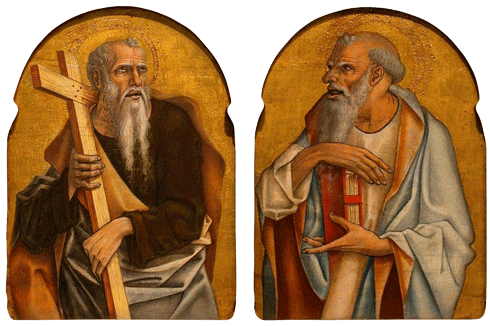
Two Apostles

Two Apostles by Carlo Crivelli, 1475

The apostles Peter and Paul had some famous disagreements.  Ultimately however, it was their shared, unswerving love for Christ that propelled their ministries.

I recently attended a lecture by Dr. Ian Hutchinson, a scientist with impressive technical credentials—and a Christian.  His topic addressed science-faith issues, and concluded with his belief that a Christian worldview is consistent with, and complimentary to, a scientific worldview.  I agree and am thankful that there are scientists of Dr. Hutchinson’s caliber who are willing to share their faith in public forums.  (Let’s be real—who am I to disagree?)

The first question from the audience at the end of the lecture involved the age of the earth and the six ‘days’ of creation.  Dr. Hutchinson’s response was along the lines that the universe is very old (13.7 billion years, again I agree), and that he believes we should not take the creation account in Genesis too literally—that the text is ‘figurative’.  And here we have a fork in the road.  I think it is somewhat dangerous to give up on the text in Genesis too easily, and to ascribe a figurative intent on the part of the author (Moses) when in fact there may be more to the inspired text than meets the eye.

In addition to his work at MIT, Dr. Hutchinson is also a lecturer for the BioLogos Foundation, founded in 2007 by another prominent Christian, Dr. Francis Collins.  These brothers and sisters in Christ adhere to the idea of theistic evolution, which—rather than have my take on this topic—you can read about directly from the BioLogos website.  There are many wonderful Christians who ascribe to the ideas of theistic evolution.

I’m just not one of them.  After studying the matter in detail, I have a different understanding.  I ascribe to old-earth creationism.

Hugh RossDr. Hugh Ross and his colleagues at Reasons To Believe have a great deal to share on this topic.  First, Moses never wrote that the universe was created in six days.  Excuse my provocative statement, but I did it to make a point— ‘day’ is an English word.  Moses did not write in English (which has a million or more words), he wrote in Biblical Hebrew (which only had a few thousand words), and the word that was written was ‘Yom’, which clearly has multiple meanings including the idea of an epoch or age. Continue reading


Veracity’s Top 10 Scorers

Veracity's Top Scorer Award

Do you ever wish there was a blacklist we could use to avoid being blindsided by bad doctrine or theology?  After all, there is so much material out there—who has the time to sort through it all?

When you think about it, a blacklist is a pretty ridiculous idea isn’t it? Not that there aren’t all kinds of names—from the famous to the infamous—that deserve to be called out, but there is a much better way for thinking men and women to attack this problem.  Study the good guys.

Welcome to Veracity’s Top 10 Scorers list. These are the players who consistently “put the puck in the net.” No deking and skating around—just on-target discipleship.

The list includes pastors, philosophers, professors, a historian, theologians, apologists, an astrophysicist, several world-class scholars, and some exceptionally gifted teachers.  (Actually there are 12 winners on our Top 10 Scorers list, because they all deserve the award.) Continue reading


Can We Trust the Bible?

“The Bible says it, I believe it, that settles it.”  Really?!

Many theologians and pastors strongly disagree.  If there was such a thing as a fantasy theology team, my top (living) draft picks would include: Dick Woodward, William Lane Craig, Hugh Ross, Ravi Zacharias, Matt Slick, Tim Keller, John Yates, Michael Card, Ray Vander Laan, Andy Stanley, Lee Strobel—and Daniel Wallace.

Here’s a slightly irreverent, very funny, and spot-on lecture by Dr. Wallace given at Dallas Theological Seminary about the “worst Christian slogan ever concocted” (my apologies in advance to people from Arkansas).

Seriously, how much research is there to corroborate Dr. Wallace’s observations and conclusions?  How reliable are the Bibles we have today?

Continue reading


The New Mormonism… And the Old

The Church of Jesus Christ of Latter Day Saints is changing. Once a marginal, persecuted sect isolated in the frontier regions of Utah in the 19th century, the movement popularly known as “Mormonism” has entered the American mainstream. Out with the “old”, in with the “new”.

Years ago, the stereotypical Mormon was a clean cut, college-aged student wearing a white buttoned-down shirt and a name tag, riding down your street on a bicycle. Now he is a professional business executive, a famous entertainer, or even a presidential candidate. In the “old” Mormonism, a Mormon was someone who wore weird underwear and perhaps thought that he might become a god of his own planet someday. Now in the “new” Mormonism, he is happily married and upholds traditional and wholesome American family values and loves his country. Sure, Mormons still have the bicycles and the underwear, but now they are those good-looking neighbors next door who always seem so nice and friendly and hug their kids…. Yeah, come to think of it… in my experience, every single Mormon gal I have ever met has been really cute.

Former Mass. Governor Mitt Romney is the first major Mormon candidate for the United States Presidency since…… Joseph Smith ran for the office in 1844.

But the Latter Day Saints (LDS) are changing in other ways, too. True, new membership rates indicate over 14 million LDS members worldwide and that number is steadily rising. However, the rates for active membership are actually in decline. LDS General Authority Marlin Jensen has stated that “attrition has accelerated in the last five or ten years.” Some research shows that even since the early 1990s, for every new Mormon convert there is at least one Mormon who leaves the church or simply becomes inactive. The LDS movement is hemmorraging, and hemmorraging fast. Out with the “old”, and in with the “new”. What explains these changes? How can evangelical Christians respond to the changes within Mormonism when doing apologetics? Continue reading


The Dalai Lama is Coming!

I play soccer with a group of friends at the College of William and Mary, where I work as an IT staff person.  At the end of one of our games, we were talking about the upcoming visit by the Dalai Lama to speak at William and Mary Hall, on Wednesday, October 10.   There were several jokes about strange Eastern religious customs and how hot it would be to wear a monk robe all day long.  One made a sly remark about attaining “enlightenment” from the marijuana fumes rising up from the crowded Kaplan Arena this coming Wednesday from smuggled-in contraband.   This is a big deal event for the College, with several thousand tickets sold out within minutes to hear the venerable representative of international Buddhism.  So what is the big deal about the Dalai Lama?

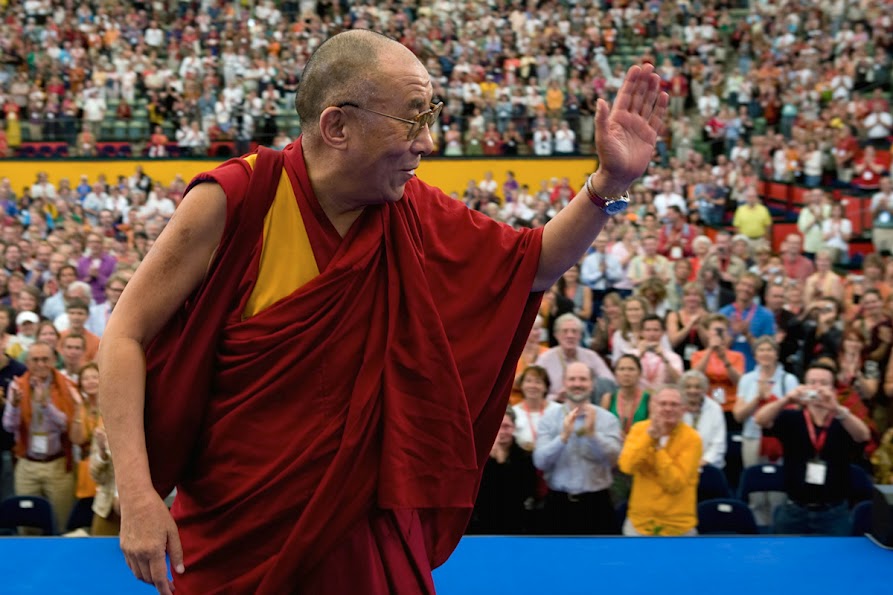
Image

The 14th Dalai Lama

Actually, Tenzin Gyatso is the 14th reincarnation of the Dalai Lama, according to Tibetan Buddhist tradition.   For hundreds of years, an unbroken line of spiritual teachers in Tibet have instructed the Buddhist faithful.  But the Dalai Lama is more than a religious leader position, it is also a  political role, unifying all of the Tibetan region north of the Himalayan mountains in Asia.  So when Communist China invaded Tibet in 1950, it put the current Dalai Lama into a difficult situation.   After a failed uprising against the Chinese in 1959, the 14th Dalai Lama fled and established a government in exile in India.  The United States government has at times given support to the Dalai Lama’s efforts on behalf of the Tibetan people during the past fifty years.

Over those years, the exiled Dalai Lama has served as an international ambassador  in the West for Buddhism.  There are Four Noble Truths of Buddhism:  (1) all of life is suffering, (2) all human desire leads to suffering, (3) the annihilation of desire releases us from suffering, which is enlightenment, and (4) there is an Eightfold path  to that enlightenment; that is, right view, right intention, right speech, right action, right livelihood, right effort, right mindfulness, and right concentration.  Buddhism, however, is not a monolithic movement.   The Dalai Lama represents part of the  Mahāyāna tradition.  But the most popular form of Buddhism in the West is a more concentrated variant, Zen Buddhism, first propagated largely by the famous Japanese philosopher,  D. T. Suzuki, in the early to mid-20th century.  Oddly enough, Buddhism is considered by many to be a “religion” but the more philosophical traditions are  technically atheistic.   Even so, there are syncretic flavors that combine animistic beliefs with traditional Buddhist philosophy.    The study of Buddhism can get very complicated very quickly. Continue reading
