Category Archives: Apologetics

Is Christianity Reasonable? A Devotional Answer

Is Christianity reasonable? As absurd as this question might seem, there are major religions founded on the premise that faith does not have to be reasonable. Fortunately, Christianity is not one of them.

How would you go about convincing someone that the Christian faith is reasonable? (Okay, this is a trick question—it’s not really our job to convince anyone, but it is our job to think.)

There are massive apologetic resources dedicated to defending the faith and making sound arguments in support of Christianity.  Check out Matt Slick’s CARM site, William Lane Craig’s Reasonable Faith site, Lee Strobel, Ravi Zacharias, Hugh Ross’ Reasons To Believe, the Poached Egg, or the One Minute Apologist.

But it is incumbent upon all Christians—not just big-name apologists, theologians, and pastors—to think.  As Tim Keller says in the following message, “You cannot be a Christian without using your brain to its uttermost.”

Jesus says (in Matthew 6) if you want to have faith, “Think, consider, deduce.” Why does thinking lead to faith? The Bible tells us that if you don’t let your thinking take you all the way to Jesus Christ it will end in despair. Martin Luther’s thinking led him to see there is a God. Then his thinking led him further to see that God must be a personal God. Then he thought, “If there is a personal God, I want to please him.” But Luther couldn’t obey even the Golden Rule, and wondered how he could please God. The Bible tells us there is only one way: Jesus Christ.
Tim Keller, paraphrased from Faith is Reason clip on YouTube

Oftentimes apologetics can be an uppercut.  And it can be an intellectual salve. Great apologists are convincing debaters, loaded with sound arguments to defend their position, and truth be told most of us wish we could dial up their arguments in our normal conversations. But there is an inherent danger in all the eloquence and logic of good apologetics—we can lose sight of the object of apologetics.

Continue reading


Historicity of the Bible

Is the Bible a reliable historical document?  This is a huge topic—too ambitious for a blog post—but here’s an attempt to whet your curiosity to dig a little deeper.

Sometimes it takes quite a bit of investigation, discovery, and thinking to connect the dots.  (For example, Rick Larson’s work on the Star of Bethlehem.)  But there are examples that are right in our faces.  Consider the Arch of Titus in Rome.  Titus was the Roman commander in charge of the Siege of Jerusalem in 70 A.D., which destroyed Herod’s Temple.  The Roman army carried off the Temple treasures, including the Menorah, Table of the Showbread, and Temple TrumpetsRecent research into the bas relief on the Arch of Titus has discovered that the Menorah in this frieze was originally painted gold.

Arch of Titus

Temple Plunder on the Arch of Titus, Rome

Here is an extra-biblical source showing the Menorah from the Hebrew Temple, carried off in the spoils of war, and sculpted into a Roman monument by the Roman people.  And it is identical to the lampstand prescribed by God to Moses in Exodus 25.  And it was described in detail by (non-Christian) first-century historian Flavius Josephus, and later rabbinical sources.  If you put that all together, we have extra-biblical evidence for the elements in the Holy of Holies, confirmation of a match between Scripture and what was found in the Temple, confirmation of the elements used in service by Hebrew priests, and a very big problem for those who deny that the Temple was ever on Mount Moriah.  It’s as close as we can get to an ancient photograph.  This particular sculpture was used to create an official seal for the modern State of Israel featuring the Menorah.  So there’s one small example of the historicity of the Bible.

Continue reading


Why I Believe

“But in your hearts revere Christ as Lord. Always be prepared to give an answer to everyone who asks you to give the reason for the hope that you have. But do this with gentleness and respect,”
1 Peter 3:15, NIV

So why do I believe?  Because the more I study, the more it all makes sense, and the more I find veracity in the wonderment of the Scriptures.  That veracity substantiates Christ as Lord.

Paris Carousel

Eiffel Tower Carousel, 2009

Personally, coming to faith is a lot easier if you’re somewhat of a thinker.  For example, take a moment to study the above photograph.  How much do you see?

People, a carousel, an interesting vignette?  A mother caring for her infant, an artist sketching a little girl, a father holding his small son on the ride, a man taking a picture of the Eiffel Tower at nightfall, people out in the late spring air?  Go a little deeper.  A street-corner amusement ride, yellow horses, lights, inertia, centripetal motion, commerce?  A woman enjoying a chocolate gelato—thermodynamics? Barely scratching the surface.  A woman wearing a Palestinian scarf—the struggles of displaced people.  What about the sounds and smells?  Music, emotion, soulful awareness?  A bunch of energy holding together particles interacting with their environment bound by the laws of the physical sciences bathed in photons?  All of this is happening in three-dimensional space and time.  Deeper still.  What might each of these people be thinking and feeling?  Love, loneliness, heartache, guilt, helplessness, grief, a moment’s rest, joy?  Now we’re getting somewhere.

Two overarching questions:
1.  Where did all of that come from, and
2.  Why is it there?

Intellectually speaking, this is where a lot of people just stay on the merry-go-round.  For whatever reasons they get lazy or distracted in their thinking and just try to enjoy the ride.  But that approach to life ultimately leads to the back end of where you were.

Conversely, if you think that picture through to a logical conclusion you can find Jesus Christ.  If you want to check the underpinnings of my faith, go to the Kaqexeß page of the Veracity blog and start reading.  I would recommend beginning with the Judge for Yourself post because it frames some really interesting facts that support Scripture, and because it challenges you to think about your burden of proof.  Specifically, it may be important to check your biases with objectivity.

But if you want me to give a reason for the hope that I have, here are just 50 of the reasons (in bulleted form).

Continue reading


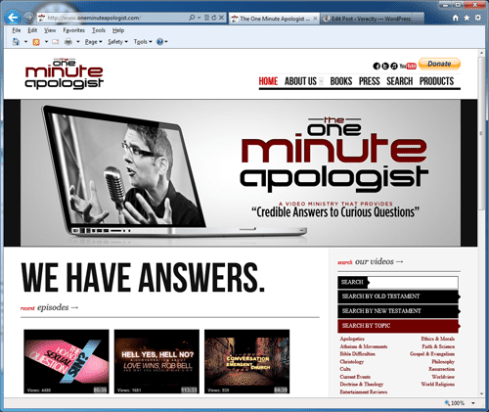
One Minute Apologist

No way around it, discipleship is a lot of work.  We all wish there were more shortcuts.  So here’s a flyer for those of us pouring through book after sermon after website.

The One Minute Apologist packs a lot of sound doctrine and theology into scores of short video clips.  Check out their Search page and start watching the experts come to the point quickly.  Enjoy!

One Minute Apologist


Veracity’s Top 10 Apologetics Sites

Come, follow me,” Jesus said, “and I will make you fishers of men.
Matthew 4:19, Mark 1:17 (NIV)fly

It seems everyone has a top 10 list: the FBI, the NCAA, Mr. Blackwell, Time Magazine, David Letterman, even God.  So why not Veracity?

We spend so much time on the web fishing for resources, we just can’t help but want to share the good stuff.  So here you go—our very first top 10 list of online apologetics resources.

These are sites you can use for personal devotional Bible study that will take you well beyond the sacred page.  They spur our imagination and challenge us to think.  They are also rich with content that keeps us coming back for more.  The list includes a devotional catalog, an indispensable reference, lessons from a historian, topical blogs, and a video outlet.  And several are straight-ahead apologetics.  Put them in your tackle box and enjoy them on your next fishing trip.

So with great appreciation we extend a Chi Rho hat tip to the following sites (all of which tied for first place). Continue reading