Category Archives: Apologetics

Searching for God

Impact Wrench

An impact wrench is a fine tool for changing brake pads or tires.  But it’s completely useless when searching for scientific evidence of God.  For that job you need a Large Hadron Collider.  Right?  (The right tool for the job and all that.)

The recent experimental confirmation of the existence of the Higgs Boson and Higgs Field comprises a major milestone in mankind’s understanding of the universe.  After 50 years of mind-numbing, abstract theoretical research, theologians and scientists are lining up to interpret the data.  But not everyone is coming to the same conclusion.

Finding the Higgs Boson doesn’t prove the existence of God.  On that theologians and scientists are in complete agreement.  But some of them are as far apart on their interpretations as the tools they use. Continue reading


Higgs Boson, “What’s in the data?”

This week particle physicists announced the experimental discovery of the Higgs Boson, a scientific breakthrough certain to win the Nobel Prize. Here is an incredibly entertaining video posted nine weeks ago that explains the physics.  (Turn your iPad to portrait orientation and watch in full screen mode to fully appreciate the video.)

[vimeo 41038445 width=500]

So let’s contemplate the question at the end of this video, and think about “What’s in the data?” and why there is such a flap about this so-called “God Particle.”

Our friends at Reasons To Believe have posted 17 articles to date on the Higgs Boson.  Dr. Hugh Ross posted a four-part series on this topic in 2011, in which he explains the theological prize that’s in the data.

The Theological Prize

“From a theological perspective, the bigger trophy will be determining the degree to which the characteristics (especially the mass, average momentum, abundance, and location) of sterile neutrinos must be fine-tuned to explain why life, especially human life, is possible in the universe. … Sterile neutrinos would bolster the biblically predicted hot big bang creation model by resolving eight anomalies in the standard cosmology and particle physics creation model simultaneously. Even more than that, they would also significantly augment the evidence for the supernatural, super-intelligent design of the universe to make possible the existence of physical life, especially human beings and their global, high-technology civilization.

Axions, as well, contribute to the evidence for the design of the universe for humanity’s specific benefit. Like sterile neutrinos, the characteristic features, abundance, and geographical placement of axions must be fine-tuned. Thanks to the recent observational and theoretical discoveries concerning sterile neutrinos and axions, scientists now possess much more complete and much better integrated models of cosmic and particle creation. Such completeness and integration adds yet more proof for the biblical creation model and the attributes of the biblical Creator.”  — Dr. Hugh Ross, 2011

That’s just what I was thinking!  It’s all in how we interpret the data.  Or maybe, more to the point, it’s all in how we appreciate what God created.


Book of Job

The Old Testament book of Job is a story about faithfulness through longsuffering, perseverance, and ultimately the love of God.  Right?  Right.  But what else might we glean from the text?

You might be surprised to learn that Job is arguably the most ancient book in the Bible—predating Genesis by as much as 400 years.  It also contains more information about the creation of the universe than most of us realize.  What might it tell us of ethics, purpose, right doctrine, obedience, redemption, and even Heaven?  Why does God ask all those specific questions?

If you’re interested in digging deeper, check out the book below.

Enjoy!

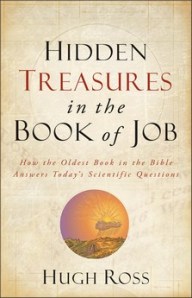
Hidden Treasures in the Book of Job


Inerrant and Infallible

We cannot explain or resolve all parts of Scripture.  However, to surmise that apparent conflicts in the Bible must be ‘errors’ is an arrogant and dangerous supposition.  Too many people give up too easily—if it doesn’t make sense they aren’t willing to dig deeper.  Or to trust. Bible

A couple of years ago I listened as wise, godly friends discussed the inerrancy and infallibility of the Bible.  All of them are mature Christians.  The issue was not the authority of Scripture for faith and practice.  The issue was whether it is necessary and/or appropriate to include in our statement of faith that the Bible contains the ‘inerrant’ and ‘infallible’ word of God.

While I try not to get too personal with this blog, the most that I can contribute on this topic is personal.  Specifically, the more I study the more it all makes sense.  Not just in a little way, but in one “Oh wow!” realization after another.

Many (not all) passages that at one time confused me or caused me to wonder if the writer was correct, came into sharper focus with deeper study.  This detailed-study-leads-to-edification process has happened so many times that my view on the inerrancy and infallibility of the Bible has strengthened considerably.

Just one example—I recently audited an apologetics course entitled Creation and the Bible by Reasons To Believe.  Dr. Hugh Ross, a renowned astrophysicist and the founder of Reasons To Believe states in his testimony that he became a Christian by reading the foundational books of the world’s religions and discarding them one by one based upon scientific errors apparent in their text.  When he got to the Bible however, he found 13 scientifically accurate statements about the creation of the universe in the first chapter of Genesis.  If you take the time to dig, the details are amazing and dramatically support the case for ascribing inerrancy and infallibility to the Bible.

There’s no shortage of opinions on the accuracy of the Bible.  Our post-modern culture promotes individual opinions and disharmony over conformity and agreement.  Fine.  Got it.  No one wants to give a straightforward yes or no to the question of Biblical inerrancy, and actually that should be the case.  What do you do with translation differences, poetry, allegorical statements, the use of Koine (slang) Greek, textual criticism, differing accounts of the same events by different authors, a lack of modern technical precision, observational descriptions of nature, the use of hyperbole and round numbers, variant selections of material in parallel accounts, and so on?  It takes a fair amount of clarification before we can get to a yes or no response.

But the concepts behind these adjectives are extremely important, and there are those who have done a very good job building a case for unity on this topic.  The Chicago Statement on Biblical Inerrancy is a document worthy of very careful reading.  Before I read it, I had my own unfocused views on the subject.  After reading it and thinking it through, I’m in.  I support the Chicago Statement.

So back to the question of whether it is necessary or appropriate to include that the Bible is inerrant and infallible in our statement of faith.  In its constitutional context, the Williamsburg Community Chapel’s statement of faith is reduced to eight points about which we believe so strongly that we would break fellowship with those who would disagree.  In this context, personally I believe it is appropriate—but not necessary—to include these terms (see Article XIX of the Chicago Statement).  In other words, would I break fellowship with someone who was struggling with the genealogies of Christ in Matthew versus Luke?  No.  Would I break fellowship with someone who insisted that the differences in these genealogies prove the errancy of the Bible?  Absolutely.  More importantly, do I believe that the Bible is the inerrant and infallible, inspired word of God?  Yes.


Noah

What do you think about Noah’s flood?  Is it a myth, or did it really happen?  If it was an actual event, is there any evidence that can help us understand Noah’s flood in the context of the history of mankind?  What can hard facts—such as the stratigraphy of the earth’s geological and anthropological records—tell us about what Noah’s flood could and could not have been?

Noah's Flood

These are all fascinating questions that have been carefully vetted by engineers, scientists, and scholars at Reasons To Believe, the science-faith think tank whose “mission is to spread the Christian Gospel by demonstrating that sound reason and scientific research—including the very latest discoveries—consistently support, rather than erode, confidence in the truth of the Bible and faith in the personal, transcendent God revealed in both Scripture and nature.”

These people are smart.  Very smart.  And they’ve got soul—and class.

The primary goal of our blog is to share resources that corroborate the Bible.  The Reasons To Believe website is a treasure trove on the information superhighway.  They have thus far written 1,564 articles since their founding by Dr. Hugh Ross in 1986.  Their website has video and audio materials that prove their mission.  Pop into their search box and you’ll find amazing resources.

Their position on Noah’s flood (they call it the “RTB Flood Model”) is controversial—because it flies in the face of what a lot of people have traditionally believed about the events recorded in Genesis 6-9.

So…check it out for yourself.  Start with these links (some pages require Flash):

Overview of RTB’s Flood Model

Raining on a Misconception
Noah’s Floating Zoo
Does Human Genetic Evidence Support Noah’s Flood?
The Waters of the Flood
The Unsinkable Search for Noah’s Ark

RTB Articles related to Noah’s Flood

Start reading, and by all means form your own opinion.

For those who might be encouraged to dig a little deeper, the classes offered by Reasons Institute contain additional videos that they do not release to the general public (you need to sign up for the courses).  These course videos are as powerful as what you are able to download or purchase from their site.  I watched one yesterday by a geologist, who specializes in the earth’s stratigraphy, that was absolutely amazing in relating the geological record to Noah’s flood.

Enjoy!