Category Archives: Apologetics

Apologetics 101

Here’s an interview with Dr. William Lane Craig in which he answers basic questions about the importance of Christian apologetics, the resurrection of Jesus, the problem of evil, and the lack of atheistic explanatory models.  He also gives some practical advice for those interested in apologetics.

Enjoy!


Who Is Jesus?

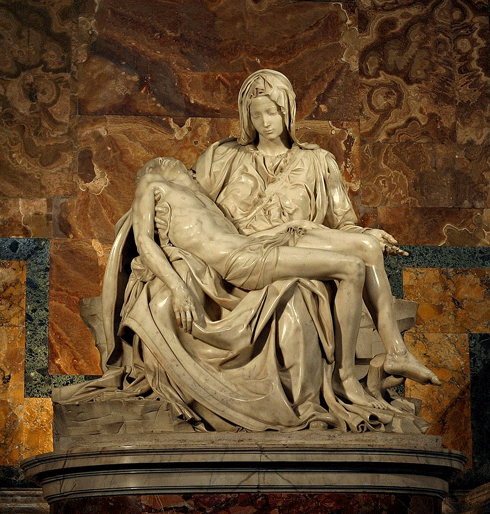
Michelangelo's Pietà

Pietà by Michelangelo, 1499

Who is Jesus?  Wow, talk about a profoundly important question!

There are a lot more people who “believe in Jesus” than there are those who know what Jesus actually claimed about himself.  Many think he was a great moral teacher, a prophet, or a wise Rabbi.  Some think a legend, a myth, or a contrivance.  Still others that he was one of many gods, or one of many roads to God.  That Jesus straightforwardly and clearly attacked these notions is of little consequence to those who will not invest the time to read the Gospels and weigh the evidence for his claims.

Jesus had to fulfill hundreds of Old Testament prophecies written centuries before he appeared on earth, and live within the Mosaic law of the Torah.  He had to submit to the cruelest punishment mankind could dish out, and to top it all off he had to rise from the dead.  No small feat.  When you think about it, he had to color between some extremely tight lines.  Lee Strobel calls this framework the “unmistakable fingerprint of the Christ.”  Only Jesus was man enough for the job—that was the whole point. Continue reading


Unreasonable Doubt

Felix Barthe (1796-1863), Minister of Justice and Deputy by Honore Daumier, 1833

Some people will not allow themselves to be convinced by evidence. I touched upon this topic recently in a post entitled Judge for Yourself, that illustrates the need to explore the standard of proof we each demand, the need to check our biases, and our ability to weigh evidence.

Lee Strobel took the approach that he was willing to follow the evidence for a Creator whether it led him to an uncomfortable conclusion or not.  Unfortunately, many atheists lack this kind of integrity.

Ironically, there are scientists who investigate the facts behind the Big Bang, the DNA molecule, the fine tuning of the universe, cellular machines, and many other physical phenomena and draw the conclusion that the data clearly indicates intelligent design. Yet some of them can’t call the designer ‘God’.  Really?

However…before we throw any rocks at scientists for not having the integrity to counter their professional biases, shouldn’t we revisit our own biases—professional and otherwise?

As Ken Petzinger points out, how we approach theism determines a lot about our lives, and how we interact with the world. Here’s a thought-provoking, on-topic article entitled Unreasonable Doubt, that Mary Petzinger wanted to share. The article (by Jim Spiegel writing in  Christianity Today, January 2011) calls intractable skepticism into the light of day.  The byline reads “The reasons for unbelief are more complex than many atheists let on.” To read the article, click here.

Enjoy!

HT: Mary Petzinger


Does God Exist?

Believe it or not, formal debates on the existence of God regularly turn out thousands of ticket-buying intellectuals to hear atheists and theists go at it. Although it may seem silly to give out medals for something every kindergartener should know, there is much to appreciate in well-turned arguments that support the affirmative.

Setting personal style biases aside, how do the best theists make their case for the existence of God? For a sampling of how heady this question can get, check out William Lane Craig, Research Professor of Philosophy at Talbot School of Theology. Sam Harris, one of today’s most prominent atheists, recently described Dr. Craig as “the one Christian apologist who seems to have put the fear of God into many of my fellow atheists.” Continue reading


Bible vs. Science: Seven Approaches

John Paine has invited me from time to time to offer a “guest post” on some topic of interest on the Veracity blog. This is a real “step of faith” for John as you don’t always know what you are going to get when you allow a guest to post! That being said… here we go!

The Bible vs. Science. Is there an eternal conflict between the two, or is the warfare between them nothing more than a modern myth? Is belief in the Bible simply a matter of “blind faith”, contrary to contemporary scientific thinking? Should the contributions of modern science have any impact on how we are to interpret Scripture? These are important questions, and different Christians have arrived at different answers. The type of answers we adopt will have an impact on how we explain our faith to a non-believing co-worker, neighbor, or family member. So how do we make sense of the Bible vs. Science debate within the church and contemporary culture?

A few years ago, I shared in our Williamsburg Community Chapel small group a model of how different people have responded to these type of questions. After having worked as a computer engineer at NASA for 15 years and now at the College of William and Mary for 12 years with a lot of “scientific” types of people, I would suggest that there is a continuum of seven basic positions in the Bible vs. Science debate.

This continuum moves along a spectrum ranging from a purely biblicist view that opposes Science to a purely science-only view that opposes the Bible. In the middle are various views that seek harmony between the Bible and Science or that view the Bible vs. Science debate as a distraction to what really matters (Click on the picture below to enlarge the diagram, if you need to see it better):

Image

At the ends of the spectrum are two extreme positions. On one end is the Fideist approach. The term “fideist” is derived from the concept of having faith at the expense of reason. A Fideist approach argues that science is completely irrelevant to matters of biblical faith. It is a type of “blind faith” in Scripture. The Bible is the only real source of truth, and so the only purpose for Science today is to give us a means for predicting future events. Science does not tell us much about God’s actions in Creation, nor can it really tell us anything about God Himself. While an approach like this is common among church-goers who show very little interest in science, it is not a view held by that many serious thinkers. About the closest serious thinker that I know of who advocates a position close to this is the recently deceased John Robbins of the in Texas. Robbins’ intellectual hero was Gordon Clark, a popular philosophy professor for many years in the mid-20th century at Wheaton College. Continue reading