Category Archives: Apologetics

Irresistible, by Andy Stanley, A Review

Irresistible: Reclaiming the New that Jesus Unleashed for the World. Pastor Andy Stanley overstates a central theme in his argument, but his critics should learn something from him as well.

A little backstory, as to why I decided to read this challenging book: I am not really the type of guy who would be naturally drawn to a pastor like Andy Stanley. At least, that is what I thought a few years ago.

Andy Stanley is the son of the well-known Atlanta pastor, Charles Stanley, who for years has been an example, par excellence, of classic, traditional Bible Belt preaching. When I think of the oft repeated phrase, “The Bible says… the Bible says…,” I think of Charles Stanley.

But I must confess. While he has had a profound, positive impact on the lives of many, and I am sure he is a wonderful man, Charles Stanley’s teaching never thrilled me personally.

About twenty years ago, I was teaching a Sunday school class on church history. I love studying and teaching church history. It helps deepen my love for God. The history of Christianity is often neglected in evangelical churches, so I was thankful for the privilege to try to fill in the gap, at our church. After a few weeks of examining how God has moved in the lives of influential Christians, across the centuries, one dear, elderly woman confronted me and asked, “It is all about history to you, isn’t it?

Apparently, this woman did not understand why anyone in a Bible-believing church needed to waste their time learning about church history. I responded by saying something along the lines of, “Yes, I do believe that God works in history. Jesus did not just stop working in the world after the completion of the New Testament, and He continues to work in our world today.” This genuinely sweet woman then had that “I-have-no-clue-what-you-are-talking-about” look on her face.

*SIGH*.

The following week, the same woman walked into class, and handed me a whole set of resources from Charles Stanley’s InTouch Ministries to look at. I gulped. In particular, she pointed me to a cassette tape, with a title, something to the effect of why “the Bible alone is the Word of God.”

I got the message: Just stick with the Bible, and forget about this history stuff. “The Bible says” is good enough.

I thanked the woman, as she was kind and well-intentioned, and while I did eventually listen to the tape, and agreed with the teaching message, I was still flustered. For if this woman, who evidently was a big fan of Charles Stanley, was learning that we should disregard the lessons of God’s working over the past 2,000 years, since the closure of the New Testament, then I was not really impressed with what she was being taught.

My less-than-enthusiatic encounter with my less-than-enthusiastic church history student pretty much poisoned me. Frankly, Charles Stanley’s son, Andy, had never been on my radar, at all, until a few years ago. When I learned that Andy Stanley, a former youth pastor, now a mega-church pastor himself, started to rise in prominence, I really had no interest in learning anything from him either. Like father, like son, I supposed. Life is short, and since I can not read or listen to every resource article or sermon someone gives to me, I just left the ministries of the Stanleys at that.

That was until son Andy began making waves among his fellow Southern Baptist, conservative evangelical constituents. Though Andy Stanley continues to believe in the inerrancy of the Bible, he no longer thinks that the old evangelical mantra of “the Bible says” really works any more in an increasingly post-Christian society. We simply can not assume today that people believe the Bible.

That is a pretty big shift in message from the elder Stanley…. and it got my attention, because that is the world I live in.

My interest was sparked. Perhaps the younger pastor Stanley has something important to say after all. As it turns out, he does. I am chagrined to think that I never paid attention to this before. Continue reading


When Did Joseph and Mary Go to Bethlehem for the Census?

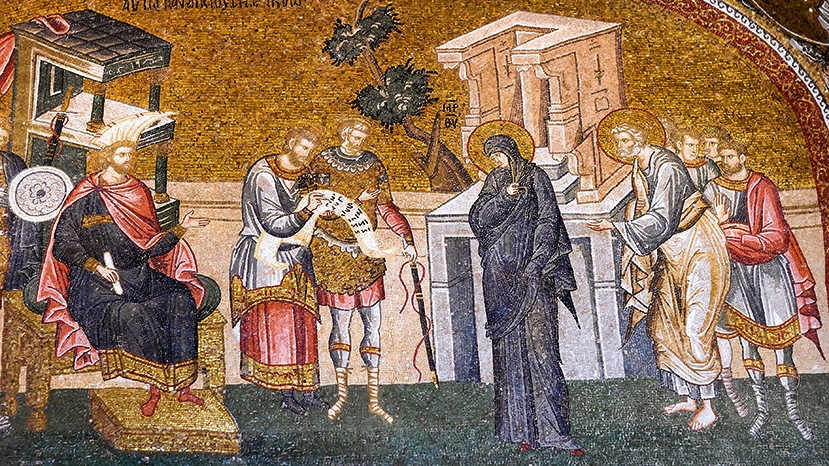
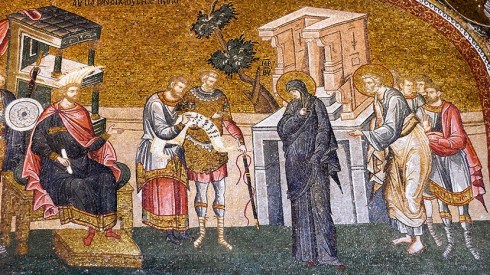
Joseph and pregnant Mary at the census. But what if we got this picture wrong, and Joseph and Mary went to Bethlehem for the census, when Jesus was 10 years old? (credit: Chora Church, Istanbul/Shutterstock)


If this proposal turns out to be correct, it would positively throw perhaps the best argument AGAINST the historical reliability of the Bible into the dumpster…. But to get the idea, you would have to completely rethink how Luke handles chronology. Veracity readers, get out your thinking caps!

One of the thorniest apologetic challenges is trying to fit Luke’s traditional dating for Jesus’ birth to Caesar’s census, during the time when Quirinius was governor, with Matthew’s version, which has Jesus born during the latter years of Herod. The big problem is the timing. Luke’s Quirinian census is typically dated to 6 A.D., largely due to Josephus’ historical record, whereas Matthew’s description of the death of Herod is somewhere around 4-1 B.C.

That is like at least a 7-10 year discrepancy. Whoops.

Skeptics of the Bible often point to this as proof that the Bible has errors in it, and therefore, the Bible can not be trusted for history.

Over the years, Christian apologists have put forward various explanations to account for this discrepancy. Perhaps we are talking about a different census, with Luke’s census happening a few years earlier, but that we simply have no secular or other record for it. Perhaps Josephus was wrong on his dating of events. While these proposals present some thoughtful possibilities, the critics often respond with, “Meh…. There go the Christians again, overreaching for an apologetic.”

But what if the traditional reading of Luke’s story has been misinterpreted? What if it is possible, that about 10 years after Jesus’ birth, after living a few years in Nazareth, the Holy Family returned back to Bethlehem for the census?  What if the story about the census is a digression, purposefully inserted by Luke, temporarily jumping ahead in the chronological narrative, before returning back to the main story about Jesus’ birth?

Sure, this rearranged chronology might mess with the familiar nativity scenes, most churches show on Christmas, but it actually might make better sense of the data we have available, both within the Scriptures and outside of the Scriptures.

I argue for a similar literary technique used by Luke in Acts, regarding the number of visits Paul makes to Jerusalem, that attempts to reconcile with Paul’s own story in Galatians. Studies by New Testament scholars, such as Michael Licona, author of Why Are There Differences in the Gospels?, argue that Luke uses such literary techniques more frequently than traditionally known, whether by evangelicals or skeptics!

In fact, Luke unambiguously does this very thing in Luke 3, by sandwiching verses 19-20, detailing John the Baptist’s future imprisonment, in the middle of the narrative regarding Jesus’ baptism. We know from Mark 1:9-11 that John the Baptist baptized Jesus, which must have happened prior to John’s imprisonment. Apparently, Luke is not afraid of reporting events in a non-chronological manner, to suit his own purposes, assuming that his readers would already know the exact historical chronology.

British bible teacher, Andrew Wilson, on the “Think” blog, pointed me to this new research done by David Armitage, and published in 2018, at the British evangelical think tank in Cambridge, Tyndale House. Armitage’s proposal has a number of exegetical and translation steps to make, but the more I think about it, Armitage’s idea is quite persuasive.

Jump on over to the Think blog to get the argument summary, but here below is Armitage’s proposed translation of Luke 1:80-2:7, that puts all of the pieces together. The chronological digression might be hard to pick out, so you may need to wait for the full explanation at the end of this post to get it straight. The main thing to look for is Luke 1:80 to 2:5, where the narrative jumps forward in time, following along the time period of John the Baptist’s upbringing, before resuming in verse 6, which chronologically follows after the narrative of where John the Baptist’s birth ends, described in Luke 1. It starts with the story of the young, John the Baptist, as he was growing up (notice how chapter headings, first introduced in our Bibles by, Stephen Langton, Archbishop of Canterbury, in the 13th century, can be misleading):

1:80 The child [John the Baptist] grew and was strengthened in spirit, and he was in the wilderness until the day of his public appearance to Israel. 2:1 As it happens, it was during that time that a decree went out from Caesar Augustus to register all the Roman world 2 (this was the first registration, when Quirinius was governor of Syria), 3 and everyone went – each into their own town – to be registered. 4 Joseph also went up: out of Galilee, away from the town of Nazareth, into Judea, to David’s town (which is called Bethlehem) because he was from the house and family of David; 5 he went to be registered with Mary (she who was his betrothed when she was pregnant).

6 Now, it transpired that the days were completed for her to give birth when they were in that place, 7 and she gave birth to her firstborn son and wrapped him in cloths and laid him in a feeding trough, because there was insufficient space for them in their lodging place.

Compare with the ESV translation, and see what you think:

80 And the child grew and became strong in spirit, and he was in the wilderness until the day of his public appearance to Israel.

2:1 In those days a decree went out from Caesar Augustus that all the world should be registered. This was the first registration when Quirinius was governor of Syria. And all went to be registered, each to his own town. And Joseph also went up from Galilee, from the town of Nazareth, to Judea, to the city of David, which is called Bethlehem, because he was of the house and lineage of David, to be registered with Mary, his betrothed, who was with child. And while they were there, the time came for her to give birth. And she gave birth to her firstborn son and wrapped him in swaddling cloths and laid him in a manger, because there was no place for them in the inn.

The most troublesome verse for me is verse 5, as the ESV follows the standard interpretation, by describing the condition Mary was in, during the Quirinian census, that of being pregnant with Jesus. But Armitage argues that the Greek allows for a different translation, with a parenthetical comment, that simply reminds the reader of who Mary was, with no immediate time reference implied. This sets us up to read verse 6 as a transition, implicitly ten years prior, back to the main narrative, emphasizing the place of Jesus’ birth, Bethlehem, and not the timing. I am no Greek scholar, but this is very intriguing! Armitage paraphrases verse 5 like this:

Joseph went there to register with Mary – that same Mary, you will recall, who whilst betrothed to him was pregnant.
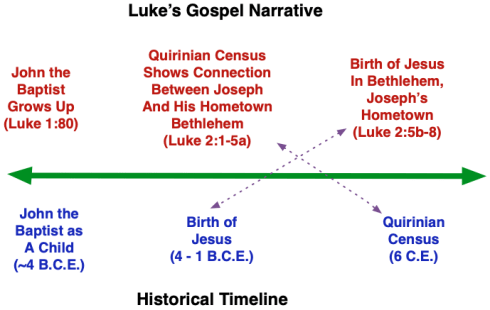
 

Objections to Armitage’s reconstruction might focus on the complex number of interpretive steps required. However, the whole solution is actually simpler, if we grant that Luke has a habit of sometimes jumping around chronologically in his narrative, for reasons clear to his original audience, that are not always intuitive to more contemporary readers. One big plus is that Armitage’s reconstruction adequately explains why Matthew’s account never mentions the Quirinian census; that is, Matthew never covers the events of Jesus’ life at age 10.

So, why does Luke insert this whole story about Joseph needing to go back to Bethlehem, some 10 years after Christ’s birth, before jumping back in with the rest of the Christmas birth story? Well, it would have been important for Luke to establish that Joseph was originally from Bethlehem, despite Jesus having grown up in Nazareth. Bethlehem was the city of David, associated with the prophecy in Micah 5:2, that indicates that the promised Messiah would come from Bethlehem.

Luke probably made it a point to mention the Quirinian census, because it would have identified Bethlehem as being place where Joseph had some family property interests. Just as residency or property interest requirements make a difference in our day, as to the cost of college tuition, taxation purposes, etc., it is certainly plausible that Joseph would have felt it necessary to go to Bethlehem, during the Roman occupation of Palestine in the 1st century, to defend his family property interest. Since the Roman census in 6 A.D. would have been a well-known event in 1st century history, it would have reinforced the idea of Jesus coming originally from Bethlehem, being born there a few years earlier.

If Armitage’s proposal holds, and he admits that it is far from being certain, this is what he says his revised chronology looks like. It totally reframes one of the most well-known Bible stories, of all time, but it solves a particularly knotty, chronological problem:

  1. Towards the end of the reign of Herod the Great, Mary – who is from Nazareth – encounters an angel who foretells Jesus’ birth.
  2. Mary visits Elizabeth in the Judean hill country, then returns home.
  3. Although already found to be pregnant whilst betrothed, Mary marries Joseph – a man from Bethlehem – who initially takes Mary to his family home.
  4. Jesus is born in Bethlehem; because of space restrictions in their quarters, Mary and Joseph place the baby in a feeding trough in the main living area.
  5. The family subsequently relocate to Nazareth, establishing there a home of their own.
  6. Several years later, when Quirinius is governing Syria, an enrolment is announced, so Joseph and Mary travel to Bethlehem, because this remains the location of Joseph’s family home, and he needs to register in connection with property there.

Pretty cool, huh?

UPDATE December, 2021:  I first published this story three years ago. To my knowledge, Armitage’s proposal has not admittedly won over other scholars…. but neither has it met wholesale rejection either. Time will tell if this proposal resolves this long-standing “Bible discrepancy.”

Additional Resources:

I wrote about the Quirinius question five years ago, but David Armitage’s new solution is by far, the most persuasive, in my view…. A couple of other twists to the birth narratives:  The traditional story of Jesus’ birth, as told in many Hollywood movies, tries to smash together the events recorded by Matthew and Luke, such that you have Luke’s shepherds together with Matthew’s wise men from the east, gathered around the newborn Jesus. It makes for a tidy story, until you start comparing Matthew and Luke together, a well-known difficulty for students of the Bible. Matthew has no shepherds, and Luke has no wise men! More than likely, the visit with Matthew’s “wise men,” or more specifically, “magi,” was a separate event, happening weeks, if not months, after Jesus’ birth. This places the trip to Egypt, as described in Matthew, at some undetermined time after the birth of Jesus, yet prior to the permanent settlement in Nazareth, an historical detail that Luke simply ignores. As another example, a growing consensus among Bible scholars has pretty much rejected the popular, traditional idea, of Joseph and a pregnant Mary going up and down the streets of Bethlehem, looking for a place to stay, only to be finally turned away at the “inn.” Contemporary scholarship makes the more modest claim that there was no available “guest room” for the family to stay in at relatives in Bethlehem, a correction made explicit in the NIV 2011 translation of Luke 2:7 (The ESV keeps the more traditional “inn,” but puts “guest room” in a footnote; see above, but according to New Testament scholar, Ian Paul, the evidence favors the “guest room” translation).

UPDATE December, 2024:

I decided to look back again at the criticisms of this view proposed by David Armitage. Earlier this year, an exchange on Reddit engaged Armitage’s argument.  Interestingly, the most coherent counter-argument acknowledged that linguistically Armitage’s argument “works,” for which which I have admitted that I could not competently make a critique as I am not well-versed in Greek grammar. The counter-argument goes onto say that the revised approach of Armitage’s solution to the chronology does not work:

“It’s an interesting exercise in textual analysis, and it technically works linguistically. But the final result is to produce such a convoluted and confusing series of awkward narrative leaps in time and place that it proposes an author who was barely able to string a coherent thought together. Luke is otherwise not such a writer, and nowhere else in his book does he jump back and forth with such whiplash confusion.”

The problem with this counter-argument is that Luke does “jump back and forth” with his chronology more often than this critic supposes.  We see this in Acts 9:26-30, where Luke foretells of Paul’s later visit to Jerusalem, also described in Acts 11:27-30. It is as though Luke is “flash forwarding” to bring Paul’s first post-conversion visit to Jerusalem closer to the time of his conversion along the road to Damascus, to satisfy a theological purpose, to say that Paul and Peter were more in harmony with one another, and not opposed to one another.  In other words, in this important part of Acts, Luke is indeed jumping back and forth, and not holding to strict chronology.

But one need not go to Acts to see this, nor even look at the episode mentioned above regarding John the Baptist’s imprisonment. You see it also in the passage just prior to the one about the census. In Luke 1, Luke writes about the birth of John the Baptist, which only happens a few months prior to Jesus’ birth.  However, Luke in one verse describes John the Baptist’s upbringing (Luke 1:80):

And the child grew and became strong in spirit, and he was in the wilderness until the day of his public appearance to Israel.

One must consider the last half of this verse, in that Luke concludes by writing about John’s public appearance to Israel in the wilderness. This happens roughly 20-30 years later after John’s birth, well after Jesus’ birth included! In the space of one verse, Luke is jumping forward 20-30 years to then jump back to the time of the census in 6 A.D. in Luke 2, with an excursus to tell of the birth of Jesus roughly 7-to-10 years earlier.

Is this a kind of “whiplash confusion?”  In a way, yes, it is “whiplash,” as Luke is ultimately more concerned about communicating his theological message than he is in providing a strict chronological sequence of events throughout his narrative in both Luke and Acts. But the “confusion” aspect has more to do with not fully appreciating the type of literary genre we have with the Gospels. As Michael Licona has argued in his Jesus, Contradicted, reviewed here on Veracity, Luke is using various compositional devices commonly used by other Greco-Roman writers in the bios genre, to communicate the message he wants to give to establish the characters of his narrative.

In a video interview by Patterns of Evidence film producer Timothy Mahoney, with Dr. Fred Baltz, Baltz argues for a worldwide census in 3 BCE that, in his view, fits the Luke 2 data better. But to make that argument, Baltz says that the “census” connected to Quirinius is really a “registration” for an oath of allegiance to Augustus, which does date back to 3 BCE.  In other words, Luke’s “census” is about making this oath of allegiance, and not a census for taxation purposes, which is what is behind the 6 A.D. census, which happens after Herod Archelaus is removed by Rome and sent to Gaul, in which Rome then establishes direct Roman rule for the first time in Judea, which is the rationale for the census.

While Baltz’s solution is theoretically possible, it still suffers some problems.  For one, the source that Baltz appeals to indicates that “all of Italy” gave their oath of allegiance to Augustus. There is insufficient evidence that this “registration” also extended into Judea in 3 BCE, which for Baltz puts Jesus’ birth in 3 BCE as well. It makes more sense to say that the oath of allegiance was for Roman citizens, whereas the majority of Judea were not Roman citizens.

Furthermore, Baltz’s solution does not explain why Joseph and Mary needed to travel to Bethlehem to register in Joseph’s “hometown” for the “registration.” Why would the entire Roman Empire be subject to undergo a registration for a loyalty oath by requiring everyone to travel to their hometown? It makes more sense to say that a property interest for the basis of establishing taxation better explains the need to go to Bethlehem, as opposed to some oath of allegiance “registration.” For if Bethlehem was indeed Joseph’s hometown, and he still held some property there in that part of Judea, it would make sense for him to make the journey to Bethlehem to protect his property interests, when Jesus was still a child.

To his credit, in the video Baltz makes a reasonable case for re-dating the death of Herod to 1 BCE (See Andrew E. Steinmann, “When Did Herod the Great Reign?” Novum Testamentum 51 (2009) 1-29). The late Old Testament scholar Michael Heiser agrees with Baltz on this point, arguing that if Herod did die in 1 BCE, then it is also reasonable to interpret Revelation 12 as a description of the birth of Jesus on September 11, 3 BCE, within two years prior to Herod’s death.

The scholarly consensus does date Herod’s death at 4 BCE, but there is a significant minority of scholars who date Herod’s death in 1 BCE. However, one advantage of Armitage’s view is that we need not veer away from the scholarly consensus regarding the date of Herod’s death, nor the date of the Census of Quirinius.

While the jury is still out on which solution is the best, in my view, David Armitage’s solution has the greatest explanatory power, with the least amount of difficulties.


SaveSave

SaveSave


Are the Christmas Stories in the Bible Fact or Fiction? (in 4 minutes)

While Christian believers prepare for Christmas, many today wonder if the whole thing was all made up. N.T. Wright responds to the skeptics’ question:


The Micah 5:2 Christmas Prophecy (…and How “King James Only” Apologetic Arguments Only Tell Part of the Story)

During the season of Advent, churches will read from the Gospels, directly referencing Old Testament prophecies, as being fulfilled at Christmas, with the coming of Jesus as Messiah. One of the most familiar prophecies is found in Micah 5:2, which is said to predict that the Messiah will come from Bethlehem, which is confirmed by Jesus’ birth in Bethlehem, by Matthew (Matthew 2:1-6) and Luke (Luke 2:1-7). Such prophecies can stir up controversy, even among those who claim to be Christians, as I will point out.

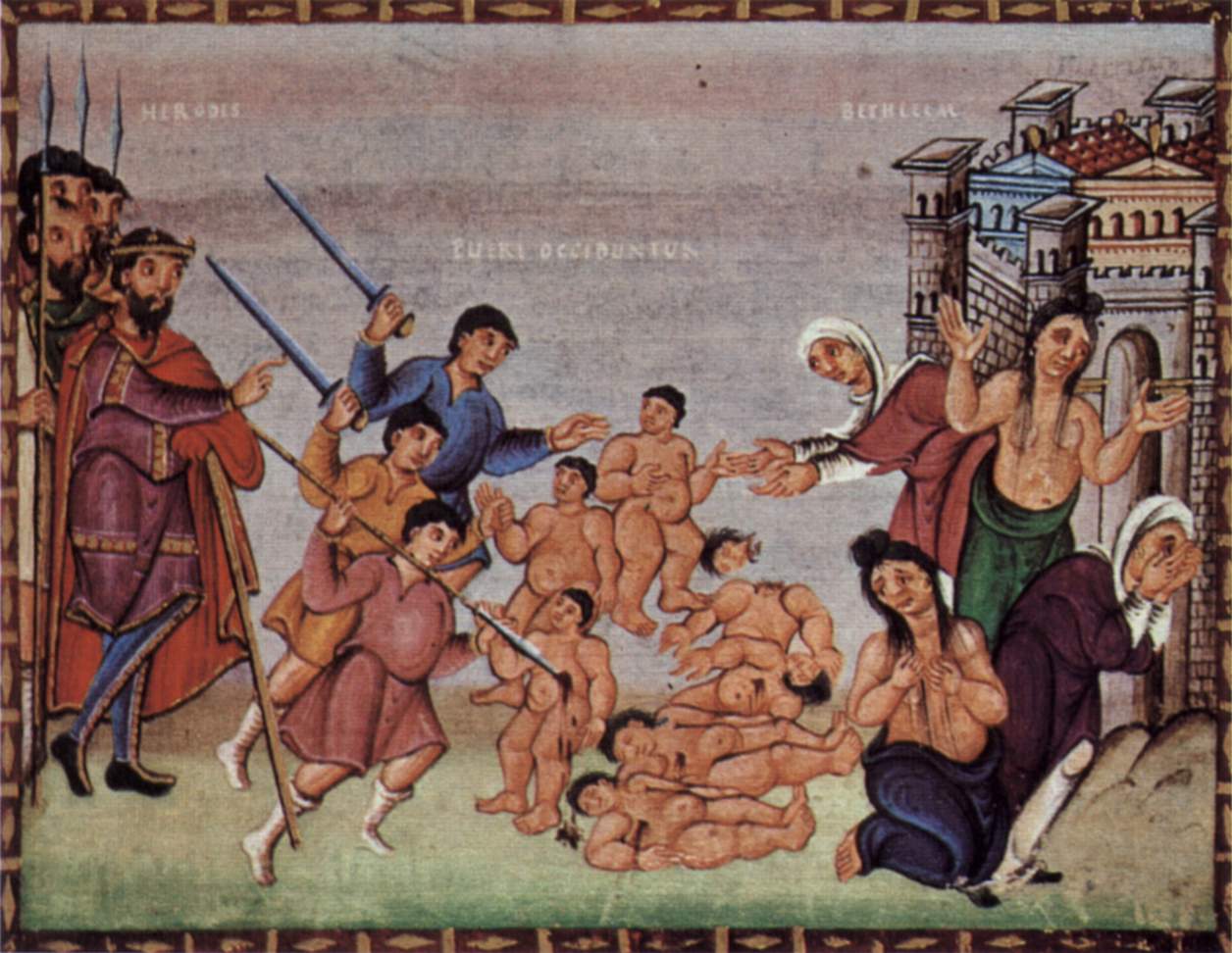
10th century image of the “Massacre of Innocents” from Matthew 2:16-18. Why would Herod take the drastic action, of murdering young children from the town of Bethlehem? The Scriptures prophesied that a descendant of King David would arise from Bethlehem, posing a threat to Herod, but a quirky dispute promoted by King-James-Only advocates only confuses the matter.

Skeptics of the Christian faith will reject such predictive prophesies. For example, the well-known critic, Bart Ehrman, focuses on the problems of Jesus’ birthplace, contending that it was really Nazareth and not Bethlehem, where Jesus was born. Erhman claims that the Gospel writers invented the Bethlehem birth story to make it all fit within Micah’s prophecy. This objection has been answered elsewhere (here by apologist Tim McGrew). But there is actually another problem, brought on by misguided thinking propagated by King-James-Only advocates, that only complicates things unnecessarily.

Let me first set the record straight: I do love the King James Version (KJV). Some of my friends simply prefer the KJV, and I can appreciate why. In several ways, modern translations have yet to improve upon the old trusty KJV. However, I also believe that other, more modern translations can help us to better understand God’s Word, expanding upon what the KJV gives us.

“King-James-Only” advocates, on the other hand, believe that only the KJV translation can be trusted, and that all modern Bible translations are the works of the Devil. I read a great book this past summer, Mark Ward’s Authorized: The Use and Misuse of the King James Bible, that I reviewed, that gently shows why some over-enthusiastic fans of the KJV can go completely overboard. Sadly, such King-James-Only folks can ironically raise unnecessary doubts in the minds of some Christians, as to the Bible’s trustworthiness, particularly among those who are new to the faith, regardless of which translation someone uses.

Here is a sample of the rhetoric from YouTube sensation, Steven Anderson, who cites the NIV (New International Verision) translation as denying the pre-existence of Jesus. For Anderson, the very Bibles most Christians use today actually undercut the doctrine of the Incarnation, that Jesus as God experienced a human birth in Bethlehem :

You can pretty much substitute “NIV” with just about any other modern English translation, and you get the power of Anderson’s rhetoric: “Do not believe modern English translations of the Bible, because they are lying to you!

Here is how Anderson’s argument works. First, let us contrast how the KJV and the ESV (another modern translation) handle Micah 5:2:

But thou, Bethlehem Ephratah,
though thou be little among the thousands of Judah,
yet out of thee shall he come forth unto me
that is to be ruler in Israel;
whose goings forth have been from of old,
from everlasting. (KJV)
But you, O Bethlehem Ephrathah,
who are too little to be among the clans of Judah,
from you shall come forth for me
one who is to be ruler in Israel,
whose coming forth is from of old,
from ancient days. (ESV)

Here we see, in both versions, that one shall come from Bethlehem, to be ruler in Israel, which explains why Matthew and Luke have such an interest, showing that Jesus would be born in Bethlehem. Anderson’s argument is that the KJV teaches that Jesus is from “everlasting,” his “goings forth,” thus emphasizing Jesus pre-existence as a non-created being, whereas translations like the ESV, that have “ancient days,” suggest that Jesus was created in time, his “coming forth,” or “origins” (in the NIV), and therefore, is not pre-existent.

In other words, please put your ESVs and NIVs in a pile and burn them, according to Anderson.

But worse than that, such varied readings of Micah’s prophecy can make some think that no Bible translation can be trusted. That is; if a modern Bible translation can not be trusted, then why trust something older, like the KJV?

*SIGH*

Sadly, Anderson leaves out some really important details. First, Anderson makes it a big deal that “everlasting” is the correct translation of the Hebrew here, and not “ancient days.” However, the KJV uses the very similar term “ancient of days,” three times in the Book of Daniel to refer to God Himself. I am not aware of any King James Only advocate who would call for a rejection of the KJV, for using such terminology, “ancient of days,” to refer to the pre-existent, non-created God. If the KJV is okay with identifying “ancient of days” with God in other places, why should we be bothered here in Micah 5:2?

Secondly, Anderson does not reveal why modern translations generally favor “ancient days” over “everlasting.” From the prior verse, Micah 5:1, we see that the former might be more accurate, with respect to the immediate context:

Now muster your troops, O daughter of troops;
    siege is laid against us;
with a rod they strike the judge of Israel
    on the cheek (ESV).

This would indicate that Micah has in mind that the one coming from Bethlehem (v.2) is associated with the judge of Israel (v.1). This judge of Israel is thought to be the ruler of Israel, none other than a king from the line of David. Therefore, Micah has in mind that the one from Bethlehem is a son of David, an heir to the Davidic kingly throne, which chimes in with the Gospel of Luke’s insistence that Joseph, the husband of Mary, was in the line of King David (Luke 2:4 ESV).

Mmmm…. So, why do “King James Only” people neglect to tell you these things?

Well, one of the main characteristics of conspiracy theories, such as King James Only-ism, is a propensity to only tell you part of the story, and then assign the worst possible motives to your antagonists, in this case, the majority of modern, evangelical Bible scholars.1

Here is some background: As Old Testament professor Claude Mariottini shows, the translation of “ancient days” ties the one coming from Bethlehem to a promise given within earthly time (Micah 7:14). Note that the covenant made with David, that there would be someone from the line of David, who would rule Israel, was made at a particular point in Israel’s history, in earthly time. In this context, there is no need to make the reference back to eternity (1 Chronicles 17:11-14).

So, does this mean that the King James Version was simply wrong to translate Micah 5:2 with “from everlasting,” instead of the more modern “from ancient days?” Not necessarily.

The debate among scholars today points more to a “BOTH/AND” answer, as opposed to an “EITHER/OR.” There were no earthly kings reigning in Israel prior to Saul and David, a fact that favors the “from ancient days” translation. And yet the translation does not preclude one from saying that God’s covenant with David was an expression of God’s larger, eternal purposes for His people, “from everlasting.”

While the immediate context of Micah 5:2 suggests that the Old Testament prophet has the connection with the Davidic covenant in mind, established from the “ancient days,” there could be a broader understanding in view as well, that ties this one from Bethlehem to having some “origin” from beyond created time, stretching back into eternity. The Hebrew phrasing here could just as well be interpreted as referring to a divine or eternal origin.2

Which is it then? Did Jesus come “from everlasting,” or “from ancient days?” The best answer is “YES.”

In other words, a good case can be made for both views, that Micah 5:2 refers to the Davidic covenant, established in time, and the pre-existence of the Messiah, established in eternity, that points us towards Jesus, who is not only the promised son-of-David, the king of Israel, from days of old, but also the very revelation of God, in human history, pre-existent from all eternity.

So, despite the rather misguided thinking that some King James Only-ist promoters like to push, modern Bible translations can be trusted. While there are different opinions among scholars as to what constitutes the best translation, there is no conspiracy here. No, the purveyors of modern translators are not trying to deny the Trinity. Instead, they are trying to find the most accurate way of rendering the original text for the contemporary reader.

A Christian may prefer the KJV. Someone else may prefer the NIV. I prefer the ESV. All of that is fine. But better yet, having access to more than one Bible translation can actually help you better understanding the full meaning of Holy Scripture.

It is very easy to browse the Internet, and find plenty of King James Only websites, or YouTube channels, that try to bombard you with pious sounding arguments and half-truths, that would cause you to doubt the reliability of modern Bible translations.3 They often raise some very good points, but sadly, they rarely tell you the full story.

Notes:

1. What you typically hear from King James Only advocates is that modern Bible translations have some type of nefarious theological agenda, bent on undermining the doctrines of the Bible, in their efforts to move beyond the King James Bible. What King James Only advocates do not tell you, on this point, is that the modern Bible translations are mainly following the latest archaeological and literary research to try to produce more accurate Bible translations. For example, in 1 John 3:1, the old KJV has: “Behold, what manner of love the Father hath bestowed upon us, that we should be called the sons of God: therefore the world knoweth us not, because it knew him not.” Compare this to a more modern translation, like the ESV, that has: “See what kind of love the Father has given to us, that we should be called children of God; and so we are. The reason why the world does not know us is that it did not know him.” Notice how the ESV adds a supposedly new phrase, “and so we are.” Does the addition of this phrase indicate some type of wicked, theological agenda, reinforcing the idea that Christians really are children of God? Does it even make sense to contend for the reverse, that the KJV removed the phrase, in order to minimize the theological truth that we are children of God? No, there is no corruptive theological agenda here, going either way. It is simply that the latest research on ancient biblical manuscripts indicates that the oldest manuscripts have the phrase “and so we are,” whereas the more recent manuscripts do not. Medieval scribes were not always perfect in making copies of the Scriptural text. In other words, the supposedly “new” addition of “and so we are” in the ESV is not “new” at all! See the notes in the NET Bible, for 1 John 3:1 (note 3), for additional explanation…. Oh, and by the way, the word for “children” in the ESV is a translation of the gender-neutral Greek word “tekna,” which is more accurate than the gender-specific “sons of God,” as found in in the KJV. 

2. The controversial Hebrew phrase being debated in Micah 5:2 is mimei olam qedem.  The mimei is understand as “from the days,” but are they temporal or eternal? From Michael Rydelnik, The Messianic Hope: Is the Hebrew Bible Messianic? (Nashville: B&H Publishing Group, 2010), p. 98: “…Micah predicted that this king’s origins would be from eternity past. The two Hebrew temporal nouns used can speak of eternity when they stand alone, although this is not always the case. Used chronologically, qedem, ‘antiquity,’ can refer to ancient times as in ‘long ago,’ to the earliest imaginable times as when the mountains first came to be (Deut 33:15), or to the ‘eternal’ God and His eternal dwelling place (Deut 33:27; Hab 1:12; Pss 55:19; 68:33). The second term ‘ôlām, ‘eternity,’ usually refers to the distant or unending future (although sometimes within the context of one’s lifetime). But it is also used of ancient times in the past (Ps 24:7) or of the beginning of creation (Ps 25:6; Joel 2:2) or before. According to Ps 93:2, God’s ‘throne has been established from the beginning [lit. ‘from then’]; / You are from eternity.’ And Ps 90:2 declares, ‘Before the mountains were born, / before You gave birth to the earth and the world, / from eternity to eternity, You are God.’ When qedem and ‘ôlām are used together, however, as in Prov 8:22-23, they always denote eternity past (cf. Deut 33:27). In Mic 5:2, these words are placed together to emphasize the ruler’s true origin, being far earlier than his arrival in Bethlehem or even antiquity. Rather, he comes from eternity past.” See the NET Bible notes on this passage for more analysis and this answer from Dr. Michael Brown. Consult Fred Sanders, et.al. for a very technical discussion.  

3. The Internet is filled with a plethora of King James Only propaganda, that while intended to honor the great value of the King James Version, has the unintended negative consequence, of causing uninformed persons to doubt the validity of the Scriptures altogether! What a sad tragedy! Robert Plummer, a professor at Southern Baptist Seminary, explains why the thinking of King-James-Onlyism is so misguided: 


A Fake-News Jesus? Why “Jesus Myth-ers” Should Take a Trip to Rome … (for Christmas)

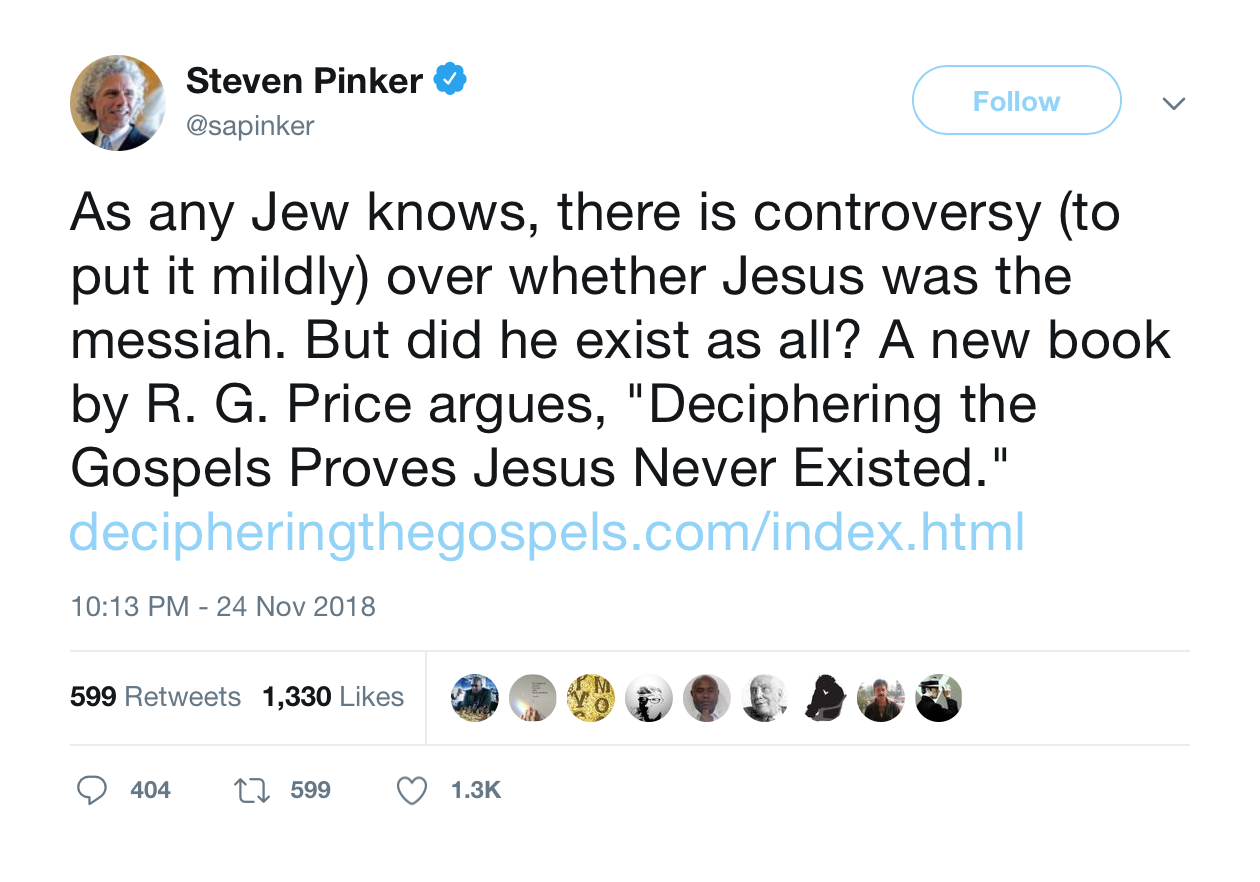
After Thanksgiving, I was greeted by the following Tweet message being passed around from Harvard psychologist, Steven Pinker:

Pinker is a brilliant cognitive psychologist, linguist, and popular science author, but apparently he needs some help with his history. This new book by R. G. Price is hoping to popularize the notion of “Jesus Mythicism,” namely that Jesus of Nazareth never existed. Perhaps such “Jesus Myth-ers” should consider taking a trip to Rome, and dig a little through history.

This idea that Jesus never existed has really taken off over the past few years, picking up a lot of intrigued interest among atheists, that apparently now includes Steven Pinker, even as early as two years ago!  If professor Pinker has no opportunity to go to Rome anytime soon, say in time for Christmas, he might want to consider reading material from Tim O’Neill, a fellow atheist, who gets his history right, as discussed months ago here at Veracity. The details are too much to go into here, but O’Neill’s series on “Jesus Mythicism” is simply fantastic, where he basically argues that “Jesus Mythicism” is roughly the atheist equivalent of the belief in a “Flat Earth,” being promoted by some conservative Christians.

I guess we all have our embarrassing, crazy family members to deal with at holiday family gatherings.

But why is Rome important when it comes to talking about “Jesus Mythicism?” (… and why Christmas?)

Price’s self-published book is a revisionist reading of the Gospels, but “Jesus Myth-ers” more commonly make a different, yet just as historically convoluted, argument. Long time Veracity readers would know that those who promote “Jesus Mythicism” often say that Christianity stole much of its belief system from the Roman cult of worshipping Mithras, popular among Roman soldiers during the first centuries of the Christian era. For example, “Jesus Myth-ers” typically contend that the Christian claim, of Jesus being “born of a virgin,” at Christmas, was actually taken from the Mithraic religion, which supposedly claimed that Mithras was also “born of a virgin,” on December 25th.

Tim O’Neill has a great (yet long) post about the cult of Mithras, that should effectively dismantle such spurious claims (O’Neill has another great post that critiques R. G. Price’s own, even more peculiar version of “Jesus Mythicism,” that does not address the Mithras religion). The evidence to support the claim, that Mithras was “born of a virgin” on December 25th, is either non-existent or terribly “stupid” at best (“stupid” is how Price’s “fellow” atheist, Tim O’Neill, describes it!).

So, when my wife and I had the opportunity to go visit Rome earlier this year, I was determined to find out more about Mithras myself…. just to make sure.

The Mithras cult was a big deal in ancient Rome, and there are several places in Rome where archaeologists have found Mithraic temples buried well below buildings from the later Christian era. The closest modern equivalent to Mithraism might be the Masonic movement. Imagine a fraternity of like-minded, Roman soldiers coming together to perform sacred rituals, with all of their secret handshakes, and whatnot.

It helps to have an idea of what Mithras looked like. I was able to get this snapshot below of Mithras stabbing the cosmic bull, at the Vatican Museums. It was hard to get a good, front-on shot, due to the crowds, but this is what I saw: That is a dagger in his right hand, being thrust into the right shoulder side of the bull:

Mithras slaying the cosmic bull, at the Vatican Museums (from Clarke Morledge’s Android phone)

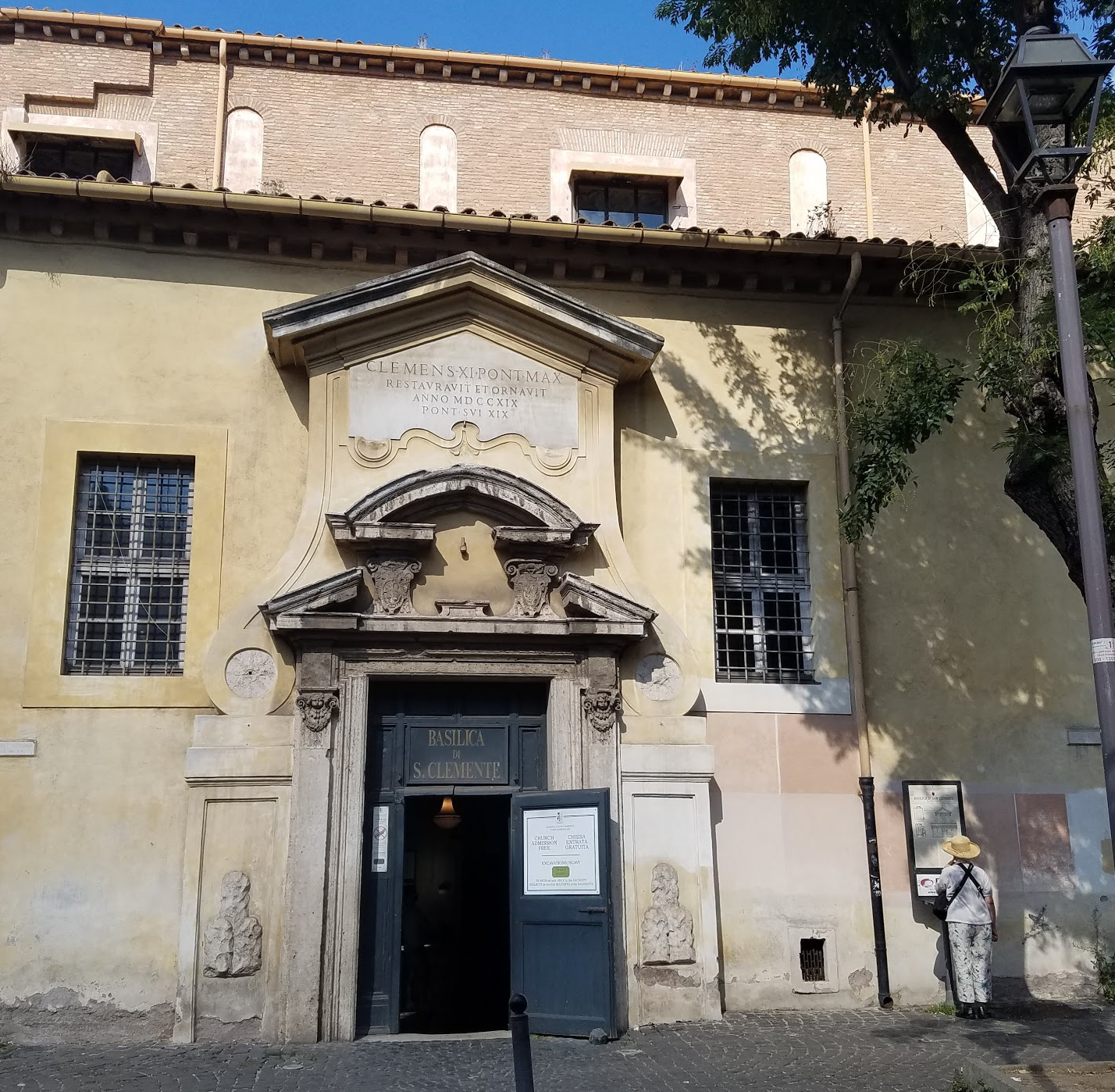
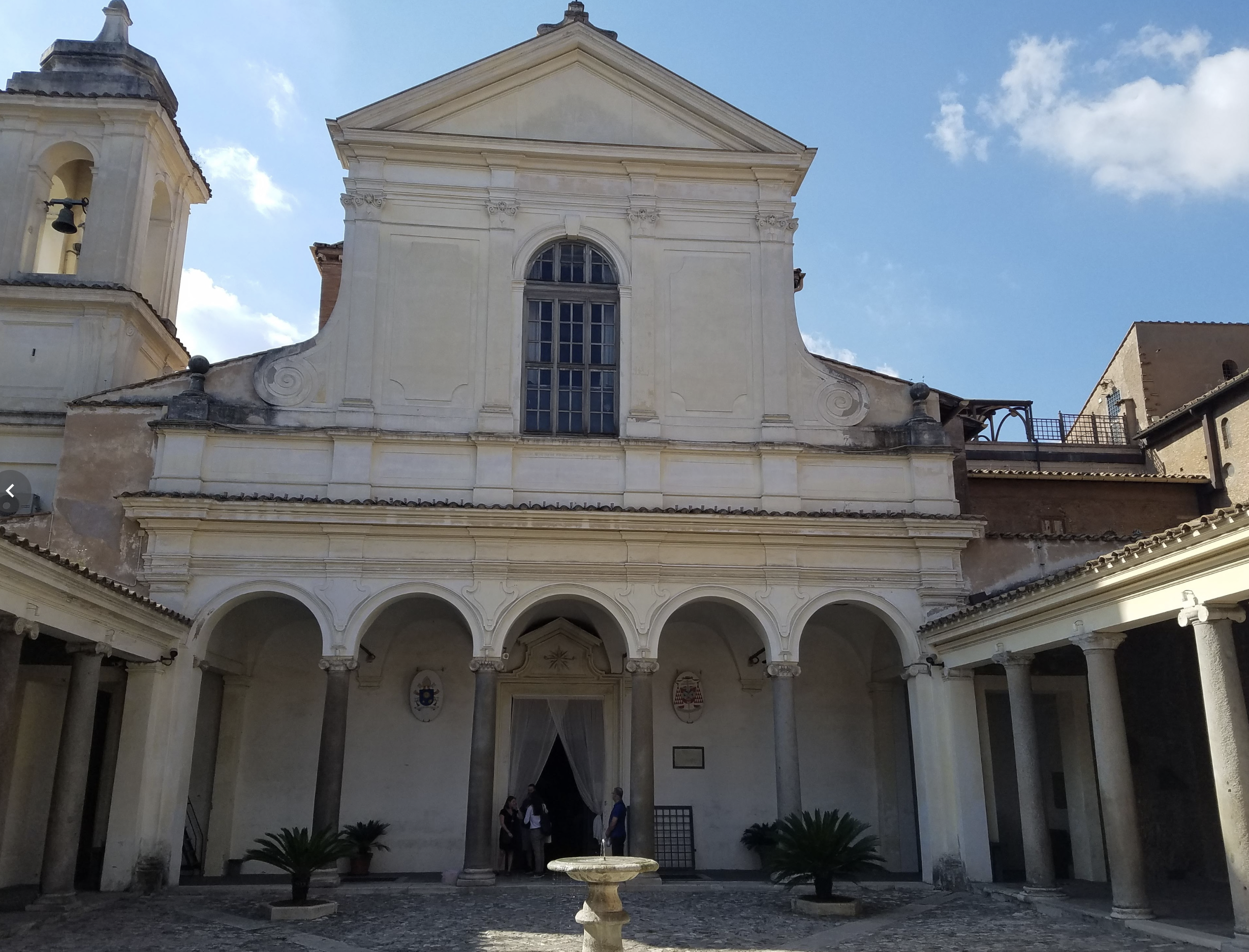
Tours to see the archaeological remains of these Mithraic temples were hard to get, as the spaces to get into these underground areas were pretty tight. Thankfully, we were able to go to the Basilica of San Clemente, a church in the Lateran part of Rome, which has a unique, multi-layered architecture. At the main entrance (see photo below), of the church, you enter the main sanctuary, built in the 11th century.

Entrance to the Basilica of San Clemente, in Rome, Italy (my wife has her back to me, as she is reading the entrance sign to the far right of the door).

From the sanctuary, I was able to walk to the church’s courtyard to get a better outside look, facing the entrance to the sanctuary:

Basilica of San Clemente courtyard, on a beautiful day in Rome (October, 2018)

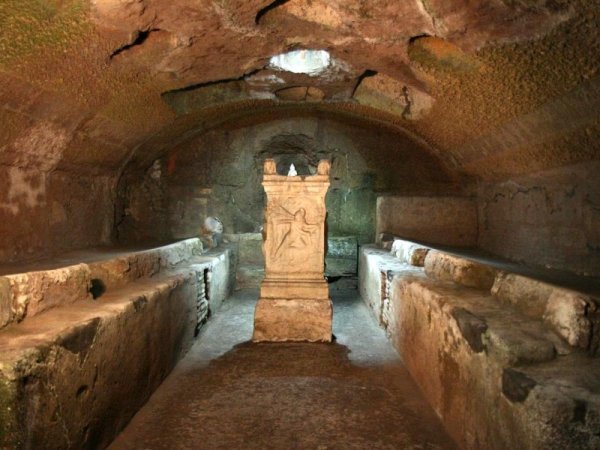
Below that level is a 4th century church, which itself was built out of a home temporarily used for Christian worship, dating back to the 1st century. In the basement of this home, was a Mithraic temple, that was in use briefly in the 2nd century A.D.

Apparently, the Christians were here in this house first, before the Mithras worshippers got to the basement. The docent we had was pursuing graduate studies in Italian history, and she was a wealth of information about all things Mithras. Not one word about the supposed parallels between Christianity and Mithraism came up. We were not allowed to take photographs inside the church or underground, but this photo comes from the guidebook you can buy from the church’s bookstore:

Basement Mithraic temple, underneath the Basilica of San Clemente (from the church guidebook). Note the relief image of Mithras stabbing the cosmic bull, on the altar.

Once you do a little “digging” (pun intended!), you get the idea that far from being a copycat faith that stole from Mithraism, Christianity is actually quite different. Neither Mithraism nor Christianity lines up anything like what the “Jesus Myth-ers” imagine them to be.

Sure, the fact that Mithraism and Christianity are very different, does not necessarily mean that Christianity is true. A strong consensus of scholars is convinced that Jesus indeed did exist, even if many of these scholars reject the idea of God becoming Incarnate at Christmas. There are atheists, like Stephen Pinker, R. G. Price, and the more historically astute, Tim O’Neill, who do not “buy into” the Christian claim of Jesus being risen from the dead. I pray that God might touch their hearts and minds in a manner that they might see the Risen Jesus clearly.

But at the very least, the trip to Rome that my wife and I took helps to confirm that when someone says “Merry Christmas,” it is not just a clever way of saying “Merry Mithras” instead.


Listen to Nick Peters’ Deeper Water’s apologetics podcast, where Nick interviews Tim O’Neill discussing Jesus’ Mythicism. Tim O’Neill wrote a short review of Steven Pinker’s 2011 best-selling book, Better Angels of Our Nature, that should cause any Pinker enthusiast to pause. Steven Pinker and Nick Spencer debate one another, on the Unbelievable podcast, hosted by Justin Brierley, earlier in 2018, on the topic, “Have Science, Reason and Humanism Replaced Faith? (Youtube)” New Testament scholar N.T. Wright responds to Steven Pinker’s claim, that human rights were not derived from Christianity (Youtube).