Category Archives: Apologetics

The Rise and Fall of Summer 2021

Now that the last days of summer are waning, I am writing a post to reflect on some spiritual matters that I have been considering lately.

As we near the end of August, 2021, aside from Hurricane Ida bearing down on Louisiana, what is on the minds of many is the deteriorating situation in Kabul, Afghanistan. The obvious quandary is that the Taliban has not had a very stellar record in the area of upholding basic human rights, to say the least. The situation is particularly precarious for women and young girls, due to the strict Taliban interpretation of Islamic Sharia law. Critics of the Christian faith have for years sought to fault the Bible for promoting misogyny, but those claims pale in comparison to the strict, Taliban readings of the Koran, regarding the treatment of women.

A friend of mine who served in the U.S. military recently sought to help an Afghan interpreter and his family leave the country. A few days ago that interpreter and his family arrived safely in Virginia, but the status of others left behind in Afghanistan is unknown. Furthermore, we must remember that there is a small, yet vibrant Christian community in Afghanistan, who have endured persecution under previous Taliban rule. We must pray for all who are facing extremely difficult circumstances, that God might deliver them from this crisis.

Please, Lord, protect the weak and powerless, and deliver them from danger. Let your loving Truth be made known to these people.

The famous 1975 Hugh Van Es photo, that sticks in the minds of many people, who lived through the 1970s, that recalls the tragic Fall of Saigon, after an extremely controversial and highly destructive war in Southeast Asia.

Reflections on a Meme: An Iconic Photo Examined

As an American, I particularly feel the angst of the loss of American prestige, following after the speedy fall of the Afghan government to the Taliban, after America’s longest active military involvement, in another country, during the entire history of the United States. More than a century ago, the British had to learn their lesson about how difficult it is to achieve military success in Afghanistan. In the 1980s, it was the Soviet Russians who faced the futility of gaining the upper hand in that country. Now, it is the turn of the United States to face the same scenario. When I saw the first video reports of people falling off of C17 planes, trying to leave Kabul, it made me think immediately of the Fall of Saigon, in 1975. I vividly remember the television reports, back when I was in middle school.
Continue reading


Judaism Before Jesus: Exploring the History Between the Old and New Testaments

What happened in Israel between the time of the end of the Old Testament, and the coming of John the Baptist in the New Testament?

Many Christians, primarily of an evangelical Protestant conviction, know very little about the so-called “time between the testaments,” the 400-ish-year period after the Book of Malachi and before the beginning of the Gospel of Matthew. Sometimes this period is also called “the silent years,” in that we have no recognized biblical prophet speaking for those roughly 400 years, before John the Baptist.

By the end of our Old Testament, the Jews were back in their homeland, after being sent into exile in Babylon in the 6th century BCE. They were struggling to rebuild their temple in Jerusalem, along with the city itself, as we learn from Ezra and Nehemiah, but things finally came together. The narrative of Jewish history pretty much stops at this point.

Then all of the sudden, we get to the New Testament, and we run into groups like the Pharisees and Sadducees, and King Herod, and an occupation by the Romans. It seems like all of these people just come from out of nowhere!

Author Anthony J. Tomasino, in his Judaism Before Jesus, gives us a helpful analogy: Imagine you are watching a thrilling movie one night. Then you get a phone call, let us say, from your boss, a baby-sitter, or whomever, and you need to deal with a situation right away, so you step out from watching the movie. You get the issue resolved, and then 20-30 minutes later walk back in and watch the rest of the movie.

But you have missed at least 20 minutes from a story told over a 2-hour period! All of these new characters pop up out of nowhere. You struggle with trying to figure out what is going on, as you have lost the continuity of the story line.

That is pretty much what happens to most Christians when they try to study the Bible, and yet completely ignore the story of what happened between the times of the Old and New Testaments, what others call the “intertestamental period.”

Were the 400 years after Malachi and before the New Testament really “silent?” While Protestant Christians recognize that there were no canonical prophetic writings directly associated with this time period, the extraordinary history that God was working through the nation of Israel was anything but “silent.” But what do we know about those years, and does that knowledge help us to read our New Testament better? (credit: excelnetwork.org)

Continue reading


Why “Progressive Christianity” is the New “Liberal Mainline”… (and The Effort Not to Toss the Baby Out With the Bathwater)

There is a massive shift going on in American Christianity, particularly over the last decade, and it is time we owned up to what is going on. For all practical purposes, the death knell of the “liberal mainline Protestant” church is approaching, and it is approaching fast. Unless something remarkable happens to reverse it, the current trend is that traditionally liberal mainline Protestant churches will effectively cease to exist within the next twenty or thirty years.

This would sadly include the Episcopal Church USA, the denomination that I grew up in as a child (and loved dearly). The decline is not unexpected though.

The cultural influence of those big churches, with big steeples, on main street are fading, being replaced by the resurgence of conservative Evangelical churches. Such Evangelical churches, particularly “mega-church” style congregations, with large campuses out in suburbia, or taking over abandoned shopping malls, are becoming the signature identifying characteristic of American Christianity.

Not your standard picture of the church in the 21st century. We have mostly moved past this. But what are we moving towards?

“Mega-church” style churches grew out of the Neo-Evangelical movement of the mid-20th century, most commonly associated with the name of the late-evangelist Billy Graham. While smaller so-called “fundamentalist” churches still proliferate, with the King-James-Only movement being the most pronounced holdouts, the “mega-church” phenomenon dominates the Evangelical landscape today, and they are swiftly overtaking the liberal Protestant mainline.

Granted, there are valiant attempts to try to revive the liberal Protestant mainline. A renewed emphasis on liturgy, an interest in “spirituality,” service to the community, or else latching onto progressive political causes, has sought to try to bring new life into the mainline. But the decline of adherence to historically Christian doctrinal teaching has been working against those efforts to revitalize the church on “main street.”

But we all see the writing on the wall. The mainline is dying. Well-documented research on the “rise of the nones,” tells the story. Children growing up in the liberal Protestant mainline can not tell the difference between what goes on in their church, and what goes on outside of the church. What passes for the liberal Protestant mainline today is often a repackaging of secular America, with religious labels stuck on top.

The liberal Protestant mainline is doing everything it can to try to avoid looking “Christian”, while somehow still trying to be “Christian.” It may convince some people, particularly for those raised in those mainline traditions, who love certain elements of those traditions. But broadly speaking, it just is not working out very well. Newer generations of young people are not buying into it.

And everyone knows it.

The Slow Death of the Protestant Mainline, and the Shift to “Mega-Church” Evangelicalism

In one sense, Protestant Evangelical Christianity has benefitted from this looming implosion of the mainline. More people are gravitating to the world of the Evangelical mega-church. This newer breed of churches are providing the very things that the mainline once did, while largely working to shed the external trappings that felt confining in the mainline.

Less organ and choirs. More guitars and drums. Less ornamentation and a less “church-y” look. More of a sense of being in a plush movie theater, or a big box discount store, or a concert hall, all depending on your tastes. Less ties and more polo shirts.

But the real big differences are less external and more theological. In those Evangelical churches there is a greater sense that these people actually believe what is being taught in the Bible, as opposed to whatever was going on in the Protestant mainline. 

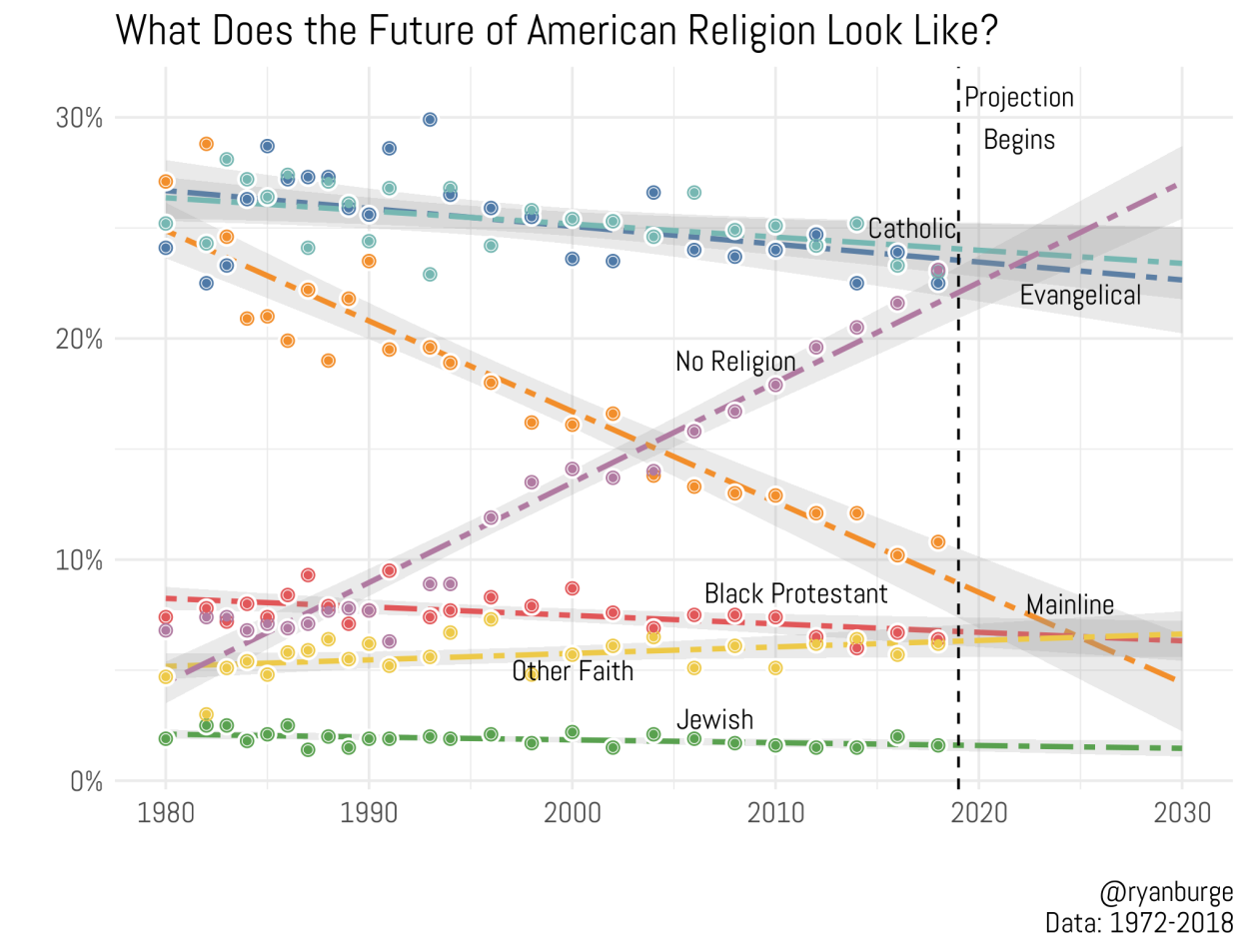
Recent data analysis by sociologist/political-scientist Ryan Burge helps to explain what is going on. Those with a Protestant mainline background, who desire to retain their faith, have grown disillusioned with liberal denominations, and are therefore more drawn to conservative, Evangelical churches. Those with conservative Evangelical backgrounds are more likely to stay within their traditions, as compared to cradle-mainliners. 

Burge puts it this way: “it’s twice as likely for a mainline Protestant to become an evangelical these days than for an evangelical to leave for a mainline tradition. In raw numbers, for every two evangelicals who became a mainline Protestant, about three mainline Protestants became evangelical.”

Here is one way to observe the mainline to “mega-church” shift: Rarely do you ever hear anymore about a distinguished mainline theologian, harkening back to the 20th century days of a Paul Tillich, Richard or Reinhold Niebuhr, or a Hans Kung (Roman Catholic). Now it is mainly popular Protestant evangelical pastors, like a John Piper, David Jeremiah, Rick Warren, or John MacArthur, with a few more Evangelical academic types thrown in every now and then (an academic class that hardly even existed a few generations ago). Protestant Evangelical Christianity is indeed vibrant and growing in certain parts of America, but there is a catch to it.

According to Ryan Burge again, much of that growth in Evangelicalism comes not from the unchurched, but rather from defections from the Protestant mainline. Essentially, the continued church growth associated with “mega-church” Christianity comes primarily from those disillusioned with the Protestant mainline. The influx of new faces in “mega-church” Evangelical churches is offset by more defections from Evangelicalism itself, where many cradle-Evangelicals are walking away from Christianity altogether …. just as you find in the Protestant mainline.

Trouble is brewing inside Evangelicalism. The decline of the mainline has meant that the problems that once plagued the liberal mainline are now making their way into the sanctuaries of Evangelical churches.

For decades, conservative Evangelical churches could be counted on as “holding the line” when it comes to fending off attacks to the Christian faith, whether they be “in your face” efforts to discredit the Bible, made by skeptical non-believers, or more subtle efforts to weaken Scriptural authority, advocated by Christians who have had a “cafeteria” approach to the faith, picking and choosing those things in the Bible that seemed acceptable to them, and discarding or simply downplaying the rest. If you wanted to find out where someone might be holding onto such a weakened view of the Bible, you would need to look at liberal mainline Christianity for that.

But with the decline of the liberal mainline, that population has begun to shift towards those Evangelical circles, that were once the bastion against theological compromise. For example, it would have been unheard of in Evangelical churches thirty years ago, to hear talk of sanctioning same-sex marriage, as a viable Christian option.

Not so today.

To put it another way, today’s Evangelical movement is becoming the new mainline…. and thus inheriting all of the problems that have come with it.

A 2018 study by political scientist Ryan Burge suggests the percentage of both Roman Catholics and Protestant Evangelicals will continue on a slight decline, for the next ten years, with Roman Catholics holding on a little better. But the most dramatic shift is the rapid decline of the liberal Protestant mainline and the rapid increase of the “Nones” or “Dones,” that is those who profess to hold to “No Religion.” Unless a spiritual revival happens, the “Nones” and the “Dones” will eventually quadruple the number of “Mainline” Christians.

Protestant Mainline Stragglers, and Wounded Evangelicals Deconstructing Their Faith

What makes the shift more complicated is the growing presence of wounded Christians, emerging from the more conservative end of Evangelicalism. In generations past, these fallouts from “fundamentalism” eventually found their way into the mainline churches. But with fewer and fewer mainline options available to them these days, these people still remain in historically conservative Evangelical circles, though perhaps they find places to hide out, and stay off the radar… (but sometimes not). Well-intentioned movements that have energized previous generations of conservative Evangelicals (and that still have staying power today), such as Purity Culture, “I Kissed Dating Goodbye,” Young-Earth Creationism, and culturally-white, right wing political causes have left scars felt by many Christians, having grown up buoyed by such movements.

Unlike their mainline counterparts, these wounded products of Evangelicalism are chafing against certain rigid elements of their upbringing. Processing those wounds and seeking a move towards healing is really what “deconstruction” is all about today.

…. side note…. If you do not know what “deconstruction” is regarding faith, the easiest way to explain it is when someone considers that they are at first strong in their Christian faith, but then begins to have a doubt about some particular aspect of that faith. As that person explores that doubt, other doubts are exposed. Then more doubts start to pile up. The prime analogy used by someone undergoing spiritual “deconstruction” is the sensation of pulling on a loose thread on a sweater, but when you keep pulling on it, the whole sweater begins to fall apart. …. That, in a nutshell, is a decent way of describing “deconstruction”end of side note

More and more wounded Evangelicals are trying to rebuild their faith, seeking to scrap those pieces of their upbringing that have become barriers to their Christian faith. In some cases, such wounded Evangelicals do find a restoration of faith, with a healthy measure of sobriety and moderation. In others cases, this process of “deconstruction” has sadly led to an all-out deconversion from the faith (see this video interview by Sean McDowell with John Marriott for a 3-minute explanation as to how bad the problem is). In other ways, someone might still call themself a “Christian,” and yet core components of Christian faith may or may not remain after such deconstruction, with certain edgy features poking out every now and then.

In the process of providing a haven for wounded Evangelicals, this leaves Evangelical churches in a precarious state. Reaction to certain excesses in the more conservative wings of the Evangelical movement can lead to overreactions that dismiss too much of the good along with the bad. It is like throwing out the baby with the bathwater.

We see this a lot in the world of online, Internet social media. As I have argued elsewhere, the Internet has made it possible to have easy access, at a click of a mouse, or a TikTok video, to information that was once locked up in libraries and university classrooms. Questions that were once only entertained in religion department seminars, and occasional PBS televised documentaries, are now topics that pop up in coffeehouses and while waiting around in a car repair shop to get your oil changed. Christian parents find it increasingly difficult to keep negative influences away from their children. It is almost impossible to keep this bombardment of information from encouraging doubt and skepticism, even in the most conservative of churches.

Over the past ten years, since devices like the iPhone have taken over the world, just about every cardinal doctrine of historically, orthodox Christian faith has come under fire among so-called “Post Evangelicals,” “Post Conservatives,”  “ExEvangelicals,” … you name it. The grievances associated with distorted presentations of such cardinal doctrines, ranging from substitutionary atonement to the authority/inerrancy of Scripture, have triggered knee-jerk reactions from those wounded by such theological misunderstandings. In some cases, those grievances are justified. Irresponsible teaching from the Bible coming from otherwise sound Evangelical pulpits has confused the intended meaning of the original Scriptural authors, as it was inspired by God. But in other cases, such grievances are not justified…. so out with the baby with the bathwater.

Do not throw out the baby with the bathwater! The danger associated with “Progressive Christianity”

“Progressive Christianity”…. and the Temptation to Toss Out the Baby With the Bathwater

This state of affairs then creates a most fascinating mix. Here you have both theologically liberal products of the dying mainline joining up with wounded Evangelicals, all gathering together in certain corners of the Evangelical subculture, sometimes incognito, and sometimes not. This is perhaps the best way of describing what is now becoming known as “progressive Christianity.”

It is important to realize that this mix is not uniform. Not all “progressive Christians” are alike. This is why it is best to leave “progressive Christianity” in quotes, as the definition of that term will be different from person to person. But the key thing to understand is that something broadly called “progressive Christianity” exists, and you will find it today in places you would never expect.

If you are in an Evangelical church, you might even find it right under your nose…. but you may not notice it right away. Furthermore, because it is so subtle, it may trip you up, if you are not careful.

… And this is why this massive shift towards “progressive Christianity” is not so good for the church. Rather, it creates a huge challenge.

Like the fundamentalist/modernist controversy in the late 19th and early 20th centuries, the secularizing cultural pressure to dislodge the moorings of historic, orthodox faith is at the heart of such testing. But unlike that controversy, a century ago, when large Protestant mainline denominations split into a large liberal wing, against multiple, smaller more conservative congregations and groups, today’s “progressive Christianity” is happening largely inside already existing Evangelical churches, that in previous generations were leaning more towards the “fundamentalist” side of the theological divide.

Loving Your “Progressive Christian” Friends… While Still Affirming Historically Orthodox Christian Faith

Now, this does not mean that we should become paranoid, and start looking under the pews in our churches, in an effort to sniff out the heretics in our midst. All you need to do is to take a glance in searching YouTube, and you will quickly find self-proclaimed “heresy-hunters” calling out what they think is false teaching, leavening the Evangelical flock, when all they are really doing is embarrassingly displaying their own ignorance.  The problem with “heresy-hunters” is that many times their wounded critics are often correct in certain elements of their criticism, and such critics deserve a fair hearing. In other words, sometimes efforts to supposedly “defend the faith” can become quite misguided and ill-informed.

Therefore, careful and generous listening is in order first and foremost when dealing with folks wrapped up in the orbit of “progressive Christianity.” Taking a “chill pill” might be in order before anyone brings out a pitch fork.

But it does mean that we should be “wise as serpents and innocent as doves” (Matthew 10:16).

It also means that we need to be in prayer now more than ever. We need to pray for the “progressive Christians” in our midst, and ask the Lord for wisdom, that we might be able to engage in conversations with others, with love and grace.

The larger challenge, going forward, will be in the evangelization of those who have deconstructed their way out of the Christian faith altogether (but that is a different story).

I have had to learn the hard way that folks who have left the old liberal mainline, as well as those who have come up wounded in Evangelical circles, who are now seeking refuge in Evangelical churches, are both people for whom Jesus died for, and whom God loves much more than I do. We must be patient, long-suffering, and willing to go the distance to try to genuinely learn from those caught up in “progressive Christianity,” to try to understand what led them into “progressive Christianity,” in an effort to win them back over into the Gospel. This is not easy, and I have failed at this many times. Nevertheless, this is something that we must do.

If you not convinced by this argument, take a listen to Alisa Childers, a former singer for the Christian band ZoeGirl, who almost lost her faith while attending what she thought was a solid Evangelical church. Instead, she was drawn into the orbit of “progressive Christianity” in that very church. It took her years to “deconstruct” and then eventually to “reconstruct” her faith, along historically orthodox lines. She offers some great wisdom here for all of us.

A quote by Saint Augustine, an African Christian and the 5th century great father of the early church, is appropriate here: “If you believe what you like in the Gospel, and reject what you don’t like, it is not the Gospel you believe, but yourself.”


Spiritual Lessons During the Pandemic

Just a little over a year ago, the world was well underway in making a global response to the COVID-19 pandemic. What we all hoped would be a short-term problem, turned into a long, drawn out situation that has created more and more turmoil in an already increasingly divided world, having a definite impact felt on the Christian church. Now, as efforts towards making several effective and safe vaccines available are signaling towards an ultimate end of the crisis, I thought it would be helpful to share some lessons I have learned over the past year or so, as we head “officially” into the Summer of 2021, near the start of the summer solstice.

Towards the end of the post, I will make an important announcement about the future of my postings at Veracity. So, please stick around for that.

In summary, I have learned that as human beings:

  • We are intuitive creatures, who only allow analytical ways of rational thought to revise our thinking when our intuitions let us down;
  • We are sacramental creatures, who need concrete expressions of the divine to makes sense of life;
  • We are religious creatures, who crave transcendent ways of viewing the world;
  • And that Christians need to preach the weird stuff of the Bible. The story of the God of the Bible, as revealed in Jesus Christ, makes the most sense about reality.
We Are Intuitive Creatures

One of the most defining aspects of contemporary life in 2021 is how we are all connected to one another via amazing progress in Internet technology… and the results of this new world we live in are mixed. On the one hand, the distribution of knowledge has grown at an accelerated rate, which in some ways is really good. You can pretty much learn how to fix anything these days, just by watching someone’s YouTube video. During the pandemic, a lot of folks were beginning to wonder why they should poor thousands of dollars into an advanced education in college, when you can learn nearly anything on your own, through an Internet-connected laptop.

We live in interesting times.

Spiritually speaking, resources that were once locked up in physical libraries are now available via the Internet. Any high school kid can “fact check” a Sunday sermon in a matter of seconds with their SmartPhone, to see if the pastor is making something up or not. The growth of great Christian apologetic resources on YouTube is simply astounding. What would before take hours of research, making multiple trips to the library, a bookstore, or visits with your pastor, or waiting for some televised interview on cable TV or over-the-air TV station, can be resolved fairly easily by going to YouTube’s search bar and looking for what you are interested in.  I wrote a blog article about this roughly two years ago, but now things on YouTube, with respect to Christian apologetics, have exploded. Here is a list of my top SEVEN YouTube apologist channels I currently follow…. great stuff to listen to while riding my bicycle during the pandemic:

  • Dr. Sean McDowell : Son of apologist Josh McDowell, Sean teaches at BIOLA, and he has a number of gracious dialogues with Christians and non-Christians alike, pertaining to a defense of the Christian message. Sean is one of my favorite all-around YouTube apologists right now (Alisa Childers is a close second: A former singer for the Christian band ZoeGirl, she has great videos critiquing so-called “Progressive Christianity.”)
  • Capturing Christianity: Cameron Bertuzzi has some of the best interviews with scholars and apologists, covering a wide variety of topics, but mostly with an interest in philosophy. Cameron’s background is primarily in photography, and not really in academia, so that makes him just a normal guy asking pretty basic questions, with a few philosophy nuggets tossed in here and there (he loves William Lane Craig).
  • Inspiring Philosophy: Michael Jones probably has the biggest apologetics channel on YouTube, with over 200K subscribers. MIchael is a big fan of C.S. Lewis and his goal is to create a high quality video to address every known apologetic issue out there, particularly in the realm of the science/Bible debate.
  • Theology in the Raw: Preston Sprinkle, one of the nicest persons I have ever met, is pretty much the “go-to” guy to interview interesting people in the area of big cultural debates today, including LGBTQ issues and racism, areas that most other apologists tend to shy away from.
  • Ancient Egypt and the Bible: Dr. David A. Falk is an egyptologist, who specializes in the intersection between archaeology and the oldest texts of the Bible, particular with respect to the Exodus. Falk is a “Late-Date” proponent for the Exodus, and a professionally trained archaeologist, providing a lot of helpful correctives to the Tim Mahoney Patterns of Evidence franchise of Christian films, from his “Perspectives on the Exodus” series.
  • Risen Jesus. Mike Licona is probably my favorite New Testament scholar on YouTube, particularly with respect to defending the Resurrection.
  • Truth Unites: Gavin Ortlund is a Reformed Protestant, Gospel Coalition guy who has some interesting apologetics content, but he is best known for gracious dialogues with Roman Catholic and Eastern Orthodox conversation partners. I have learned a lot about other Christian traditions, besides my own, through Gavin’s videos.

That is just a short list! If you know of other YouTube channels that have benefitted you, as you were stuck at home during the pandemic, please let me know about them in the comments section below.

During the pandemic, there has been an extraordinary increase in fascinating interviews with Biblical scholars and thought leaders, as so many smart people who have studied the Bible for years were stuck at home for months. Over the past year or so they have been able to share their knowledge with the online world, that anyone with a decent Internet connection can access, view and listen to, while doing all sorts of mundane tasks, from doing laundry to riding a bike near your home (like I have done during the pandemic).

However, this ease of access of information has come at a heavy cost, as our ability to adequately filter out overwhelming amounts of disinformation, has been hampered by our intuitive senses, that often only serve to reinforce our own assumptions, rightly or wrongly. Nowhere has this been so greatly seen as in the world of social media platforms, like Facebook, Instagram, TikTok, Snapchat, etc. Such platforms know how to redirect your attention to articles, videos, etc. that match your interests, that tailor to your own assumptions, and blind you from seeing evidence that might challenge those assumptions. They can also send you down rabbit holes, that can sometimes be difficult to get out of!

Furthermore, if and when we do venture out from our information silos, the experience of hearing a different point of view can be very disorienting. This is particularly a problem for children and other young people, who are now growing up with a SmartPhone (apparently) glued to their hands, and their eyes absorbed in what they view on a screen. Being physically isolated during the pandemic, and being forced to use screens all of the time has not helped matters. Parents: Do your children a favor and keep them away from Smartphones until as late in life as possible.

On top of that, the way we use words and phrases seem to be changing at an increasingly rapid rate. Take for example the phrase “cancel culture.” About two years ago, the idea of “cancel culture” primarily referenced the practice in educational institutions whereby students were being shielded from listening to alternative points of view, on the basis that harm was being caused by simply hearing other points of view. Now in 2021, the phrase “cancel culture” has a plethora of applications, whereby being “canceled” can simply mean voicing a disagreement about a particular topic. However, voicing disagreement is not the same thing as restricting the freedom of speech. This definition of “cancel culture” is far removed from the original context I have experienced working in a university setting. It is as though the goal posts keep moving all of the time when it comes to how words and phrases, having significant cultural impact, are used in conversation.

Anxiety and depression are at an all-time high, as young people are having an incredibly difficult time trying to navigate our online social media world. When was the last time you had a meaningful, reflective, face-to-face conversation with someone below the age of 18?

Jonathan Haidt’s incredibly informative book, The Righteous Mind: Why Good People Are Divided by Politics and Religion, makes a lot of sense of these conflicting phenomena. Haidt argues that we are primarily motivated by our intuitions, and only secondarily motivated by rational, logical thought and empirical analysis. In other words, if our intuitions lead us in a certain direction, we become less likely to trust sources of information that drive against our intuitional instincts. In our informationally overloaded world, we are mainly inclined to trust authorities that align with our assumptions, and will tend to distrust evidence presented from other sources that we distrust. All of the various debates over the coronavirus, the vaccines, Black Lives Matter, the 2020 Presidential election, etc., all painfully demonstrate how the intuitive nature of humanity can sometimes cause exasperating conflict.

Some see all of this as a sign of the “End Times.” That very well maybe, but either way, it makes the task of navigating our post-modern world very challenging, particularly for the young.

Typically, we only consider alternative points of view when certain life experiences cause some sort of cognitive dissonance with our preconceived intuitions. For young people in particular, who have not had enough life experiences to build up a set of firm, intuitional boundaries, our complex online world can simply be overwhelming.

Here is another case to make my point. I have been trying for years to get various Christian friends interested in studying Christian apologetics. As Christian philosopher William Lane Craig has said, as a stern warning, you really are not doing evangelism in the post-modern world if you do not have at least some basic grasp of Christian apologetics. But I have learned that many of my fellow Christians never bother with thinking about apologetics until they encounter a loved one who has left the Christian faith. This is particularly a problem for parents. When a son or daughter, raised in a Christian home, walks away from church, it is typically only then that I meet Christians who begin wondering what type of evidence there is to the Christian faith. However, in my view, the best way to make use of Christian apologetics is BEFORE your son or daughter leaves the Christian faith…. NOT AFTER!!

There are no easily articulated answers here. But it does help to understand why people think and act as they do, and how they handle evidence, whether they be Christians or not. Knowing this has helped me to learn how to have better conversations with other people, as evangelical apologist Greg Koukl has so helpfully demonstrated with his basic introduction to Christian apologetics, Tactics.

Following our intuitions is not always a bad way to go. Properly calibrated intuitions can be a very good thing in that they can keep us from being “tossed to and fro by the waves and carried about by every wind of doctrine,” as Ephesians 4:14 reminds us. We rely on our intuitions most of the time anyway. It only leads to trouble when you are staring reality in the face, and you flat out deny that reality.

Sadly, I have seen many people, Christian and non-Christian alike, simply dig their heels in and cling ever so tightly to their intuitive assumptions (NOTE: I have done this before myself, so I need to be careful when being so preachy here!!!). The fundamental problem is that many people simply believe what they want to believe, without considering all of the available evidence…. and if we are all honest, we generally have neither the time nor the interest to pursue the deep questions of life, until life situations force us to take stock of where we are at. I have had to change my mind on a number of issues over the years, in light of the evidence presented to me. It can be very painful to go through that kind of a process. It can be quite humbling. But I do not regret having gone through it. Learning the truth is worth it.

One particular area where we see this dynamic at work is in terms of how and where people get their news. The fracturing of the journalism industry makes it more difficult to even get the right “facts” to move conversations forward. Big Tech censorship does not help much either.

One tool that I have now found useful is GroundNews, a website that crawls the Internet to look at how different media organizations portray news stories, and ranks each news source for each news story on a sliding scale; for example, leaning right or leaning left. Ground.News is a helpful resource to make sure I do not get stuck and blinded in an information silo.

We are Sacramental Creatures

Some Christians balk at the idea of “sacrament,” as it may sound to some as being “too Roman Catholic,” but such hesitancy is unwarranted. As Saint Augustine famously said, a “sacrament” is simply a visible expression of an invisible grace. Many Christians have spent a decent chunk of the last year and a half watching church services online. But while viewing something via a screen is better than being totally disconnected from a church, it just is not the same as actually being physically present with someone else.

When it became reasonably safe to do so about a year ago, my wife and I began to meet again physically with our small group Bible study. This became our lifeline. Matthew 18:20 talks about where two or three are gathering, Christ is present among us. Nowhere have I experienced that reality more than being in physical fellowship with fellow believers. I had endured many Zoom sessions on a laptop, but nothing compares to being in a room with other Christians, studying God’s Word together.

This is what being a sacramental creature is all about. Being physically present with another believer makes the teaching of Scripture regarding the nature of the church all the more real. I have greatly benefited from online sermons and podcasts, over the past year and a half, but nothing beats sharing a “fist bump” with another Christian, as we “break bread” together over a meal, or even sharing snacks in someone’s home, and enjoying Christ-centered discussion. Gathering together in something like a small group is that visible expression of an invisible grace. When you take something rather mundane, like sitting down in someone’s living room with an open Bible, and praying together, it can be a journey into the sacred.

This whole notion of experiencing sacrament, through meeting in a small group Bible study, has helped me to better appreciate the role of Christian practices that are intended to reveal the great truths of the Christian faith, most significantly through acts like Baptism and the Lord’s Supper (but not exclusive to those practices!). We need those practices designed to allow us to enter into certain mysteries, that I simply can not explain through words in a blog post, though writing about it does help to frame how to think about it. I have become more convinced that living through concrete expressions of Scriptural truth impacts us in ways that are nearly impossible to articulate intellectually.

Sadly, those very things that God uses to reveal truth to us, in non-cognitive ways, are often an occasion for bitter theological disputes, that tragically serve to divide people. Consider all of the church splits throughout Christian history over the nature of the Lord’s Supper and Baptism. We see it also in more contemporary issues, like the relationships between men and women in the church and family (the complementarian vs. egalitarian debate), and in spiritual warfare, and in experiencing the person of the Holy Spirit (the charismatic vs. cessationist debate).  These all speak to sacramental realities at their core.

However, perhaps these debates all point to how important it is for Christians to revel in the importance of sacrament. If we are going to experience God through concrete expressions of Christian practices, we should be concerned about getting it right, theologically! Let us enter in and enjoy the presence of God as we experience the Divine through sacrament!

We are Religious Creatures

This will surely upset some people who read this, but I am more convinced than ever that this is true: As the so-called “Christian” West descends more into post-Christian, post-modernity, I have become increasingly aware that while the world around us seems to be becoming “less Christian,” this does not mean that people living in a secular world are becoming less religious. Recent trends show that the opposite is more likely the case.

Political causes are increasingly taking upon themselves religious overtones. Whether it be QAnon conspiracy theories on the right, or neo-Marxist ideologies and critical race theories on the left, we are witnessing what happens when people fail to fully engage the Christian Gospel, in its fullness. Ideologues, whether they be on the right or the left, can be just as dogmatic and intolerant as the so-called dogmatic and intolerant Christians they left behind, when they left the church (assuming they grew up with any real exposure to genuine Christian community to begin with).

A lot of Christians get pulled down into the rabbit hole of QAnon-type conspiracy theories. How many more failed predictions that Trump will be finally installed as the truly elected President of 2020 must we endure before we realize that these failed predictions are exactly that: failed predictions?

The QAnon world of certain segments of the right, is particularly embarrassing, as more than a few of my Christian friends have appeared to buy into large chunks of the narrative. A lot of the enthusiasm associated with QAnon is closely associated with valid concerns over the direction of America, and the sense that the Judeo-Christian heritage of the nation is getting lost. However, much of this excitement over QAnon, and all things similar, stems in large part from professing Christians having a greater interest in politics than in participating in the communal life of a local church and fulfilling the Great Commission. If we were to focus on having better conversations with our non-believing neighbors, we would probably be less motivated to expend so much energy on political causes that often generate more heat than light.

For example, a recent survey, with data prior to the COVID-19 crisis, indicates that roughly 40% of Christians who identify themselves as being “born again” evangelicals attend church only one time per year, or less. The drop in church attendance has been on a slight, steady decline for at least 12 years. With attendance statistics like this, it is no wonder why there is not as much discipleship going on in our churches as there should be.

These right-wing extremes are evident in popular culture, and bring about ridicule of Christians in the media. One brief example will suffice. One particular Congresswoman, several weeks ago, has compared efforts to promote COVID-19 vaccination as encouraging “exactly the type of abuse” as murdering Jews in gas chambers during the Holocaust.

Really? Weeks later, this same Congresswoman apologized for making her vaccination-holocaust comparison after visiting the Holocaust Museum. I surely appreciate her apology, and think that there might be other satisfactory methods of defeating COVID, aside from vaccination (the presence of antibodies from a previous COVID infection, the possibility of using ivermectin as a treatment, etc.), but why it took her weeks to figure out that associating COVID-19 vaccination promotion with the Jewish Holocaust is a horrible comparison is beyond me.

But please allow me to poke at some of my progressive friends on the left, too: Take for example the Black Lives Matter movement (and its academic counterpart, Critical Race Theory) that engulfed the world in 2020. In one sense, Black Lives Matter seeks to continue the legacy of the Civil Rights Movement, associated with the Christian-inspired leaders of the 1960s, like Martin Luther King, Jr., in an effort to end racism. When framed around that narrative, the message of Black Lives Matter is a positive call for real change and transformation. White American evangelicalism needs to hear more of the voices of African American Christians…. and vice-versa. There are some good signs that these type of conversations are indeed happening. Celebrating today, Juneteenth (technically tomorrow), goes a long way towards that end.

A lot of children, particularly white boys, are being indoctrinated into believing that they are the root of all evil today. We surely need to fight racism, but also need to address our underlying sinfulness, that cripples everyone, regardless of gender or skin color.

However, there is another side to Black Lives Matter, and many other things “woke,” that have sought to repudiate the Christian message with yet a different religious alternative, but not a better one. Take a walk across a college campus these days, and try to talk with someone about “Black Lives Matter” and you will know what I mean.

To put it another way, Critical Race Theory can be a valid tool to use to address certain issues regarding racism. But the problem with any tool is that it can easily evolve into becoming an entire worldview, that can distort reality. In other words, a hammer can be a great tool to drive in nails. But if a hammer is the only thing in your tool bag, then after awhile, everything begins to look like a nail. When that type of thinking sets in, you end up with an ideology, if not an alternative religion, that becomes impervious to self-reflective analysis and criticism.

Christians have historically preached a message regarding “original sin,” but in Black Lives Matter, the language of “original sin” can get replaced with a message of systemic racism. Instead of everything being reduced to sinning against a Holy God, now everything gets reduced to being something about race. Having a “spiritual awakening”, a hallmark of evangelical faith and life, gets replaced with having an “awokening,” whereby certain segments of society are encouraged to embrace one’s unconscious racism. Color blindness as a virtue, whereby we celebrate with MLK a vision of where someone is judged by the content of their character, instead of the color of their skin, is replaced in the new religious narrative with an appeal to be extremely conscious of the color of a person’s skin, flipping the MLK narrative on its head. Instead of the Christian message of forgiveness, the new narrative has no place for forgiveness, only a call to become an “ally,” and accept one’s miserable state (If people could just sit down and listen to African American thinkers, such as Columbia University linguist and atheist, John McWhorter, we would all receive a huge dose of common sense).

Historian Tom Holland’s most excellent book, Dominion, explores these themes more fully, for those who have the interest to dig into this more deeply. Suffice to say, as more and more turn their attention away from the Christian faith (or towards a watered-down version of it), they ironically turn more and more towards different religious ways of thinking, that serve as shallow copies of the Gospel, counterfeits that simulate the illusion of spiritual wisdom, without genuine spiritual power existing behind it. It will be interesting to see how support for things like QAnon conspiracy theories and Black Lives Matter will continue on in the future, or if some will begin to look for something more, all to realize that what they longed for all along can be found with Jesus!

The Lord’s Supper was meant to unite Christians together, as an expression of our common faith and practice. But far too often, the Lord’s Supper divides us instead. But let’s face it: The Lord’s Supper is a pretty “weird” practice of Christians. Perhaps a more reflective view of the mystery behind the Lord’s Supper will help us to better appreciate the “weird stuff” in the Bible.

Christians Need to Preach the Weird Stuff in the Bible

One of things that really struck me in reading Tom Holland’s Dominion last year during the pandemic is his challenge for Christians to preach the “weird stuff” in the Bible. The Bible has plenty of “weird stuff” in it, but most of the time, that “weird stuff” becomes an occasion for embarrassment for a number of Christians.

Tom Holland is a respected historian from the U.K., who walked away from his Christian upbringing during his teenage years. For decades, Holland spent much of his life thinking just how unimpressive, and irrelevant, the story of Christianity can be. But over the past ten years or so, this atheist has changed his tune. Tom Holland now sees that the secular world that he so greatly values and treasures would not have been possible if it had not been for the role of the Christian faith in the history of humankind. A number of other profound and influential cultural thinkers in our day, ranging from atheists like Jordan Peterson, to orthodox Jews like Ben Shapiro, to gay intellectuals like Douglas Murray, echo that same type of appreciation for the Christian story, despite their hesitancy to accept historical Christian faith as their own. Yet when asked what makes Christianity so distinctive for Tom Holland is what he called the “weird stuff” in the Bible.

Ironically, far too often, Christians will try to play down the “weird stuff” in the Bible, in order to try to make it all seem more palatable to skeptics. Now, this does not mean that we should embrace wacky, irresponsible interpretations of the Bible. But it does mean that we should endeavor to understand how the Scriptural writers of the Old and New Testaments viewed reality, and really try to get into their heads as to how they saw God and how they saw the world. As Dr. Michael Heiser puts it, an author whom I have been reading a lot lately, if something in the Bible is “weird, then it is important.”

Let us face some facts as Christians: Virgin birth, Resurrection, Angels, Demons, the Trinity….. these are all examples of “weird stuff” in the Bible that make sense to less and less people in the 21st century. Instead of shying away from this “weird stuff,” Christians ought to embrace this “weird stuff” and tell the world around them why the message of the Bible makes Christians look different.

The secular world around us does not need some wishy-washy expression of Christianity that merely parrots what the surrounding culture is saying, and then slapping Christian labels on top of it, to give it a flavor of “Christianity.” I find that most people out there who are interested in learning about the Christian faith really want to try to understand what the Bible is all about…. especially the weird stuff. In my own Christian journey, I find that by actually thinking through some of the weirder parts of the Bible, more carefully, that I begin to better appreciate just how radical the message of the Bible is, as best embodied in the character and person of Jesus.

An Announcement About What I Am Now Doing on the Veracity Blog… And the Future

I have been writing for the Veracity blog since about the fall of 2012. I have been thoroughly enjoying it over the years. But long-form blogging just is not what it once was, as in those early days. Today, the whole realm of social media really makes productive, invigorating conversation very difficult, if not impossible. For one thing, people just seem too bombarded with information, lacking sufficient enough tools out there to filter the good stuff from the bad stuff. This is a confusing state-of-things, but thankfully, we do have a lot of good Christian resources out on the Interwebs (see my recommendations on YouTube above for some examples)!

Though long-form blogging is not the same as what you find on Twitter, Facebook, Instagram or TikTok, dealing with some of the less-than-helpful comments on the Veracity blog has been becoming less enjoyable. Thankfully, some of the best dialogues I have had has been with thoughtful commenters, and that has been wonderful. Sadly though, far too many blog comments seem to be more about “virtue signaling,” as in “I disagree with you, so I will leave a snarky or self-righteous comment, just to show how good a person I am, and how deluded Clarke, the author of this blog article is.” Now, I know that I am never going to make everyone happy, and I have learned a lot from making mistakes in online discussions, too. But sometimes I get too many comments that never lead to anything fruitful, and this damages the soul. Rarely does this type of engagement lead to good-faith kind of conversations, which are the kind of conversations that I want to be after.

I originally started writing on this blog to stimulate better conversations within my own local church family. For those of you who are reading this blog, and fit in this category, I thank you for your continued interaction with me, and appreciate all of your comments, and I want to continue in those insightful and generous conversations.

However, I frankly get more interaction with people outside of my own local church family on the blog. I am not entirely sure why that specifically is the case, other than the fact that I do not participate in some of the more popular social media apps (like Facebook), that a lot of my local Christian friends like to use. I much prefer reading something like a letter, a carefully crafted blog post, or even better, a book, than I am in slogging through a barrage of “pithy” Facebook comments, that typically engender more frustration than enlightenment, in the current social media landscape.

I have met some really fascinating people via Veracity, from all over the world, and really look forward to meeting some of you in-person some day! But such interaction with people who only connect via the Internet, and who live far away, is just not the same as having flesh-and-blood encounters with human beings living within my own local community.

I write all of this to explain why my frequency in posting has been dropping off during 2021. This downward trend will likely continue. I want to try to continue to use Veracity as a means of publishing book reviews, and preparing educational materials for use in adult Bible classes, with an aim to stimulate better conversations in Evangelical Christendom. I still have several blog posts queued up, so I am not completely going away.

However, the biggest contributor to this change of frequency in posting is actually technical. Veracity is a WordPress blog, but WordPress has been making some changes to their platform that have really become painful. WordPress is in the process of retiring their “classic editor” in favor of a newer style of editor. Unfortunately, that newer style of editor is clunky, less user friendly, and does not work well in all web browsers. I will give it another shot to see if WordPress can get their act together, but I feel more inclined at the moment in bagging WordPress completely, and moving to some other platform, like SubStack. WordPress is nice in that you do not get distracted by annoying advertisements, so hopefully something will improve here. We will see how well all of this goes over the coming summer months.

In the meantime, stick around for some of the next blog posts showing up over the following weeks, featuring some reviews of some books that I have found really helpful. Blessings to you all! Keep the faith in Jesus!!


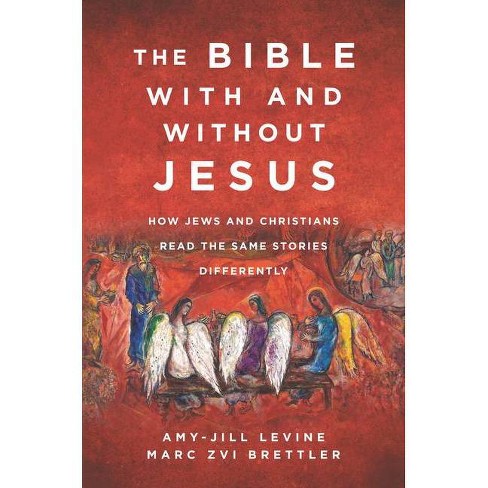
The Bible With and Without Jesus: Jews and Christians Reading Scripture Differently

Jews and Christians read the same stories in the Bible differently: So argues Jewish Bible scholars Amy-Jill Levine and Marc Zvi Brettler, as the sub-title to their 2020 book, The Bible With and Without Jesus: How Jews and Christians Read the Same Stories Differently.

So, why would I, as an evangelical Christian, read a book like this from two Jewish scholars titled as “The Bible With and Without Jesus?” Well, both Jews and Christians have at least one thing in common: The Old Testament, or what many Jews prefer to call “the Hebrew Bible,” or “the Hebrew Scriptures.” But one group reads the Old Testament with all eyes focused on finding Jesus in the text (the Christians), whereas the other group finds it difficult to see Jesus at all in the text (the Jews….. at least the non-Messianic Jews).

What do non-Christian Jews find in the Old Testament, if they do not find Jesus there? I was on a mission to find out. Having worked previously with a Jewish colleague of mine for seven years, with many hours of spiritual conversation, this was not just an academic interest. It was personal.

As Levine and Brettler put it, wherever there are two Jews, there you will find three opinions. This is as true now as it was in the time of Jesus, and in the few centuries leading up to Jesus’ birth.


How Jews and Christians Read the Bible in Different Ways

Last year, I read a history of the “time between the testaments,” Crucible of Faith: The Ancient Revolution That Made Our Modern Religious World, by Philip Jenkins (see this review on Veracity). Learning about the history covering several hundreds of years before Jesus was born helped me to better understand why sometimes understanding the Old Testament can be so tricky.

By the time Jesus walked the earth, different Jewish groups all held to the Law of Moses, yet came to different conclusions on certain important theological issues. The Pharisees believed in the resurrection, and the Sadducees rejected it. The Pharisees believed in an oral tradition, that had authority side by side with the written Law of Moses. The Sadducees rejected anything that was not in the written Law of Moses; that is, the first five books of the Bible. As for the rest of the books of what most Christians call the “Old Testament,” such as the Prophets (like Isaiah, Ezekiel, etc.), the Sadducees were highly suspicious as to their status as Scripture.

Other complexities abound: The Pharisees believed in a world filled with angels and demons, that interact with humans. The Sadducees rejected such grand diversity of supernatural beings, and present day communication with them, as being a bunch of nonsense, that obscured the reality of there being but one and only one ultimate divine power, that of God and God alone (Acts 23:8). The Sadducees emphasized the centrality of the Temple, whereas the Essenes (think “The Dead Sea Scrolls” people at Qumran, according to at least some scholars) rejected the Temple as a completely corrupt institution. But the Essenes went beyond even the Pharisees, as they considered books like 1st Enoch as part of Scripture…. but they interestingly dismissed Esther as not part of the Bible. This can be all quite confusing.

These type of differences, some of which are recorded in the New Testament, stem back to different ways of interpreting and translating the Hebrew Scriptures. Fast forward beyond the destruction of the Jerusalem Temple, in 70 C.E., the Jews eventually settled on a basic body of Scripture, and have since figured out ways of maintaining their tradition, without a central Temple. Nevertheless, Jews still today regularly debate the interpretation of many important aspects of their faith.

So, when I saw that Levine and Brettler had written a book that tries to show how Jews (in general) read the Bible differently than Christians, my curiosity was pricked, to dig into this issue some more. After all, I have long made the assumption that some of the most basic stories we find in the Old Testament are read the same way, by Jews and Christians alike. Apparently, my assumption has been quite embarrassingly wrong.

Levine and Brettler have been intimately involved in two major projects, that serious students of the Bible have found useful, one being The Jewish Study Bible (Brettler), taking an English translation of the Old Testament and providing study notes, written from a Jewish perspective, just like you would find in a Christian Bible. The other project is the Jewish Annotated New Testament (Brettler and Levine), which is geared towards introducing Jews to the thought world of the New Testament, but which has also helped me, as an additional resource to better understand a more Jewish context in reading the New Testament (see this book review at Themelios).

In The Bible With and Without Jesus, Levine and Brettler take some of the major theological themes as found in the New Testament, to compare how Christians view the same themes as found in the Old Testament, and contrast them with how such themes have been typically interpreted by Jews, who just read the Old Testament, by itself.

Jewish vs. Christian Understanding of Biblical Prophecy??

For example, biblical prophecy, especially as Christians have thought of Jesus fulfilling certain prophecies of the Old Testament, is a big issue. Since the Reformation, particularly after the first generation of folks like Luther and Calvin, many Protestant Bible teachers have tended to dismiss allegorical-type interpretations of the Old Testament, that were common in the medieval church, as such allegorical-type readings of the Bible tended to lead to doctrines that were considered to be theologically suspect, such as the perpetual virginity of Mary. As a result, most Protestant Reformed Christians have believed that only an historical-grammatical interpretation (sometimes called a “literal interpretation”) of the Bible is permissible when studying Scripture.

But this strict approach becomes a problem when trying to handle certain elements of biblical prophecy. For example, in Isaiah 7:14, we find the famous Christmas prophecy for the virgin birth of Jesus, as told by the Gospel of Matthew. The immediate historical-grammatical context shows that the prophecy was originally fulfilled in the birth of the prophet Isaiah’s son, in Isaiah 8. But many Jews acknowledge that there is an additional, deeper meaning of the prophecy, that finds its fulfillment in the birth of King Hezekiah. Christian scholars, even Protestant Reformed scholars, typically refer to this interpretive method as typology (or as many Roman Catholic apologists frame it, in terms of a somewhat different hermeneutical method called sensus plenior, or the “fuller sense” of the text). C.S. Lewis called this interpretive characteristic of the Old Testament to be the second meaning of the Hebrew Scriptures.

Levine and Brettler note Justin Martyr’s Dialogue with Trypho, where the early Christian apologist, Justin Martyr, engages in a debate with Trypho in the 2nd century C.E. As a Jew, unconvinced by the Christian message, Trypho was emphatic in insisting that Isaiah’s prophecy ultimately had King Hezekiah in mind back in the 6th century B.C.E, and not Jesus of Nazareth, centuries later. In other words, Isaiah 7:14 does not prophecy the coming of the Jewish Messiah. Justin Martyr, as a Christian, took a different approach, contending for the Gospel of Matthew’s claim that Jesus was the real reason and ultimate fulfillment for Isaiah’s prophecy.

The ESV translation reads Isaiah 7:14 as follows, “Therefore the Lord himself will give you a sign. Behold, the virgin shall conceive and bear a son, and shall call his name Immanuel.”  For most Jews, the “virgin” is said to be a mistranslation of the ancient Hebrew, since the translation of “virgin” comes from the Septuagint, the Greek translation of the Old Testament, favored by Greek-speaking Jews, including the earliest Christians, in the first century. However, the Septuagint’s translation may indicate an older, more authentic Hebrew tradition, that is currently lost. Or it may indicate some special insight that the Septuagint translators had, which was not made clear in the ancient Hebrew tradition, preserved by the Masoretic text. This Masoretic text, that most orthodox Jews believe to be authoritative, translates “virgin” simply as “young maiden.”

When the verse talks about “give you a sign,” Levine and Brettler note that the “you” is plural, which might suggest that the prophecy does, in fact, have a plural meaning, which might allow for one of the “you” to refer to the time of Joseph, the betrothed husband of Mary, in addition to the original reference to the time of Isaiah, through the birth of Isaiah’s son, or even the prophetic prediction of Hezekiah’s birth. Levine and Brettler’s discussion of this controversial passage reveals the complexities that show why Jews and Christians have differed in their interpretation of certain key texts of the Bible.

Psalm 22 provides another famous example of how New Testament writers used this Old Testament psalm to speak of Jesus, according to Levine and Brettler. In Matthew 27:46, we have Jesus’ well-known cry upon the cross, “My God, my God, why have you forsaken me?,” which is a direct quotation from Psalm 22:1. But certain Jewish traditions extending back to the time just before Christ treat Psalm 22 differently. In the Apocrypha version of the Book of Esther, part of what Roman Catholics call the deuterocanonical writings, we have a Greek commentary to the Hebrew version of the Book of Esther. The Hebrew version of Esther, commonly found in Protestant Bibles, has no reference to God found in the text. So, the Greek version offers a theological interpretation of Esther’s story, running throughout the text. But many Jews have noted that some significant parts of Esther contain direction allusions to Psalm 22, leading many Jews, even today, to say that Psalm 22 is not about Jesus, but rather, is about Esther.

However, it would be a mistake to conclude that the Hebrew Bible (Old Testament) can only be appreciated in a postmodern way; that is, by admitting that the original meaning intended by the original author has very little bearing on what the text says to us today. In postmodernism, what really matters is the reception history of the text; that is, how different reading communities over the centuries have articulated the meaning of the text, for themselves. Yet this would not be consistent with how Jews and Christians have understood the inspiration of Scripture, over thousands of years. Instead, the Bible has a progressive character of revelation to it, where God continues to unfold its meaning and the reading communities develop in their understanding of the text, as God intended it to be understood. In the case of the Christian, the culmination of this progressive revelation is the coming of Jesus of Nazareth, as the Messiah, whereas a non-Christian Jew sees the culmination of the message differently.

Helping Christians and Jews Understand Why They Read the Bible Differently

Levine and Brettler admit that their project is two-fold, to help Christians better understand how Jews approach the Bible, and to help Jews better understand how Christians read the Bible. As a Christian, I would say that both Levine and Brettler are to be warmly commended for treating the Christian tradition fairly.  I was won over by their effort, not to try to get everyone to agree on “the” interpretation of particular passages, but rather to encourage sympathy as to why Jews and Christians do indeed differ, in their reading of the text. Nevertheless, there is a polemic edge that pokes through in some spots The Bible With and Without Jesus. Their project is not an apologetic for any sort of relativism. Rather, their work is still an apologetic for their approach to Judaism.

For example, in their chapter on supersessionism in the Book of Hebrews, they correctly note the New Testament claim that the revelation of Jesus does supersede other Jewish interpretations of the Jewish Scriptural tradition. The author of Hebrews repeatedly tries to show how Jesus is better than the angels, better than Moses, better than Joshua, and better than the ancient Jewish sacrificial system. Levine and Brettler reject such a claim, as they consider themselves to be faithful Jews, unconvinced that the Christian message, that asserts that Jesus is the Messiah, is really true. In other words, Levine and Brettler are convinced that the Jewish tradition is still doing pretty well as it is, thank you very much, without having to make an appeal of accepting Jesus as the promised Messiah.

Furthermore, Levine and Brettler would not fit into a purely “conservative” category of scholarship, and this might bother some Jews, in addition to some conservative evangelical Christians who might read their work. For example, Levine and Brettler find a plethora of evidence in the Book of Jonah, that would indicate to them, that this short, popular story from the Old Testament is a work of historical fiction. A few conservative Christians scholars might agree with them, but a vast majority of Christians, and many Jews as well, will probably find such an idea difficult to swallow. But unlike other prophetic books, like Nahum, Hosea, and Haggai, the Book of Jonah has a completely different look and feel to it, which raises questions, both today and in the long history of Judaism and Christianity, as to what is really supposed to be going on in the Book of Jonah. Is it an allegory, a report of factual history, or something more complicated than that? While Levine and Brettler affirm that Jonah was a genuinely historical prophet, in Israelite history, they conclude that the story of Jonah and the big “whale” (thanks to William Tyndale’s translation of Matthew 12:40, that made its way into the King James Version of the Bible), and subsequent repentance of Nineveh was originally meant as a theological message, describing the merciful and compassionate character of God, and not as observable history.

Levine and Brettler happily argue that the Bible is ambiguous, or “slippery,” in its very nature. They would contend that such ambiguity is a virtue. To a certain degree, such ambiguity should cause Christians to embrace a kind of hermeneutical humility, particularly when Christians are unable to agree with one another, on certain Scriptural passages, involving non-essential matters of faith. Fair enough. However, there are limitations to this. Such limitations are found on both the Jewish and Christian sides of the discussion. But I will only focus on a Christian critique here.

For while The Bible With and Without Jesus succeeds in helping the reader to better appreciate why people can read the Bible so differently, thus creating a pathway for better conversation, it still can not get beyond the fact that the fundamental New Testament claim, that Jesus is the Messiah, stands in stark contrast with any other Jewish reading of the Old Testament. Effectively, the New Testament seeks to set forth the definitive commentary and critique challenging other (competitive?? for lack of a better term?) Jewish readings of the Old Testament. After all, Jesus, Paul, and many of the key figures in the early Jesus movement were all Jewish themselves. Yet the scandal of the New Testament is the claim, drawing on the testimony of Jesus as the Crucified and Risen Messiah, that the teachings of Jesus seek to properly interpret the true meaning of Israel’s Scriptures.

Applying this to the example of Isaiah’s prophecy noted above, Christians believe that Isaiah’s prophecy ultimately had Jesus in mind, despite how other Jews might interpret it. Why? Because the New Testament teaches that the birth of Jesus is the ultimate fulfillment of what is preserved in the Book of Isaiah.

Critics will indeed dispute this. The claim that Jesus is, in fact, the promised Jewish Messiah is stilly a gutsy bold claim. Grounded in the resurrection narrative, the claim of a once-died but now Risen Messiah still offends the sensibilities of most Jews.

Sadly, Christians like me, for the past 2,000 years, have at times assumed the worst about the Jews. After all, Christians over the centuries have sometimes settled for some rather odd, at best, or even conspiratorial, at worst, understandings of what Jews really think. In response, a number of Jewish critics have charged that it is the Christians who have been the ones to twist the Old Testament Scriptures to serve Christian purposes, thereby obscuring the message of the Torah.

But once we dive into the world of the New Testament, peeling back layers of tradition, we can see the essential Jewish character of the earliest Jesus movement. Far from being a Hellenized (Greek-influenced) heretical spin-off from Judaism, as popularly believed by some in modern times, or even more so by certain extreme skeptics, that Christianity was simply a “copy-cat” religion of other pagan faiths, the early Christian movement was rooted in the central debates of Jewish thought, that were alive and well in first century Palestine, and other surrounding Jewish communities.

The New Testament as Authoritative Commentary on the Old Testament (…. and Not Some Attempt to Paganize/Hellenize Judaism)

Contrary to many critics of Christianity today, there are good reasons to believe that the Christian faith is thoroughly rooted in a first century, Jewish theological context. Here is a good example of this, that blows my mind, every time I think of it, with respect to the work of Dr. Michael Heiser (see my review of Heiser’s groundbreaking book, Angels). Dr. Michael Heiser teaches about how Jesus uses the reference to the “cloud rider” and “one like a son of man,” in Daniel 7:13-14, to refer to himself, in his defense before Caiphas, the High Priest, in Matthew 26:62-65. For years, it really puzzled me as to why Caiphas immediately charged Jesus with uttering blasphemy, because of this statement by Jesus. However, during the inter-testamental period (that time between when the Old Testament and the New Testament were written), some Jews were actively thinking about how to best interpret Daniel’s mystifying statement.

It was as though Daniel was suggesting that Yahweh, the God of Israel, was giving a prophecy regarding the coming of Yahweh, in human-flesh form (“one like a son of man”). Does this mean that there were somehow “two Yahwehs,” one who was not like “a son of man,” and another who was? According to one Second Temple Judaism tradition, this is exactly what they believed.

This “two-Yahwehs” (or “two-powers”) theology was alive and well in the days of Jesus, which is really the reason why Caiphas freaked out, over Jesus’ claim made before the Sanhedrin. Interestingly though, the mainstream of Jewish thought eventually abandoned this interpretation of Daniel, during the early Christian era. Christians, in turn, found in this Jewish strand of thinking, the basis for affirming the divine nature of God the Son, simultaneously with the divine nature of the Father, thus serving as the Old Testament basis for the doctrine of the Trinity. If you have about 10-minutes, it is worth hearing Dr. Heiser summarize the whole thing:

For a 7-minute exploration of the topic at a deeper level, follow this link to YouTube. If both Christians and Jews are “people of the book,” what really separates them, when it comes to how they interpret Scripture? It is worth now taking a stab at an answer.

Whereas Jews can suffer through having multiple interpretations of their sacred texts, but still remain Jews together, due to their ethnic identities and traditions, this can not be said so easily of Christianity. Christianity is not about embracing a particular ethnic identity, rooted in tradition, as in Judaism. Rather, Christianity has an essential universal claim to truth that demands a response from any and all peoples, not just those who share a Jewish tradition. The Christian faith is ultimately bound up in its unified affirmation of fundamental Christian doctrinal teachings, primarily focused around the proclamation of a crucified Jesus as the Risen Messiah.

We Christians still have much to learn from our Jewish friends, in that many Christians still divide over and against one another, in non-essential areas of Christian doctrine. Many of these disputes have been ongoing for centuries, where it is unlikely that there will be any clear resolution to such controversies, prior to Christ’s final return. We can learn more than a few tips from our Jewish friends, in learning how to still view one another as fellow Christians, when we have disagreements with one another over non-essential matters of the faith. For that reason alone, I am grateful for Levine and Brettler’s book.

At the same time, there are essentials to the Christian faith that can not, and need not, be compromised. If you try to take away an essential to the Christian faith, you no longer have a Christian faith. Either Jesus is the crucified Messiah, Risen from the dead, or he is not. Either Jesus is the unique Son of God, or he is not. Either God has revealed himself  in the pages of the New Testament, thus completing what was started in the Old Testament, or he has not.

And so, this means, that Jews and Christian still have much to think about and talk about. Let the conversation continue.


The following 4-minute video clip is from an interview with Brettler and Levin about how Christians and Jews interpret the Sabbath commands of the Bible differently. I am not necessarily endorsing the video, but this section of the interview is surely food for thought.


How can a Christian worship Jesus, and still be a monotheist? For a more in-depth examination of the “two-Yahwehs” or “two-powers” theology, which was an important component of some Jewish thinking, during the time of Jesus, that prefigured the development of the divinity of Jesus and Trinitarian thinking in Christianity, please spend some time considering the following teaching by Dr. Michael Heiser:

For a longer and earlier version of this lecture (with somewhat inferior audio-quality), please consider this presentation of Dr. Heiser’s teaching: