Author Archives: John Paine

About John Paine

Unknown's avatar
This blog is topical and devotional--we post whatever interests us, whenever. If you want to follow in an orderly fashion, please see our Kaqexeß page.

Why Study the Skeptics?

Personal Discipleship Week 3 Class Presentation

Click on the images inside this file to link to the online resources. (You may need to adjust your browser settings to allow the links to work, or open it in iBooks, or save it to your desktop and open it with Acrobat Reader.)

Have you ever been blindsided by a hostile comment about your faith? For whatever reasons, someone has a chip on their shoulder about Christians. Maybe you weren’t even talking about anything spiritual, and they let go a pejorative that hits you like ice water in the face. If they’re angry and intelligent, you might hear a diatribe that is well articulated and seems to challenge your Christian worldview in a really disturbing way.

If you’ve been a Christian for any length of time, welcome to the real world. Skepticism is nothing new.

“Blessed are you when they revile and persecute you, and say all kinds of evil against you falsely for My sake. Rejoice and be exceedingly glad, for great is your reward in heaven, for so they persecuted the prophets who were before you.”
Matthew 5:11,12 (NKJV)

Being on the receiving end of mocking and ridicule is bad enough, but how do you respond to the underlying challenge?

Personal discipleship is more than a process—it’s a lane to drive in when your faith is challenged. One of the (many) reasons that ice water in the face feels so cold is that we are poorly prepared to graciously address the underlying objections. Not just poorly prepared in terms of having a pithy response, but poorly prepared to engage in a manner that is gentle and respectful. Bobby Conway says the purpose of apologetics is to remove barriers to the Christian faith. Apologetics is not about winning arguments. Got it. But we have little chance of presenting Christ in a favorable light if we don’t know where people are coming from—emotionally and intellectually.

Dr. Norman Geisler

Dr. Norman Geisler

Dr. Norman Geisler gave an interview to Apologetics315 in which he made some statements that get at the heart of the matter. Geisler is a prolific author, systematic theologian, philosopher, and professor. He has founded two evangelical seminaries and was the chief architect behind the Chicago Statement on Biblical Inerrancy. He is a standard-bearer for conservative Christian doctrine.

“I learned a lot from all skeptics. I tell my students that I spend most of my time studying and teaching what I don’t believe, namely the history of philosophy, and I’m writing a book on it now, The History of Philosophy From a Christian Point of View. You have to have a knowledge of what’s going on, that’s the bread and butter, that’s the standing on the shoulders of giants. As someone said, ‘You can learn more from the error of a great mind than you can the truths of a small mind.’ Because, the error of a great mind is a significant error, and you learn a lot from significant errors. Furthermore, I would encourage reading atheists because when I see the fallacies, the flimsy grounds upon which they base their belief, it encourages me in my own faith. So, I don’t read Streams in the Desert, or Daily Bread for devotion, I read atheists. Because they’re encouraging Nietzsche, and Freud, and Fromm, and Feuerbach, and Schopenhauer, and all the great atheists. Because as I read them, I strengthen my own faith, I see how to answer the fallacies in their writings, and I’m able to do what the Bible tells me—to destroy arguments and every proud obstacle against the knowledge of God and bring every thought captive to Christ (2 Corinthians 10:5).”

So why study the skeptics? To encourage and strengthen your own faith, so that you can destroy arguments and proud obstacles to the knowledge and love of God. And always with gentleness and respect.
Keeping It Real

Personal Discipleship Week 2

Click on the images inside this file to link to the online resources. (You may need to adjust your browser settings to allow the links to work, or open it in iBooks, or save it to your desktop and open it with Acrobat Reader.)

(Note: For those interested in the calculations for the precise dating of the first Easter, here is the link to the paper Dr. Ken Petzinger shared with our Personal Discipleship class.)

Truth is not relative. Truth is not—as Ogden Nash so eloquently wrote—that “people believe what they believe they believe.” Truth is not dogma. It is not—as Ravi Zacharias argues—logically inconsistent, empirically inadequate, or experientially irrelevant. Truth is incredibly important. Truth is the reason Jesus Christ was born and came into the world.

“In fact, for this reason I was born, and for this I came into the world, to testify to the truth.”
John 18:37c (NIV84)

Okay, okay…Why spend time studying ‘truth’? People who harp on ‘truth’ make me nervous (and sometimes nauseous). Sometimes dangerous ideologies are launched on malformed or manipulative notions of truth. Got it. But objective truth is the proper basis for personal discipleship. Without objective truth, the door is open to wield the Bible as a weapon, perverting the very purpose of Divine revelation. Without objective truth one can hold up the Bible and say with a clear conscience, “The Bible says it, I believe it, that settles it!” (New Testament scholar Daniel Wallace calls this attitude “bumper sticker theology.”) Among many other problems, that approach has a glaring flaw—an inherent internal focus. In other words, “that settles it (for me).”

Those who ascribe to a “that settles it (for me)” approach to the Bible tend to miss the beauty that comes from understanding how well it can withstand objective, historical, logical, philosophical, and (yes) scientific scrutiny. It takes a great deal of effort to “work out your own salvation with fear and trembling” (Philippians 2:12), but the juice is worth the squeeze.

We don’t tell people what to think on Veracity, but we’re not afraid to share opinions. Rather than sticking our heads in the sand and ignoring challenges to the Bible and the Christian faith, why not take a hard look at these challenges and study the appropriate responses? Could it be that the reason some Christians are unwilling to address atheistic or skeptical objections is that, deep down, they fear the answers might be inadequate? Why upset the applecart when it is settled (for me)? Could it be laziness or complacency?

With objective truth as the basis for personal discipleship, our studies can become rich and full of awesome discoveries. Without it we’re apt to flounder, or even end up spiritually bankrupt. Okay, enough of my testimony.

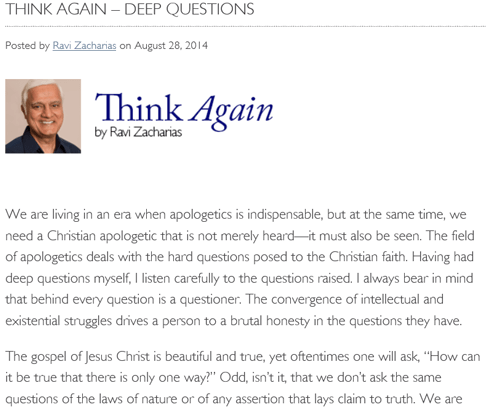
“The gospel of Jesus Christ is beautiful and true, yet oftentimes one will ask, “How can it be true that there is only one way?” Odd, isn’t it, that we don’t ask the same questions of the laws of nature or of any assertion that lays claim to truth. We are discomfited by the fact that truth, by definition, is exclusive. That is what truth claims are at their core. To make an assertion is to deny its opposite. Rather than complain that there is only one way, shouldn’t we be delighted that there is one way?”
Ravi Zacharias, Think Again – Deep Questions, 28 August 2014

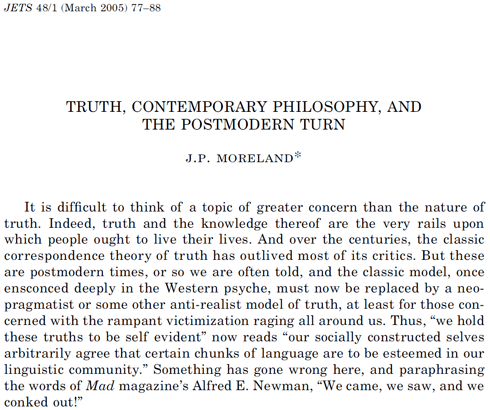
In addition to J. Warner Wallace’s excellent video on The Case For Truth, there are two essays I would recommend for anyone interested in personal discipleship. The first is a brief blog post by Ravi Zacharias entitled “Deep Questions.” The second is a paper delivered by J.P. Moreland at the Evangelical Theological Society, November 18, 2004. Click on the images below to read these essays.

Ravi-Zacharias: Truth

J. P. Moreland: Truth


Personal Discipleship Class

Personal Discipleship Class

Click on the images inside this file to link to the online resources. (You may need to adjust your browser settings to allow the links to work, or open it in iBooks, or save it to your desktop and open it with Acrobat Reader.)

Starting today (February 1st), I will be facilitating a new class on personal discipleship. For the next nine weeks, we will meet promptly at 10:45 a.m. in room 156 at the Williamsburg Community Chapel.

This class will build upon the apostle Paul’s instruction in (Philippians 2:12):

“Therefore, my beloved, as you have always obeyed, not as in my presence only, but now much more in my absence, work out your own salvation with fear and trembling;”

“Personal discipleship” is the process by which a believer or seeker accepts personal responsibility for exploring the claims and content of the Bible. The class will explore resources and topics, going beyond the sacred page to meet some of today’s most interesting and thought-provoking theologians, apologists, and philosophers. We will discuss historical evidence for the Resurrection, the dating of Easter, apologetics, textual criticism, the trustworthiness of Scripture, biblical inerrancy, science and faith, and current topics in theology.

The first session will focus on resources for personal discipleship. Click on the image above to download a PDF file containing hyperlinks to some of my favorite resources, which I will demonstrate in the class. If your personal studies are getting a little rote, try clicking on the images in this file to find some refreshing new tools and resources that you can use to reinvigorate your devotional life. The breadth and depth of high-quality resources available today is absolutely stunning.

Objective Truth As The Basis For Our Study

I posted the following video a couple of weeks ago. It presents an interesting, refreshing basis for studying the Christian faith—specifically that Christianity is founded on objective truth. The ideas in this video will frame our approach to studying during this class.


The Nature of Truth

The Best of Ogden Nash

SEEING EYE TO EYE IS BELIEVING

by Ogden Nash


When speaking of people and their beliefs I wear my belief on my sleeve;

I believe that people believe what they believe they believe.

When people reject a truth or an untruth it is not because it is a truth or an untruth that they reject it,

No, if it isn’t in accord with their beliefs in the first place they simply say, “Nothing doing,” and refuse to inspect it.

Likewise when they embrace a truth or an untruth it is not for either its truth or its mendacity,

But simply because they have believed it all along and therefore regard the embrace as a tribute to their own fair-mindedness and sagacity.

These are enlightened days in which you can get hot water and cold water out of the same spigot,

And everybody has something about which they are proud to be broad-minded but they also have other things about which you would be wasting your breath if you tried to convince them that they were a bigot,

And I have no desire to get ugly,

But I cannot help mentioning that the door of the bigoted mind opens outwards so that the only result of the pressure of facts upon it is to close it more snugly.

Naturally I am not pointing a finger at me,

But I must admit that I find any speaker far more convincing when I agree with him then when I disagree.

_______
HT: Ogden Nash


The Case for Truth

As you might imagine, truth is a very important topic on a blog named Veracity. Veracity is a one-word description of the Bible. The Bible is true. Most people really have no idea how true. Unfortunately, some believe that it is true because they feel it is true. Others hope that it is true without ever really knowing how true it really is. Agnostics doubt that it is true. Skeptics believe it is untrue.

So how important is it that your faith be based on truth? It sounds like a silly question, but it has profound personal implications. When you engage others about your faith, do you say things like, “This happened to me,” or ” I feel that…”? Unfortunately, these type of statements can point to a subjective faith. But Christianity is much truer than that.

Veracity is also a one-word description for Jesus Christ, taken from his own words:

Jesus said to him, “I am the way, the truth, and the life. No one comes to the Father except through Me.”
John 14:6

So, ultimately, truth is a person. Got it. Plain and simple. But is it an objective truth?

I’m currently preparing to teach a class on personal discipleship, which we define here at Veracity as “the process in which a believer or seeker takes personal responsibility for investigating the claims and content of the Bible.” It is personal and inherently objective. And it should be.

The class will be full of mature Christians. Many of these folks have spent a lifetime studying the Bible, and can offer encouragement to anyone who wants to ask questions. They have encouraged me. I’m hoping to give back by delving a little more deeply and father off the sacred page than most are accustomed to exploring. It will require an open mind that thirsts for the truth. No dogma, no “This is the way I’ve always thought it to be,” and no fear of what we might discover. If successful, some may find a more intimate appreciation of the Bible and the veracity of their faith. But it requires an honest assessment of our biases (we all have them), and an open and objective mind.

Anyway, I spend hours and hours looking at videos, trying to find just the right ones that will fit within the class schedule and leave time for discussion. There’s a ton of candidate material to share from brilliant apologists like Ravi Zacharias and John Lennox. There are studied academics like Daniel Wallace, Darrell Bock and Craig Evans. Theologians and philosophers like William Lane Craig and Alvin Plantinga. Seminarians like Michael Kruger, Norman Geisler and Gary Habermas. Pastors and teachers like Dick Woodward, Tim Keller and Andy Stanley. Scientists like Hugh Ross and Francis Collins. And a retired cop.

J. Warner Wallace

J. Warner Wallace

J. Warner Wallace

A retired cop?! Yup. J. Warner Wallace was a keynote speaker at the 2014 National Conference on Christian Apologetics. When my friends and I were looking at the conference syllabus, we had heard of his ministry but it sounded pretty much like a shtick to us—“A cold-case homicide detective looks at the Resurrection.” But we were blown away at his sessions. He is likely one of the most gifted rhetoricians you will ever hear.  There’s nothing wrong with good rhetoric—St. Augustine of Hippo was a professor of rhetoric and one of the most influential thinkers in the early Christian church. Martin Luther King, Jr. successfully persuaded the majority of Americans that racism is wrong and that it was time for the country to move in a more just direction. We need good rhetoric.

By way of background, Jim Wallace had a storied career as a homicide investigator in Torrance, California. Right before he spoke at the Charlotte conference, his last case was chronicled on the TV news program NBC Dateline. (Four of his cases have been featured on Dateline—he never lost a single case in his career as a cold-case homicide detective.) It was the oldest homicide cold case ever brought to trial in the United States, and the defendant’s lawyer was none other than Robert Shapiro, the famous Hollywood attorney from the O.J. Simpson case. It was Shapiro’s last court case. You can watch the NBC Dateline video to see what happened.

I will show some of his remarkably persuasive and compelling videos during the upcoming personal discipleship course but want to put this one out to Veracity readers. The truth matters—if we’re not after the truth, what’s the point in studying the Bible?