Clarke Morledge -- Computer Network Engineer, College of William and Mary...
I hiked the Mount of the Holy Cross, one of the famous Colorado Fourteeners, with some friends in July, 2012. My buddy, Mike Scott, snapped this photo of me on the summit.
Tracing back to Francis and Edith Schaeffer’s L’Abri, there is now a growing movement to establish centers for Christian study, physical presences near leading American universities, where conversations can take place to engage the secular campus with the story of the historic Christian faith. In fact, a new one is being established near the Williamsburg, Virginia campus of the College of William and Mary. It is called the Cambridge House, and I am excited to be part that movement.
According to Charles E. Cotherman, author of, To Think Christianly: A History of L’Abri, Regent College, and the Christian Study Center Movement, a “Christian Study Center” is a “local Christian community dedicated to the spiritual, intellectual and relational flourishing via the deep cultivation of deep spirituality, intellectual and artistic engagement, and the cultivation of hospitable presence. To be a study center, each of these four elements — spiritual, intellectual, relational, and spatial — must be cultivated” (Cotherman, p. 8).
What was just a few generations ago only a higher education opportunity made available to the cultural elite, has now become almost a rite of passage to adulthood, for a growing number of Americans across diverse backgrounds. The college students of today will become the social, political, business, and intellectual leaders of tomorrow. What part will Christians today have in having conversations that shape the kind of world we will live in 20 to 30 years from now?
I agree with Cotherman that Christian study centers are a vital component for connecting Christians in a local community with the world of their neighboring college campus to make those conversations happen. In the forward to To Think Christianly, Ken Elzinga, an economist at the University of Virginia, and one of the leading founders of the Center for Christian Study in Charlottesville, Virginia, observes that what makes a “study center” unique is that it is a center, a “place having a geographical footprint.” Such a center is a “safe place” where one can bring their disagreements and doubts, to meet with the scornful Nathaniels who ask “Can anything good come out of Nazareth?,” (John 1:46) as well as the doubting Thomas’ who wonder if the resurrection of Jesus is really true.
Furthermore, a “study center” is not just about students, but it is also a place for Christian faculty and college staff to congregate, and build a wide-ranging experience of community.
Unlike the many campus ministries, like InterVarsity Christian Fellowship and CRU, that often require working with the local university for obtaining meeting space, a “Christian study center” is owned by a non-profit entity, to make such a space available, ideally within walking distance of a college campus. In the case of the new Cambridge House at the College of William and Mary, at 930 Jamestown Road, this new center is just a five minute walk away from the Mason School of Business, and around the corner from the student Ludwell apartment building complex.
But a “Christian study center” is more than a place for stimulating conversation, as it can be a place for prayer, and a place for meditation and study, a short distance away from the hustle and bustle of a college campus. It can also be a place for exploring one’s vocation, to help discern God’s calling for an individual or group in our world.
Finally, according to Elzinga, a “study center” is irenic, “marked by relational warmth and hospitality.” Instead of viewing a secular university as an adversary, a “Christian study center” can engage the campus environment as a partner in dialogue, to help move conversations forward, for the benefit of all, believer and non-believer alike.
As the Cambridge House at William and Mary gets established, having a book like To Think Christianly available now helps to provide the historical context for understanding why several dozen study centers are starting to pop-up across college and university towns across the country. After all, what does it mean “to think Christianly?”
Cotherman examines the history of this movement by first focusing on the story of Francis and Edith Schaeffer, and the work of L’Abri, an alpine retreat center at a Swiss chalet founded by the Schaeffer’s in the mid-1950s. The Schaeffer’s were a product of mid-20th century American fundamentalism, when denominational bickering and Francis Schaeffer’s own crisis of faith led this missionary couple to establish L’Abri, which is French for “the shelter.”
Francis and Edith Schaeffer opened up their Swiss home to young people over the following decades, offering hospitality for short-term guests, as well as opportunities to work for the upkeep of the center for longer-term visitors and future staff. Edith in particular took great care to make sure dining ware placement at meals was done with excellence, with attention to detail, as conversation over meals were an essential part of the L’Abri experience. Francis had an appreciation for the history of art, providing many opportunities for conversation among philosophically inclined skeptics. This was no sterile classroom setting, but rather, a living, breathing community that put out the welcome mat for all seekers of truth.
But what the Schaeffer’s became most known for were for the talks given at L’Abri, and the informal conversations that followed, discussing the implications of a Christian worldview with respect to contemporary challenges to such faith in the 20th century. The content of these talks eventually became the substance of books published by InterVarsity Press, which led the Schaeffer’s towards giving lectures across the evangelical world.
In the early years, the Schaeffer’s L’Abri was a “faith-based” ministry, not asking others directly for funds, but rather, the Schaeffers appealed to God in prayer for the Lord to meet all of their needs. By the 1970s, as word of L’Abri spread and brought many more guests into the fold, and the “counter-cultural movement” was in fashion, Francis ‘”took to wearing beige Nehru jackets, odd linen shirts, and mountain climbing knickers” while wearing his hair long and growing a goatee‘ (Cotherman, p. 39). Through the Schaeffer’s, Christ was meeting the counter-culture!
But Cotherman’s story only begins there with L’Abri. Cotherman also chronicles the work of James Houston to establish Regent College in Vancouver, and the subsequent development of the Cornerstone house at the University of Maryland and the C.S. Lewis Institute. Begun in the late 1960’s, Houston’s work at Regent College paralleled L’Abri, but also differed in substantial ways. L’Abri was located away from university settings whereas Houston believed that study centers were best served by being located adjacent to a college campus. Houston was an academic, having done advanced degree work in geography, whereas Francis Schaeffer had no academic training beyond his theological studies. Schaeffer gained most of his knowledge of modern philosophy and art from magazines, as opposed to reading peer-reviewed scholarship found in academic books.
James Houston was concerned that Schaeffer’s L’Abri tended towards creating a type of evangelical celebrity culture and intellectual isolation, whereby a teaching “guru” like Schaeffer was the center of discussion. Alternatively, Houston believed that study centers should participate in academic discussions on college campuses, and he worked towards having a good relationship with the nearby University of British Columbia, in Vancouver, even himself teaching classes there on occasion.
Houston’s vision for Regent College was primarily oriented towards lay education, as opposed to providing seminary education for ordained clergy, thus making theological teaching available to a wider spectrum of people. Part of the early, original ideal was to offer a one-year program of study, particularly for recent college graduates to participate in, before pursuing careers in a variety of professions. By focusing on lay persons, study centers like Regent College, and others, have been able to side-step the thorny issue of women’s ordination, and have continued to improve over the years in providing opportunities for both young men and women to grow deeper in their faith and intellectual life as Christians, living out their vocations in a secular world, as well finding new ways to diversify the ethnic and racial make-up of their communal lives.
The Cambridge House, at the Crossroads, at 930 Jamestown Road, in Williamsburg, Virginia. With close proximity to the campus of the College of William and Mary, the Cambridge House is one of the newest Christian study centers.
Cotherman, to varying degrees, also tells the stories of other study centers, such as New College Berkeley, in California, and R.C. Sproul’s Ligonier Valley Study Center in Stahlston, Pennsylvania. The example of R.C. Sproul’s Ligonier is particularly insightful, as it shows some of the challenges that study centers face in figuring out what type of focus each study center should take. There are a wide-variety of approaches!
R.C. Sproul had been forced to delay the completion of his doctoral work in theology at the Free University in Amsterdam, due to family emergencies. This event triggered a series of decisions that helped him to cross paths with Francis Schaeffer, and consider establishing a L’abri-like study center in Stahlston, Pennsylvania. This Ligonier study center sought to offer a wide variety of classes and seminars aimed at providing good, intellectual Christian content, not often found in local churches, while seeking to create a hospitable environment for speakers to share their lives together with their students. In those early part of the 1970s, Ligonier attracted well-known evangelical Christian speakers to offer talks, that had a cross-denominational appeal, albeit leaning towards a Reformed theological tradition.
Ligonier was able to take advantage in the growth of technology, to get R. C. Sproul’s Ligonier content out to a wider-audience, and video-tape recording made this development possible. But as Ligonier’s influence as a study center grew, it also changed its style and focus for ministry. Opening up the homes of speakers for Christian hospitality gave way to a more formalized approach for Ligonier. In the early days of video taping R.C. Sproul’s talks, Sproul appeared nicely tanned, sporting a countercultural appeal with plaid pants, turtlenecks, sunglasses, and long hair. But by the time Ligonier moved their operations to Orlando, Florida, in the 1980s, Sproul was appearing before taped classes with a polished suit and tie look. Gone were the days when volleyball games were followed by casual meals around a dinner table, that allowed for deep spiritual conversation. Now, large, well-attended conferences were giving evangelical audiences a hefty, hearty diet of theological training for which they were starving to receive.
Is a study center a place for theological and philosophical discussion? A place where Christians and skeptics can ask their questions? A place for prayer? A place for hospitality? A place for Christian learning? The answer for each of these questions can indeed be “yes,” but each study center wrestles with trying to flesh out what is distinctive to each discrete instance of a study center. The value in reading To Think Christianly is in helping people interested in the study center movement to tie all of these things together.
All of this serves in Cotherman’s story as the backdrop for the eventual late 1970’s founding of the Center for Christian Study, in Charlottesville, Virginia, adjacent to the University of Virginia campus. The Charlottesville house has served as an intriguing model for what study centers across the country can do, in the local campus communities. Over the years, the Charlottesville house has offered residential living for students, a large library filled with Christian books and material for deeper study, quiet study areas for students as well as kitchens for providing meals and snacks, meeting spaces for prayer groups and Bible study groups, and even a Christian bookstore.
In the wake of its success, a Consortium of Christian Study Centers, originally led by Drew Trotter, was formed, and the Cambridge House near the College of William and Mary is among the Consortium’s newest members. In Virginia, the Cambridge House joins other new study centers near campuses like the University of Richmond, and Virginia Tech, in Blacksburg. What will the Cambridge House eventually look like, in terms of its distinctives? All of this depends on how God moves among the students, faculty, staff, and local churches and interested individuals, in figuring out how to invest in this exciting experiment.
Did the Apostle Paul condone slavery? Yes and no. A fuller answer requires a bit of unpacking.
In short, the Apostle Paul never comes out to explicitly condemn slavery. On the other hand, Paul deftly and implicitly undercuts the whole basis for why a person should remain a slave, or can become a slave in the first place, thus laying an axe at the root of the slavery system. Let me explain.
While done with good intentions, sometimes Christian apologists come out a bit too quick to exonerate the Bible from charges of condoning slavery. The story is actually more complex. A cursory reading of American Southern defenders of 19th century slavery should dispel that notion, as preachers who wrote tracts in support of enslaving Africans had a number of different Bible verses to choose from to make their case. Here is a short sample from Paul’s writings:
Ephesians 6:5: “Bondservants, obey your earthly masters.” (ESV)
Colossians 3:22: “Bondservants, obey in everything those who are your earthly masters.” (ESV)
Yikes. Those verses alone can make a lot of Christians today cringe.
Yet notice how the English Standard Version above uses the word “bondservant.” Who uses the word “bondservant” today? Does anyone?
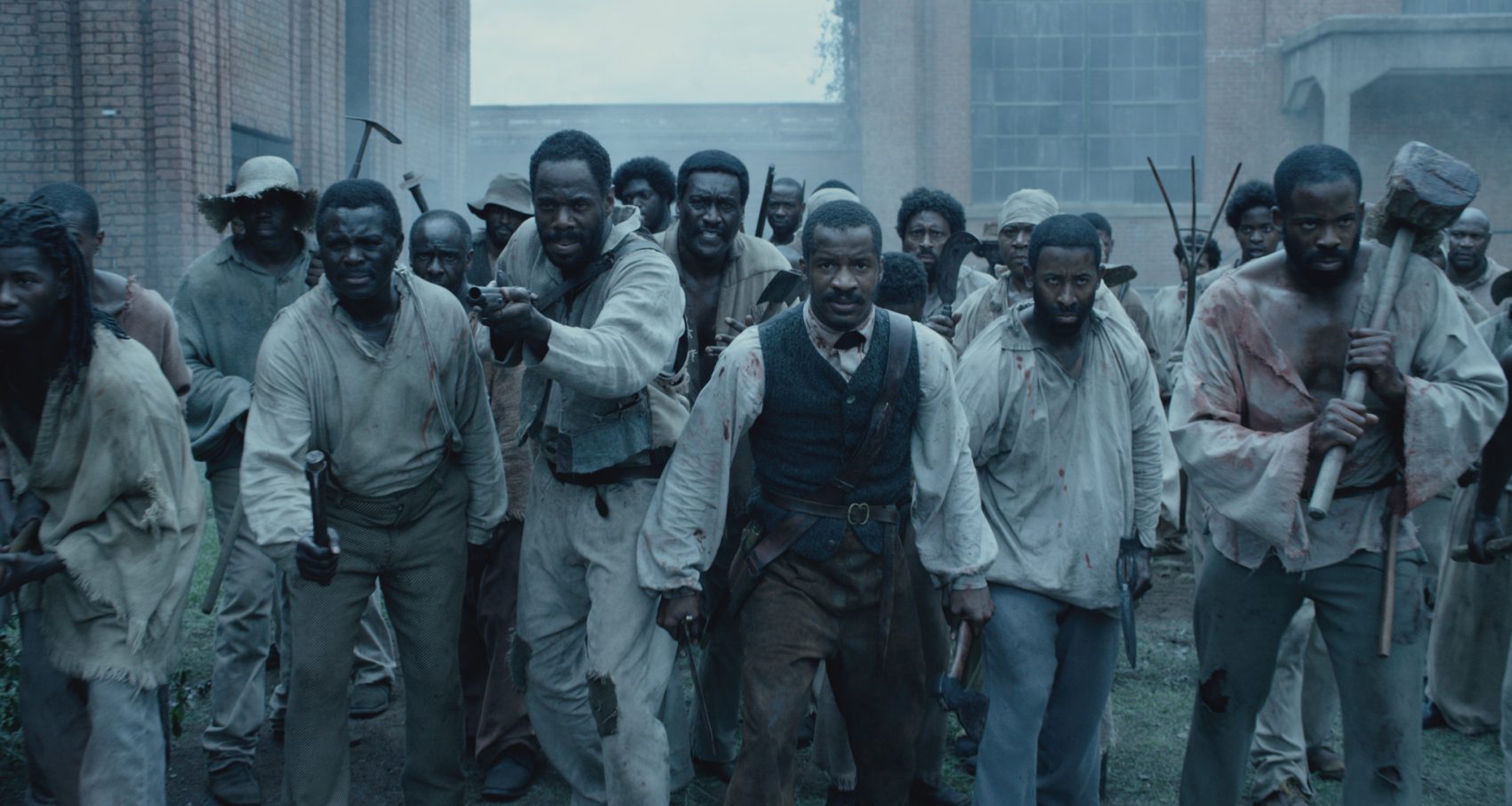
Nate Parker’s 2016 film The Birth of a Nation tells the story of the Nat Turner slave rebellion of 1831, in Courtland, Virginia, a little over an hour drive from my home. The Nat Turner tragedy is a complicated story about American history, slavery, and bad Bible interpretation. We need to be honest and clear about what the Bible says and not says about slavery.
A number of secular-minded critics today of the Christian faith will cry foul, claiming that popular evangelical Bible translations are sugar-coating passages in the Bible regarding slavery. They claim that Christians are trying to sidestep the hard truth: that the Bible sanctions slavery, and that is simply not morally acceptable for a 21st century person. Therefore, Christianity should be rejected as immoral.
As a Christian, when I hear criticisms like this, I tend to do either one of two things: One, I will stiffen up in defense of my Bible, and perhaps immediately run to some other passage, like God delivering His people, Israel, from slavery in Israel, as described in the Book of the Exodus. While raising an objection like this surely has its place, it can often come across as a “my-Bible-verse-beats-up-your-Bible-verse” approach to spiritual conversation.
Or second, I will want to ignore the topic at hand, change the subject, or otherwise just try to fade into the woodwork, hoping that the criticism will simply go away. The problem with both approaches is that they do not fairly address the criticism being presented. Sometimes our non-believing friends are a lot more honest about reading the Bible than we as Christians are. So, we need to face the criticism head-on, and see if we can dig deeper to get at a better solution.
“Political Correctness” In Today’s Bible Translations?
The vast majority of Christians today would condemn all slavery as unthinkable. But such was not so in the antebellum American South, during the plantation era. Back when I was studying history in college, reading books about early 19th century Southern (and even some Northern!) preachers defending slavery, I would rant in my dorm room that so many of my white Christian ancestors were not really Christians at all! But when I read some of those apologetic defenses of slavery, they sounded eerily like some Christian condemnations of same-sex marriage today. Charges of bigotry against Christians are not that far behind. A lot of 21st century Christians, who are familiar with the history of how some early 19th century Christians fought tooth-and-nail to defend slavery, are often left confused.
So, is it true that today’s Christians are somehow embarrassed at what is plainly in view, when we read our Bibles? Is it true that Christians are making their Bibles more “politically correct,” in order to find more social acceptance in our post-modern society?
The cynicism laced throughout Rosenberg’s essay and Perry’s interview critique is pretty hard to ignore.1 But Rosenberg/Perry do raise a point, as to how tricky it is to properly translate “slave/bondservant” for a 21st century English readership. The new Legacy Standard Bible, being produced by Pastor John MacArthur’s Master’s Seminary faculty, takes aim at the ESV from the opposite direction and unashamedly reinserts “slave” largely wherever the ESV has “bondservant.” So, how are we then to think of “slave/bondservant” today, when we read our Bibles?
Placing the Slavery/Bible Question in the Larger Historical Context
When I was a young believer, I often imagined that Paul was really talking about the relationship between workers and their bosses, more broadly. Well, that kind of works, but not really. Slavery was built into the very fabric of the ancient world, from the time of the Israelite patriarchs up through the Greco-Roman world of Paul’s day. To be a slave in the ancient world was a dehumanizing status to have.
Part of our problem is that our 21st century way of thinking about slavery is seen through the lens of America’s tortured history of racially-based, cradle-to-grave, chattel slavery, that precipitated the crisis of the American Civil War of the mid-19th century. A better approach would be to begin with this: What was slavery like in the days of the Old and New Testaments, when compared to the horror experienced by the vast majority of today’s African American ancestors?
Much of what we know of ancient history indicates that the institution of slavery was primarily a means of erasing debt. Even in the Old Testament, voluntary servitude was acknowledged as a legitimate means of canceling certain kinds of personal debt. For example, if you were a poor ancient Hebrew, and you owed your fellow Hebrew some money, and you had no personal property available to pay off that debt, you could voluntarily arrange to offer the labor of your own hands and body, for a limited time, in order to work off that debt. In a day where bankruptcy laws were unknown, the Bible appears to be acknowledging such forms of slavery as a morally acceptable practice, within limits. In our day, when many of us get mailed credit card applications sent to us on an almost weekly basis, we become oblivious to the historical reality that getting into debt with someone else was a serious matter, where the slavery system seemed to be the most obvious solution.
Extending that notion of slavery to a more macro-level gets more complicated. In the ancient world, an entire people group could be enslaved as result of war. Wars, then and now, cost money. Even if one side is victorious, the victor must find a way to pay for military activity. Soldiers deserve compensation for their service, care for the wounded is required, etc. The victor would seek reparations from the loser, just as in more modern times, when the victorious Allied powers after World War I sought to make Germany pay for the war effort. But what if the loser of the war was so devastated by the loss that they could not reasonably pay reparations with worldly goods? This is where slavery on a mass scale came in.
As opposed to the American history of slavery, which was primarily based on skin color, the question of race was less of an issue in ancient times. When the empires of the ancient near east world fought one another, and drove people into enslavement, the skin color differences between the victors and those conquered were largely minimal. Greeks, Persians, and even Jews, rarely differed that much in terms of skin pigment.
This more nuanced understanding of slavery partly explains why the ESV translation chose to translate the Greek word doulos as “bondservant,” a person bound in service without wages. Whether scholars agree or not agree, “bondservant” carries a lot less cultural baggage than does the typical American connotation behind the word “slave,” which is often front-loaded with concepts of race today, which were foreign to the Scriptural writers.
Furthermore, even in our day, if you experience indebtedness to someone else, or if, for example, a friend of yours owes you money, and does not pay you back, then you know how awkward it is to have a relationship with someone who you are not “right” with when it comes to an unsettled debt. The person owing the debt feels “enslaved” to the one owed the debt. The bigger the debt, the greater the feeling of enslavement. You do not need be an ancient person, nor someone living in the Deep American South, during the Antebellum era, to know what the distortion of slavery feels like.
Nevertheless, despite all of these noted differences, one still wonders why at least the New Testament does not come out and explicitly condemn slavery as an institution. Many readers of the New Testament can still get stuck on those disturbing words of the Apostle Paul, cited above.
I know that many Christians like to then appeal to Jesus Himself, over Paul, in defense of the abolition of slavery. After all, Jesus is God in human form, and Paul was not, right? Jesus’ preaching takes priority over Paul, correct? I mean, those words from the lips of Jesus, written in red, as those “Red Letter Bibles” tell us, carries more weight, right?
Well, that might sound convincing, until you start reading the Gospels more closely.Jesus talks quite a bit about slaves working for their masters. But Jesus himself never gives any indication that slavery is an evil institution. For example, when Jesus teaches the parable of the tenants, in Matthew 21:33-46, he indicates that these tenants beat up the slaves who work for their master. The reader does gets the sense that beating up the slaves was wrong, according to Jesus. But Jesus never suggests that there was anything specially wrong with slavery itself.
Mmmm……
Pardon an expression from football that might offend Roman Catholic readers, but trying to throw a “Hail Mary” pass in making an appeal to the Jesus of the Gospel, to rescue the Bible from charges of upholding slavery, does not really work.
Instead, you need to go back to Paul if you are looking for some definitive posture that the New Testament takes on slavery. So, what else do we find in Paul?
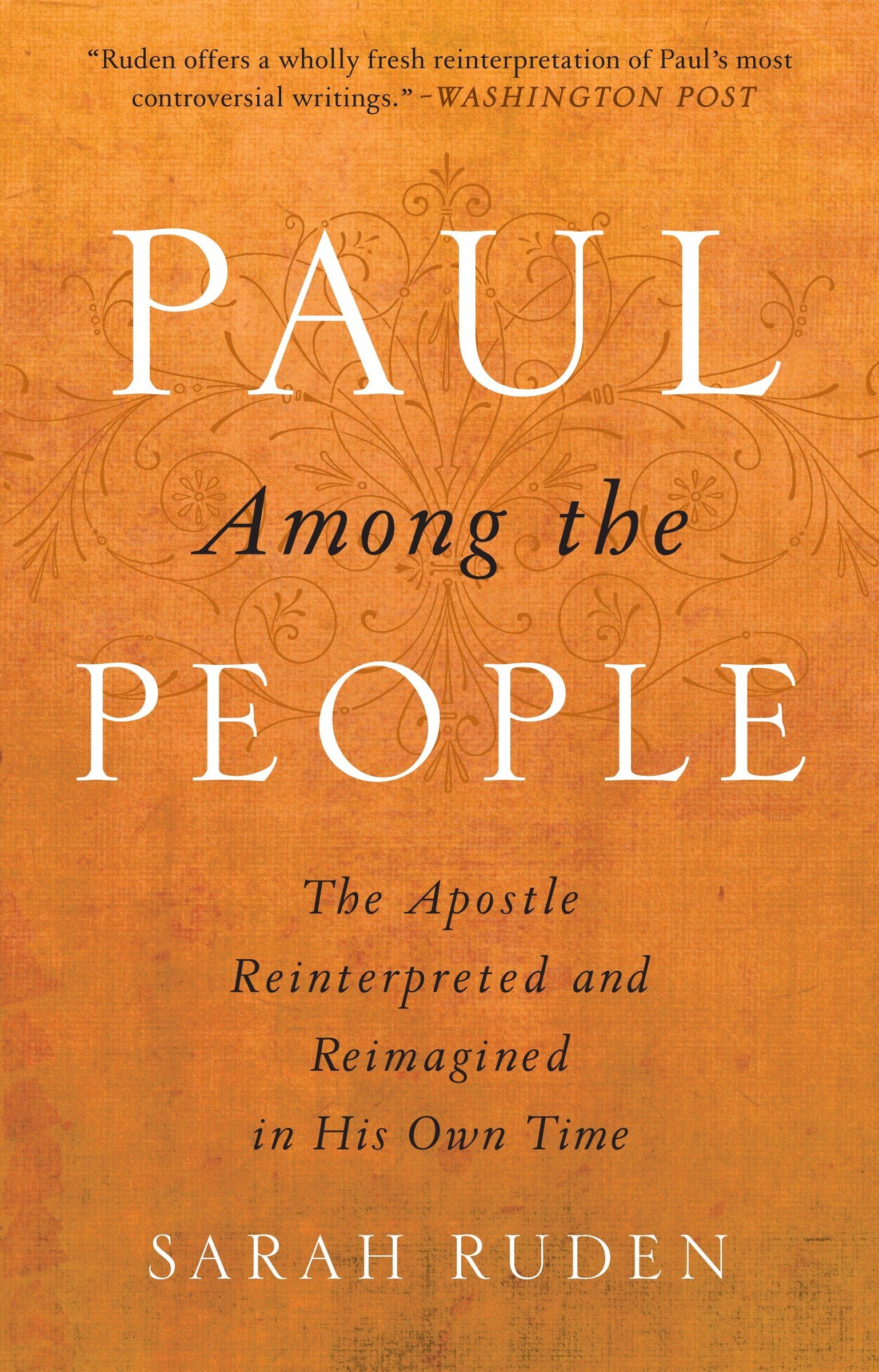
Sarah Ruden’s Paul Among the People straightens out of misconceptions that both Christians and non-Christians have about the Apostle Paul, regarding such topics as homosexuality, the treatment of women, and in particular, slavery.
Is Paul the Great Apologist for Slavery? The Answer May Surprise You
To get a better handle on this, I wanted to learn more from a scholar who specializes in the history of the classical period. Sarah Ruden is a scholar of the Greco-Roman classical period, who knows the cultural setting that Paul lived in better than most people.Unlike most scholars interested in Christian origins, Ruden specializes first in Greco-Roman culture, and from there takes an interest in Paul. Ruden is best known for her English translations of ancient Greco-Roman texts, who also recently released her own translation of the Gospels.2 While Sarah Ruden professes to be a Quaker, she does not expressly believe in a conservative evangelical view of the inspiration of the Bible, as being the definitive, inspired Word of God.3 But her specific area of research challenges a lot misconceptions that both Christians and non-Christians have about the Bible’s perspective on slavery.
It should come as no surprise that the Apostle Paul has been derided as representing the very worst characteristics of the Christian faith. As my kindly-Virginian mother told me on more that one occasion, “I really like Jesus, but I am not so sure about that Apostle Paul.” Paul has at various times been regarded as a chauvinistic hater of women, an apologist for the political establishment, a homophobe, and, for the purposes of this blog post, a callous proponent of slavery. Yet what is so intriguing about Sarah Ruden’s scholarship is that she insists that we read Paul within his own historical context, as a Jew and a Roman citizen, in an ancient era. Ruden’s work effectively works to dismiss this common negative narrative that surrounds the Apostle Paul, thus working against the grain of so many popular portrayals of his deficiencies.
“We really want Paul to have been against slavery, but the evidence is galling. It’s not that he was for slavery… It’s that he doesn’t seem to have cared one way or another.” (p. 177)
That seems like an overly crass and unfair evaluation, but I get Ruden’s point. On the one hand, you can read a passage like 1 Corinthians 7:21-23 , where Paul advises; “Were you a slave when you were called? Don’t let it trouble you—although if you can gain your freedom, do so,” Paul at least encourages slaves to seek their freedom, if possible. Score a major point in Paul’s favor!
In comparison to the Gospels, the “Red Letters” of Jesus do not even give you that! But there is also a sense that in this passage, Paul, like Jesus, really does not condemn slavery as an institution as forcefully as many of us would like to hear today.
Nevertheless, Sarah Ruden offers some powerful insight showing how Paul’s approach to the question of slavery, more than any other Biblical writer, has proven to be the most potential force for radical culture change, even down to the present day. In Ruden’s study of the Greco-Roman world, slaves were essentially subhuman. They were more “like pets: good treatment of them was about the master’s enlightenment, never about the slaves’ inherent equality” (Kindle location 2448). A slave was “nobody and nothing aside from his usefulness” (Kindle location 2512).
Ruden rightly points out that the most significant treatment of slavery is found in one of the most neglected books of the New Testament, Paul’s letter to Philemon, the shortest of all of Paul’s letters. Most Christians and others who dislike Paul tend to skip over this tiny letter, at the very end of the Pauline corpus found in the New Testament. But in doing so, Sarah Ruden discovers a nugget of prose that shows just how revolutionary and progressive Paul really was. In writing to Philemon, Paul is telling about his relationship to Onesimus, a runaway slave who had belonged to Philemon, but who met up with Paul for support and for a sanctuary. Paul, in turn, wishes to hand Onesimus back over to Philemon, but with some extremely provocative requirements involved:
Accordingly, though I am bold enough in Christ to command you to do what is required,yet for love’s sake I prefer to appeal to you—I, Paul, an old man and now a prisoner also for Christ Jesus—I appeal to you for my child, Onesimus, whose father I became in my imprisonment.(Formerly he was useless to you, but now he is indeed useful to you and to me.)I am sending him back to you, sending my very heart.I would have been glad to keep him with me, in order that he might serve me on your behalf during my imprisonment for the gospel,but I preferred to do nothing without your consent in order that your goodness might not be by compulsion but of your own accord.For this perhaps is why he was parted from you for a while, that you might have him back forever,no longer as a bondservant but more than a bondservant, as a beloved brother—especially to me, but how much more to you, both in the flesh and in the Lord (Philemon 8-16).
Among the several things to observe in this passage, we read that Paul considers Onesimus to be his “child” (son) as well as a “beloved brother.” Unlike what we see in popular Hollywood movies, like 12 Years a Slave, or The Birth of a Nation, that portray the horror of slavery inflicted on African Americans, Paul does not come across as an angry white dude, intent on returning a runaway, disobedient slave. Instead, Paul displays a tender affection for Onesimus, and wants to make sure that Philemon knows that.
True, Paul does not explicitly demand that Philemon set Onesimus free from being a slave. However, Sarah Ruden states that “Paul had a much more ambitious plan than making Onesimus legally free. He wanted to make him into a human being, and he had a paradigm. As God chose and loved and guided the Israelites, he had now chosen and loved and could guide everyone… The way Paul makes the point in his letter to Philemon is beyond ingenious. He equates Onesimus with a son and a brother. He turns what Greco-Roman society saw as the fundamental, insurmountable differences between a slave and his master into an immense joke” (Kindle location 2541).
In the history of ancient slavery, a slave generally had no value in terms of being part of a family. Even up through the dawn of the modern era in the late 18th century, during the near thousand year period since about the beginning of Islam, Islamic raiders in ships would invade European costal towns and kidnap European Christians, and take them back to Islamic countries, to be placed in forced servitude, for the remainder of their lives. Though dwarfed by the some 12 million Africans taken to the Americas, during the colonial period, historians estimate that nearly 1 million European Christians ended up in this forgotten system of slavery, by their Islamic captors. Yet we know little of what became of these Europeans as their line of descendants were largely wiped out, during their experience of slavery.
Certainly in the Apostle Paul’s day, the story of what happened to Greco-Roman slaves was forgotten, because of the loss of familial connections: no sons, no brothers. Ruden comments that “one of the greatest cruelties of slavery was that, having no legal family, a slave was boxed off in time, without a real tomb or recognized descendants or anything else to ensure he was remembered” (Kindle location 2550).
However, in the letter of Philemon, the Apostle Paul changed all of that. Paul cut at the very heart of the ancient slavery system, by declaring his affection for Onesimus and challenging Philemon to do the same. For if Paul were to merely ask Philemon to set Onesimus free, it would not have helped Onesimus very much in a culture that regarded slaves, particularly runaway slaves, as nobodies. By asking Philemon to take Onesimus on as a family member, as Paul did, this act of treating Onesimus as a human being, and not subhuman, effectively turns the whole rationale behind the slavery system on its head.
In other words, according to Torah, Jews were forbidden to enslave fellow Jews in the same manner the pagan Greco-Romans would enslave one another. Why? Because a fellow Jew was like family. They were like sons and brothers.
Under Paul’s new Gospel message, the implications were clear in Paul’s mind. Now in the era of the Risen Jesus, the message of Christ has gone beyond the borders of covenant Israel, to include the Gentiles, for those who have faith in that Risen Jesus. Now, we can call Jew and Gentile as brothers and sisters (sons and daughters) together in Christ, including both slave and free (Galatians 3:28). By calling Onesimus both a son and a brother, Paul considers the runaway slave to having the same status as a fellow Israelite under the Law of Moses.
The message is as subtle as it is profound. In not mounting a full scale frontal attack on the institution of slavery, Paul was not one to directly challenge the social order. Instead, Paul takes an indirect, yet more radical approach, of undercutting the very conditions by which one is made a slave in the first place. As the Gospel goes forth, inviting all to place their faith and trust in Jesus, more people are added to the family of God. But since the most dehumanizing form of slavery is forbidden of family members, the whole system of chattel slavery is set on notice. As Ruden puts it, Paul “turns his sermonizing into a bomb, presses down the detonator, and walks away, leaving glittering fragments of absurdity in place of the conviction that people solve problems” (Kindle location 2657). God has declared a new family order of things, and Paul has been entrusted with the message of that declaration, to be given to all peoples. Kaboom!!
An Implicit Argument, Found in the Bible, that Rejects Slavery
As a side note, some Evangelical Bible scholars have tried to make the case that Christians should apply a redemptive-movement model of interpreting the Bible, such as found in William J. Webb’s Slaves, Women & Homosexuals. In other words, instead of getting too hung up on the actual thoughts of Paul described in the Scriptural text that tend of embarrass us today, Christians should seek to best understand the spirit behind the text, so that we might arrive at a new ethic that moves beyond the static literalism of certain statements made by Paul. Critics of this thesis argue that such a hermeneutical model of reading Scripture is unsustainable, as similar redemptive movement models have been used in recent years to justify same-sex marriage and transgender-based ideologies. Furthermore, a redemptive-movement hermeneutic does not seriously enough take into the consideration that the New Testament is ultimately the definitive commentary on the Old Testament.
Yet when it comes to slavery, my reading of Sarah Ruden’s Paul Among the People convinces me that there is enough substance in the subtext of Paul’s argument in Philemon that makes Paul into a compelling advocate for the elimination of the slavery system, albeit through an implicit means. A problematic redemptive-movement model is not necessary when it comes to dealing the death blow to slavery.
Proof of this can be seen in the history of the early church itself. The aftershocks of Paul’s letter to Philemon have been felt down through the centuries. As historian Tom Holland tells us, Gregory of Nyssa, one of the greatest and influential of the early church fathers, was an outspoken critic of slavery as being against the very concept of what it means to be created in the image of God. Ruden herself observes that as the Christian faith grew throughout the Roman empire, the slavery system almost entirely disappeared, as those early Christians, within just a few hundred years after the closing of the New Testament, chimed in with Gregory of Nyssa’s condemnation of slavery. True, feudalism eventually replaced slavery in the medieval era, but this was nothing like the chattel slavery system that was revived hundreds of years later by European slave traders, who sought to take advantage of conquered African tribes, in hopes obtaining greater wealth from the New World in the Americas. Many centuries before William Lloyd Garrison, Frederick Douglas, and 20th-century activists like Martin Luther King Jr., Christians like Gregory of Nyssa were paving the way towards a slave-free society.
If anything, it was the utter failure of the Christian church, in the era of the African slave trade, to properly interpret the Bible responsibly, that led to the false justification of the slavery system, during the colonial era (for more on that, read this critique found on Veracity). It was as though the slave-holding Christians during the colonial era became totally disconnected from the witness of Gregory of Nyssa, hundreds of years earlier.
A lot of the contemporary distrust of the Bible stems back to the ugly stain that the American slavery system has left on Christian history. Sarah Ruden’s exploration into the world of the Apostle Paul has reminded me that the original New Testament context, within the period of the early church, tells a much more balanced story.
Evangelical theologian and reviewer Peter Leithart observes that Sarah Ruden’s book is “one of the best defenses of Paul,” in an age where Paul is often perceived to be an embarrassment to the Christian faith, in comparison to Jesus. Ruden offers other provocative defenses of Paul, with respect to Paul’s condemnation of homosexual acts, as well as Paul’s treatment of women. Ruden does not hold to an evangelical view of Scripture, as she holds to the critical consensus, that only seven of the thirteen letters attributed to Paul are indeed authentically Pauline. Interestingly however, as an academic critical scholar, she still comes to many of the same conclusions regarding Paul, that are agreeable with historically orthodox perceptions of him.
A final word of warning here, for potential readers of Ruden’s book: Paul Among the Peoples is not for the faint of heart. Her quotations of Greco-Roman poets of the day demonstrate just how crude, bawdy and degrading Greco-Roman pagan culture could be. Plus, there are moments where she tends to psychoanalyze Paul a bit too much. Sure, she humanizes Paul, but she does so at the expense of diluting the divine character of the sacred text at times. But the best benefit in reading Sarah Ruden, despite her wide embrace of the more liberal, critical end of historical criticism in New Testament scholarship, is in showing just how much the writings of the Apostle Paul completely re-oriented the world of ancient Greco-Roman culture, and continues to impact the world today.
Circling back to those difficult passages in Colossians and Ephesians, towards the beginning of this blog post, it helps to read more of the text, to see just how revolutionary Paul was, in challenging the status quo of his day. Simply consider what we read in Colossians (which parallels Ephesians 6:5-9):
Colossians 3:22-4:1 (ESV)“Bondservants, obey in everything those who are your earthly masters, not by way of eye-service, as people-pleasers, but with sincerity of heart, fearing the Lord.Whatever you do, work heartily, as for the Lord and not for men,knowing that from the Lord you will receive the inheritance as your reward. You are serving the Lord Christ.For the wrongdoer will be paid back for the wrong he has done, and there is no partiality. Masters, treat your bondservants justly and fairly, knowing that you also have a Master in heaven.”
First, note how bondservants/slaves are not simply to obey their earthly master, but that they are to fear the Lord, to “work heartily, as for the Lord and not for men.” As opposed to the pater familias tradition of Greco-Roman culture, that Sarah Ruden describes with such unease to our modern ears, which put the male head of household in complete autocratic rule over slaves, to do anything they want with them, Paul argues that ultimately bondservants/slaves are to serve the Lord instead. Secondly, Paul does not let slavemasters get off of the hook for one minute, urging slavemasters to treat their bondservants/slaves “justly and fairly,” which undermined the dehumanizing practice of the Greco-Romans.
Do I wish that the Bible had been more explicit in condemning slavery? Sure, I do. But when we read the Bible within its historical context, and in particularly take a closer look as to how Paul’s strategy worked in trying to persuade Philemon to welcome the runaway slave, Onesimus, we get a far more liberating picture of the message of the New Testament.
——————-
For a helpful video that briefly summaries some of the arguments found in this blog post, I would recommend the following video by Dr. Matthew Hall, at Southern Baptist Seminary:
Notes:
1. See this thorough and excellent YouTube video rejoinder by Bible Study Magazine editor, Mark Ward. Mark Ward’s YouTube channel is “Bible Nerdy,” but entertains just as well as it educates. The Slate article goes onto rightly observe that the English Standard Version (ESV) of the Bible does have a definite complementarian bent to it, emphasizing the distinct roles that differentiate men and women, in contrast with other translations, like the Common English Bible (CEB), that favors a more egalitarian approach, that tends to see male and female in more or less interchangeable terms, particularly when it comes to leadership offices in the church. The Slate article also suggests that the ESV was “compromising” by putting together a special translation of the ESV to the Gideons, that kept more “KJV-friendly” verses in the Bible, which is overly-simplistic. The KJV is outdated in many ways, but the ESV has always sought to stand within the tradition of the KJV. So, the idea that the ESV is simply “marketing” the Bible to appeal to a particular audience is really a cynical way of looking at Bible translations. Kudos to Mark Ward for his work in expose the flaws in the Slate article. ↩
2. Here is a delightful nugget of insight that Sarah Ruden has in reading the Gospels, which is simply too good to ignore: Matthew 15:26-27 is part of an episode where Jesus meets a Canaanite women (i.e. not a Jew, but a Gentile), where the woman cries out to Jesus for him to help her. The NIV renders Jesus’ response and the woman’s rejoinder like this, ‘” He replied, “It is not right to take the children’s bread and toss it to the dogs.” “Yes it is, Lord,” she said. “Even the dogs eat the crumbs that fall from their master’s table.”’ The problem with this type of translation is that it makes Jesus sound very severe and serious, even condescending towards the woman. But Ruden rightly notes that the word for “dog” used by both Jesus and the woman is not what many Christians typically think. Most Greek dictionaries will translate this directly to English as “little dog,” which is better, but Ruden says that there is more to it. Instead, Ruden says that Jesus is being playful here, as the word is better rendered as “little doggie.” That sounds less seriously spiritual, but it is more accurate. The NIV could have been improved with the following, for Jesus’ statement: ““It is not right to take the children’s bread and toss it to the little doggies.” That sounds a lot less harsh, and more tongue in cheek. What a wonderful insight Sarah Ruden gives to the passage. ↩
3. For those unfamiliar with a “conservative evangelical” view of the Bible’s inspiration, a short of way of putting it is that conservative evangelicals believe that the Bible is not only written by humans, it is also written by God. There is an essential divine/human character to Holy Scripture. More liberal scholars, who adhere to what is typically described as the “historical critical method,” mainly emphasize the Bible as a human work of literature. Sarah Ruden herself even says that she is trying to lay aside the idea of the Bible as being “sacred” in order to get more at the humanity of the text. But why the dichotomy? Why not do scholarship with the Bible that reads it as both divine revelation AND as human literature? While the “historical critical method” can help at times to reveal certain blindspots in how to read and interpret the Bible, which sometimes happens with conservative Christians, one must be careful to understand that historical criticism inherently takes an anti-supernatural bias contrary to biblical revelation. Thankfully, Sarah Ruden focuses most of the time on using the “good” side of historical criticism, when doing her work, which is extremely rewarding and helpful to the church. Conservative Christians have a lot to learn from her. ↩
William Lane Craig is often regarded as the most prominent living Christian philosopher on the planet defending the Christian faith today. However, a recent article that Craig wrote for the magazine First Things has resulted in a firestorm of controversy.
Craig, the founder of the apologetics ministry, Reasonable Faith, and Professor of Philosophy at Houston Baptist University and Research Professor of Philosophy at Talbot School of Theology, has recently published a book regarding the historicity of Adam and Eve, and the literary genre of Genesis 1-11 more broadly: In Quest of the Historical Adam: A Biblical and Scientific Exploration. His essay at First Things summarizes his thesis, and Craig concludes that the Adam and Eve of Genesis are both historical and mythological figures in the Bible, and Craig also concludes that Genesis 1-11 is an example of the literary genre of mytho-history found in the Bible. Furthermore, Craig argues that Adam and Eve go back to a common ancestor shared between modern humans and Neanderthals, between 750,000 to 1,000,000 years ago. Craig’s view can be quickly summarized in this 4-minute linked YouTube video.
Some Christians, such as Reformed apologist James White, of Alpha Omega Ministries, and one of the most capable Christian debaters today, hold largely to a presuppositionalist approach to Christian apologetics, where one begins one’s apologetic method with an assumption, or presupposition, that exists as revelation that can not be refuted. This is different from an evidentialist approach to Christian apologetics, that William Lane Craig tends to follow, urging Christians and non-Christians to “follow the evidence wherever it leads” towards the discovery of truth. Interestingly, White is not consistent with his own apologetic method, as White comes across as holding an evidentialist position when defending the reliability of modern Bible translations, in contrast with the presuppositionalist approach taken by KJV-Onlyists (see the comments in this linked Veracity article), who only view the King James Version of the Bible as being THE one-and-only divinely preserved version of the Bible. Nevertheless, James White gives his own broadly framed critique of William Lane Craig in this linked YouTube video, selected from one of his Dividing Line podcast programs. White’s critique here is a bit “off-the-cuff” but it can give you a flavor as to how different Christians approach apologetics differently.
Many Christians are convinced that the truthfulness of the Christian faith hangs and falls on the historical narrative of Adam and Eve. Others view Adam and Eve as merely metaphorical symbols representative of the story of humanity more broadly. Is there a common ground solution to be had here?
What makes this issue so challenging to navigate is that while many Young Earth Creationists, and even some Old Earth Creationists, will make an appeal to the beliefs of the earliest Christians among the early church fathers, in support of their views, the question of relating history and metaphor together is far from simple even among the early church fathers, when it comes to interpreting Genesis 1-11.
In the following YouTube video, Protestant theologian Gavin Ortlund offers a friendly rebuttal to Owen Strachan’s critique of William Lane Craig, by focusing on the complex views of Saint Augustine, the most influential Christian theologian in the Western church, dating back to the early 5th century. After that, I have linked to a YouTube interview by apologist Sean McDowell with William Lane Craig about his new book. The Ortlund video is 15-minutes long. The Craig interview with McDowell is an hour long.
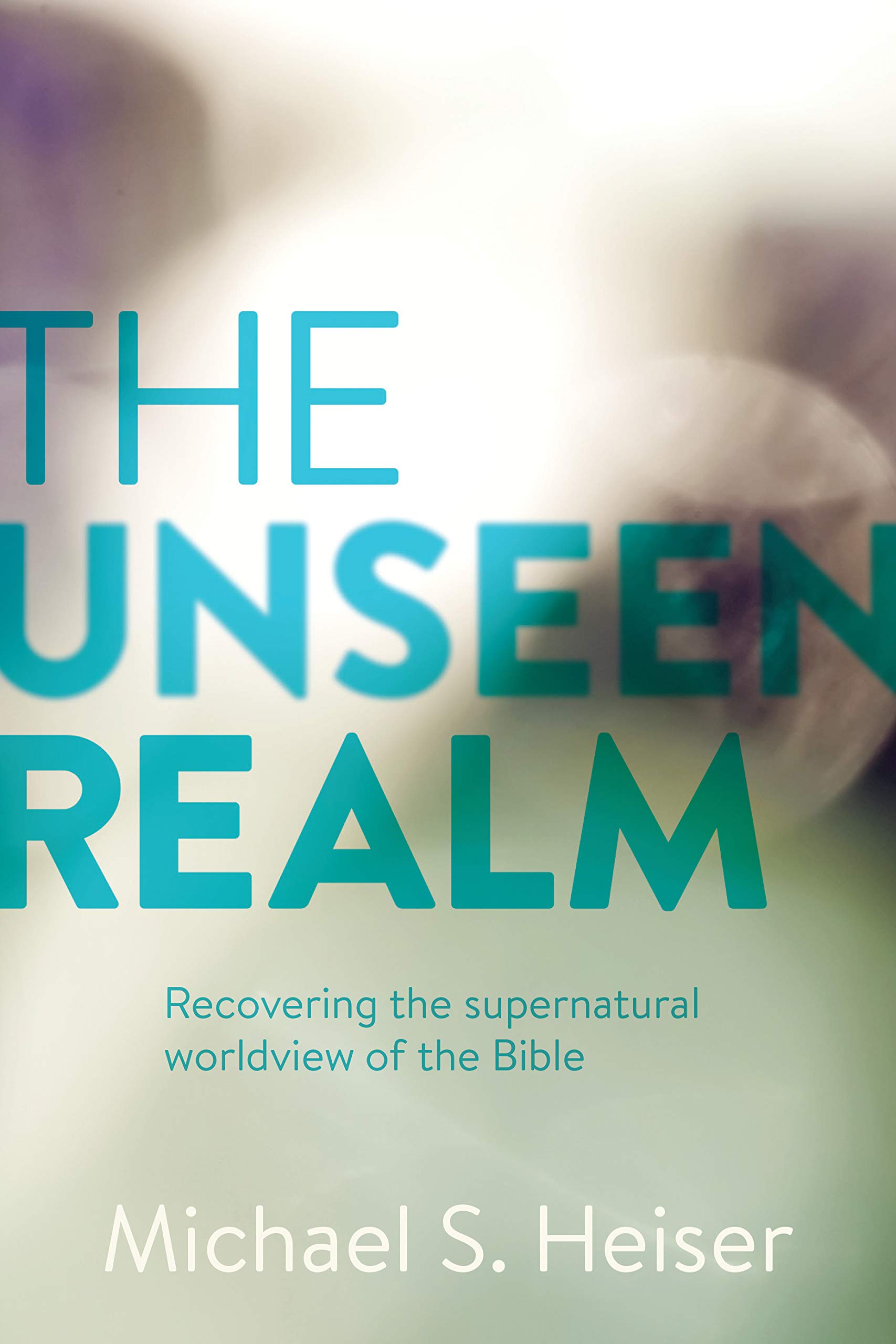
Every now and then a book comes along that just revolutionizes your thinking. After having this book on my “to-be-read” list for at least five years, I finally got around to reading Dr. Michael S. Heiser’s The Unseen Realm. Talk about a revolution. I will never read my Bible the same way again. I am not sure that Michael Heiser has EVERYTHING right, but he pretty much nails a lot of things smack dab on the head.
Michael Heiser got on my radar a few years ago with the Naked Bible Podcast, where this Old Testament and Semitic languages scholar goes through books of the Bible, mostly passage by passage, and focuses on a lot of the “weird” stuff in the Bible that is simply left untaught in most evangelical churches from the pulpit these days.
Heiser is a great Bible teacher, unafraid to challenge traditional denominational categories. Furthermore, a lot of what you find in popular media regarding the Old Testament is downright skeptical of Scriptural revelation, ranging from your typical college introductions to the Old Testament to televised programs on the History Channel. But Michael Heiser knows his stuff, tackling such skepticism of the Bible head on. Yet he introduces you to a paradigm of understanding Bible that affirms the full trustworthiness of the Scriptures, while maintaining a solid footing in the best of contemporary scholarship. Along with Wheaton College’s John Walton (see here and here), Michael Heiser is pretty much the “go-to” scholar when it comes to all things Old Testament, and relating that world to the New Testament, in the fiery world of Christian apologetics.
How Contemporary Evangelical Avoidance of the Supernatural in Holy Scripture Has Obfuscated the Meaning of Many Difficult Texts in the Bible
In 2020, I decided to read one of Heiser’s more recent in-depth books first, Angels, and it was great, but I became aware that a lot of what you find in Angels assumes you understand the basic ideas presented in The Unseen Realm. The Unseen Realm seemed a bit daunting to me at the time, as it is somewhat academic (but not too academic), and I was not ready to dig that deep into the topic. But my goal of reading (errr… listening via Audible) The Unseen Realm on my bike rides this year left me stopping on the bike path, several times, to rewind the last paragraph or two, to fully digest the topic.
But let us look at something right near the beginning of the whole Bible. Before you get a few chapters into Genesis, most every Christian I know gets stumped on this one: How about the story in Genesis 6, where the “sons of God” took the “daughters of men” as wives, and the offspring produced were called the Nephilim?
Pretty weird, huh?
In fact, I have always thought that this passage was SO weird, that I wrote a blog post almost 6 years ago explaining that most Christians have no clear idea as to what this passage is talking about, and urging humility when studying it. I still think we need humility, but I am pretty well convinced that Dr. Heiser’s approach is correct (I will leave the old blog post up anyway, just so that you can compare and see where my mind has changed). The amount of explanatory power behind Heiser’s thesis is simply breathtaking.
So, who are the “sons of God” in Genesis 6? A tradition going back to Saint Augustine suggests that these were descendants of Seth, the other son of Adam and Eve, aside from the well known Cain and Abel. In a nutshell, these “sons of God” were godly descendants of Seth, who had sexual relations with women descended from Cain; that is, “daughters of men,” such that God’s anger against humankind was stirred enough to trigger Noah’s flood, as a sign of divine judgment against the world.
Saint Augustine is surely one of the greatest teachers of Scripture of the Christian faith. The entire Protestant movement, for example, finds its backing squarely in the thought of Augustine’s view of justification by faith. Augustine was no slouch! However, Augustine was not proficient in his understanding of Greek, knew close to nothing about the Hebrew language, and lacked the cultural background of Second Temple Judaism, that was pretty well assumed by the original Jewish audience, living in the time of Jesus. Instead, according to Dr. Michael Heiser, a much older tradition, predating Augustine’s views, going back to the Book of Enoch, and other writings in the inter-testamental period, between the Old Testament and New Testament suggests that the “sons of Gods” were actually divine beings that rebelled against Yahweh, the name for God in the New Testament.
Genesis does not give us that many further details concerning these “sons of God,” but Heiser’s overview of the Jewish literature written within a few hundred years prior to the earthly ministry of Jesus reveals that Jesus’ listeners were thinking a lot about the “sons of God.” Are there other “sons of God,” other than the Genesis 6 rebels?
If you take a glance at just about any modern Bible translation, for the most popular verse in the Bible, John 3:16, you might see a clue here. For years, older translations of this verse spoke about Jesus this way, like in the KJV: “For God so loved the world, that he gave his only begotten Son, that whosoever believeth in him should not perish, but have everlasting life.” Most newer translations have removed the word “begotten“, an older archaic word, typically having something to do with “birth” or “generation.” But it is not because “begotten” is archaic that this word has been removed. Though still a topic of some debate, recent scholarship indicates the original Greek word, monogenes, actually has a meaning closer to “unique” or “one of a kind,” close to what the NIV 2011 translation has as “one and only Son“. Michael Heiser probably prefers a translation along these lines: “For God so loved the world, that he gave his one of a kind Son“. In other words, Jesus is the unique, one of a kind, Son of God. Unlike any other divine being, Jesus has a unique relation to God the Father that no other divine being has ever had.
So, what is the big deal about that? Well, have you ever wondered why the Gospels talk so much about demons and demon possession? Today, Christians normally fall into two camps when they think about demons. Either they see demons everywhere around us, even to an extreme, under your bed, in your neighbor’s mini-van, etc., a belief that is particularly strong among certain hyper-charismatic Christians. At the other extreme, other Christians (along with many non-believers) are embarrassed about such talk of demons, as demonic possession is typically thought of today as being an out-dated relic of unscientific, pre-modernistic cultures. Is there another alternative?
Furthermore, Heiser argues that this understanding of demons explains the perplexing passage in 1 Peter 3:19-20, where Jesus is said have preached to the “spirits in prison.” This passage is most probably the basis for the (in)famous descensus clause from the Apostles Creed, whereby Jesus descends into Hades (“hell“), between his crucifixion and resurrection. Who are these “spirits in prison?” For Heiser, and according to a large body of contemporary scholarship, these are the dead Nephilim that Jesus preaches to, condemning the demonic powers to their eternal demise and judgment. While not ruling out other possible explanations, that could run side by side with this one, the idea that Jesus was sent to preach a message of condemnation to the demons is a pretty awesome thing to consider.
That is some powerful stuff to think about!
Yes, it does sound quite weird. But then, that is partly why the message of the Bible still has a striking message for our fallen world today, that secularizes just about everything, and robs our day to day life of mystery and deeper meaning.
How an Old Testament Approach to the “Divine Council” Makes Better Sense of the New Testament
Behind Dr. Heiser’s approach to the Bible is the notion of a “Divine Council” being expressed in the pages of the Old Testament, whereby we understand Yahweh, the God of Israel, to have a court of other divine beings, that Yahweh himself created (see the Bible Project). These divine beings, whom we encounter in the Bible, including angels, cherubim, seraphim, and even the rebellious ones, like Satan and the demons, were created originally to serve Yahweh, as most clearly articulated in Psalm 82.
Traditionally, the “gods” of Psalm 82 have been primarily understood to be Jewish elders. On the other hand, Heiser makes the case that these “gods” are not human creatures, but rather they are divine creatures, that bring their supernatural influence to bear among the nations, as members of God’s “Divine Council.” Heiser makes the bolder case that this “Divine Council” interpretation predates the “traditional” interpretation of Psalm 82, as it is thoroughly rooted in the worldview of Second Temple Judaism, a perspective that many of the great Gentile patristic teachers of the early church never fully grasped.
Once one understands the workings of the Divine Council in the Old Testament, this then unlocks a lot of the mystery behind dozens of passages in the New Testament, that typically confuse the vast majority of Christians. Heiser gives multiple examples of how a Divine Council framework of thinking helps to make more sense out of the New Testament.
Are you ever confused about Paul’s statement that we are to “judge angels” (1 Corinthians 6:3 ESV)? What about the rebellious angels that Jude highlights in his short letter (Jude 6)? Have you ever wondered why the tribe of Dan is omitted from the list of the 144,000 in Revelation 7? Had you ever considered that the plain of Meggido, in northern Israel, may not be the proper location of the battle of Armaggedon? And to top all of that off, what about that strange passage mentioned above in 1 Corinthians 11, requiring that women wear head coverings while praying/prophesying in church, because “of the angels” (verse 10)?
Sure, other competent scholars might suggest other interpretations. But Heiser’s work is most impressive for the broad explanatory power his thesis has in bringing together so many loose ends in Scripture, that continues to puzzle many students of the Bible.
Solving Old Testament Mysteries, Too
Of particular interest to those who are concerned about faith/science issues, as they relate to the Bible, is Dr. Heiser’s understanding that at least some of the Nephilim survived Noah’s flood. The Nephilim, products of the angelic/human procreation rebellion in Genesis 6, were considered to be giants. Heiser links these to the giants that the Israelite spies saw, when they identified the land as being filled with milk and honey. When the Israelites were commanded to wipe out the Anakim, when entering the Promised Land, Dr. Heiser suggests that these Anakim, as giants, were descendants of the Nephilim who survived the flood. Goliath, the great giant that David faced, is also identified as a descendant of the Anakim.
This view of the Nephilim also dampens claims that the Bible advocates genocide of humans, as the wiping out of the Anakim would be for destroying these giant angelic/human hybrid offspring, instead of normal humans. Sure, it is some weird stuff to think about, like something out of a science-fiction movie. But it makes more sense than some of the peculiar ideas put forward by some Young Earth Creationists, regarding a global flood, and answers at least some concerns that skeptics have about the conquest of Canaan by Joshua.
What makes Dr. Heiser’s work in The Unseen Realm so compelling is that none of this research that he brings to bear on the Bible is unique or new to him. Everything you read about in The Unseen Realm is a result of peer-reviewed Biblical scholarship, researched and studied over the past few decades, that often remains locked up in the halls of academia. Instead, Michael Heiser takes this vast treasure of Biblical insight and makes it available to common, everyday Christian believers, putting it lower down towards the bottom shelf, so that everyone can benefit. The Unseen Realm is jam-packed with details that frame the Biblical story in a whole new way.
The main caution I would again point out is that The Unseen Realm assumes that the reader has some advanced understanding of the Bible. The Unseen Realm is therefore loaded with footnotes, which might be off-putting to the casual or uninitiated reader, but that will really help more knowledgeable students of the Bible put all of the pieces together. As an added bonus, Dr. Heiser has a website that gives even more extended notes for Bible students to dig deeper into the meaning of the text.
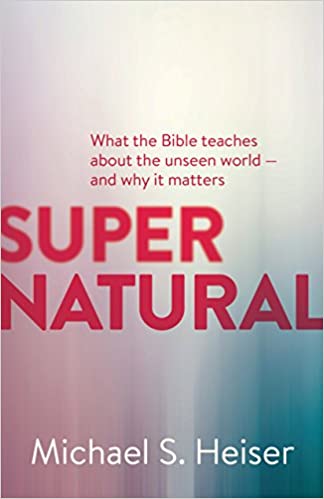
Fortunately, Michael Heiser’s more accessible version Supernatural will really help newer believers and other Bible novices comprehend his paradigm shifting argument. In other words, if you are fairly new to the Bible, get Supernatural instead, and leave the The Unseen Realm to the Bible nerds. If even that sounds too intimidating, Michael Heiser has also written a short introduction to what the story of the Bible is all about, What Does God Want?, that introduces the Gospel within the framework of his research.
Michael Heiser’s Supernatural is a “beginner’s guide” to Heiser’s thesis about the supernatural worldview of the Bible, otherwise known as the less academic version of his groundbreaking The Unseen Realm.
Seeing the Bible in a New Way Can Unsettle Older Ways of Thinking
Like any paradigm shifting work of theology published today, there are bound to be critics who will emerge to pushback on Heiser’s work. A Google search easily brings up a number of Heiser’s critics. I will just cover a few of the interesting one’s I found recently:
To varying degrees, some much more than others, each one of these critiques suffers from the same fundamental flaw. Each critique is at least somewhat nervous, or perhaps even scandalized, that Dr. Heiser seeks to ground his interpretation of these weird Scripture texts within the context of both the Ancient Near East and Second Temple Judaism. Yet this is precisely Dr. Heiser’s point, that we should best interpret the Bible within its ancient context, as opposed to depending on later traditions of thought, centuries removed from the original context, with little contact with ancient culture. The majority of Michael Heiser’s most severe critics therefore fail to appreciate the process of progressive revelation that took place among the Jewish writers and readers of Scripture, stemming hundreds of years back to the era of Moses, and on through the eve of Jesus’ public ministry (including the inter-testamental period, the so-called “Silent Years”).
Dr. Heiser is pretty adamant that we need to have the ancient Israelite “living in our head” if we ever expect to understand and interpret the Bible responsibly. Otherwise, we are simply reading “someone else’s mail,” thus imposing our own 21st century ideas on the text of Scripture, at the expense of neglecting the mindset that the ancient writers of Scripture held.
My teachers back during my years in seminary constantly hounded me for irresponsibly reading things back into the ancient texts of the Bible, and now I understand why. The original readers of the ancient Scriptural text were not able to consciously understand their Old Testament, in its fullness. Prior to the coming of Jesus, they got bits and pieces, but they lacked the full picture. It is a whole lot easier to skip that fact and try to read things back into the Old Testament, than it is to appreciate how God worked in the minds and hearts of His people over hundreds of years, to eventually disclose the mystery of the faith to Jesus’ earliest disciples in 1st century Palestine, and those like the Apostle Paul.
In other ways, Heiser likes to stand aloof from various controversies that plague the church today. For example, Dr. Heiser often states in his Naked Bible Podcast, that he “does not care” about the various eschatological systems that give us conflicting interpretations about the nature, timing and events associated with the Second Coming of Jesus. He also takes no position on the complementarian/egalitarian discussion regarding “women in ministry” dividing churches today, for pretty much the same reason. Some might find that to be a relief, whereas others might think that he is just dodging controversy. Presumably, I think that Dr. Heiser simply has no interest in trying to resolve any of the “hot-button” issues that trigger many Christians today, in the church, preferring instead to focus on his research into the Divine Council, which in my view, is a whole lot more intriguing and substantial anyway. Finally, some of the “science-fiction-like” interpretations that Heiser offers can sound a little crazy. People who get into fascinations regarding UFOs and paranormal experiences likely will be totally spellbound by Dr. Heiser’s research, whereas skeptics of those type of things might tend to be dismissive of Heiser’s ideas.
However, getting a glimpse as to how so many previously confusing passages of the Bible fit together in a coherent whole is really mind-blowing. More than any other contemporary Bible scholar, who writes for a popular audience, Michael Heiser’s detailed work in the supernatural character of the Bible, and love for verse-by-verse exposition of the Scripture, has created in me a deeper love and interest in the study of the Scriptures. The broad explanatory power of Heiser’s work that simultaneously undermines secularist skepticism about the Bible, and takes Jewish readings of the Bible more seriously, while illuminating the meaning of once difficult passages, makes an appreciation of Michael Heiser’s work both theologically stimulating and exciting. For Christians tired of shallow, thematic-based sermons in church, that dodge the more tricky parts of the Bible, and non-believers who struggle with making sense of the Bible, The Unseen Realm does an excellent job of opening up a whole new way of reading the Bible.
I have not been able to read my Bible the same way ever since.
Over the past few months, as I was writing the first draft of this book review, I learned that Dr. Heiser has been diagnosed with pancreatic cancer. An August, 2021, update showed that Dr. Heiser’s medical status was uncertain, and that he has been having trouble eating for the last few months. But as of early September, 2021, we have some good news, that the cancer growth has not spread beyond the pancreas, which means that the cancer might be treatable. Please pray for healing for Dr. Heiser. His teaching work has been a real gift for the church, for the past decade or so, helping many thousands across the world grow in their deep love for God and His Word.
Dr. Michael Heiser currently teaches at Celebration Church in Jacksonville, Florida. Here are three introductory sessions to his teachings, summarizing the basic contour of his book Supernatural, which is essentially his The Unseen Realm, without all of the footnotes.
Those interested in biblical archaeology have perked up recently, as a paper published in the scientific magazine, Nature, suggests that “A Tunguska sized airburst destroyed Tall el-Hammam a Middle Bronze Age city in the Jordan Valley near the Dead Sea.” Some archaeologists and other scholars identify Tall el-Hammam as the ancient site of the city of Sodom, where its destruction by “fire and brimstone” is recorded in Genesis 19.
The Nature paper describes evidence that shows that a large meteor, roughly the size of the Tunguska 1908 meteor strike in Russia, devastated a region on the eastern side of the Jordan River, around 1650 BCE. Research shows that melted pottery and other artifacts found at Tall el-Hammam indicates that an explosion 1000 times more intense than the Hiroshima atomic bomb, wiped out the population of the region, and even deposited a large amount of salt, making the area uninhabitable for decades.
(Credit: Nature article, September 20, 2021, in Scientific Reports)
Some Christians have concluded from this paper that we now have strong scientific evidence, demonstrating the historical accuracy of this particular episode from the Bible. However, other Christian archaeologists and scholars are not persuaded. Archaeologist Todd Bolen, for example, argues that the location of Tall el-Hammam does not line up with the standard interpretation of Genesis 18:16, which some suggest indicates that Sodom was located nearer towards the southern end of the Dead Sea, as opposed to Tall el-Hammam’s location, north of the Dead Sea.
The late Middle Bronze Age date of Sodom’s destruction, driven by archaeological considerations, must be the iron-clad standard against which the biblical chronology is ascertained.
This date demands a birth date of Abraham about 1699; since he was 175 when he died, that occurred in 1524, 76 years after the destruction of Sodom.
Isaac’s lifespan is 1599-1419 and Jacob’s 1539-1392!
Even a 215 year Egyptian sojourn must cover the years 1415-1200, requiring the Exodus to be in 1200 and the conquest, 40 years later, in 1160-1150.
The various judges and the reign of Saul must be compressed between 1150 and 1010, the established date of the commencement of David’s reign.
The only way out of the conundrum if Hammam is Sodom is to (1) disregard the biblical figures for the ages of the patriarchs; (2) jettison or greatly reduce the 215-year sojourn; and (3) minimize the length of the ministries of the judges and the reign of Saul nearly to the vanishing point.
Dr. Merrill suggests that the 1650 BCE date for Sodom’s destruction would require a chronology that fits within something like the following framework, a framework that Dr. Merrill believes does not fit within the Bible. Non-literal numbering estimates are highlighted below:
Abraham was 75 at the 1600 date of Sodom’s destruction; therefore, he was born in 1675.
Isaac was born in Abraham’s 50th year—1625.
Jacob was born in Isaac’s 30th year—1595.
Jacob moved his family to Egypt in his 60th year—1535.
The sojourn lasted for 215 years—1535-1320.
The exodus took place in 1320.
The Sinai wanderings took 20 years—1320-1300.
The conquest took 10 years–1300-1290.
The administration of the judges lasted for 250 years—1290-1040.
The most central of Dr. Collins’ arguments in favor of Sodom’s destruction near 1650 BCE, at Tall el-Hammam, is from archaeological population and tree density studies conducted in the Jordan Valley area. These studies show that the population of the Jordan Valley area was drastically reduced near the year 1650, which would coincide with the data from the Nature paper, postulating a large meteor strike, which would result in a significant and rapid population loss. However, the same research indicates that the 2067 BCE date for Sodom’s destruction proposed by Merrill does not coincide with any change in population, as the population of the Jordan Valley was already relatively low for 100-200 years prior to Merrill’s proposed date for Sodom’s destruction.
This analysis begs the question: Is a bird in the hand worth two in the bush?
Nevertheless, the debate over the timing and location of Sodom’s destruction and whereabouts has not been settled by the Nature paper. But it does lend some credence to the argument that the basic historical chronology of the Bible is still credible, in an age where skepticism is the order of the day.









 Veracity