
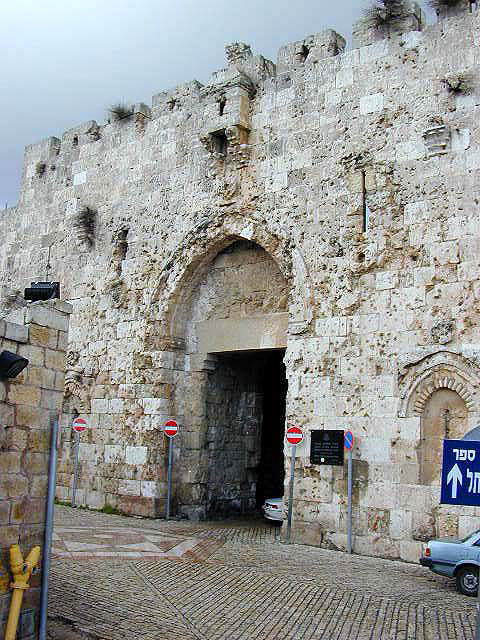
Bullet holes riddle the exterior of the Zion Gate in Jerusalem, a center of conflict during the wars of 1948 and 1967 for control of the Holy City. I visited Jerusalem in December, 1993, and the sight of these bullet holes gripped me deeply.
It has been one year since Hamas led a surprise attack against the modern state of Israel. The situation in Gaza has been desperate and dire, while daily life in Israel continues under constant threats from Yemeni Houthis, Lebanon’s Hezbollah, and Iran. The fact that the original attack came 50 years plus a day after the Yom Kippur War of 1973 was no coincidence.
Hamas’ name for the October 7, 2023 attack was “Operation Al-Aqsa Flood.” Al-Aqsa is the name of the great mosque located on the Jerusalem Temple Mount. Israeli police had been limiting the number of worshippers who visit the iconic mosque, spreading concerns about access to the mosque.
Fears of the war spreading invite Christians to consider how all of this connects with biblical prophecy. As I write this, concerns about climate change in the wake of Hurricane Helene’s devastation of western North Carolina, with yet another storm bearing down on Florida recall Luke 21:25: “And there will be signs in sun and moon and stars, and on the earth distress of nations in perplexity because of the roaring of the sea and the waves.”
So, are we nearing “The End?”
Between 2014 and 2018, I spent about two-years on and off, on a deep-dive research project to look into the whole issue of “Christian Zionism,” reflecting on a common evangelical expectation that the Bible teaches that a restoration of national Israel, within its original borders as defined in the Book of Genesis, is part of God’s prophetic plan coinciding somehow with the return of Jesus. If there was anything I learned in doing this, it was that the issue of national Israel in prophecy is exceedingly complex.
Since then, my thinking has changed in the sense that the legacy of antisemitism is worse than what I thought before embarking on this study, and that this legacy sadly extends way back into the history of the Christian church. There is inherently a “supersessionist” element in Christian theology in the New Testament, particularly in the Book of Hebrews. In some sense, the message of the Christian faith supersedes the message of traditional Judaism, from whence the Christian movement came. There is no getting around the fact that Christianity has its roots in the world of the Old Testament. The debate is over what that whole notion of “superseding” actually entails, in terms of the ramifications of that type of thinking.
I thought it might be helpful to repost the “blog post compendium” all of that research, with links to other Veracity blog posts, in order to better navigate this complicated issue which crops up almost daily on our news feeds. I originally posted this in January, 2018. I hope at least someone finds this helpful, just as I have….
————————————————————————-
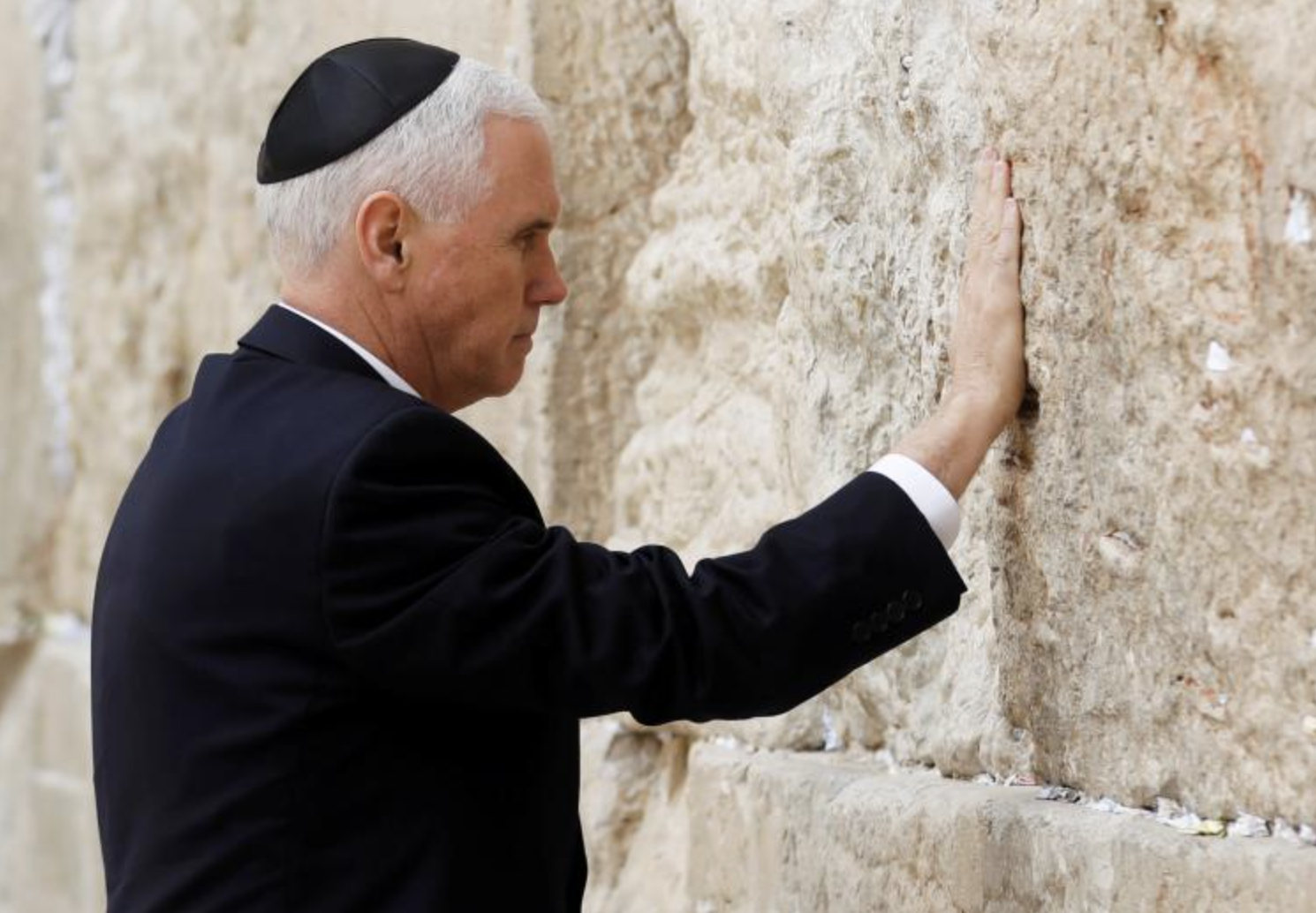
U.S. Vice President, Mike Pence, an evangelical Christian, at Jerusalem’s “Wailing Wall,” January 23, 2018. While many American Christians enthusiastically supported the visit of U.S. Vice President Mike Pence, to Jerusalem, many Middle Eastern Christian leaders refused to meet with him. Why the rebuff of the American leader, by fellow Christians? (photo credit: REUTERS, Ronen Zvulun)
U.S. President Donald Trump made news in December, 2017, by announcing that the United States would move their embassy from Tel Aviv to Jerusalem, to honor the Israeli claim that Jerusalem is truly the capital of that modern nation-state. For many Christians, when they read their Bibles, they think that this is a “no-brainer.” Jerusalem has been the center of Judaism since the days of the Old Testament. Why not now?
But a lot of other Christians, when they read their Bibles, beg to differ.
As British theologian Ian Paul writes, Theodore Herzl, the pioneer of modern Jewish Zionism, modestly envisioned Mount Carmel as the capital for a modern Jewish state, and not Jerusalem. Ben-Gurion, the first prime minister of modern Israel, was willing to accept the loss of Jerusalem as the price to be paid for having a homeland at all, for the Jews, in the Middle East.
The 1967, Six-Days War, whereby Israeli forces took control of all of Jerusalem, changed all of that.
The latest move by the United States, as many see it, is simply accepting what everyone knows is the reality behind modern day Israel. Why pretend? Jerusalem is, and should be, the capital of Israel.
Well, others are quite uncomfortable with the idea, The planned implementation of U.S. foreign policy creates concerns that this move could lead (and in a few cases, has already led) to unnecessary violence..
They call Jerusalem, the “city of peace.” Why then, is it so controversial? What does the Bible have to say about all of this?
A Compendium of Previous Veracity Blog Posts… With More to Come
In 2016, I got about halfway through a blog series on “Christian Zionism,” before I took a break. Aside from the “science vs. the Bible” issue, this has been the most fascinating and complex issue I have ever written about here on the Veracity blog. It involves all sorts of topics, including the relationship between the Old Testament and the New Testament, dispensationalism vs. covenant theology, and the “End Times.” All of that serves as a mere backdrop to the pressing geopolitical concerns in the Middle East.
The status of Jerusalem is just one piece in a much larger puzzle. In a nutshell, “Christian Zionism” is at the root, and it involves one primary question: Is God now restoring, or will God in the future restore, the land of Israel to the Jewish people, to the original borders as described in the Old Testament, extending from the border with Egypt, to the Euphrates River in central Iraq, hundreds of miles away, with Jerusalem as its capital?

Is the secular nation state of Israel a fulfillment of Bible prophecy? Veracity tackles a “hot potato.”
Christians are divided on this issue. So, it takes some effort studying the Bible, and in current events and history, to try to sort all of this out… and learning to listen to one another. Throughout the coming year, I plan to publish the remaining half of the drafted blog posts that address “Christian Zionism,” in order to resume that conversation.
But before doing that, I am compiling here a compendium of previous blog posts, that you can review, if you are new to the series. Some posts are introductory in nature, some are interesting rabbit trails I went on, and others constitute the main flow of the story; that is, my story as to how I am trying to get a handle on this most difficult issue.
One thing is for certain: the topic of “Jerusalem,” or “Israel,” in general, is not simply about some far away place off in the Middle East. What we think about “Jerusalem” tells us a lot about what it means to be a “Christian.” As philosopher Richard Weaver once said, “Ideas have consequences.” So, the ideas presented here will make you think, and they will have an impact on how you live your life as a Christian, whether you realize it or not, whether you agree or disagree with certain ideas presented for discussion:
Introductory:
- Christian Passion About Israel: Can We Talk?: What is the controversy all about? Two movies tell very different sides of the story.
- Replacing Replacement Theology?: What is “replacement theology,” and why do people even care?
- Revelation…(And the Rapture Reboot): How to interpret the Book of Revelation.
- Who is a “True” Jew?: That is a really important question!
- Four Views on the Land Promise: A Zionism Cheat Sheet. How different Christians view the status of God’s covenant with Abraham and his descendants.
The Zionism Series (The First Half!):
- What is “Christian Zionism?”
- The Parting of the Ways: A look at how Jews and Christians became divided, during the early history of the Christian movement.
- Luther’s Deadly Error: How antisemitism became a horrid stain on church history, and why we should continue to remember the “Holocaust” that killed 6 millions Jews. 500 years have passed since Martin Luther’s nailing of his Ninety-Five Theses. But many wish to bury Luther, due to his virulent anti-Jewish polemic.
- Theodor Herzel’s Quest: The story of how hatred against the Jews led to the search for a permanent Jewish homeland.
- Dueling Narratives: Many Jews claimed modern day Palestine as their homeland…. but so did Palestinian Arabs.
- The Holy Land Today?: The crisis between Jews and Arabs in the Middle East today.
- Forgotten Christians: The lost story of those Christians caught in the crossfire between Jews and Arab Muslims.
- The Promise of the Land in the Old Testament: The Abrahamic covenant in the Old Testament.
- The Promise of the Land in the New Testament.
- Why Proof Texting Has its Limitations: Christians disagree about the future for national, ethnic Israel.
Romans 9-11: The most important passage in the New Testament relevant to this topic.
- VIDEO: Romans 9-11 Panel Discussion Night One: First night of a two week pastors’ panel at our church.
- VIDEO: Romans 9-11 Panel Discussion Night Two: The second night of the panel.
- Who is the “All Israel” in Romans 11?: My take on how to interpret Romans 9-11, broadly, and how we can avoid extreme views concerning “Israel,” on both sides of the discussion.
- Questions about Romans 9-11: A resource list for further study.
Rabbit Trails:
- When is a Gentile Not a Gentile (or Pagan or Heathen)?: What does it mean to be a “Gentile?”
- What is the “Church?” #1: Is the New Testament church something completely different from the “Israel” of the Old Testament?
- What is the “Church?” #2: More on the relationship between Israel and the church.
- Is the European Union the Beast of Revelation?
- God Dwells Among Us. A review of G. K. Beale’s and Mitchell Kim’s book on the theme of Jerusalem’s temple woven throughout all of the Bible. G. K. Beale has written one of most well-respected commentaries on the Book of Revelation.
- When a Jew Rules the World: Joel Richardson’s Defense of Israel, An Extended Review. Joel Richardson is probably the leading spokesperson for the idea that the future Antichrist will rise from the Islamic world, and not from a “revived” Roman Empire, as many Christians believed in the 20th century. I read his book that defended a future for national, ethnic Israel.
- Augustine and the Jews, by Paula Fredriksen: Book Review. A very scholarly book, but incredibly informing, as she digs into the much of the history as to why Christians have had such a conflicted history in their dealings with the Jews. In this post, I also include a mini-book-review of Barry Horner’s Future Israel: Why Christian Anti-Judaism Must Be Challenged.
- Does the Prophet Amos Predict a Literal Rebuilding of the Temple? Many Christians believe that towards a future millennial reign of Christ, in Israel, the Temple in Jerusalem will be rebuilt. Does the prophet Amos make such a prediction for a still yet future event, or for an event that has already been fulfilled in the past, or something altogether different?
- Are the “Kingdom of Heaven” and the “Kingdom of God” Different? Matthew is the Gospel that uses the phrase “Kingdom of Heaven” to describe the “Kingdom” that Jesus preached. A popular 20th century theory suggests that the “Kingdom of Heaven” is really a specific reference to the future literal fulfillment of the Abrahamic land promise, with the capital of Israel in Jerusalem. So, why do most scholars today reject this idea, even those sympathetic to Christian Zionism?
- The difference between dispensationalism and covenant theology, in 8 minutes.
- Many older dispensationalists favor the King James Version of the Bible’s rendering of 2 Timothy 2:15. But is this really the best translation? Are We Charged to “Rightly Divide” or “Rightly Handle” The Word of Truth?
UPDATED October 2018:
Here is the second half of the blog posts series, posted September through October, 2018:
- A Dispensationalist Perspective on Zionism: How a theological movement in Britain the 19th century changed the course of evangelical thought regarding Israel.
- A Covenant Theology Perspective on Zionism: The traditional Christian perspective on Israel, throughout the bulk of church history.
- Has the Church Replaced Israel?: Why talk about “replacement theology” can become so unsettling.
- The Shifting Theological Landscape Regarding the Land: Why the old debate between “dispensationalism” and “covenant theology” does not adequately explain what evangelical Christians think about the land of Israel today.
- Fulfillment Timeframe… 1948, Past or Future?: What does it mean to say that the existence of the modern nation-state of Israel might be a fulfillment of Bible prophecy, and does the question even make any sense?
- One More Time with Martin Luther… and Vampires: Some quirky thoughts on how Martin Luther might be surprised today, at what has happened with the Jewish people, and why this surprise impacted the life of popular vampire novel writer, Anne Rice.
- Tentative Conclusion: This blogger’s attempt to draw something together, as to how Christians might think about the “land of Israel.”
- A Parable: Cheeseburgers, filet mignon, and how the restoration of the “land of Israel” might help us to think more deeply about the promises of God.




 Veracity
What do you think?