Monthly Archives: August 2016

Announcement: Romans 9-11 Panel Discussion!

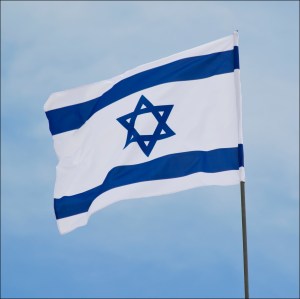
Is the secular nation state of Israel a fulfillment of Bible prophecy? Veracity tackles a "hot potato."

Is there a future for ethnic, national Israel?

If you are in the Williamsburg, Virginia area next Sunday night (August 28) and the following Sunday night (September 4), I invite you to attend a panel discussion on Romans 9-11 sponsored by the Williamsburg Community Chapel and the folks here at the Veracity blog.

I have been living in Romans 9-11 for over a year now, and it has been a challenging study. Questions about predestination and human free will are addressed by the Apostle Paul in these chapters, but the central and most intriguing theme concerns God’s plans and purposes for Israel.

Is there a future for ethnic, national Israel? Or should we think of the church, Jewish and Gentile believers together, as the spiritualized, contemporary embodiment of true Israel today?

Come and hear our panelists, all pastors at the Williamsburg Community Chapel, discuss this important topic: Hunter Ruch, Doug Bunn, Rich Sylvester, Wes White and Claude Marshall. I will serve as the moderator for our discussion.

  • Williamsburg Community Chapel, 3899 John Tyler Highway, Williamsburg, VA 23185
  • Student Ministries Worship Room
  • Sundays, August 28 and September 4, 6:30 – 8:00 pm

The Promise of the Land in the Old Testament: Zionism #8

Is the secular nation state of Israel a fulfillment of Bible prophecy? Veracity tackles a "hot potato."

Israel, the land, in the Old Testament.

Picking up from where we left off a few weeks ago….

When we read the Old Testament, it becomes quite clear that the ancient Jewish people, Israel, were given a promise of a homeland. An early figure in the Bible, Abram (or Abraham), was unilaterally called by God to leave his former home, back when he was still a moon worshipper, to settle in this patch of real estate in the Middle East, where he could worship the one true God. This God would give Abraham and his descendants a claim to this land.

Now the Lord said to Abram, “Go from your country and your kindred and your father’s house to the land that I will show you. And I will make of you a great nation, and I will bless you and make your name great, so that you will be a blessing. I will bless those who bless you, and him who dishonors you I will curse, and in you all the families of the earth shall be blessed.” (Genesis 12:1-3 ESV)

And he brought him outside and said, “Look toward heaven, and number the stars, if you are able to number them.” Then he said to him, “So shall your offspring be.” And he believed the Lord, and he counted it to him as righteousness. And he said to him, “I am the Lord who brought you out from Ur of the Chaldeans to give you this land to possess.” (Genesis 15:5-7 ESV)

Not only that, but many understand this claim to the land to be permanent:

And I will establish my covenant between me and you and your offspring after you throughout their generations for an everlasting covenant, to be God to you and to your offspring after you. And I will give to you and to your offspring after you the land of your sojournings, all the land of Canaan, for an everlasting possession, and I will be their God. (Genesis 17:7-8 ESV)

Some say that Joshua’s conquest of the land of Canaan fulfilled the promise in this covenant (Joshua 21:43-45). Throughout history, and to this day, there have always existed at least some Israelites who have inhabited the land.

Others say that Joshua’s conquest of Canaan only partially fulfilled the land promise. But however one understands the outcome of Joshua’s conquest, the unconditional character of the land promise stands out. However, the ability for Israel to actually stay in the land, paradoxically, did have conditions placed on it. This paradox has puzzled readers of the Bible for centuries.1
Continue reading


William and Mary, Confederate Memory, Faith, and the Power of Symbols

Behold, I am sending you out as sheep in the midst of wolves, so be wise as serpents and innocent as doves (Matthew 10:16 ESV)

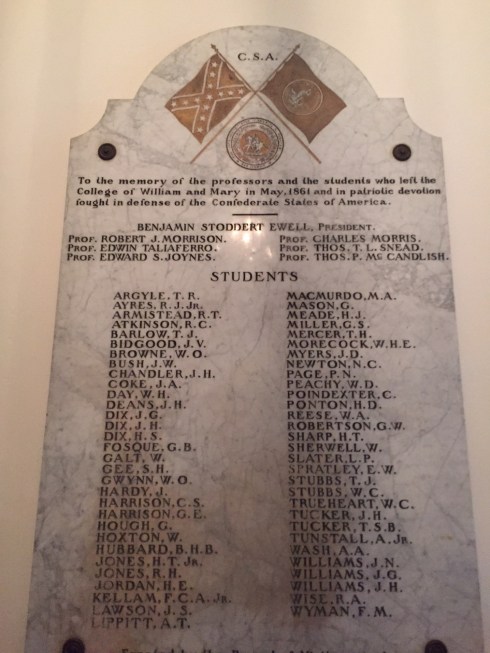
The College of William and Mary will replace a plaque commemorating Confederate soldiers, formerly on display at the Wren Building, with a new plaque remembered W&M students who fought on both sides of the Civil War.

The College of William and Mary will replace a plaque commemorating Confederate soldiers, formerly on display at the Wren Building, with a new plaque remembering W&M students and faculty who fought on both sides of the Civil War.

W. Taylor Reveley III, president of the College of William and Mary, announced recently, that a plaque remembering Confederate soldiers who fought in the Civil War, and Confederate emblems on the school’s mace, will be removed, placed in the school’s library, and replaced by a new plaque and emblems, respectively. For a full FAQ on what the school has done, read the official press release and FAQ.

If you visit various news websites, you will find a number of heated discussions in the comments sections, ranging from why the Civil War was fought (was it about slavery or states rights?) to our American racist past (are we burying our history, or are we moving on from a terrible blot on our past?). I know that many people find history “boring,” which is something I do not understand. The importance of history is bound up in how we are to remember the past, informing how we understand the power of symbols, in how we live day to day today, as well as the type of values we carry with us into the future.

I do not want to focus on these historical debates here, but I do want to back up a bit and address a general theme as a Christian: symbols matter to people, their meanings change, and these symbols do not always mean the same thing to everyone. Continue reading


What is the “Church?” #2

What is a the "church?"

What is a the “church?”

As we discussed in the previous post in this series, the original word for church, the Greek ekklesia, had a secular meaning in first century, Mediterranean society. This sense of an “assembly” or “congregation” of people was given a more theological meaning by the writers of the Bible. But what did that mean?

Many people today assume that the church is essentially the New Testament description of the people of God, which is made of both Jews and Gentiles who worship Jesus. This is often set in contrast with the nation of Israel, which is the Old Testament people of God, who kept the Law of Moses. Others say that there has always been but one people of God, whereby Old Testament Israel was simply an early form of the one church. But a closer look at how the Bible uses ekklesia shows that such assumptions are rather complicated.

For example, while there are numerous examples of the church (Greek, ekklesia) in the New Testament (such as in Romans 16), as Jews and Gentiles worshipping Jesus together, there are exceptions. The first famous martyr of the Christian movement, Stephen, describes the gathering of the Israelites in the wilderness centuries earlier under Moses, as being “in the church in the wilderness,” as Acts 7:38 puts it in the King James Version (KJV). There were clearly no Gentiles in that church!

Again with the KJV, the New Testament writer of Hebrews says that Jesus will sing praise to God in Hebrews 2:12, recalling an Old Testament passage, Psalm 22:22:

in the midst of the church will I sing praise unto thee

The writer of Hebrews has in mind a description of Jews and Gentiles together, as the church. But in a slightly different way, going back to Psalm 22:22 itself, the same word ekklesia, from the first Greek translation of the Bible, namely, the Septuagint, is handled by the KJV differently to describe the worship of the Israelite community, despite it being the same word! No Gentiles here!

in the midst of the congregation will I praise thee

Also in the Old Testament, the Greek ekklesia, from the Septuagint translation, can be found to describe the gathering of the Israelite people to come and hear the Lord, in Deuteronomy 4:10. Notice that the KJV translation does not use the English word church, but the Greek ekklesia is the same, though in the verbal form of “gather”:

Specially the day that thou stoodest before the LORD thy God in Horeb, when the LORD said unto me, Gather me the people together, and I will make them hear my words, that they may learn to fear me all the days that they shall live upon the earth, and that they may teach their children.

So, is the ekklesia, or the church, strictly a New Testament concept, or both a New Testament and an Old Testament concept?

This trouble, with the word for church, has been the center of a debate for several centuries as to the relationship between Israel, the Old Testament people of God, and the church as the New Testament people of God, where the barrier between Jew and Gentile has been broken down (Ephesians 2:11-21). While it is difficult to establish such a distinction based on the literal interpretation of the words alone, there are two different schools of thought as to how we are to understand these theological concepts of the people of God in both Old and New Testaments:

  • The dispensationalist school favors the idea that the nation of Israel and the New Testament community of Jews and Gentiles together worshipping Jesus, represent two different theological concepts. Some in this school put it like this: the ekklesia of the Israelite community is mainly ethnic in character, being the descendants of Abraham, but also bound together by the Law of Moses. In contrast, the ekklesia of the New Testament community is bound together only by faith in Christ, both Jew and Gentile together.
  • The covenant theology, or covenantalist, school favors the idea that there is a progressive development of the one people of God in the Bible. The Old Testament introduces us to the people of God embodied in the ethnic community of Israel, Abraham and his descendants. But when we get to the New Testament, Jesus the Messiah fulfills the purposes of Israel, which leads then to the ultimate expression of the people of God through the ekklesia, rooted in faith, made up of Jew and Gentile. Israel was therefore also an ekklesia, foreshadowing the new ekklesia that was to come.

The debate is a crucial discussion as to how we as Christians are to understand the message of the Bible as a whole. There is a sense that both sides have something important to contribute.

Dispensationalists are concerned to honor the Biblical principle that God has set apart, or elected, the Jewish people, Israel, for a particular purpose, for the benefit of the whole world. This particular purpose for Israel, even to this day, is associated with a set of promises, that are not to be nullified or revoked by the arrival of the New Testament people of God, as Jew and Gentile together.

Covenantalists are concerned to honor the Biblical principle of the oneness of the people of God, whose purpose should not be obscured by ethnic considerations that would otherwise distract us from that fundamental, universal unity. Therefore, Israel, as founded in the Old Testament, finds its fulfillment through the establishment of the New Testament people of God, including both Jew and Gentile, united together by faith in Jesus Christ.

The debate can not be resolved here in this blog post, but an understanding of what church means in the Bible helps us to better appreciate the differences between these two schools of thought among Christians.


What is the “Church?” #1

What is a the "church?"

What is a the “church?”

When you think of the word “church,” what springs to mind?

The first thing that pops into my mind is a building, a physical meeting place where Christians gather for worship.  You know, some place with a cross on the outside, a steeple on top, surrounded by a black asphalt parking lot, and with lousy coffee inside, right? But a closer look at the Bible and the history or our word church reveals a different story.

The word church actually has a Germanic root to it, etymologically. It stems back to the German kirche, which probably goes back to the related Greek word kyriakon, which means “of the Lord.” In Germanic based cultures, the “house of the Lord,” where Christians gather for worship, began to acquire the meaning of the word kirche, which reasonably explains why we often think of a church as a building. However, the original usage of church in the Bible has a more specific meaning.

The original Greek word for church is “ekklesia.”  In ancient Greek, prior to the writing of the New Testament, ekklesia had essentially a secular meaning, that of an “assembly,” or specifically “a gathering of people called out of their homes into a some public place.” In the New Testament sense, the ekklesia is the assembly of people who come to worship Jesus. The emphasis is on the community of the people, and not where those people meet. For example, the Apostle Paul uses the term ekklesia, or church, several times in the last chapter of the Book of Romans, to refer to a community or communities of his believing friends in different localities.

By the time we get to the late medieval period in Western Europe, the word church had taken on a more formal meaning. The church was not merely an assembly, but rather it was an institution, namely the church as an organized social structure.

When William Tyndale took upon the task of translating the Bible into English during the 16th century, he rattled people in the church institutional establishment by translating the word ekklesia into the English word congregation, such as in his rendering of Romans 16. The word congregation retains more of the local, “assembly” meaning of the term, and this upset those who were more concerned about maintaining the church as a national or global institution. For example, some years after Tyndale’s death, the legendary King James Version of the Bible was translated, guided indirectly by the King himself. The King sought to make sure that this translation was sympathetic towards the Church of England, for which he was the official head. So, for the word ekklesia in the New Testament, the translators opted for the word church, never using Tyndale’s congregation (see the KJV relevant verses in Romans 16).

In contrast, the 17th century Quakers took the more literal approach to ekklesia and adopted the word meetings to describe their decentralized church structure, much to the chagrin of those who saw the church as having a more hierarchical structure. Who would have thought that such a single Greek word, ekklesia, would cause such controversies!!

Modern Bible translations are less beholden to the concerns of monarchs in the 17th century. But neither do they always stay away from the word church. Broadly speaking, the church in the Bible can mean both a local assembly of believers, as well as the universal community of all Christian believers across the globe, and down through the centuries. The specific meaning of church depends on the context of where it is found in the Bible. A good example of church in the universal sense can be found in Ephesians 5:25-30, which speaks of Christ’s love for the ekklesia, or the church body as a whole.

Nevertheless, new concerns about the meaning of church provoke lively discussions among Christians today, as we shall see in our next post.