Tag Archives: veracity

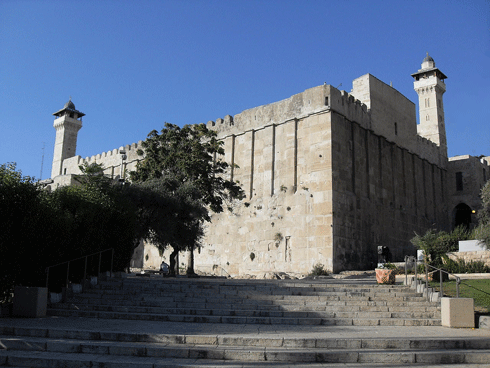
Cave of the Patriarchs

Cave of the Patriarchs

Cave of the Patriarchs, Hebron, Israel

“Then Abraham breathed his last and died at a good old age, an old man and full of years; and he was gathered to his people. His sons Isaac and Ishmael buried him in the cave of Machpelah near Mamre, in the field of Ephron son of Zohar the Hittite, the field Abraham had bought from the Hittites. There Abraham was buried with his wife Sarah.”
Genesis 25:8-10, NIV

There are so many strange names and places in the Bible it’s easy to just keep reading without digging into the details.  But the details contain evidence for the historicity of the Scriptures, even if we don’t appreciate them.  Just because we’re dealing with “long ago and far away” doesn’t mean we’re reading fairy tales.

For all their pratfalls and controversies, archaeology and history have a lot to offer in terms of making sense of obscure names and places.  Take the “cave of Machpelah near Mamre” in Genesis 25 for instance.  It turns out that this cave is a well-known place, also known as the “Cave of the Patriarchs.”  The cave is memorialized in Judaism underneath the only fully surviving Herodian structure from the first century.  According to the biblical accounts in Genesis, Abraham, Isaac, Jacob, Sarah, Rebecca, and Leah—the Patriarchs and Matriarchs of the Jewish people—were all buried in this cave.  We are also told in Genesis 23 that Abraham paid Ephron the Hittite 400 Shekels of silver for the cave, the field, and all the trees in the field.  Pretty detailed information. Continue reading

The Dalai Lama is Coming!

I play soccer with a group of friends at the College of William and Mary, where I work as an IT staff person.  At the end of one of our games, we were talking about the upcoming visit by the Dalai Lama to speak at William and Mary Hall, on Wednesday, October 10.   There were several jokes about strange Eastern religious customs and how hot it would be to wear a monk robe all day long.  One made a sly remark about attaining “enlightenment” from the marijuana fumes rising up from the crowded Kaplan Arena this coming Wednesday from smuggled-in contraband.   This is a big deal event for the College, with several thousand tickets sold out within minutes to hear the venerable representative of international Buddhism.  So what is the big deal about the Dalai Lama?

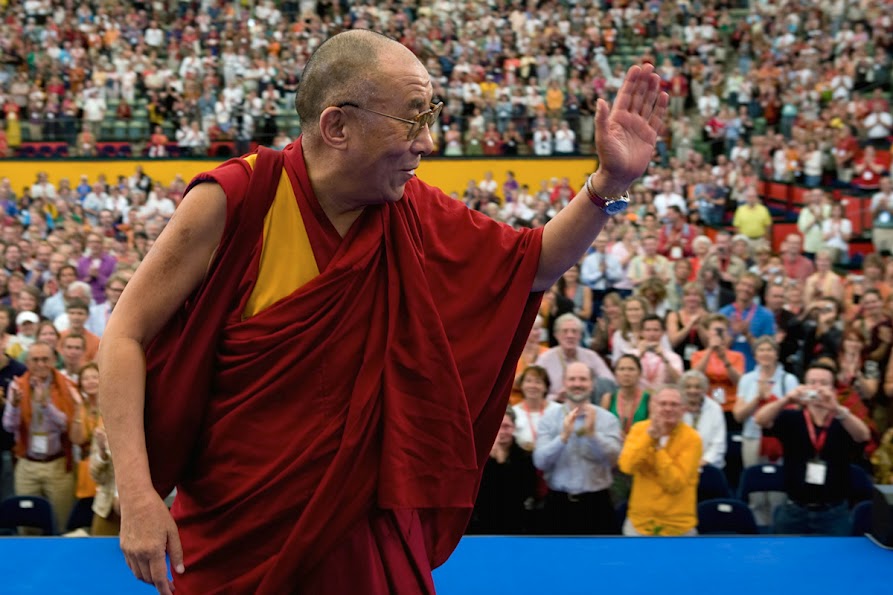
Image

The 14th Dalai Lama

Actually, Tenzin Gyatso is the 14th reincarnation of the Dalai Lama, according to Tibetan Buddhist tradition.   For hundreds of years, an unbroken line of spiritual teachers in Tibet have instructed the Buddhist faithful.  But the Dalai Lama is more than a religious leader position, it is also a  political role, unifying all of the Tibetan region north of the Himalayan mountains in Asia.  So when Communist China invaded Tibet in 1950, it put the current Dalai Lama into a difficult situation.   After a failed uprising against the Chinese in 1959, the 14th Dalai Lama fled and established a government in exile in India.  The United States government has at times given support to the Dalai Lama’s efforts on behalf of the Tibetan people during the past fifty years.

Over those years, the exiled Dalai Lama has served as an international ambassador  in the West for Buddhism.  There are Four Noble Truths of Buddhism:  (1) all of life is suffering, (2) all human desire leads to suffering, (3) the annihilation of desire releases us from suffering, which is enlightenment, and (4) there is an Eightfold path  to that enlightenment; that is, right view, right intention, right speech, right action, right livelihood, right effort, right mindfulness, and right concentration.  Buddhism, however, is not a monolithic movement.   The Dalai Lama represents part of the  Mahāyāna tradition.  But the most popular form of Buddhism in the West is a more concentrated variant, Zen Buddhism, first propagated largely by the famous Japanese philosopher,  D. T. Suzuki, in the early to mid-20th century.  Oddly enough, Buddhism is considered by many to be a “religion” but the more philosophical traditions are  technically atheistic.   Even so, there are syncretic flavors that combine animistic beliefs with traditional Buddhist philosophy.    The study of Buddhism can get very complicated very quickly. Continue reading


Who Is Jesus?

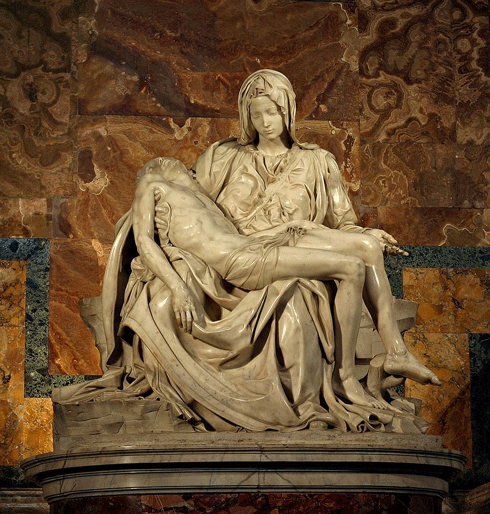
Michelangelo's Pietà

Pietà by Michelangelo, 1499

Who is Jesus?  Wow, talk about a profoundly important question!

There are a lot more people who “believe in Jesus” than there are those who know what Jesus actually claimed about himself.  Many think he was a great moral teacher, a prophet, or a wise Rabbi.  Some think a legend, a myth, or a contrivance.  Still others that he was one of many gods, or one of many roads to God.  That Jesus straightforwardly and clearly attacked these notions is of little consequence to those who will not invest the time to read the Gospels and weigh the evidence for his claims.

Jesus had to fulfill hundreds of Old Testament prophecies written centuries before he appeared on earth, and live within the Mosaic law of the Torah.  He had to submit to the cruelest punishment mankind could dish out, and to top it all off he had to rise from the dead.  No small feat.  When you think about it, he had to color between some extremely tight lines.  Lee Strobel calls this framework the “unmistakable fingerprint of the Christ.”  Only Jesus was man enough for the job—that was the whole point. Continue reading


Unreasonable Doubt

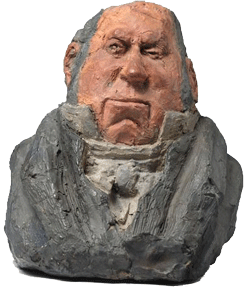
Felix Barthe (1796-1863), Minister of Justice and Deputy by Honore Daumier, 1833

Some people will not allow themselves to be convinced by evidence. I touched upon this topic recently in a post entitled Judge for Yourself, that illustrates the need to explore the standard of proof we each demand, the need to check our biases, and our ability to weigh evidence.

Lee Strobel took the approach that he was willing to follow the evidence for a Creator whether it led him to an uncomfortable conclusion or not.  Unfortunately, many atheists lack this kind of integrity.

Ironically, there are scientists who investigate the facts behind the Big Bang, the DNA molecule, the fine tuning of the universe, cellular machines, and many other physical phenomena and draw the conclusion that the data clearly indicates intelligent design. Yet some of them can’t call the designer ‘God’.  Really?

However…before we throw any rocks at scientists for not having the integrity to counter their professional biases, shouldn’t we revisit our own biases—professional and otherwise?

As Ken Petzinger points out, how we approach theism determines a lot about our lives, and how we interact with the world. Here’s a thought-provoking, on-topic article entitled Unreasonable Doubt, that Mary Petzinger wanted to share. The article (by Jim Spiegel writing in  Christianity Today, January 2011) calls intractable skepticism into the light of day.  The byline reads “The reasons for unbelief are more complex than many atheists let on.” To read the article, click here.

Enjoy!

HT: Mary Petzinger


Does God Exist?

Believe it or not, formal debates on the existence of God regularly turn out thousands of ticket-buying intellectuals to hear atheists and theists go at it. Although it may seem silly to give out medals for something every kindergartener should know, there is much to appreciate in well-turned arguments that support the affirmative.

Setting personal style biases aside, how do the best theists make their case for the existence of God? For a sampling of how heady this question can get, check out William Lane Craig, Research Professor of Philosophy at Talbot School of Theology. Sam Harris, one of today’s most prominent atheists, recently described Dr. Craig as “the one Christian apologist who seems to have put the fear of God into many of my fellow atheists.” Continue reading