Tag Archives: veracity

Have a Merry Mithras!?

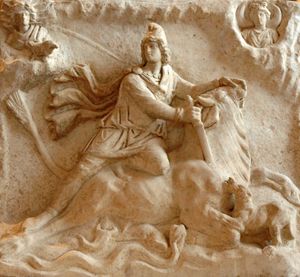
Roman bas relief from 2nd or 3rd century depicting Mithras, a central figure of the "Mystery Religions" of the early Christian era, killing a bull.

Roman bas relief from 2nd or 3rd century depicting Mithras, one of the gods of the “Mystery Religions” of the early Christian era, killing a bull.

Who was born on December 25th? Born of a virgin in a stable with shepherds present? Who had twelve disciples? Who was killed and buried in a tomb, and then rose up three days later after his death? Students of the Bible might think the answer is obvious. Not so, according to a popular movement known as “mythicism”. For the “mythicists” this original ancient figure is Mithras, a Persian god. Christianity is really just a copycat faith of Mithraism. Should we be wishing one another a “Merry Mithras” instead during the Christmas season?
Continue reading


Who Created God?

Who created God?  Good question. Atheists fall on their backside thinking this one through.  It’s all in how deeply we can think—specifically being able to think outside the box of our own worldly experiences.  Here…if you’re still wondering, I’ll save you a headache the next time someone asks you—God is transcendent.

Here’s a short video by Oxford mathematician and Christian apologist John Lennox that shows why you might not want to mess with someone who’s wise—particularly when he is wearing a grin.

John Lennox is a delightful, gentlemanly, brilliant and crafty defender of the faith.  He gives atheists fits with his use of logic and his calm, unflappable, charitable demeanor.   In 1962 he attended the last lectures of C.S. Lewis, to whom he is now sometimes compared.  Dr. Lennox can hold his own, and give as good as he gets. Continue reading


It’s the End of the World?

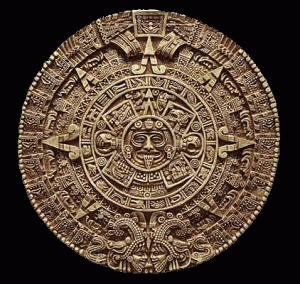
Descendants of the Mayan people were first evangelized by Spanish missionaries in the 16th century.   Once a great civilization prior to the arrival of the Spanish, the collapse of the Maya remains an enigma to anthropologists.... which partly explains the fanciful theorizing regarding the Mayan calendar among New Age movement enthusiasts.

Once a great civilization centuries before the arrival of the Spanish in the 16th century, the collapse of the Maya remains an enigma to anthropologists. The “Mayan mystery” partly explains the contemporary fascination with and speculation about their ancient calendar system.

Head for the hills, folks! THE END IS NEAR! The Georgia rock band, R.E.M., wrote “It’s the End of the World as We Know it (And I Feel Fine)” in 1988. Whenever I hear threats of impending apocalypse, I always hum that song. But seriously, should a Christian be concerned when we hear doomsday talk?

At the time of this blog posting, the fascination has been with the end of the Mayan calendar on December 21, 2012. Much has been made of potential cataclysm on this date, but the fact is that it really is not a big deal. On that date, the Mesoamerican Long Count calendar will need to flip over to the next b’ak’tun, according to Mayan mythology. Anthropologists who study Mayan culture contend that linking the idea of universal catastrophe with the end of the Mesoamerican Long Count calendar is simply speculation, having absolutely zero correspondence to historical Mayan thought. However, this does not dissuade popular New Age theorists from “cashing-in” on all of the fuss.
Continue reading


Your Move

Chess

How are you doing with your decision-making?

I have a long daily commute, with lots of time to fill running the Interstates of eastern Virginia.  Four months ago Veracity’s bass player, Clarke Morledge, got me into podcatching, and life hasn’t been the same since.  It’s definitely getting to me—there have been several times lately when I’ve been happy to be stuck in traffic.  Really.  I plug my iPhone into the car stereo and dive into a world of wonder, mentally shielded from the wacky races occurring all around me.  On-demand theology, philosophy, apologetics, interviews, sermons, and some of the world’s finest teaching.

If you need a how-to primer, check out our previous post on Podcasts & Podcatching, and give your spiritual life a real booster shot.  Try it, really.  If you want some great sources of Podcasts, check out Veracity’s Top 10 Scorers.

So What’s the Point of This Post?

OK, now that we have the mechanics out of the way, let’s get to the content.  One of my favorite (free) podcast subscriptions is Andy Stanley’s Your Move. Continue reading


Personal Discipleship

The Life Line

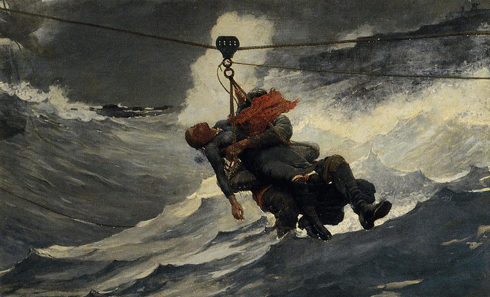
The Life Line by Winslow Homer, 1884

Personal discipleship has been a lifeline for me between what had become a comfortable and complacent Christian experience, and one that became vibrant, exciting, and very real.

If you search for “personal discipleship” on the Internet, you’ll find a variety of  not-very-standardized definitions.  So up front, here’s my homegrown definition: personal discipleship is the process in which a believer or seeker takes personal responsibility for investigating the claims and content of the Bible.

While we all appreciate hearing a well-turned sermon in a moving worship service, sitting in a pew is a passive experience.  None of us would get very far academically if all we ever did was attend lectures.  We have to read, study, work some problems through, write, engage others in discussion, apply ourselves, and prepare to be tested.  And so it is with our faith.

Kierkegaard argued that Christians should take the initiative to work out our own relationship to God.[1]  But this wasn’t Kierkegaard’s original idea, it came from the Apostle Paul.

“Therefore, my beloved, as you have always obeyed, so now, not only as in my presence but much more in my absence, work out your own salvation with fear and trembling, for it is God who works in you, both to will and to work for his good pleasure. Do all things without grumbling or questioning,”
Philippians 2:12-14 (ESV)

Here the more literal ESV translation of the text leads to great doctrine.  This is not the Talmud instructing students to “Find thyself a teacher.”  It’s the author of half the New Testament telling disciples to work out our own salvation with fear and trembling.  Not to make up our ideas of God, but to reverently and humbly work on our relationship with him.  Not to have anyone do the work for us, but to do it ourselves. Continue reading