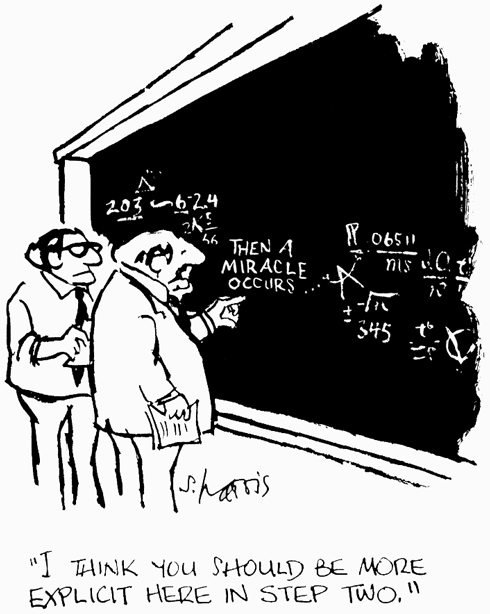
The Bible is full of miracles, from Genesis to Revelation. From the parting of the Red Sea, to the raising of Lazarus, to Jesus’ resurrection—there’s no shortage of the spectacular recorded in the Scriptures. Regardless of our perspective and biases, we have to process the testimony of miracles.
Truth be told, most of us tend to be spiritual Missourians when it comes to the supernatural. We may have no qualms about praying for God to grant a miracle, but when someone actually claims to have experienced one we get edgy and uncomfortable. Continue reading
Yesterday, at our worship service for Easter, we played a modern rendition of the classic hymn, Now the Green Blade Riseth. With lyrics written by an Anglican clergyman, John Macleod Campbell Crum, in 1928, it is based on an old French Christmas Carol tune and 15th century melody, Noël Nouvelet.
Now the green blade rises from the buried grain, Wheat that in the dark earth many years has lain; Love lives again, that with the dead has been: Love is come again, like wheat that springs up green.
In the grave they laid Him, Love Whom we had slain, Thinking that He’d never wake to life again, Laid in the earth like grain that sleeps unseen: Love is come again, like wheat that springs up green.
Up He sprang at Easter, like the risen grain, He that for three days in the grave had lain; Up from the dead my risen Lord is seen: Love is come again, like wheat that springs up green.
When our hearts are saddened, grieving or in pain, By Your touch You call us back to life again; Fields of our hearts that dead and bare have been: Love is come again, like wheat that springs up green.
When engaging with those who are skeptical about the truth of the Christian faith, it all comes down to whether or not the story expressed in this hymn is a real event in history, fantastic wishful thinking, or a really bad April Fools joke. I’ll go with the first option.
For a more traditional version of this hymn, enjoy this by the Choir of Ely Cathedral:
God took Enoch (Genesis 5:24). From Figures de la Bible, Gerald Hoet and others, 1728.
Jude is one of those obscure little books. Just one page in most Bibles. Whenever I glance at it, I want to sing with the Beatles, “Na na na, na-na na na. Na-na na na, hey Jude!” Often overlooked, the Letter of Jude references a critical key to help unlock the mystery of Jesus as the Son of Man.
The odd key is found in verses 14-15:
It was also about these that Enoch, the seventh from Adam, prophesied, saying, “Behold, the Lord comes with ten thousands of his holy ones, to execute judgment on all and to convict all the ungodly of all their deeds of ungodliness that they have committed in such an ungodly way, and of all the harsh things that ungodly sinners have spoken against him (Jude 1:14-15 ESV).
The funny thing about this is that you will search your Bible in vain for this prophesy from Enoch. Enoch is only mentioned a handful of times in the whole Bible, such as in Genesis 5:24:
Enoch walked faithfully with God; then he was no more, because God took him away.(Genesis 5:24 ESV)
Pretty brief. Pretty curious, too. Pretty much leaves a lot open to the imagination. So, what is up with this Enoch, who just disappears, and what does he have to do with Jesus as the Son of Man? Continue reading
“This is my Body… This is my Blood.” Matthew 26:26-28. Literal or symbolic interpretation?
Zwingli, with tears in his eyes, extended the hand of fellowship, but Martin Luther steadfastly refused: “Yours is a different spirit from ours“. Luther walked out. The split was final. The unity of the Protestant Reformation movement was in tatters.
Marburg, Germany. 1529. Martin Luther’s attempt to reform the Roman Catholic church and restore confidence in the Bible “alone” was in full swing. Years earlier, he had nailed his famous 95 theses to the Wittenburg church door, protesting abuses within the church. Four hundred miles away, in Zurich, Switzerland, a young renegade priest, Huldrich Zwingli, was beginning to do the same thing Luther had started in Germany. Both Luther and Zwingli felt that the Church of Rome had lost its way. Christianity needed to return to the Holy Scriptures as the pure, unadulterated Word of God. The medieval church had allowed man’s traditions to creep in and compromise the truth of the Gospel. Luther and Zwingli were hoping to stand together against what they saw as the corruption within the Roman church. Continue reading
In an effort to alert the Veracity community in the greater Williamsburg, Virginia area about other resources…..
Ken Petzinger asked us to help spread the word that Faith Bible College will present an Apologetics Conference at Tabernacle Church (Norfolk, Virginia) on April 12 & 13, 2013. The brochure can be downloaded from the Faith Bible College, and the topics will surely be of interest to Veracity readers.
Daniel Janosik, professor of Apologetics and Islamic Studies at Southern Evangelical Seminary will be speaking. A College of William and Mary graduate, Dr. Janosik will cover a number of topics, including his areas of specialty, Science and Islam.