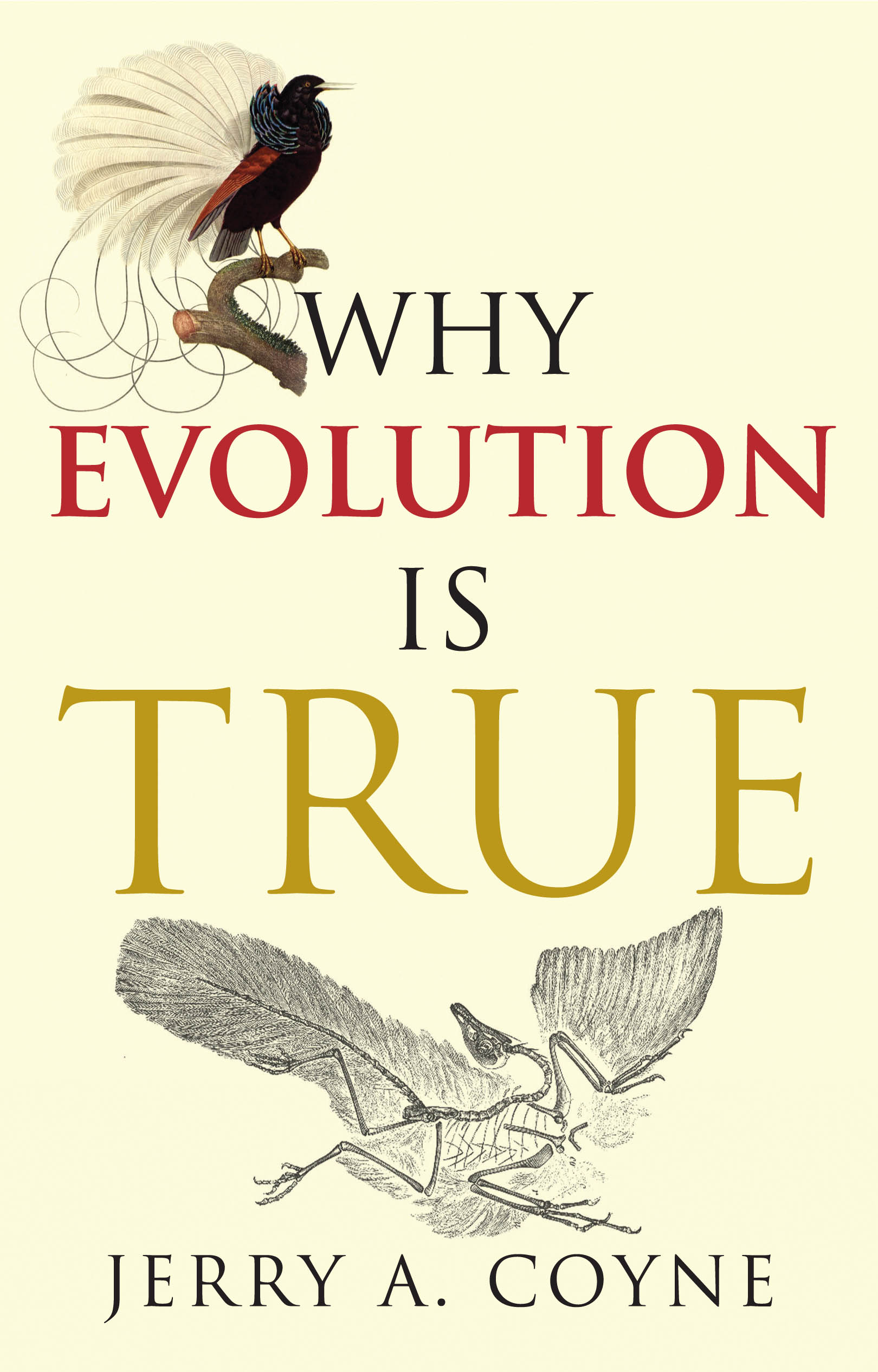
In Why Evolution is True, biologist and atheist Jerry Coyne seeks to drive a wedge between intelligent design and NeoDarwinian evolution, favoring the latter. But what if the Bible and “real world” engineering both make a case that there is less of a contrast than what Coyne would have us believe? Would a little imagination from an engineer help?
When God created the world did He do so as a Master Engineer or as a Tinkerer?
I recently finished listening to an audiobook by Jerry Coyne, a University of Chicago biologist, and vocal critic of Christian interpretations of science. In Why Evolution is True, Jerry Coyne is making the argument that the biological theory of evolution rules out the possibility of Intelligent Design. Evolution does not reflect the divine activity of a Creator. According to Coyne, the biological world does not resemble the work of someone creating things from scratch. Instead, the evolutionary process demonstrates the work of tinkering; that is, working with a limitation of available parts, experimenting at putting together different solutions. Tinkering is not very efficient, nor does it always produce the most beneficial results, hardly becoming the activity of a Divine Creator. But for Coyne, this tinkering is exactly what NeoDarwinian evolution is all about… and it is true.
Jerry Coyne did his undergraduate work at the College of William and Mary, finishing in the 1970’s. I currently work at William and Mary as a network engineer. Coyne is a superbly skilled scientist, but I need to respond to him as an engineer. Continue reading
Williamsburg Community Chapel Men’s Breakfast
Saturday, February 15th, 2014
7:30 am
3899 John Tyler Highway
Williamsburg, Virginia 23185
Cost: $8, (bring a friend)
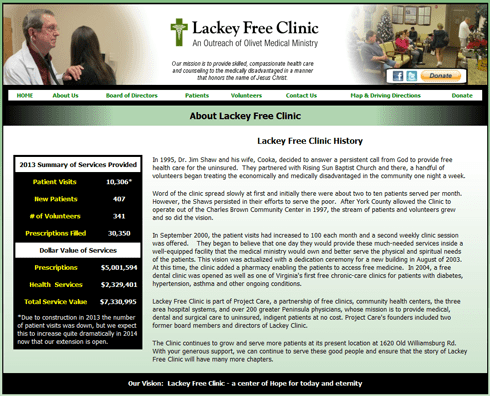
Dr. Jim Shaw has won numeroushumanitarian awards for his work in founding and leading the Lackey Free Clinic. He has had a wonderful career as a pulmonary specialist, and has made a real difference in our community and in the lives many people who had nowhere else to turn for medical help. The Lackey Free Clinic successfully provides skilled, compassionate health care and counselling to the medically disadvantaged in a manner that honors the name of Jesus Christ.
But Jim has not had an easy ride. This will not be a boring success story. I won’t give away the details, but will offer that Jim’s presentation will be a true encouragement to all who attend. Hope you can make it Saturday morning (bring a friend).
A friend of mine asked me today if I knew someone doing evangelical work by the name of Nabeel Qureshi. I vaguely recalled the name, and doing a little digging on the Internet discovered that Nabeel Qureshi had grown up in his high school years in Virginia Beach, Virginia in a Muslim family. My friend’s older brother was at one time very good friends with Nabeel. Nabeel would come over and visit and play video games. My friend recalls Nabeel leaving the house terribly frustrated because he kept losing all of the time.
Nabeel’s father was a member of a persecuted Islamic sect in Pakistan who brought his family to America for the purposes of religious freedom. In gratitude to the opportunities given to him in the United States, Nabeel’s father joined the Navy, eventually bringing his son and the rest of the family with him to the Virginia Beach area. According to his story,Nabeel described himself as being a very devout Muslim.
An aside: I would like to know if his religious parents had let him play video games or if he just snuck out some nights to play on an Xbox or whatever (rather badly) at his friend’s house, but that will be something to talk about if I ever meet Nabeel…
Anyway, by the time Nabeel entered his freshman year at Old Dominion University (ODU) in Norfolk, Virginia, he thought of himself as a fairly competent Muslim evangelist. Sincere Christians would come up to him and ask him if he knew that Jesus was God. Nabeel was well equipped to respond and demonstrated that the average Christian had absolutely no clue how to respond to his logical argument that Christian belief was nonsensical and could not even be supported by the Bible. No Christian he ever met could provide a satisfactory explanation of the Trinity. It all sounded ridiculous to him.
Christians simply could not answer his questions…
That is, until he met a sophomore named David Wood. Unlike most Christians he had met, Nabeel found David at one point reading his Bible in his free time. Furthermore, David had actually studied apologetics. So when Nabeel tried to stump David with how corrupt the Bible really was, David responded with much of the same arguments that my fellow co-blogger John Paine knows about regarding the reliability of the Bible.
Nabeel had met his match. He and David became fast friends and they looked at the claims of the Bible and the Qu’ran together. Through their debates with one another, it was their friendship that kept things in check as they learned and shared a lot of hard things with each other. Eventually, Nabeel’s mind was opened to Christianity, but he was fearful about the cost. After experiencing a vision and several incredible dreams, Nabeel finally gave himself over to Jesus Christ as his Lord and Savior.
Some ten years later, despite the terrible costs to him and his family, Nabeel Qureshi has dedicated himself to the ministry of Christian apologetics, particularly engaging in debates with Islamic apologists. Apparently, Muslims who are motivated by their own missionary interests love debates. These debates can get testy at times, but I find that the interchange of ideas and arguments have challenged me to dig deeper in the Bible myself so that I might be better prepared to answer the type of questions that Nabeel had back in his college days at ODU. As Nabeel has matured in recent years, he has also done some teaching with some introductory videos on Islam and at Biola University, where he received his masters in Christian apologetics.
In his testimony, Nabeel tells about witnessing a debate between Mike Licona and Shabir Ally about the resurrection of Jesus Christ, held about ten years ago at Regent University. This debate helped convince Nabeel of the intellectual integrity of the Gospel message. Shabir Ally is one of the most engaging Islamic debaters today, very well liked by his Christian counterparts, despite their differences. Mike Licona is probably one of my favorite Christian apologists today, ably defending the Gospel of Jesus Christ in a winsome way. If you live in or near Williamsburg, Virginia, we hope that there might be a great opportunity to see Mike Licona in action with Lee Strobel and Mark Mittelburg within a few months (stay tuned for that). I highly recommend Mike.
God…right? While that may be a profound and direct answer, it’s also overly simplistic. The Bible is God’s special revelation to mankind, delivered through the divine inspiration of human authors. So who were the human authors?
There’s a lot riding on the answer. Not so much in terms of their actual identities, but because many attacks against Christianity are targeted at disproving the reliability of human authorship. What kind of defense can those of us who believe that the Bible is theinspired, inerrant, and infallible word of God offer regarding the trustworthiness of the authors of the Bible?
It’s not essential that we know the names of the human authors (otherwise they would have laid out their identities in the text with certainty), but it is essential that we know that the Scripture is trustworthy. So with this post we begin a series to help readers appreciate the Bible as an accurate, historical, and trustworthy document. In a companion series we will explore how we got the “Holy Bible,” but for now we’ll begin with the authors.
Let’s lay out one precept: we’re about discovering the truth, not defending traditional notions. For example, it is widely believed that Moses wrote the first five books of the Bible. But that cannot be completely true. Why not? Because the fifth book (Deuteronomy) contains the accounts of his death and post-mortem reflections on his life—so at the very least someone else put the ending on his five books. Likewise, some people who haven’t really read the Bible have notions that God’s inspiration constituted divine dictation. But it is obvious in many passages that the Bible is not dictation from the Creator of the universe. How do we know that? Because the human authors state so—point blank in many verses (see this post for one clear example).
Back to the authors. Ezra was a priest, who mourned over his people’s disobedience to God after they were delivered from the Babylonian captivity. He was also a painstaking historian whose detailed historical records are downright anal-retentive (who counts plates, really?!). Jeremiah was called the weeping prophet—and why not? You’d weep too if you went through what he endured (by the way, there have been some stunning archaeological finds involving Jeremiah in recent months). Gad was the bag man for David’s bad news. Obadiah is said to have been a descendant of Eliphaz, the friend of Job. And on and on…you get the point. There are a lot of fascinating biographical details to appreciate about these authors. Our aim in writing this post is to make them readily accessible.
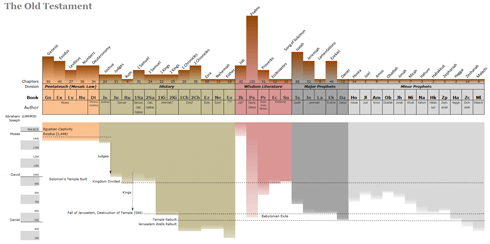
We created the following Bible infographic depicting the grouping of the Old Testament books, the authors, the approximate dates of writing, and how many chapters each book contains. It’s a snapshot of the construction of the Old Testament.
So…sticking with just the Old Testament for now, here is a new color-coded table keyed to our original infographic with hyperlinks to articles about the inspired authors of the Bible. As you’ll read in the linked material (click on the author’s name in the right-hand column), some books have considerable contention about authorship. But the point here is not to resolve that contention—we simply want to expose you to the biographies of the plausible authors.
In an upcoming post we will give similar treatment to the New Testament authors, and then review apologetic arguments that defend the trustworthiness of the human authors of the Bible. Enjoy!
Resources
The spring 2012 issue of the Areopagus Journal is an excellent resource for further study, and we will make use of several articles in our upcoming posts.
My wife and I were still out making our monthly run to CostCo while last night’s debate between Ken Ham and Bill Nye was going on. It was not like the SuperBowl or anything, but somewhere between a half a million to a million people watched the YouTube version online.
I only caught the closing statements near the end and rewinded to the beginning to catch their opening statements. I actually thought the exchange went better than I thought it would, and it did turn out a little different than I expected and predicted here on Veracity.
Instead of focusing on the harm evolution education he reports is causing in our schools, Ken Ham focused more on the distinction he was making between historical science and observational science. His main argument was that he and Bill Nye actually share the same perspective on observational science that gives us things like modern technology today. The disagreement is over historical science. For Bill Nye, historical science gives us genuine knowledge about the past. For Ken Ham, science can not give us reliable knowledge about the past. We must look to the Bible for that.
Likewise, Bill Nye surprised me, too. Though he clearly has an agnostic orientation towards the Christian faith, he made some approving mention that not all Christians share Ken Ham’s Young Earth Creationist views.






 Veracity
