Tag Archives: veracity

Bad Blood Moon Rising?

End-times prophecy fascinates many Christians. This is understandable. The Bible talks quite a lot about the fulfillment of prophecy.

Popular American preacher and Christian Zionist, John Hagee, has been recently promoting the idea that we are on the verge of seeing some “world shaking event”, a type of prophecy fulfilled corresponding to a rather unusual astronomical occurrence. Starting in April 2014 through 2015, observers on planet earth will be able to witness four “blood moons” in a relatively short period of time,  according to researchers at NASA and other astronomers. A “blood moon” is simply an informal expression for a lunar eclipse, when the moon will appear the color of a blood red. In the following clip promoting a recent book, John Hagee summarizes his ideas:

Hagee derived his ideas from fellow dispensationalist pastor, Mark Biltz. Biltz is a leading figure in the Hebrew Roots Movement, a rather provocative teaching that urges Gentile Christians to stay more faithful to the Bible by adopting more traditionally Old Testament Jewish practices in terms of a calendar of worship. Highlighted before here on Veracity, Biltz’s Hebrew Roots teaching has proven very controversial.

In this latest turn in the analysis of biblical prophecy, Biltz suggests that the rare events of having four blood moons, a tetrad, happening so close together in time has been historically associated with major events in Jewish history. In 1492, the Jews were expelled from Spain, followed within a couple of years by one of these four blood moon events. In 1948, the modern nation-state of Israel was founded, followed again within a few years by a series of four blood moon events. In 1967, Israel fought the Six Day War, gaining full control of the old city of Jerusalem. Oh yes, soon after that, there were four blood moon events.

What does the upcoming blood moon events in 2014 and 2015 signify? Well, Biltz and Hagee continually reiterate that they are not “setting dates.” However, Biltz says that something major will happen regarding Israel. Hagee goes a little stronger and states that something big will happen somehow related to Christ’s second coming… Mmmm….. While both preachers seek to distance themselves from the rather boldly absurd claims made by Harold Camping a few years ago, their pronouncements are unsettling and should cause believers to pause to reconsider the historical and biblical grounding for such teachings. Now, I am sure that many Christians have benefited positively from the teaching ministries of  Biltz and Hagee. However, both preachers, notably Hagee, have made curious statements suggesting that Jewish people do not need conversion to Christ, which if the reports are true, is a deeply disturbing situation in terms of sound Christian doctrine (per the Christian Research Institute).

A number of biblically informed Christians are not enthusiastic about the blood moon teachings associated with Biltz and Hagee. I do not always agree with Gary Demar, but I would urge those who are drawn to the teachings of Biltz and Hagee to at least soberly ponder over what the founder of American Vision has to say.

Demar argues that the speculation over the future fulfillment of prophecy actually has a negative impact on the witness of the Christian church. From Hal Lindsey to Harold Camping, and to somewhat a lesser extent in the late Chuck Smith, those who are tempted to focus too much on future biblical prophecy have historically been wrong, wrong, wrong pretty much most of the time. When people have tried to nail down the exact date of Jesus’ return, their attempts have proven 100% incorrect. If it turns out that no spectacular “something” happens within the next couple of years regarding Israel, will the integrity of Christian witness in the eyes of a skeptical world be damaged?

If we as Christians repeatedly pay too much attention to even vague attempts at the “date-setting” of nebulous prophecies, will our non-believing neighbors trust us when we try to tell them about the prophecies that have been fulfilled already in Jesus Christ 2000 years ago?

What do you think? Is there a bad “blood” moon rising?

Additional Resources:

For you science-geeks out there, the first total lunar eclipse in the tetrad sequence will be visible early, early the morning of April 15, 2014 on the U.S. East Coast.

Some experienced students of the Bible might object that Gary Demar is a partial preterist, and therefore not trusted with respect to Biblical prophecy. Okay, how about this:  for another dispensational, futurist perspective that objects to Hagee’s and Biltz’s understanding of the Bible, you might want to view the following 13-minute critique of the Four Blood Moon theory.  The bottom-line: do not simply swallow everything some television preacher says. Check it out against reliable history and the truth of God’s Word:


To The Least of These: Phoebe Palmer

It has been said that behind every successful man is a remarkably great woman who has made that man who he is. How true that is! I do not know how I qualify, but as a married guy myself, I am surely thankful for my bride and all that she does to support me!

Women have often been sadly neglected in the history of church. But the truth is that the church never would have grown as it has apart from the contribution of women raised by God to serve His purposes. These women need to be remembered, honored, and celebrated.

One of the greatest forgotten women in the church was the 19th century Phoebe Palmer. The following blog post in our Lenten series gives you an introduction to this extraordinary woman….

lathamta's avatarLessons in Lent

Phoebe Palmer (1807-1874). Evangelist and Social Reformer. Phoebe Palmer (1807-1874). Evangelist and Social Reformer.

On the night of July 29, 1836, Phoebe Palmer had rocked her 11-month-old daughter to sleep, and placed her in her crib. A few minutes later, a carelessly handled oil lamp landed in the crib, pouring hot and burning oil on the child. Within a few hours, the child was dead, and Phoebe Palmer’s life was in bitter agony. This was her third child lost in infancy. Why had God allowed this to happen? This may sound harsh to us today, but Phoebe wondered if perhaps she had loved her child too much, making her daughter into an idol. A year later, Phoebe had a profound encounter with Jesus Christ. Her “heart was emptied of self and cleansed of all idols” and she had come to know the Lord as being her “ALL IN ALL”.

Phoebe Palmer was the firebrand of the 19th…

View original post 347 more words


How To Live

John Paine's avatarLessons in Lent

Plumb Line In Matthew 25:14-30 Jesus gives us a clear parable about God’s expectations for His people. The basic point of the story is that God has given every one of us gifts, and that He will turn away those who fail to use their gifts wisely. Some parables are difficult to understand, but not this one. It’s a tough object lesson.

N.T. Wright comments on these verses that, “Each of us is called to exercise the primary, underlying gifts of living as a wise, loving human being, celebrating God’s love, forgiving, praying, seeking justice, acting prudently and courageously, waiting patiently for God’s will to be done.”

Okay…how?

To tell you the truth, I’ve never been big on taking a spiritual gift inventory or getting wound up about discerning God’s will for my life. That’s just me. I trust that God has a plan for my life. But the parable does beg…

View original post 836 more words


The Case For Easter Wrap-up

The Case for Easter

We had a very interesting evening of apologetics last night at the Williamsburg Community Chapel. Lee Strobel, Mark Mittelberg, and Michael Licona presented the Case for Easter in a simulcast to churches throughout North America.

Please use this post to make comments, ask follow-up questions, or share anything related to this event.  We also offer the following materials and resources from the simulcast producers:

Based upon questions from attendees after the event, here are a few apologetics resources we recommend:

For larger lists, check out our Toolbox, or this post.  If you’d like to dive into apologetics, here’s a sampling of Veracity’s apologetics posts.

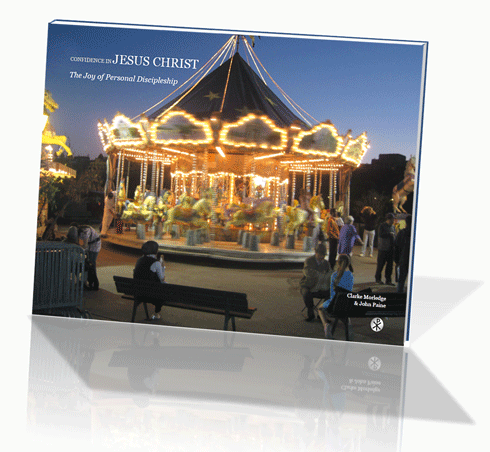
For those new to—or unsure of—the Christian faith, here is a presentation of the Gospel in an interactive ebook that uses apologetics to share the joy of personal discipleship.

Confidence in Jesus Christ

Have a question, comment, or something to share? Please use the “What do you think?” box in the Comments section below. We look forward to sharing with you!


HT: Shirley Vining, Judy Williamson, Martha Karam, Dave Rudy, Clarke Morledge, Cliff Roebuck, Arlene Vander Loon, Eileen Grant, Andy Flint, Kevin Wilkins, Steve Flanary


Noah vs. Noah

A Veracity reader suggested that I review the Darren Aronofsky movie, Noah, if I happen to see it. My small group wanted to go, and since I had just seen God’s Not Dead, I figured I was on a roll anyway.

My biggest problem with Noah was that it really departed greatly from the story of the Bible without a compelling reason as to why this was necessary. To say that Aronofsky had a “creative interpretation” of the Genesis story is clearly an understatement. To put it in a nutshell, though I was fairly critical of some aspects of the God’s Not Dead movie, as a Christian if you had to pick between movies, go see God’s Not Dead instead, save the rest of your money and read the Bible story of Noah on your own. Probably the best thing to come out of the Aronofsky film is that hopefully it will encourage people to actually go read and study the Bible and talk about it (that is why I went to see the film in the first place with my Bible study small group!).

Please do not get me wrong. I really like well-constructed, imaginative sci-fi flicks and Noah was no exception.  Noah clearly had a strong mythological feel to it, provocative reflections on the Book of Enoch’s “Watchers” (speculative ancient Jewish literature based on Genesis 6), a somewhat curious allusion to Abraham’s faith testing with respect to offering up Isaac as a sacrifice, and a strong environmentalist message with breathtaking views of Iceland. As a story with lots of Biblical elements, Noah was intriguing.  I just think the actual Biblical story in Genesis 6-9 is far more interesting. Not only that, the Biblical narrative is also true. I will take the truth of Scripture any day over the speculative fantasies of Hollywood film producers.

The challenge for the Christian in reading Genesis is in trying to determine in what sense is it true. We already covered some of the basics here before on Veracity, but in light of the movie, a number of creationist ministries have produced material to help the church to process the Genesis Flood story.

  • Reasons to Believe has a number of helpful videos, podcasts, and other resources from an Old Earth perspective that sees the flood more in terms of a local event impacting the then known world of that time.
  • The BioLogos Foundation understands the flood from an Evolutionary Creationism perspective, viewing the flood with respect to the original, ancient literary genre of the text as the key to interpreting this passage of Scripture.

I want to highlight one approach from BioLogos given by Old Testament scholar, John Walton, from Wheaton College, who views the Noah story in terms of transforming the world of disorder into non-order and then into a world of order within the context of God’s covenant with His people.

One more closing thought: one of the problems with the flood narrative from a  scientific perspective is that if you understand a pure literal reading of only Noah and his immediate family and their wives entering the ark, it makes the subsequent re-population of the earth problematic from a genetic diversity perspective.  But if the human population on the ark also includes others in Noah’s extended family, household servants, etc. that the Bible simply omits to tell us about, this becomes less of a problem. Also, remembering that the flood was specifically sent upon the “world of the ungodly” (2 Peter 2:5), this  may allow for the possibility of the Noahic survivors of the flood contacting other humans who were not impacted by the judgment of the flood. I have nothing definitive here, as these are just some thoughts to stimulate further study in this most intriguing text of God’s Word.

The final takeaway: the movie is more than a little weird, but it has some elements that warrant good discussion and critical engagement with its themes, and it rightly presents Noah as a complicated man. Contrary to popular belief, the Biblical Noah was not righteous because of his works. Rather, he was declared righteous by the grace of God. Humanity is in rebellion against God. That includes Noah. Thankfully, God’s salvation is extended to us by His loving mercy. If we can get this central message of the Biblical Noah in our minds and hearts, then the rest of the details should fit within the proper Biblical perspective.