Tag Archives: replacement theology

Notes on Leviticus: By Michael Heiser. Part Two

A popular online video makes the rounds every now and then with a clip from The West Wing, a political drama television series broadcast from 1999 to 2006. It features a scene where the President of the United States, played by the actor Martin Sheen, has an interaction with either a Jewish or Christian call-in show host, with a PhD, where they have some back and forth regarding the interpretation of the Book of Leviticus, and a few other passages describing particulars of Old Testament Law.

The scene dramatizes a heightened conflict, concerning the instruction in Leviticus 18:22 prohibiting same-sex relations. The President challenges the doctor by quoting select verses, such as Exodus 35:2, which prescribes the death penalty for those who violate the Sabbath. Then there is Leviticus 11:7-8, which forbids an Israelite from touching the dead skin of a pig. Would someone playing football be required to wear gloves to avoid becoming unclean? What about Leviticus 19:19, which forbids planting two different kinds of crops within the same field, and wearing different kinds of fabric in their clothing?

The message of The West Wing video connects with many in our culture today, appealing to both non-believers and progressive Christians alike, who find the regulations described in the Book of Leviticus to be baffling, to say the least, if not overly harsh and rigid. At least on an emotional level, it is difficult to parse out why a prohibition against same-sex relations would be mixed in with odd requirements about not wearing two types of clothing (Leviticus 19:19). If historically-orthodox Christians seem so adamant about defending a definition of marriage restricted to one man and one woman for one lifetime, why is it that they seem so casual about wearing clothing made up of both cotton and polyester, when Leviticus addresses both subjects with disapproval?

Such a posture comes across to many critics today as needlessly judgmental, hypocritical, and not very loving. As a result, many progressive Christians (though not all) would rather lump the Levitical prohibition against same-sex acts in with instructions about not planting two different kinds of crops within the same field: Dismiss both of them!

The non-believer would go further and dismiss the whole Bible as a muddle of contradictions, an outdated moral system stuck in the Late Bronze age. Either way, the conclusion drawn by such critics and skeptics is the same: the regulations in Leviticus as a whole are a bunch of nonsense and no longer apply in today’s world. Get your morality from somewhere else other than Leviticus.

On the late Michael Heiser’s Naked Bible Podcast, this Old Testament scholar brings out important highlights, accessible to everyday Christians, who want to have a better grasp on Leviticus, one of the least studied, least understood, and least read books in the Old Testament.


Leviticus: An Outdated Relic from the Late Bronze Age?

Frankly, there are many conservative Christians, who while not being persuaded by such an impactful rhetorical argument, simply would not know how to respond to this kind of message. Disagreements between such progressive Christians and non-believers on the one side, and conservative and even moderate Christians on the other, are indeed very difficult to resolve. Is there any way to make sense of Leviticus? What would it have meant to an ancient Israelite many hundreds of years ago? Is there any kind of sensible application to make today for Christians? Or to put it bluntly: Are historically orthodox Christians really hopeless bigots?

I took the time to listen to Dr. Michael Heiser‘s Naked Bible Podcast series, covering the Book of Leviticus. I was surprised to learn that there are indeed ways in which scholars have been able to parse through such difficult texts, and make sense of them. Heiser’s teaching, where the transcripts of these podcasts have been put into book form, Notes on Leviticus: from the Naked Bible Podcast, while not a full-blown verse-by-verse analysis of every sentence in Leviticus, it nevertheless is an in-depth treatment of the Levitical system, exploring the logic of what is what in Leviticus, and what continues to be applicable today (and how) in a New Testament context, and what does not. While not every question I had in mind was answered, I gained a much better perspective as to how the Bible can be read within its historical, cultural context.


The Difference Between Ritual Impurity and Moral Impurity, in the Old Testament Jewish Mindset

In the previous post in this series, I reflected on Heiser’s teaching regarding “sacred space,” and the distinction between ritual impurity and moral impurity, despite the fact that both concepts of impurity often share the same language of “clean versus unclean.” Ritual impurities are simply things that happen in the normal course of life, and therefore, are not sinful, whereas moral impurities do qualify as sin, in the New Testament sense. The tabernacle/temple idea in Old Testament Judaism is about defining an area of “sacred space,” where God dwells. For someone to enter this “sacred space,” one needs to be fit to enter it, cleansed from both ritual and moral impurity.

One may easily see that the prohibition against same-sex relations is an example of a moral purity regulation as it is associated with the language of “abomination” (Leviticus 18:22). But it is difficult to understand how this relates to commands about mixtures in Leviticus 19:19, just one chapter later:

“You shall keep my statutes. You shall not let your cattle breed with a different kind. You shall not sow your field with two kinds of seed, nor shall you wear a garment of cloth made of two kinds of material.”

A similar passage is found in Deuteronomy 22:9-11. The New Testament is silent about the Leviticus regulations on mixtures. Some scholars argue that since the prohibition against same-sex relations is repeated in the New Testament (1 Cor 6:9-10, Romans 1:26-27), and that the commands against mixtures are not repeated in the New Testament, that the prohibition against same-sex relations is applicable for Christians today but that the commands against mixtures are not. While there is strength to this argument, it does not help us much in understanding why these commands are different from one another. If the commands against mixtures are not related to moral impurity, what about them makes them related to ritual impurity? What is the logic behind both of these regulations: the one concerning homosexual practice and the commands against mixtures?

With respect to homosexuality, it can be easily established that male same-sex relations can imply a role and power imbalance, where one sexual partner dominates and penetrates the other. Outside of ancient Israel, same-sex relations were allowed, with caveats. Heiser notes that same-sex relations were still looked down, but in general, they were not severely punished, in comparison with what is described in the Old Testament. Outside of Israel, homosexual rape was condemned in certain cultures. However, pederasty, where Greek adult men would have sexual relations with younger men, was used as a method of training in the art of war. In this context, homosexual activity was not condemned. Israel was the exception in that all same-sex relations were condemned (Heiser, p. 231ff).

In citing the Jewish Old Testament scholar, Jacob Milgrom, Heiser concludes that homosexual practice goes against the creation order, in that it removes the possibility for procreation. While procreation is not the sole purpose of sex, as texts like the Song of Solomon celebrate human sexuality without reference to procreation, homosexual practice takes the procreative act out of sexual expression. Since the God of Israel is a God of life, to deny procreation from an Old Testament standpoint runs against God’s purposes for human sexuality.

The omission of any reference to lesbianism in the Old Testament is curious. Nevertheless, Paul’s inclusion of a prohibition against lesbian sexual expression in Romans 1:26-27 shows a parallel to male-male sexual relations. As Heiser summarizes:

These passages are not written so that space is devoted to being mean. They’re written to reinforce a worldview that elevated the production of and care for human life” (Heiser, p. 237).1

The commands which restrict mixtures in Leviticus,about wearing different types of clothing, planting different types of seed in a field, etc., are even more perplexing. Centuries later, in the time of David, the Bible mentions mules, which are bred with a mixture of horse and donkey (1 Kings 1:45-47). But the Bible never has anything negative to say about mules. So, how does a student of Scripture make sense of all of this? Thankfully, recent scholarship, particularly from the eminent Jewish scholar, Jacob Milgrom, which Michael Heiser relates to the reader/listener, can help to sort things out.

Continue reading


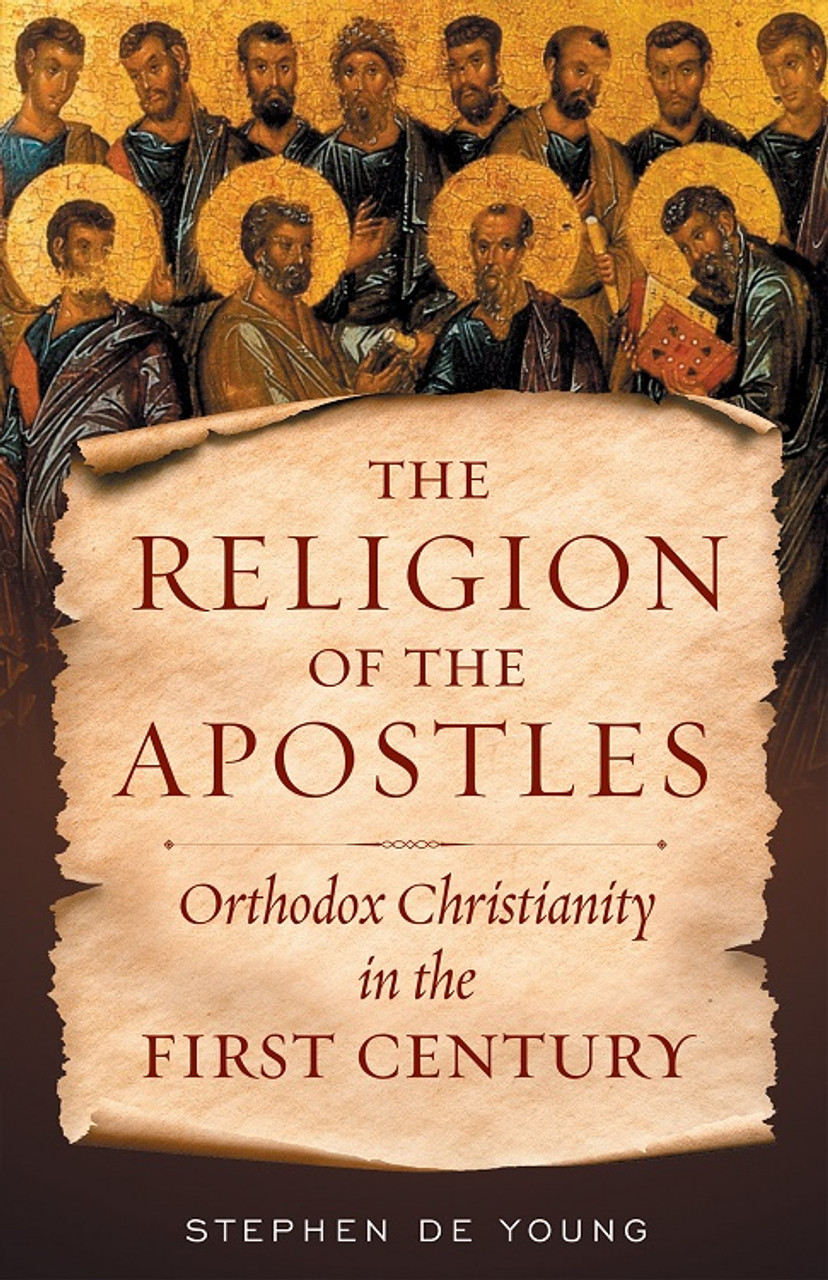
Religion of the Apostles, by Stephen De Young, a Multi-Part Review (#4 Concluding Topics: the Lost Tribes, Law, Sacraments, Elders)

Here we wrap up this review of Stephen De Young’s The Religion of the Apostles: Orthodox Christianity in the First Century, with an assortment a various topics, and some critical reflection.

The Religion of the Apostles, by Stephen De Young, shows how the beliefs and practices of the early church connect with the world of Second Temple Judaism, the historical context for Jesus of Nazareth and the New Testament.


The most important parts of The Religion of the Apostles cover the Trinity, the Divine Council, and the Atonement. But after the chapter on the atonement we have a grab bag of topics that I will just toss into this last post of this book review, looking an Eastern Orthodox perspective on the earliest Christians, by Father Stephen De Young.

The Ten Lost Tribes …. and the Gentiles

The next chapter examines what took place to transition the Old Testament people of God, Israel, to that of the New Testament church, made up of both Jew and Gentile alike. De Young makes much of the mystery of what happened to the Ten Lost Tribes of Israel, who were conquered and deported by the Assyrians, about 150 years before the destruction of Jerusalem and the Southern Kingdom, by the Babylonians. The message of the prophets was to promise that not only would the Jews of the Southern Kingdom be restored to the land following the Babylonian exile, but that the Ten Lost Tribes associated with the Northern Kingdom would be restored as well.

De Young argues that the process of cultural assimilation of the Ten Lost Tribes meant that “the northern tribes could be restored only from among the Gentiles” (De Young, p. 230). While some might consider this as controversial, we see this in the Jewish “apocryphal” tradition preserved in Eastern Orthodoxy and Roman Catholicism: “The Hasmonean Kingdom, after the Maccabean revolt, formed a treaty with the Spartans in which they are said to be descendants of Abraham (1Mc 12:21)” (De Young, p. 230).

How else could these Spartans be considering descendants of Abraham if they were not somehow connected to the Ten Lost Tribes? While there is legitimate criticism that a kind of “replacement theology” unfortunately played a negative role in the early church after the destruction of Jerusalem in 70 C.E., De Young’s argument shows that the Scriptural treatment of the Ten Lost Tribes reveals just how “nonsensical” such a replacement theology really is, going back to a Second Temple Jewish context (De Young, p. 237).

This opens up a way of reading Paul’s enigmatic statement in Romans 11:26, “all Israel will be saved.” This may not sound like a big deal to most readers of the Bible, but it serves as a clue as to what Paul was really getting at in the Book of Romans, particularly Romans 9-11,  by demonstrated that Paul was appealing to a known tradition within Second Temple Judaism, about the relationship between the Ten Lost Tribes and the Gentiles, as opposed to just making something up out of his own head.

Was Paul inventing his own weird interpretation of the prophet Hosea in Romans 9:22-26, as some critics of the Bible claim, like Rabbi Tovia Singer? Perhaps not!! The original context for Hosea 2:23 is a reference to Israelites conquered by the Assyrians, but Paul sees this as a reference to the Gentiles. Stephen De Young’s analysis offers a defense of Paul’s reading grounded in the thought world of Second Temple Judaism.

The Law of Moses and the Gentiles

The chapter on “The Law of God” argues that Christ indeed came to fulfill the Law, but that more recent developments in theology, particularly since the Protestant Reformation, have divided the Law of Moses into three categories: the civil, ceremonial, and moral commandments. It is generally thought that Christ fulfilled both the civil and ceremonial aspects of the Law, and yet the moral aspect is still binding on the Christian. However, De Young argues that this three-fold classification is not found in Scripture, as there are no divisions in the text regarding the meaning of the Law (De Young, p. 257ff).

The whole Law of Moses is fulfilled in Christ. The best way of understanding the fulfillment of the entire Law of Moses is through the Sabbath. “The first day of the week, then, becomes the Lord’s Day.” God’s people “now participate in the Resurrection of Christ in anticipation of their own resurrection and eternal life in the world to come” (De Young, p. 264).

The Council of Jerusalem, found in Acts 15, helps us to comprehend the relevance of the Law of Moses in the life of the New Testament church. An appeal to portions of Leviticus were made at the council as the means by which Gentiles can be brought into the community formerly made up of Israel alone, by instructing Gentile believers to follow four commands: to abstain from food dedicated to idols, sexual immorality, from meat with blood still in it, and from blood. It is in this sense that the Law of Moses still applies to all Christians.

Therefore, all four commands of these commands are binding among Christians today. Refusing to eat food offered to idols is still to be followed, as well as the prohibition against sexual immorality, which has been challenged in recent years by certain Christian groups. The author does mention that the eating of blood, and the eating of meat with blood still in it is connected to the context of pagan worship in Leviticus 17:10-14 (De Young, pp. 264-265).

But he does not go into detail on the specifics of how this should be applied today, a significant drawback in this particular chapter. Nevertheless, De Young insists that Eastern Orthodoxy consistently seeks to apply these four commands even today, as well as holding to more ancient worship practices more closely associated with the “ceremonial law,” whereas both Protestant and Roman Catholic Christians have shifted away to varying degrees from such practices, which were standard in the first century church (De Young, pp. 264-275).

As an evangelical Protestant, I am not wholly persuaded that the three-fold distinction of the Mosaic Law, as articulated by John Calvin in his The Institutes of the Christian Religion lacks the Scriptural basis that De Young says it does. But he does make a good argument that the Acts 15:19-20 ruling for accepting believing Gentiles among the people of God is still in force. However, I am inclined to think that the restrictions against eating food from animals still with blood in them, and against eating strangled animals generally, are really admonitions to stay away from practices associated with idolatry. In most Western contexts today, as opposed to theologically-oriented customs in the Ancient Near East, the eating of animal blood has little to do with idolatry.

In the Ancient Near East, animals that were strangled still had blood in them, and since blood has been understood as the symbol of life, and the surrounding pagan cultures around the Israelites used such blood in their worship practices, the Old Testament instructs the people to stay away from such idolatrous worship practices. But while the use of blood is generally not common in idolatrous worship practices today, at least in the Western secular world, there are plenty of idolatrous worship practices that Christians in a secular world context should still stay away from.

Baptism Fulfills Circumcision

De Young closely associates the practice of baptism with being a fulfillment of circumcision. In this way, just as infant Jewish boys were circumcised, so in Christ’s church both infant boys and girls are to be baptized. This is not that far from a covenant theology approach dating back to the Protestant Reformation, which affirms infant baptism, without getting bogged down in certain aspects of baptismal regeneration, which most Protestants vigorously reject; that is, the idea that the very act of baptism in and of itself in some sense saves the person.

“…baptism, like circumcision before it, was never an individual act or pledge. Rather, it has always been, from the very beginning, a communal act of family, clan, tribe, and nation; the new nation that is called by Christ’s name, the Church” (De Young, p. 284).

The emphasis on baptism as a communal act, and not an individual one, is a pretty foreign idea to Western Christians. Baptism is about drawing the believer into the life of the covenant community, just as circumcision identified the Old Testament Jew as a member of national Israel. I wish Stephen De Young would have explained this communal sense of baptism some more.

Linking the Presbyteriate of the Church to the Elders of Israel: The Sacramentality of Eldership

This is a bit of a rabbit trail, but it is an important one. De Young defends the origins of the clerical orders of the church by connecting them back to practices in ancient Israel and Second Temple Judaism. The dominant scholarly narrative has been that the development of church order did not arise until the late first century at the earliest, or even into the second century. This scheme of church order, as articulated primarily in the Pastoral Epistles (1 Timothy, 2 Timothy and Titus) sought to domesticate Paul’s message to make it more palatable to the social standards of Greco-Roman culture:

“This narrative has been put forward with such force that it has been used to argue for a later dating of any book of the New Testament that mentions the Church or her orders. In the case of the Pastoral Epistles, it is used to argue that they must be minimally sub-Pauline, reflecting later developments after the end of the apostle’s life” (De Young, p. 288).

In other words, this common scholarly narrative suggests that some admirer of Paul forged letters (the Pastoral Epistles) to make them sound Pauline, but in doing so, changed Paul’s message to make his teaching appear to inline with the cultural standards of the day.

In contrast, according to De Young, Paul really did write the Pastoral Epistles, and he did so with a genuine reason in mind going back to the Old Testament. The great apostles of the early church functioned much like the elders selected by Moses, the seventy, who assisted him in governing the Israelite people in the wilderness (Numbers 11:16-17). Paul then describes what this apostolic ministry looked like in 1 Corinthians 4.

Once the original apostles begin dying and are removed from the scene, the “episkopos,”  or “overseers” or “bishops,” take upon themselves the continuation of the unfulfilled apostolic task.  The “episkopos,” sometimes translated as “herdsman” in the Greek Old Testament, are often interchangeably associated with the “presbyters,” the elders of the church. These overseers/elders are charged to maintain continuity with the original apostolic ministry. In addition to the episcopate and presbyterate (made up of qualified men), an additional level of ministry leadership was added and fleshed out by the second century, to include both a male and female diaconate (De Young, pp.290-291).

It is interesting that De Young ties the New Testament concept of elders to the elders of ancient Israel, and not to the Levitical priesthood. For many Protestant Christians today, it is still somewhat confusing when the concept of “elder” (“presbyter,” in Greek) is often interchanged with the notion of “priest.” But when one realizes that the term “priest” is simply the shortened version of “presbyter,” this should be less problematic to those Protestants who are wary of connecting “elder” and “priest” together. In other words, a “priest” in the early church did not strictly correspond to a Jewish Temple “priest,” if it did at all.

We know this from the New Testament as the Book of Hebrews (Hebrews 7:13-17) mentions that Jesus is a priest, not in the order of Aaron, but rather in the order of Melchizedek, a point that De Young brings out (De Young, p. 286). De Young does not connect the dots here, but this would suggest that the concept of New Testament “elder” is tied back to this earlier notion of priesthood, and not the priesthood of the Second Temple. The Levitical priesthood, associated with the ritual of the temple, which no longer physically exists, has now been superseded by the final sacrificial ministry of Christ. But the concept of priesthood more generally, as with the priesthood of Melchizedek, still has relevance.

There is, of course, the “priesthood of all believers” which suggests that Christ is the sole mediator between believers and God. Nevertheless, there is still a kind of continuity that the New Testament concept of presbyter (elder) has with the Old Testament, demonstrating that the office of elder by the early Christians was not simply some invention without precedent. Elders are not “above” other believers, as though they are members of a superior class, but they do serve a specific sacramental function in the life of the local church.

Many Protestants tend to miss this, ignoring the sacramental function of New Testament “elder,” however ill-defined this might be, for fear that this might be confused with the more medieval sacerdotal practice of Roman Catholicism. Granted, there is no explicit teaching found in the New Testament which links the Old and New Testament concepts of “elder” and “sacrament” together, but De Young makes a strong case that the early church did understand it this way. When “elder” is understood without a sacramental sense standing behind it, then the notion of “elder” in Protestant circles tends to get relegated to the sense of the person or persons “in charge,” or a purely administrative “board of directors,” which does not carry the proper sense and function of the New Testament word.

Presbyters (Elders)… And “Women in Ministry” in the Early Church

Furthermore, while De Young also does not mention this, his reasoning would further explain why Jesus only selected men to be his twelve apostles, despite the fact that women figured prominently in Jesus’ earthly ministry, several of whom effectively bankrolled the itinerant movements of the wandering band of Jesus’ disciples, and who were the first witnesses to the Resurrection.

Some have suggested that Jesus only selected men to be among “the Twelve” in order to be sensitive to the cultural norms of the day. But this argument is highly problematic. For example, this type of egalitarian apologetic does not seem consistent with the Jesus who made mincemeat of other cultural norms of the day, by publicly rebuking Pharisees, challenging normative interpretations of the Sabbath laws, throwing out the money changers in the Temple, and even challenging the very Temple system itself. Why would Jesus be so forceful in challenging those cultural norms of the day while being so timid with the question of women being possible candidates among the Twelve?

Instead, it is apparent from reading The Religion of the Apostles that the Paul’s establishment of the office of elder (presbytery) is meant to continue the apostolic ministry that he, and other apostles, original represented, to ensure that the Christian movement would stay on the right track, after that original group of apostles were dying off and leaving the scene. In the pastoral letters in particular, Paul is greatly concerned about false teachers corrupting his own teaching that he was trying to pass on. This is why Paul charged the elders of the church in Ephesus to properly stay in alignment with his teachings and to protect the people (the sheep) from being led astray from false teachings, as Paul was quite clear that he would not return to them (Acts 20:17-38).

It follows then, that it would be consistent that Paul would restrict the office of elder/overseer in 1 Timothy to be only for qualified men, while still affirming the leadership roles of women in other areas, like deacon. If Paul believes that the office of elder/overseer was meant to carry on the role of the original apostles, once the apostles were dead and gone from the earthly scene, as was evidently the case in the early church, then it would make sense for Paul to only designate qualified men to serve as elders/overseers, consistent with how Jesus designated those who were among the Twelve.

De Young’s treatment of the development of the presbytery (office of elders) resolves a number of lingering questions in my mind. For if Paul indeed did follow Jesus’ model for selecting the twelve male disciples to be the original group of “elders,” and copy Jesus in establishing the presbytery to continue the apostolic ministry of that first generation of Jesus’ inner circle, it does raise the question as to why both Jesus and Paul had only men in mind for this, considering that women were also highly valued as disciples and in exercising leadership functions themselves.

Yet De Young demonstrates that it was not the Aaronic line and its association with the Jewish temple priesthood that Jesus or Paul had in mind to emulate. Rather, it was the position of Jewish elders grounded in the twelve patriarch fathers of Jacob’s sons that served as the model. Jesus’ selection of twelve Jewish men as apostles was therefore not simply a one-time, one-off fulfillment of some Old Testament prophecy, but rather, it set a pattern for the early church moving forward beyond the lifetimes of those original twelve.

We might also add that the priesthood in the order of Melchizedek is relevant. De Young associates the celebration of the Lord’s Supper as being an imitation of the priesthood of Melchizedek (De Young, p. 287). The office of elder can be thought of as a sacramental reminder that the local church is a kind of expression of the twelve tribes of Israel, extending back through history, preserving a long line of family lineage. I am only guessing, but it would have been more helpful if Stephen De Young could have “tied off the bow” with the discussion, as this seemed to be where he was aiming.

All of what has been noted above concerning the office of elder is hotly contested within Protestant evangelical circles today. The debate among complementarian and egalitarian Christians continues to divide Protestant evangelicals, as to the roles of women and men in church leadership. Complementarians insist that Paul’s directive in 1 Timothy 2 & 3 has a universally binding character, while disagreeing amongst themselves as to how the distinction between men and women in church office is to be applied. The main feature common among most complementarians has been that only qualified men are to serve as elders in a local church, whereas there are no gendered restrictions anywhere else in the New Testament church. In other words, women may lead in the church in various ways, but that the office of elder has been reserved for qualified men.

Alternatively, egalitarians, at least the most exegetically sensitive ones, say that Paul’s teaching regarding men and women in 1 Timothy suggests a different context, focusing on the particular issue of female false teachers in Ephesus specifically. Many such Protestant egalitarians reject any sacramental function served by local church elders, preferring a more secular-type role for elders in terms of Christian leadership. Yet this egalitarian perspective is inconsistent with a more general, universalizing design for church offices, a view classically held by Eastern Orthodox thinkers, including Stephen De Young.

Is the New Testament Canon of Scripture Fixed? In Eastern Orthodoxy, the Answer is Yes

The charge of misogyny against the early church in terms of women in local church leadership is a highly sensitive matter in today’s culture. Much of the controversy stems back to how early church history is interpreted. Yet as I have suggested before, if it could be successfully argued that the pastoral letters of Paul, including 1 Timothy, were indeed outright forgeries, then this would most simply settle the matter in favor of the egalitarian concerns, without the complex exegetical gymnastics often associated with those egalitarians who try to defend Pauline authorship.

But there is no indication that such a revision of the canon would ever be accepted in Eastern Orthodoxy. Nor does there seem to be any significant felt need to attempt such a revision. I doubt that such a re-evaluation of the canon of the New Testament will take place in other branches of Christianity, like Roman Catholicism or Protestantism (except for perhaps progressive Christian Protestants). While many modern scholars have their doubts about the authenticity of 1 Timothy, Eastern Orthodox tradition solidly affirms 1 Timothy as genuinely Pauline, and started to do so fairly early within the history of the early church. As indicated by De Young, the whole array of Eastern Orthodox church offices depends upon the entirety of the tradition drawn from the pastoral letters, primarily including 1 Timothy.

Yet while Stephen De Young sees a certain kind of continuity between the Paul of 1 Timothy and his Second Temple Jewish forebears regarding relations between men and women in the worship assembly, there is also a discontinuity. Some, though not all, Second Temple Jewish texts do suggest a kind of misogyny. For example, the pseudepigraphical Apocalypse of Moses, which scholars date as a Jewish writing from the time period of Jesus, reads a completely different twist into the Genesis narrative. According to the Apocalypse of Moses, Eve and the serpent had a sexual relationship with each other, at the instigation of the devil. A plot was then conceived to cast Adam out of the Garden of Eden. In contradiction to Genesis, Adam was not even present when Eve and the serpent had their discussion about the forbidden fruit, thereby deceiving the innocent Adam in the process.

Nevertheless, the early church rejected this particular narrative, in favor of a different tradition within Second Temple Judaism. In other words, it is better to speak of “Judaisms” in the plural as opposed to “Judaism” in the singular when when we think of the Second Temple Jewish tradition.

The early church followed certain strands of Judaism, or certain “Judaisms,” while rejecting others. Some of these rejected “Judaisms” helps us to explain how certain Christian heresies became popular in the early church. For example, the Gospel of Thomas, probably dated to the second century, was deemed not worthy of inclusion in the New Testament canon, in part because of its teaching that women must somehow become men in order to find salvation, a view which historic orthodox Christianity, in both the East and the West, flatly rejected. If there is ever clear evidence of misogyny in the early centuries of the Christian movement, it was surely in the kind of Gnostic heresy reflected in the Gospel of Thomas.

Paul’s push towards having a female diaconate, most exemplified by the example of Phoebe in the Book of Romans, shows clear evidence of being accepted within early Christian communities. The common assumption that women never had leadership positions within the early church is without foundation, as the ministry of the diaconate served a vital role in the early centuries of the Christian church. Nevertheless, the practice of having a female diaconate faded out in later years of Eastern Orthodoxy. It suggests to me that given the evidence at hand, Scriptural and historical, that Eastern Orthodoxy might be open towards re-establishing a female diaconate…. or at least they should.

Critical Evaluation of The Religion of the Apostles: MORE FOOTNOTES PLEASE!!

One other observation to note in Religion of the Apostles is the lengthy discussion regarding the peculiar reference in 1 Corinthians 15 about the “baptism for the dead” in the chapter about redeemed humanity’s role within the Divine Council (De Young, pp. 161ff). But this must be saved to a future blog post.

While The Religion of the Apostles is very thorough and helpful, there are some drawbacks with the book. The most troubling is the unevenness regarding De Young’s footnotes. Sometimes De Young pinpoints the ancient Second Temple sources he uses to make his case. But too many times De Young fails to adequately cite his sources,  leaving the reader with incomplete footnotes. To me this explains why some other reviewers of The Religion of the Apostles have concluded that De Young is over promising what he actually delivers in the book.

Perhaps De Young opted to try to keep his footnotes to a minimum in order to make his book more accessible to his intended audience. I can imagine that if De Young would have fleshed out his footnotes it might have doubled the size of the book, and he did not want to do that.  If this is the case, then perhaps De Young should consider a second edition of The Religion of the Apostles with more extensive footnotes, enabling readers to better see for  themselves what sources he is using.

Some claims are even made by De Young that lack any source citation whatsoever. “The four rivers that flow from Eden are the Tigris, the Euphrates, the Nile, and the Danube” (p. 174).  Those last two rivers are typically found in English translations of Genesis 2:10-14 as the Pishon and the Gihon, which are not the same as the Nile and the Danube, at least to my knowledge. So, where does De Young get the Nile and Danube from? De Young is assuming certain details as common knowledge among his readers, which is not the case.

Eastern Orthodox Apologetic Stumbling Blocks

The apologetic purpose of Stephen De Young might serve as a stumbling block for those who might benefit the most from his book. There is plenty in The Religion of the Apostles which will ruffle the feathers of those outside of the Eastern Orthodox tradition. Evangelical egalitarians will bristle against the idea that the concept of a male-only presbyteriate goes back to Jewish sources grounded in the Old Testament, and perhaps even Jesus’ selection of twelve men as the original apostles, as opposed to some adoption of Greco-Roman misogyny which supposedly crept into the early church, as some evangelical egalitarians imagine.

Evangelical Protestants of all stripes will find offense at the suggestion that Protestants have erred by leaving a deep hole in the history of God’s revelation, by ignoring various books of intertestamental literature (known as the “Apocyrpha” in Protestant circles), which the Eastern Orthodox consider to be Scripture (De Young, p. 14). Roman Catholics will be chagrined at charges of unwarranted accretions in the Catholic Mass, and other areas of Roman Catholic doctrine (De Young, p. 285), for which the Eastern Orthodox see as innovations away from the original religion of the apostles.

As might be expected from an Eastern Orthodox theologian, De Young cites evidence from the Old Testament which affirms the veneration of Mary, as the “Theotokos,” though not certainly not as dogmatic as what you can find from some Roman Catholic writers. De Young cites 1 Kings 2:19 to show that Solomon had a second throne placed on his right hand for his mother, Bathsheba, as queen, establishing the precedence for Marian devotion which arose during the early church period (De Young, p. 152). Protestants probably will not find such evidence to be convincing. Along with a variety of other Eastern Orthodox distinctives, there will be Roman Catholic and Protestant readers who will not be persuaded by particular arguments made here and there.

The Religion of the Apostles of the First Century: Tied to Certain Second Temple Judaic Traditions

However, the greatest value of The Religion of the Apostles is not in its apologetic for Eastern Orthodoxy, but rather in its tying the earliest beliefs and practices of the Christian church back to beliefs and practices associated within Second Temple Judaism. Stephen De Young may or may not present arguments which will ultimately sway readers to embrace Eastern Orthodoxy. For example, I remain currently unpersuaded by Stephen De Young’s apologetic, but I appreciate the challenge he brings to some of the deficiencies of evangelical Protestantism.  Nevertheless, De Young challenges the evolutionary notion that much of the early church beliefs and practices were pure innovations disconnected from the Second Temple Judaism that preceded it. This insight is worth the price of the book alone.

As one can probably tell from the length of this review, over multiple blog posts, The Religion of the Apostles is a remarkably substantial book coming in at about 320 pages. But while the topics covered are many, the argumentation is concise, dealing with fundamental matters of doctrine, and answering many, many questions about the Bible along the way.

Much of what Stephen De Young writes about, particularly as that which pertains to theological strands within Second Temple Judaism and the Divine Council, will be new to some readers. But De Young’s book should sufficiently demonstrate that the contribution of contemporary scholarship which seeks to retrieve significant elements within Second Temple Jewish thought is far from being “new,” as some uninformed critics have wrongly claimed. As a reminder, it is important to repeat that Second Temple Jewish thought was wide-ranging, and that the teachings of the New Testament fall in line with certain particular elements of Second Temple Jewish thought, and not the whole range of Second Temple era ideas. In summary, the thematic content addressed in The Religion of the Apostles goes back to the early church era, and even beyond that, back to particular strands of Judaism in Jesus’ day, which is also the main point made by the late Protestant Old Testament scholar, Michael Heiser, in his book The Unseen Realm.

In many ways, The Religion of the Apostles is the Eastern Orthodox version of Michael Heiser’s work found in The Unseen Realm. (Father Stephen De Young is also pleasant to listen to, as his narrates himself the whole of the Audible audiobook version of The Religion of the Apostles).

Stephen De Young’s treatment of the development of the doctrine of the Trinity stands out as a particularly helpful apologetic for Nicene orthodoxy.  The same could also be said regarding the doctrine of the atonement, offering a bridge where common ground can be held for Western and Eastern Christians alike.

I can engage with at least one friendly critic briefly at the end of this review here. Kaspars Ozolins, a research associate at the Tyndale House in Cambridge, England, and a thankfully informed, sympathetic, and competent reviewer of efforts to educate the church about Divine Council theology, still says that an emphasis on the Divine Council “is sometimes imbalanced and suffers from a deliberate attempt to downplay the church’s historical engagement with Scripture.” Yet readers of The Religion of the Apostles will find a cogent argument which does the exact opposite, emphasizing the church’s historical engagement with Scripture to make its case for continuity between historic Christian orthodoxy and Second Temple Judaism. Evangelicals would do well to take such Divine Council theology more seriously as an apologetic answer to those critical scholars, going back to the German higher critical movement of the 19th century, to say that early Christianity, and even the New Testament itself, was primarily a product of syncretism with Hellenistic philosophy and theology.

Those who are skeptical about the theology of the Divine Council would do well to read The Religion of the Apostles, to show just how much various early church fathers accepted certain Second Temple Jewish interpretive traditions into their reading of the New Testament.  I just wish that Stephen De Young would have beefed up his footnotes and interacted more with critics. Hopefully, such criticism will get back to De Young, and  spur him on in writing an expanded future second edition of this important work. But if footnotes do not matter to you, you will still benefit from Stephen De Young’s expert combination of scholarship grounded in Second Temple Judaism and the teachings of the early church.


Paul, the Pagans’ Apostle, by Paula Fredriksen. An Evangelical Review.

When Paul became a Christian, did he cease to be Jewish? What prompted the thinking behind Paul’s Gospel, which sought to include Gentiles among the people of God through having faith in Christ signaled by baptism, and not through circumcision? Such are some of the questions that Paula Fredriksen seeks to answer in her Paul, the Pagans’ Apostle.

(Time for another Bible-nerdy book review…..this book is very rich, but can be very dense, for the average reader)

Paula Fredriksen is one of the most recognized and highly respected scholars of early Christianity today. It took me two years, but I thoroughly enjoyed her monumental study Augustine and the Jews: A Christian Defense of Jews and Judaism, and reviewed it here on Veracity several years ago. She knows her field incredibly well. Until 2009 she researched and taught at Boston University and has since served at Hebrew University in Jerusalem. She hit the media spotlight in 1998 when she acted as the primary consultant for the PBS Frontline program, From Jesus to Christ: The First Christians, which was one of the first mainstream television programs to bring the so-called “third” quest for the historical Jesus, active in academic circles, to the eyes and ears of a popular American audience.
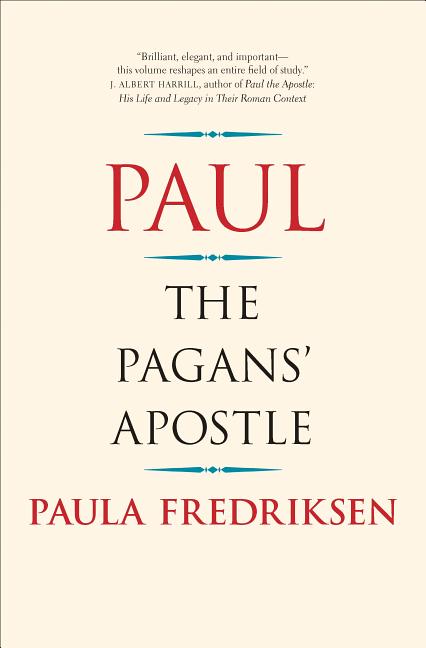
Early Christian historian Paula Fredriksen, though not a professing Christian, argues in her Paul: The Pagans’ Apostle that Paul did not “convert” to Christianity. Rather, Paul saw Christianity as fulfilling the message of the Hebrew Scriptures, and that Paul remained within the fold of Judaism to the very end of his ministry.


A Scholarly, Non-Evangelical Look at the Life & Ministry of the Apostle Paul

For Veracity readers, it is important to know that Dr. Fredriksen is not an evangelical in her theological orientation. From Jesus to Christ: The First Christians alarmed conservative Christians in the promotion of “Jesus Seminar” views that were well publicized in the 1990s. But in fairness to Dr. Fredriksen, she does not come across as having an axe to grind, as it is not completely clear to me even what her theological convictions are, though I have been told she is a former Roman Catholic turned Jewish. According to her writings, she seeks to act purely as an historian, putting together what she estimates is a competent reconstruction of the historical record, even where our current sources are not as plentiful as we would all like. Though popular among skeptics, Paula Fredriksen does not appear to be cynically antagonistic, for she acknowledges a set of facts, an “historical bedrock,” that does not explicitly rule out the central Christian claim that Jesus bodily rose from the dead.

To say that Dr. Fredriksen is not an “evangelical” is also to acknowledge that she does not uphold an historically orthodox, Christian view of the New Testament and its inspiration. Instead, she follows the thinking common in secular academia today regarding how the New Testament documents can be viewed as historical sources for reconstructing the life of Jesus and the period of the earliest Christ followers. This would include the topic of Paul, the Pagans’ Apostle, the life of the Apostle Paul. Outside of academia, and certain social media circles, few evangelical Christians know how a certain breed of scholars have a view of the Bible so radically different from their own.

For example, whereas the letters of Paul can be trusted upon as historically reliable, the Book of Acts is only reliable up to a certain point in comparison (Fredriksen,see footnote 1, chapter 3. ). She furthermore dates the writing of the Book of Acts to the early second century, which effectively takes the traditional authorship out of the hands of the historical Luke, who probably died long before the first century ended. She concludes this, despite the fact that the well known British 20th century liberal scholar, John A.T. Robinson, saw no firmly established scholarly reason why the entire New Testament could not be dated before the year 70 C.E.

But even with the “letters of Paul,” a caution is in order, in that of the thirteen letters directly ascribed in the New Testament as being written by Paul, only seven of them are considered to be authentic, whereas the letters 2 Thessalonians, Ephesians, Colossians, 1 Timothy, 2 Timothy, and Titus are to be regarded as letters written after Paul’s death, by writers other than Paul, seeking to modify Paul’s theological agenda. None of this would sound strange at all to an atheistic scholar, like a Bart Ehrman, who fully embraces such views.

For those committed to the idea that our received New Testament canon is the final authority for Christian faith and practice (as I do), such views held by academics like Dr. Fredriksen (and Dr. Ehrman) are in direct conflict with an evangelical view of Scripture. As will become evident in this review, a number of conclusions that Dr. Fredriksen makes about early Christianity will stand at odds with more classic understandings of Christian belief. Nevertheless, while I disagree with Dr. Paula Fredriksen regarding her view of the Bible, I still think that historically orthodox Christians can learn a good deal from her, particular from someone as skilled and learned as she is.

As a Christian, Did Paul Remain a Jew? 

With this caveat in mind, there is much to be gained from Paula Fredriksen’s central thesis that Paul remained a Jew, and continued to be thoroughly Jewish, as he became perhaps the single most articulate and influential leader of the early Christian movement, after the crucifixion, resurrection, and ascension of Jesus. The question that continues to puzzle such scholars is in explaining how such a committed Jew like Paul came to the conclusion that a way be opened up to include Gentiles among the people of God, along with Israel, without the circumcision requirement that classically identified what it meant to a member of God’s covenant people.

For many Christians today, knowing that Paul has a Jewish background is a “no-brainer.” I mean, is it not obvious?  Paul was Pharisee, was he not? However, Dr. Fredriksen argues in Paul, the Pagans’ Apostle that the importance of Judaism in the life of Paul, after he became a follower of Jesus, and as apostle to the Gentiles, has been greatly misunderstood and under appreciated.

Part of the key in appreciating Paula Fredriksen’s approach comes in perceiving the difference between “Gentiles” (a religiously neutral, ethnic term) and “pagans” (a religiously specific, ethnic term denoting non-Jews and non-Christians). For a non-Jew to follow Jesus, in Paul’s mind, they would remain a Gentile but they would need to give up their pagan idolatry and beliefs.The question of what is a “Gentile” and what is a “pagan” has interested me for years, and Paula Fredriksen thoroughly explores the topic.

Since the 1977 publication of (the late) E.P. Sanders Paul and Palestinian Judaism, a revolution has taken place in the academic study of Paul. Since the days of Martin Luther, in the 16th century, much of Protestant scholarship has insisted on a radical break between the Christian message of Paul and the story of Judaism. But with the advent of this “New Perspective on Paul,” inaugurated by Sanders’ research, a one-time professor at the College of William and Mary, where I currently work on staff, scholars have been working to reassess Paul’s relationship to the Judaism of the first century. Some look upon the “New Perspective on Paul” as a refreshing way of trying to approach the intractable divide between Protestants and Roman Catholics on the thorny issue of justification, whereas others view it as a threat to undermining the classic Reformation view of salvation.

Paula Fredriksen’s Paul, the Pagans’ Apostle attempts to steer a middle course through the debate between the New and Old Perspectives of Paul, which is probably the most sensible path forward. Fredriksen’s research is top notch, as her endnotes are well documented, something that the audiobook version I listened to on Audible sorely lacked, which meant a trip to the library for me! Fredriksen’s description of the Greco-Roman and Jewish worlds that Paul lived in is very insightful, and gives the reader a lot of food for thought. Still, there are other assumptions made in Fredriksen’s work that will frustrate evangelicals who try to read her.

Did the Council of Nicea Get Paul Wrong?

A modest acceptance of at least some of the New Perspective on Paul has even made its way into conservative evangelical circles, notably through the writings of N.T. Wright, perhaps the most well known New Testament scholar living in our day, in the first quarter of the 21st century. Nevertheless, Fredriksen’s approach is colored by a sharp disagreement she has with scholars like Wright, mainly in what undergirded the sense of urgency that Paul had in trying to spread his Gospel far and wide throughout the Roman Empire.

In a stunning statement, most likely directed at scholars like Wright, Paula Fredriksen urges “that we try to interpret both Paul and his Christology in innocence of the imperial church’s later creedal formulas.” This would suggest that Dr. Fredriksen believes that the early church’s move to articulate in the Nicene Creed an affirmation of the Son as being of the same substance as the Father is actually a distortion of the Gospel message being promoted by the historical Paul, as she sees him. Really?

Her analysis comes partly from her reading of Philippians 2:5-11:

Have this mind among yourselves, which is yours in Christ Jesus, who, though he was in the form of God, did not count equality with God a thing to be grasped, but emptied himself, by taking the form of a servant, being born in the likeness of men. And being found in human form, he humbled himself by becoming obedient to the point of death, even death on a cross. Therefore God has highly exalted him and bestowed on him the name that is above every name, so that at the name of Jesus every knee should bow, in heaven and on earth and under the earth, and every tongue confess that Jesus Christ is Lord, to the glory of God the Father (ESV).

Fredriksen notes that our English translations can fool us here, in that the word “God,” capitalized four times in this passage, commonly suggests the one divine being, God the Father. However, in the first two instances (verse 6) the word “God” has no definite article whereas later (verse 9), beginning with “Therefore God,” does have the definite article in the original Greek. In her view, this suggests that the reference to “therefore (the) God” means that it was God the Father who highly exalted Jesus, but those two prior references, which she translates in lower-case merely as “god,” or “a god,” as in “in the form of a god,” is a reference to divine status, but that this divine status is for some other divine being apart from God the Father. “Paul distinguishes between degrees of divinity here. Jesus is not ‘God’” (Fredriksen, p. 138).

I can only imagine Arius, the arch-heretic who debated the other early church fathers gathered at the Council of Nicea, issuing to Dr. Fredriksen a hearty “thank you!,” as Arius believed that Jesus was divine, but not in the same way the Father was divine. Jehovah’s Witnesses today pick up the same type of idea by asserting that Jesus was an angel, a divine being, but surely not of the same substance as God the Father, which was articulated in the creed at Nicea.  For Fredriksen, Arius was simply reading his Greek New Testament to make his case against anything that hinted of a Triune nature of God, in an effort to uphold what he understood to be monotheism.

Dr. Fredriksen then goes onto handling an objection, namely that for Paul to say that “Jesus Christ is Lord,” according to the ordinary Greek of the day, suggests that the meaning of “Lord” (kurios, in the Greek) is a deference to any social superior, and not necessarily divine (Fredriksen, p. 139). However, a careful examination of the passage that Paul is drawing from in the Septuagint (LXX) indicates otherwise. Throughout Isaiah 45, from where Paul gets his “every knee shall bow” and “every tongue confess” (Isaiah 45:23), each reference to the one true God is that Greek word for “Lord;” that is, kurios.  This would indicate that Paul undoubtedly had Jesus’ associated with the one true God in mind, and not merely some lesser divine being.

In other words, while Arius might have had certain good intentions of protecting against some form of polytheism in his reading of Paul, the orthodox church fathers who eventually won the debate at the Council of Nicea were able to read Paul better in his Old Testament context, thus making the case for Trinitarianism, against Arius. Dr. Fredriksen would strongly disagree with my assertion here. Nevertheless, historically orthodox Christian believers have understood Paul this way ever since. The Nicene Creed remains one of most familiar and well-affirmed statements of Christian belief in the history of the Christian movement, a common statement of faith among Protestants, Roman Catholics, and Eastern Orthodox alike.

A Common Assumption in Academia: Paul Emphatically Expected the Return of Jesus Within His Lifetime

So, given the shortcomings in her argument, why does Dr. Fredriksen urge such a movement away from the conclusions drawn up at the Council of Nicea? Dr. Fredriksen follows the standard consensus view among notably critical New Testament scholars, such as Bart Ehrman, that Paul “lived and worked in history’s final hour” (Fredriksen, p. xi), a well-known thesis popularized by the influential German New Testament scholar of the early 20th century, Albert Schweitzer.  In other words, Paul was absolutely convinced that Jesus would return as the victorious Jewish Messiah, to set the world order aright, sometime during his lifetime. This apocalyptic, eschatological expectation of the Apostle Paul is what drove him to preach far and wide across the greater Mediterranean coastlines and even inland.

As this story goes, when Paul eventually died, probably in the 60’s C.E., and there was no returning Messiah in sight, the Christian church was put into an existential crisis. What we possess in our New Testament today is essentially a combination of those early writings by Paul, along with other writings that came later, like the Gospels, that seek to refashion the message of the early Christian movement. With the failure of Jesus’ imminent return, this modified Christian movement, ultimately defined and regulated by the early church councils, most notably the Council of Nicea, now must endure for the “long haul,” something which has continued to survive and thrive now for 2,000 years.

Pushing Back Against the “Ghost of Albert Schweitzer”

In his multipart review of Paul, the Pagans’ Apostle, evangelical New Testament scholar Ben Witherington, of Asbury Seminary, critiques this presuppositional mindset that scholars like Dr. Fredriksen possesses. Witherington acknowledges that Fredriksen presents her central thesis well, despite the inadequacies of the Ehrman/Schweitzer approach that Fredriksen front loads to her book.

For example, when Paul states in Romans 16:20 that Christ will “soon” crush Satan under the feet of the Roman Christian community, he means that the crushing of Satan will happen “quickly,” a statement about how Satan will be crushed and not exactly when this would happen. For Paul also reminds the Romans in chapter 15 that he must go to Jerusalem, then to Rome, and then hopefully to Spain. So it would be odd for Paul to tell the Romans of his planned future schedule, years out in advance, while simultaneously announcing the coming end of the world, as he knew it, at any moment, as he was writing this letter. After all, Jesus himself acknowledged that he did not know the exact timing of his Second Coming (Mark 13:32). Witherington remarks, “Could we please now let the ghost of Albert Schweitzer rest in peace, and stop allowing his misreading of Paul to continue to haunt the way we evaluate Paul?

Nevertheless, even Witherington largely agrees that Dr. Fredriksen is correct to say that Paul was not a “convert” to Christianity, in the sense that Paul was somehow leaving his Judaism behind to become a Christian. Instead, Paul saw that the Gentiles’ acceptance of the Gospel was part of the new post-Resurrection-of-Christ reality, that had been a part of Israel’s story told for centuries within the Old Testament. In other words, for Witherington, Paul’s “conversion” was an expression of his Jewishness, in light of the coming of the Messiah, albeit a rather radical expression, more radical than what Fredriksen is willing to admit.

Many Christians for centuries have imagined Paul to have “converted away” from Judaism, when he became a follower of Jesus, whereas Fredriksen is an advocate of the “Paul Within Judaism” school of thought. Sadly, this “parting of the ways” between Judaism and Christianity was exacerbated by the severe drop off of Jews entering the Christian movement, and rapid increase of Gentiles joining the movement, particularly after the failure of the Bar Kokhba revolt in the early 130’s C.E.

That being said, Witherington faults Fredriksen for being too dismissive of some of the historical details that Acts offers up to support the narrative found in Paul’s letters about his own life, or to miss the more radical implications of Paul’s message, even in his own letters. For Paul saw that the death and resurrection of Jesus inaugurated a New Covenant, a fulfillment of what Jeremiah 31 says would be the law written on people’s hearts. Yes, Paul remained a Jew throughout his life, but following his road to Damascus experience, he radically reframed his Judaism along the lines that would eventually inform historical, orthodox Christianity (The late New Testament scholar Larry Hurtado shares a similar appreciation of Fredriksen’s approach while offering critiques similar to Witherington’s).

Paul in prison, by Rembrandt (credit: Wikipedia)

True Judaism for the Apostle Paul

With those critiques already in view, it is helpful to consider positively more what Paula Fredriksen is trying to do in her central thesis regarding Paul. The challenge of properly translating a passage like Galatians 1:13-14, when Paul explains his former life before becoming a follower of Jesus, is a case in point:

For you have heard of my former life in Judaism, how I persecuted the church of God violently and tried to destroy it. And I was advancing in Judaism beyond many of my own age among my people, so extremely zealous was I for the traditions of my fathers (ESV).

What does Paul mean by “Judaism” here? Is he implying that by becoming a follower of Jesus that he is leaving one religion to join another? No, says Fredriksen. But if not, what then does Paul mean?

Furthermore, what is one to make of Romans 2:1-29, where Paul suggests that “true circumcision” is a matter of the heart (particularly Romans 2:29)? Being a “true Jew” is a matter of the spirit, of having the law inside of you, and not in one’s flesh. Is Paul redefining Judaism by taking circumcision out of the mix? Or is Paul addressing Gentile Christians here, showing them that circumcision should not be a barrier to their following Jesus?

There were certainly barriers for Gentiles to become Jews in the first century. The “God fearers” of the New Testament were attracted to the message of Judaism, but would not follow with circumcision. You also have the question as to how much proselytizing of Gentiles by traditional (non-Christian) Jews was actively being done in the first century, a practice that Dr. Fredriksen is skeptical about.

Who exactly were the Judaizers that Paul opposed in Galatia, those supposed followers of Christ who opposed Paul’s anti-circumcision efforts among the Gentiles? Did they really come from James’ church in Jerusalem? Were they instead other supposed Christ-followers, unaffiliated with James, who opposed Paul’s missionary tactics as being compromising? Was the conflict in Galatia over the same issue Paul faced in Antioch, or something different? Was the specific Judaizing complaint table fellowship between Gentile and Jewish believers in Jesus, or something else?

Paul vs. Judaism, or Paul vs. Christian Judaizers?

These are the questions that preoccupy Paul, the Pagans’ Apostle. One point that Fredriksen raises deserves highlighting. In Galatians, particularly in Galatians 4, where Paul brings out an allegory comparing the children of Sarah versus the children of Hagar, Fredriksen notes that most interpreters historically have said that Paul is comparing Christianity (children of Sarah) with Judaism (children of Hagar). But Fredriksen claims that this interpretation is incorrect, in that Paul is arguing for the difference between Christ-followers who take his approach to Gentile evangelism (children of Sarah), and those other Christ-following Jews who oppose him, and distort the Gospel (children of Hagar). On this observation, I find Paula Fredriksen’s argument quite persuasive (Fredriksen, p. 99-100).

Scholars, both conservative and liberal, have acknowledged that the preaching ministry of Jesus, prior to the crucifixion, was oriented towards the Jews of Palestine. Jesus rarely ventured outside of Jewish-dominated areas in what we now call the land of Israel. With a handful of exceptions, Jesus’ primary audience was Jewish.

It was not until Paul came along, with his road to Damascus experience with the Risen Jesus, that the early Christian movement began to actively engage outreach among the Gentiles. By emphasizing having faith in Christ, and removing circumcision as the traditional barrier for entry among the people of God, as described in the story of the Bible, Paul revolutionized the Christian movement. At the same time, Dr. Fredriksen argues, the Apostle Paul himself, along with the original members of Jesus’ apostolic circle, remained committed to their own ancient Jewish customs, despite the trend in later Christianity to make Paul appear to be anti-Jewish (Fredriksen, p. 106).

For while Paul vehemently opposed the “Judaizers” who distorted his Gospel in Galatia, Paul still insisted on at least some form of “Judaizing” for Gentile followers of Jesus. He insisted that Gentile believers forsake idolatry, adhere to the Ten Commandments, give up sexual immorality, and uphold “any other commandment” of the Law (Romans 13:9, Fredriksen, p. 119). This raises the question as to why Paul drew the line at circumcision as he did.

Rethinking Old Approaches to Paul

Dr. Fredriksen wades into the debate over the meaning of “faith” (pistis, in Greek), which she sees as having a long history of referring to “psychological inner states concerning authenticity or sincerity or intensity of ‘belief‘.” She corrects this misunderstanding by appealing to a meaning more sensible to Paul’s first century context, that of ‘“steadfastness” or “conviction” or “loyalty”‘(Fredriksen, p. 121). I resonate with her translation of Romans 13:11b: “Salvation is nearer to us now than it was when we first became convinced.”  Compare this with the Common English Bible translation of the same: “Now our salvation is nearer than when we first had faith,” which is much more ambiguous.

From a fresh perspective, Dr. Fredriksen contends that the mysterious “I” of Romans 7:7-22 is a rhetorical device used by Paul, and not a reference to his own spiritual struggles, neither as a non-believer before his encounter with Christ, nor himself as a believer (example v. 15: “For I do not understand my own actions. For I do not do what I want, but I do the very thing I hate“). Accordingly, Paul is self-identifying as “the non-Jew who struggles to live according to Jewish ancestral customs,” as they follow Christ (Fredriksen, p.123-124). This reading is quite plausible, though it is quite different from the late-Augustine interpretation of Paul’s struggle with indwelling sin as a believing Christian. Nevertheless, both Fredriksen’s reading and the late-Augustinian reading are not necessarily in conflict with one another.

Fredriksen is convinced that Paul knew his Hebrew Scriptures (the Old Testament) well enough to know that there would come a day when the nations of the world would turn from their idolatry and embrace of the God of Israel. With the coming of Jesus as the Messiah, Paul knew that this day had come. But this bringing in of the Gentiles into God’s covenant people would not be limited by circumcision, but rather would be conditioned by their response of having faith in Jesus. Paul sees this as being completely consistent with the message of the Hebrew Scriptures, and is therefore adamantly opposed to other Jewish “Christ-followers” who do not read the Old Testament just as he has.

Furthermore, there is no such thing as two different ways of salvation, one for the Jews and another way for the Gentiles. All of the people of God, whether they be Jew or Gentile, are reconciled to God through faith in Christ.

The way Dr. Fredriksen frames her argument has implications on how Christians should read their Bible. For example, many Christians continue to read the Book of Romans without this Pauline mindset in view. As a result, many Christians look at his whole argument for justification/salvation as starting in Romans 1 and culminating in Romans 8, with Romans 12-16 as being about the application of Paul’s theological treatise. Romans 9-11 then sticks out like a sore thumb, as like some sort of appendix bolted onto Paul’s teaching in Romans 1-8. Yes, Romans 8 does end with a glorious promise that no one will separate us from the love of Christ. But there is more to the story. The lesson I take from Dr. Fredriksen is that the Romans 1-8 story only gets us part of the way there to where Paul is going. Rather, Paul wants to show us how “all Israel will be saved” (Romans 11:26). Paul’s theological argument runs from Romans 1-11, where Romans 8 offers a theological crescendo, but Romans 11 is the real climatic conclusion.

As an aside, on a somewhat minor point, Paula Fredriksen is completely right to say that Paul’s allusion to Isaiah 45:23, that “every knee shall bow” to God, in both Philippians 2:10 and Romans 14:11 is about all of the nations coming to the conscious realization that Jesus is the True Messiah, not simply that of Israel, but that of all of the nations of the world, at his final return (footnote 15, chapter on “Christ and the Kingdom”). These New Testament verses have been used either to justify some type of begrudging acceptance of Jesus’ Lordship by the wicked in hell, after the final judgment, or to justify a type of Christian Universalism, implying that every human individual will be saved in the end. However, the reference to “every knee shall bow” by Paul is not about individuals but rather about the nations, with every bowing of the knee referring to each distinct national allegiance, as the context of Isaiah 45 shows.

Rethinking Pauline “Anti-Jewishness” …. (Without Compromising Historically Orthodox Christianity)

Nevertheless, a number of other conclusions made by Dr. Fredriksen are driven by her acceptance of the common academic narrative that the authentic Paul only wrote seven of the thirteen letters we possess, which is further skewed by her adoption of the Ehrman/Schweitzer “imminent end of the world” thesis. In fact, these are fundamental assumptions that she makes without apology (Fredriksen, p. 252).

This is quite evident when you compare Fredriksen’s reading of 1 Thessalonians, an undisputed letter of Paul, which includes the famous passage on the “Rapture” (1 Thessalonians 4:13-18), which she believes teaches the imminent return of Christ within Paul’s lifetime, with her reading of the disputed 2 Thessalonians, which she believes was written by another author claiming to be Paul, which “explained the reasons for the Kingdom’s evident delay, adding a punch-list of necessary further events before the final apocalyptic scenario could unwind (2 Thes. 2:1-11)” (p.169). In other words, in her view, 2 Thessalonians attempts to fix Paul’s erroneous expectation, sometime after Paul’s death of the coming Kingdom with a different message, that emphasizes a more “we-are-in-this-for-the-long-haul” approach to the consummation of world history.

As another example, she appears to favor the position that the “deutero-Pauline author [of Ephesians] collapses the ethnic distinctions that Paul himself upheld” (footnote 35, chapter on “Paul and the Law”) between Jew and Gentile, in contrast with the authentic Paul. Furthermore, she believes that the authentic Paul discouraged the act of having children, as being a distraction from the imminent return of the Messiah (p. 113). She believes that the “Pauline” teaching about parents having authority over their children, as described in Ephesians and Colossians, was a non-Pauline teaching introduced into our New Testament to accommodate the reality of the failure of Jesus to return within Paul’s own lifetime.

Paula Fredriksen asks vital questions about Paul’s precise thinking about the message of the Gospel with his self-understanding of what it meant to be Jewish. Fredriksen rightly reveals the theological wedge driven between Paul the missionary to the Gentiles and Paul the faithful Jew, a trend that eventually dominated a great deal of Christian theology. While the phrase “replacement theology” is often too elusive here, it is correct to say that if there was one particular failure of the early church, particularly from Constantine onwards, it was the tendency to marginalize the Jewishness of the earliest Christian movement to the point of enabling a kind of anti-Judaism that has done tremendous harm throughout Christian history.

While voices like Origen and Augustine resisted such anti-Jewish thinking, by reminding their readers that Paul and other early Jewish Christian leaders maintained many of their ancient Jewish customs, not everyone heeded these voices. This anti-Judaism wedge was even codified into certain aspects of Roman law, in the post-Constantine era (Fredriksen,see footnotes 25, 26, under chapter “Paul and the Law”). Aside from Origen and Jerome, very few of the early church fathers even understood Hebrew, which is the primary language in which the Old Testament was written in!!

But Paula Fredriksen’s attempt to obliterate that wedge is eventually an overcompensation, a product of her historical methodology. For it is evident that her view of the New Testament contrasts sharply with the received view of the church, down through the centuries, which views all of the thirteen letters of Paul as being authentically Pauline. I, on the other hand, believe that the early church got the canon of Scripture right!

Anti-Judaism is not a core feature of historical, orthodox Christianity. For example, you would be hard-pressed to find conservative evangelicals who do not possess profound sympathies with Jewish people today. In other words, you do not have to buy into the full revisionist program of much of critical scholarship today in order to root out “anti-Jewishness” understandings of Paul that have, nevertheless, crept into at least certain interpretations of the New Testament.

There are plenty of resources within historical, orthodox Christianity to tackle the task Paula Fredriksen takes up. She convincingly demonstrates that a traditional view of a Paul who “converted” from Judaism to Christianity is anachronistic and wholly unnecessary. For the language of “conversion” presupposes a modern concept of “religion” which was in many ways foreign to Paul and his world. Paul’s Christianity was not a rejection of Judaism, per se, but rather it was the outworking of his Jewish faith, set within the context of the coming of the Messiah.

In other words, while is it surely correct to say that Paul indeed “converted” to Christ, by embracing Jesus’ mission and following the Risen Lord, it would be wrong to say that Paul “converted” away from Judaism to get to something else, like “Christianity.” As an evangelical, I am thankful to Dr. Fredriksen for pointing this out. However, it is not a prerequisite to accept the whole of Fredriksen’s critical, non-evangelical assumptions about the Bible to get her central thesis.

Rethinking Paul’s Greatest Letter: To the Romans

However, I am not entirely convinced yet by Dr. Fredriksen’s attempt to re-read Romans is correct, though it is a coherent and plausible reading.  She believes that Paul’s audience are Gentile Christians, at least some of whom consider themselves as “Jews” (Romans 2:17). Yet she does not think that Paul is addressing any actual Jewish, bodily-circumcised Christians in Romans. Instead, Pauls uses a rhetorical style, by implicitly addressing a “so-called Jew” as the interlocutor of his argument; that is, a Gentile Christian who is trying to Judaize too much (Fredriksen, pp. 156ff). This goes against the standard reading that the recipients of Paul’s letter to the Romans were a mix of both Gentile AND Jewish Christians, who were not necessarily getting along very well with one another, from the reports Paul had received. So in Romans 2, according to Fredriksen, Paul is addressing a Gentile “who calls himself a Jew,” and not someone who was bodily circumcised, a view consistent with how she interprets Romans 7 (see above).

The problems here are several. First, it is hard to imagine that Paul would go to such great lengths to write such a treatise to a Christian community he had not yet met, and completely ignore the Jewish part of that community in his correspondence. When Phoebe presented Paul’s letter to the church in Rome (Romans 16:1-2), did she ask the Jewish Christians to leave the room while inviting the Gentile Christians to stay and listen? Probably not. But perhaps the believers in Rome, both Jew and Gentile, would have caught onto Paul’s rhetorical style. But then, maybe not.

Secondly, according to Dr. Fredriksen, Paul’s great statements in Romans about justification, particularly in Romans 3, are primarily aimed at Gentile believers, and not all believers as a whole. This does not necessarily mean that Paul’s teaching about justification could not be extended to Jewish Christians as well, as a further application of Paul’s teaching in Romans. But I am not yet persuaded that her reading of Romans will bring about a clear breakthrough in the persistent debates regarding the nature of justification among theologians. Excluding Rome’s Jewish Christians from the intended audience of Paul’s letter to the Romans is a problematic weakness to Dr. Fredriksen’s argument.

I might add that there are a few other places in Paul, the Pagans’ Apostle, where it is hard to connect Dr. Fredriksen’s conclusions with the actual data she cites. For example, in her discussion about the controversial term “righteousness“, (in Greek, dikaiosynē) she ties Paul’s thinking of righteousness quite exclusively to the adherence to the second table of the Ten Commandments, which does not exactly line up with the Scriptural texts she references (Fredriksen, p. 120-121).

In the prior paragraph, she rebukes the RSV translators for rendering Romans 1:4b-5 as “Jesus Christthrough whom we have received grace and apostleship to bring about obedience to the faith,” as there is no definite article associated with “faith” in the Greek original. Fredriksen is correct in that the use of “the faith” connotes the idea of faith as a set of propositional statements that one must believe, which is not in view here in Paul’s writings. But the version Fredriksen is quoting dates back to the 1953 printing of the RSV, a reading that was apparently grandfathered in from the KJV. Yet as of 1973, the inclusion of “the” in “the faith” had been removed from the RSV, and I could find no modern, recent translation of the RSV, the ESV that succeeded it, nor the new NRSV with the definite article included. Perhaps Dr. Fredriksen mistakenly had the KJV in mind, but it would seem odd to point out an error in the RSV that was corrected perhaps some 50 years ago. Little head scratchers like these pop up every now and then in Paul, the Pagans’ Apostle.

With all of this in mind, I would not necessarily recommend Paul, the Pagan’s Apostle to Christians who are unfamiliar with Fredriksen’s type of critical biblical scholarship. The landmines you would have to walk over to get to the valuable insights Dr. Fredriksen has regarding a neglected aspect about Paul and his mission might be too distracting and discouraging. But for someone who can read something like a Bart Ehrman book, without throwing it at the wall in utter frustration, Paula Fredriksen’s Paul, the Pagan’s Apostle makes for a provocative and refreshing look at the Apostle Paul.

Rethinking Paul? So What??

Some might respond with a yawn about such questions that come up about Paul and his relationship to Judaism, with a “So what?” But such indifference is woefully mistaken.

The circumcision issue in Paul’s day is not something which has no bearing for Christians today. A lot of people wonder if certain other “quirks” of Judaism still apply for Christians in the 21st century. Some argue that Paul’s dismissal of the circumcision requirement for Gentiles, in order to be Christian, is a model for jettisoning other peculiarities associated with the Old Testament-inspired Jewish tradition for us living 2,000 years later. Others (like myself) disagree, saying that Paul’s “disputable matters” position on eating food sacrificed to idols and his opposition to Gentile circumcision for Christ-followers was more probably unique for those particular issues Paul was thinking about and should not be confused with contemporary concerns, such as with Westernized rethinking concerning gender, sexuality, and marriage, explosive topics for not only non-believers but believers in Jesus today as well.

There were “God-fearers” in the first century Roman Empire, such as the centurion in Luke 7:1-10, who admired the Jews and who were drawn to the God of Israel, and yet they were not prepared to go the full conversion route into Judaism by becoming circumcised.  Perhaps there are “God-fearers” today (or some nearly equivalent category) who admire the Christian faith, but who find certain obstacles to historic orthodox Christian belief and practice that they are unwilling to embrace. This is an area that requires concentrated thought and discussion, in our current post-Christian era where once widely accepted Christian beliefs and practices have now become deeply controversial in recent decades.

Then there is the whole debate about justification, that placed an intractable wedge between Protestants and Roman Catholics in the 16th century, that still haunts the church to this day. The type of reassessment of the Apostle Paul offered by scholars like Paula Fredriksen might go a long way towards opening new paths for dialogue in healing this rift within the Christian movement. I read her Paul, the Pagans’ Apostle, as a prelude to her more popular and accessible work, When Christians Were Jews, which I hope to get to in due time.



The “Replacement Theology” of Eric Metaxas?

Eric Metaxas, If You Can Keep It, encourages our culture to consider the legacy of American exceptionalism. I like a lot of what Metaxas has to say. But does he take us down the right road theologically?

Eric Metaxas, If You Can Keep It, passionately encourages our culture to consider the legacy of American exceptionalism. I like a lot of what Metaxas has to say. But does he take us down the right road theologically?

While your hot dogs are grilling and you wait for the fireworks…

There is much talk about “replacement theology” in the church today, as I am exploring in this summer’s blog series on Christian Zionism, concerning how national Israel relates to the Christian church. However, as the Fourth of July is nearly upon us, I wanted to briefly tackle a more pressing kind of “replacement theology” that dangerously threatens Christianity today. There is a disturbing trend among some Christians, who, in a sense, see the American nation as somehow “replacing” either the church or national Israel, or possibly both, within the plan and providence of God.

Popular Christian author and public intellectual, Eric Metaxas, has written a new book based on a saying attributed to Benjamin Franklin at the 1787 Constitutional Convention. When asked, “Well, Doctor, what have we got? A Republic or a Monarchy?,” the elder statesman replied, “A Republic, if you can keep it.” Metaxas’ If You Can Keep It: The Forgotten Promise of American Liberty, is a spirited defense of American exceptionalism, the idea that the American nation has a special, unique and even divine calling in world history.

Now, let me first say that I highly recommend Eric Metaxas to you as an astute public thinker. His Socrates in the City interviews with other thinkers are very helpful and stimulating. He has written one of my favorite biographies of Dietrich Bonhoeffer. But when I read two reviews of Metaxas’ latest book, first by Wheaton College historian Robert Tracy McKenzie, and the second by the Masters College  historian, Gregg L. Frazer,1 a question was raised in my mind.

In If You Can Keep It, Metaxas’ reviewers note that the author makes a number of historical errors that hamper his otherwise noble thesis. One of the most egregious errors concerns a common misreading of Massachusetts Bay governor John Winthrop’s 1630 sermon, “A Model of Christian Charity.” Metaxas misreads the famous line by Winthrop, that “we shall be as a city on a hill,” to be a reference to the American nation for all time. However, the original context of Winthrop’s sermon is concerning the witness of Winthrop’s particular Christian community, going back to the teaching of Matthew 5:14. In other words, Winthrop is teaching about the church, not about America as a nation.

Think about it: By replacing the church as the “city on a hill” with the American nation, does this not radically change the message of Matthew 5:14?

Furthermore, Metaxas proclaims that Founding Father, John Adams, was a “theologically orthodox Christian.” However, an observant reader in colonial American history will know that Adams rejected a number of core tenets of orthodox Christian faith, such as the deity of Christ, the atoning work of Christ for salvation, and the belief in the Triune nature of God.2 Adams also preferred the Hindu Shastra as the best source for “orthodox” theology.

Think about it: Does remaking the great patriot, John Adams, into an honorary evangelical Christian really help Metaxas’ case? Does not this mishandling of historical data, at the very least, confuse the reader?

So, while I am very sympathetic to Metaxas’ call to virtue and the role of Christian values in public life, his reworking of some details of American history raises this  disturbing question: Is Eric Metaxas promoting a kind of “replacement theology,” whereby the American nation replaces either the church or national Israel in the message of the Bible? For starters, read those two book reviews, previously linked above, read Winthrop’s sermon, or even allow Eric Metaxas to make his own case. Examine the evidence, think about it as you enjoy your hotdogs and the fireworks this weekend, and then come to your own conclusion.

Notes:

1. The Masters College is affiliated with the ministry of Southern California pastor and teacher, John MacArthur.

2. Concerning Adam’s views on the Trinity, popular evangelical speaker and writer, David Barton, has also made the same error on numerous occasions, suggesting that Unitarians prior to 1839, like John Adams, actually believed in the Trinity. Really??? Is not the whole point why Unitarians have historically called themselves “Unitarian” is because they reject the Trinity?


Christian Passion About Israel: Can We Talk?

Is the secular nation state of Israel a fulfillment of Bible prophecy? Veracity tackles a "hot potato."

If I had to name one, persistent, mind-boggling issue that has divided so many conservative, evangelical Christians, it would be this one: Israel.

Unlike, say the creation vs. evolution controversy, women in ministry, etc., that some categorize as conservative vs. liberal splits, the question of what to think and do about national Israel defies simple labels. There is tremendous pressure from the surrounding culture to go in very opposite directions. On one side, are those who view Christianity as complicit in enabling, and even consciously encouraging, centuries of antisemitism. On the other side, are those who view Christianity as terribly narrow and closed-minded, urging Christians not to try to share their faith with the Jewish people.

Nowhere does the issue become more focused and heated among believers, than when it comes to the subject of the land of Israel, and the current Jewish nation state that exists there in the modern Middle East. To one extreme, are those who view any criticism of the nation of Israel as being hateful and antisemitic. On the other extreme, vocal support of the nation of Israel at the expense of spiritual concerns is sometimes viewed as a compromise on the centrality of Christ, diminishing the need to have Christ, and Christ alone, for salvation.

Israel can be deeply polarizing.

Call me naive, but I am a big believer in the need for Christians to have better and more civil conversations with one another, on emotionally-charged subjects like Israel.  Otherwise, the consequences can be devastating. If Christians are unable to have frank and open dialogue with one another, without resorting to name-calling, then this brings ill repute upon the message of the Gospel to a watching world. In an effort to promote such open and brotherly discussion, I will soon embark on a multi-part blog series on the question of “Zionism,” and its relationship to Bible prophecy1.

As I have been studying Romans 9-11 over the past year or so, the theme of how a Christian should respond to “Zionism,” the Jewish desire to return to their ancestral homeland, pops up over and over again in my conversations with fellow believers. Keep an eye out for this upcoming blog series…. and keep your Bibles, and your minds, and your hearts open.

Do you want to get the conversation going? How about two movies that illustrate the tension in the discussion?

Continue reading