
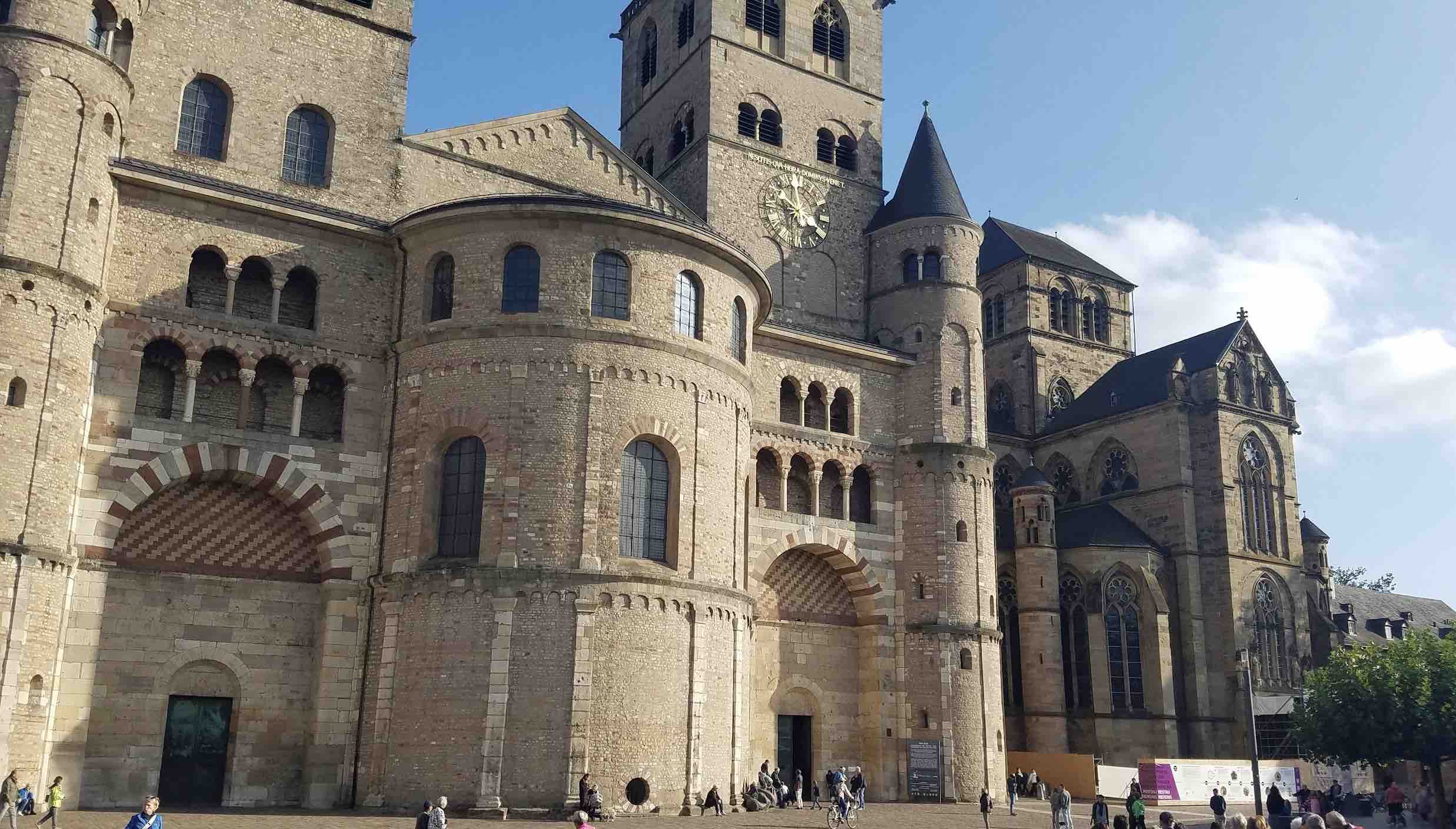
The Cathedral of Trier, Germany, with its mix of Gothic and Baroque architectures, built with bricks dating back to the Roman era. A grand symbol of Christianity which towered over the home of Karl Marx’s youth, just a few blocks away.
From the Christianity Along the Rhine blog series….
My elderly Scottish friend was looking a bit agitated, after she came walking back from viewing the statue of the (in)famous author of The Communist Manifesto…
My wife and I were waiting for our bus to pick us up after taking a walking tour of Trier, Germany. It was our last stop on our week-long cruise down the Rhine River, in October of 2025, which included an extra day or so traveling up the Moselle River, which flows into the Rhine. Trier is located up the Moselle River, close to the border with Luxembourg.
Trier is a very ancient city, going back to Roman times. Emperor Constantine, of the 4th century, spent a good bit of time there. Since Constantine, the influence of Christianity can be felt in Trier, with several large churches and a cathedral rising prominently above the city. As we left the plaza where the city cathedral was, we made our way to find our bus near the Porta Nigra, a wonderfully well preserved Roman gate to the old city.
While waiting for the bus, our tour guide pointed out an unassuming storefront with what looked like an apartment above it. Our tour guide told us that Karl Marx had lived in this apartment in the 19th century, until he was about 17 years old.
Who would have thought that one of the greatest masterminds of social change in the modern era grew up above a storefront like this one….
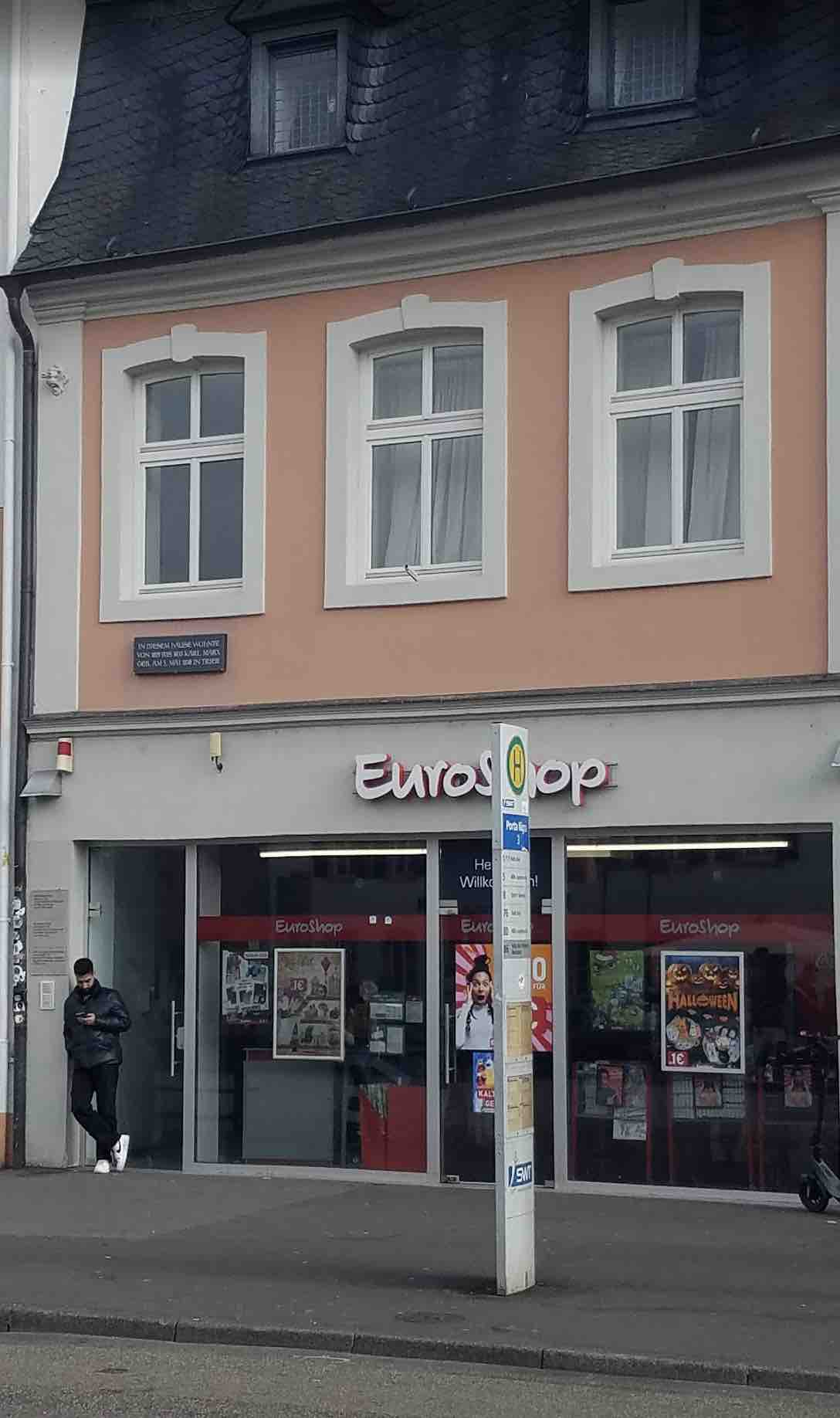
Karl Marx’ childhood home in Trier, Germany. Across the street from Porta Nigra, one of most well preserved architectural artifacts dating back to the Roman era.
Karl Marx infamously remarked that “religion was the opiate of the masses.” I do wonder if Marx’s experience living in Trier, with its massive cathedral only a few blocks away, had influenced him somehow to have such a negative view of Christianity. Marx’s parents were nominally Jewish when they grew up, but Marx’s father converted to Lutheranism just before young Karl’s birth, not because the father had a genuine faith experience, but rather because it allowed the father to retain his career as a lawyer in a predominantly Christian city.
Just down the street from Porta Nigra, I spotted an interesting statue about a block away. We had about fifteen minutes before our bus would arrive, so I went to check out this statue.
I passed a member of our group walking back from the statue, a sweet older lady from Scotland. My wife and I enjoyed several dinners together on our Viking longship with this lady and her Scottish husband during our week together on the Rhine River.
Her pace was brisk as I stopped her to ask about the statue. She told me that it was a statue of Karl Marx, but once she saw it, she immediately lost interest. Quickly, she took up her pace again, swiftly making her way back to wait for the bus. Clearly, her speech was dripping with disdain for the controversial intellectual, whose theories of economics and religion in the 19th century plunged the 20th century world of Europe into decades of chaos and the turmoil of the Cold War. Obviously, my Scottish friend lived through several of those decades as the Soviet Union and the rest of Europe were at odds with one another.
While Karl Marx never lived to fully realize his dreams of a utopian society free from the supposed shackles of Christianity, he had his followers. The most significant figure was the Russian political theorist Vladimir Lenin, the chief architect of the Bolshevik Revolution. Russia was really where the communist social experiment unfolded for the first time. But the seeds of the Russian revolution were germinated in coffee shops, universities, factories, newspaper printing shops, and apartments all over Europe in the era before the Great War (World War One).
A quick glance at Lenin’s biography indicates that he traveled extensively across Europe, outside of the watchful eye of the Russian government. London, Paris, Munich, Stockholm, and Bern, Switzerland were all cities where Lenin developed his ideas for radical social change, based on his reading of Karl Marx’s work. Having spent several weeks in Europe in October, 2025, it gave me an opportunity to think about how the legacy of Marxist/Leninist ideology had its beginnings.
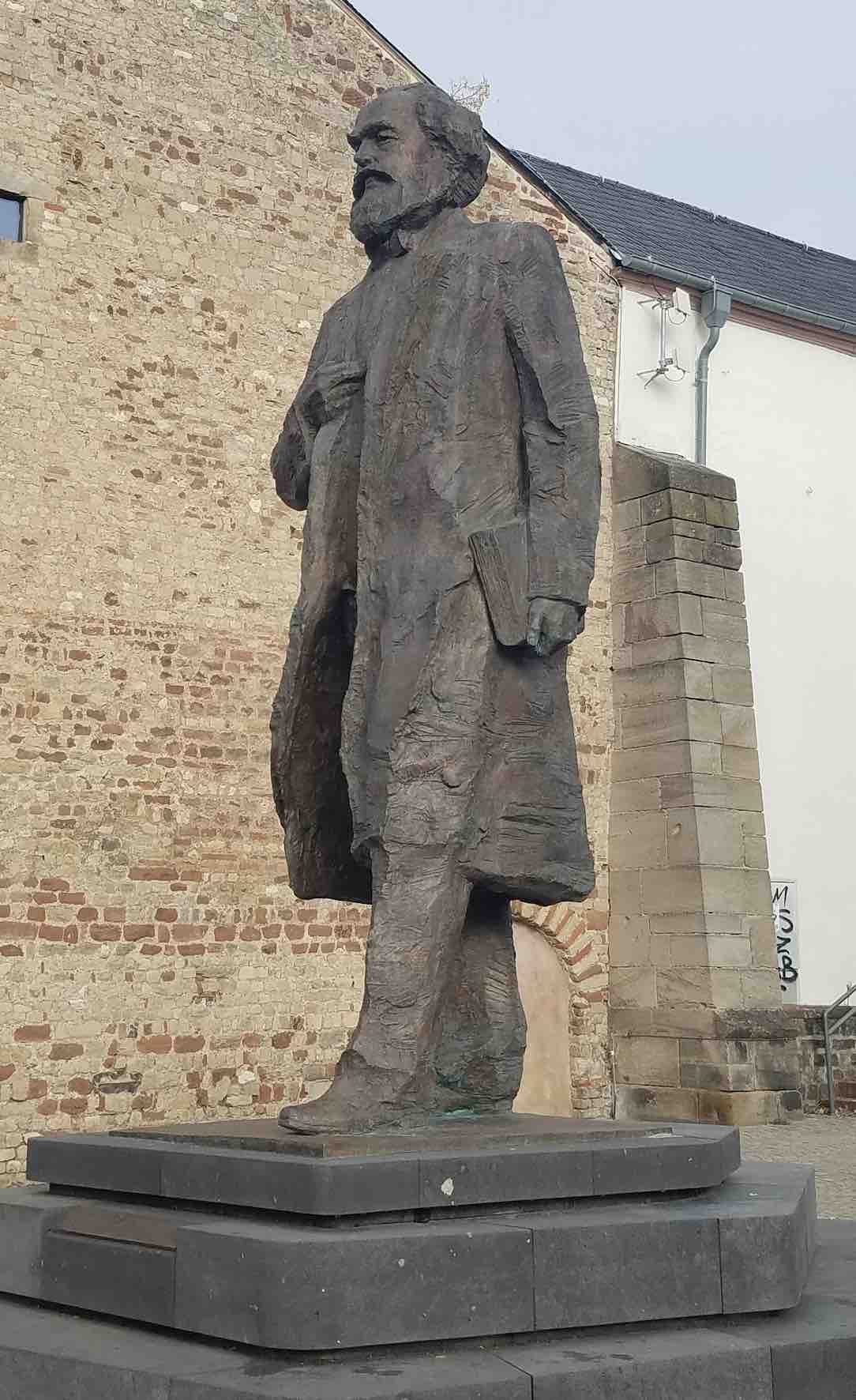
Statue of Karl Marx in Trier, Germany, the city of Marx’s youth. The statue remains as a testimony to the secularization in recent centuries of Europe, which was once the heart of the Christian world.
Historian Sean McMeekin wrote The Russian Revolution: A New History, published on the 100th anniversary of the Bolshevik Revolution in 2017, chronicles the story of the revolution, where Lenin had taken the theories of Marx and sought to put them into practice, towards the end of World War One. The book had come recommended to me by an evangelical Christian historian, Thomas Kidd. After visiting Trier, and walking around Marx’s statue there, I decided it was time to learn about the Marx-Lenin legacy.
The story of the book is a wild ride through the history of Europe a little over a hundred years ago. By the late 19th century, modern revolutions against traditional monarchical governments had shaken up Europe. The tsarist kingdom of Russia was no exception. A young Vladimir Lenin had grown up witnessing the conflict for himself.
Lennin’s older brother had joined a revolutionary group while studying at university. This older brother became involved in a plot to assassinate the tsar, but the plot was foiled before the attack could take place. Lenin’s brother was executed for this act of treason in 1887. Lenin would never forgive the tsarist government for killing his elder brother.
When Lenin himself went to university, he discovered the writings of Karl Marx, and it changed his life. By the last decade of the 19th century, and after recently getting married, Lenin had been arrested and sentenced to exile in Siberia. The tsarist government had given him a light sentence, as they did not view Lenin as being a serious threat, so Lenin was given a large measure of freedom during his exile. After serving his sentence, Lenin left Russia to wander around Europe. In city after city, Lenin would try to find other like-minded revolutionaries who had read Karl Marx’ writings, hoping to inspire them to come up with plans to achieve their utopian goals.
The Bloody Sunday massacre of starving Russian peasants by the tsar’s army in 1905 sparked a whole series of events which forced the tsar to allow for some reforms. Lenin thought these reforms were not enough, being completely sold on a vision of radical reform, based on violent overthrow of the government. Lenin moved back and forth, in and out of Russia, looking for an opportunity to put his plans into action.
Finally, the crisis of World War One served as the eventual opportunity to realize his dreams of a utopian world. Lenin was a brilliant strategist, and his Bolshevik party established the Soviet government. Part of Lenin’s apocalyptic vision was that once Russia would embrace communism that the rest of war torn Europe would follow suit shortly thereafter. While the full apocalyptic vision of Lenin was never realized, he did manage to trigger an intense civil war, with a bloody end leaving his revolutionary government with absolute power.
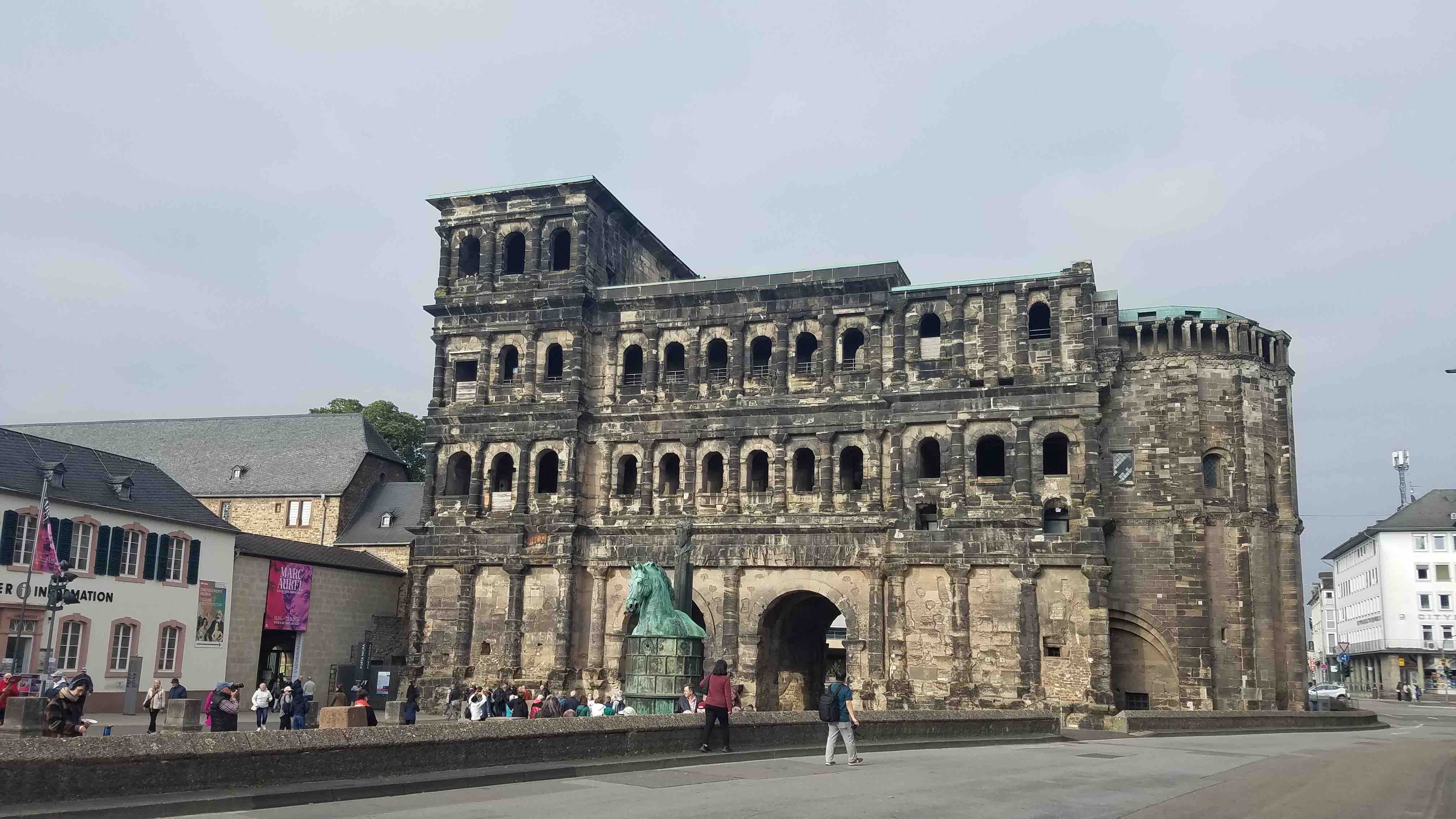
Porta Nigra is one the best preserved Roman gate to the city of Trier, Germany. The gate dates back to 170 CE, before Christianity had thoroughly spread across the Roman Empire. I took this photo from the sidewalk in front of Karl Marx’s boyhood home (at least for a time), an apartment above a retail shop.
McMeekin takes the reader on the journey, with all of its twists and turns. While the book never dives too deeply into the theological beliefs of the leading figures of the Bolshevik Revolution, including Lenin, it does make one think how such an ideological vision of a political utopia, bent on trying to destroy Christianity, could have wrecked so much havoc on the world of the 20th century. The main drawback of McMeekin’s work is that he focuses primarily on secular and political matters, without going enough into the reasons why Bolsheviks like Lenin were motivated to do what they did.
The big takeaway from McMeekin’s work I got was that Lenin managed to pull off a massively successful bait-and-switch tactic to obtain power in Russia. World War One was not going so well, forcing Tsar Nicholas to abdicate his throne in the spring of 1917. But the Russian liberals who succeeded Nicholas did not fair much better, and Lenin seized the opportunity culminating in the October Revolution later that year. Lenin campaigned on a peace platform for getting Russia out of the war with Germany, only to focus his energies on fighting an intense civil war, between the Red and White Russian armies, all in the name of Marxist ideology. The Reds ultimately won, but at a terrible cost. Many more Russians died during the Russian civil war than during the war with Germany, mostly due to disease and starvation.
As I stood staring at that statue of Karl Marx in Trier, Germany, it made me wonder if Marx ever really imagined that his theories of political utopia would lead to the deaths of millions of people. At one point during the Bolshevik rise to absolute power, the new government was so short of cash that gangs of Bolshevik thugs raided and looted Russian Orthodox churches, looking for treasures of chalices and artwork that could be sold on the black market, murdering devout Christians who stood in their way. McMeekin puts the number of deaths related to the Russian revolution at over 20 million people.
I never made it to Russia when my wife and I went to Europe in October, 2025…. probably could not even get there now, even if I wanted to. Much has changed since the late 1980’s collapse of the Soviet Union, which was built upon the ideologies of Karl Marx and Vladimir Lenin, but Russia’s place in the world today has been severely complicated by its military invasion of the Ukraine. It makes me wonder how much the Marx-Lenin legacy still lingers on in Putin’s Russia.
After finishing Sean McMeekin’s book, The Russian Revolution: A New History, I fully understood why my older lady friend from Scotland, whom my wife and I met on our river cruise down the Rhine River, never wanted to learn any more about Marx’s statue once she spotted it. Now I know why she looked so agitated, as she briskly walked away from viewing Marx’s statue. As someone living in Europe, in the shadow of the 20th century conflict resulting from the terror introduced by Marxist-Leninist ideologies, she knew enough already.
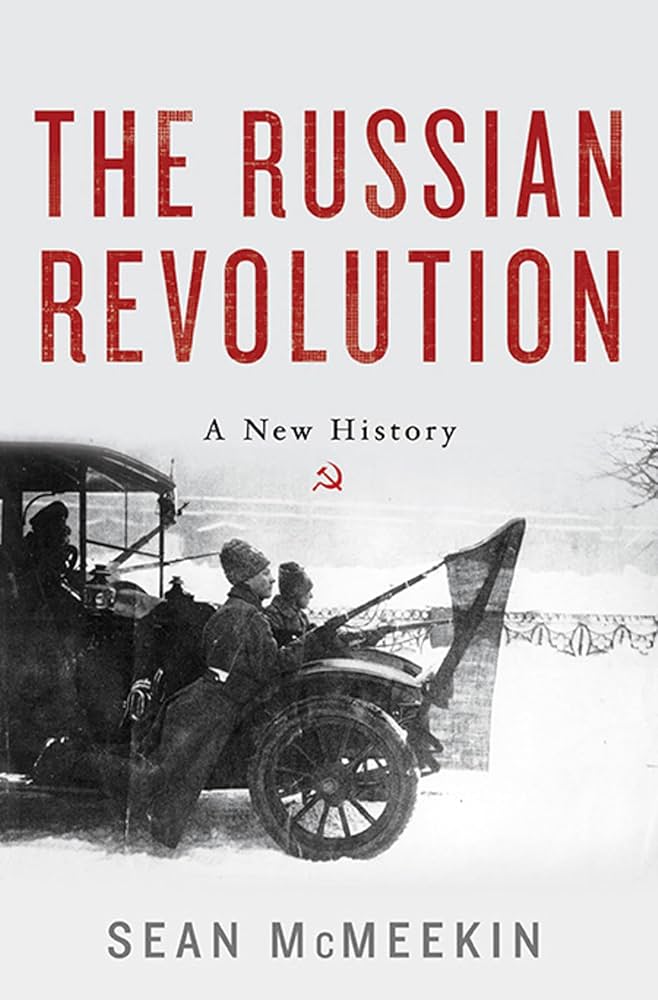
The Russian Revolution: A New History, by Sean McMeekin.



