Tag Archives: joshua swamidass

The Scopes Monkey Trial: One Hundred Years Ago

I do not know where all readers of the Veracity blog live, but here in my native Virginia, it is blazing hot now in mid-July!

In between sweating through yet another shirt, I ran across a fascinating article by Washington University biologist Joshua Swamidass at Christianity Today magazine: “Setting Our Scopes on Things Above.” I was reminded that exactly one hundred years ago this week, that the “trial of the century” took place in an extremely hot Tennessee, long before courtrooms had air conditioning!

John T. Scopes, a high school biology teacher, was charged with violating Tennessee’s Butler Act, which prohibited the teaching of evolution in a public school. Scopes was found guilty, and forced to pay a $100 fine, which was later overturned, but that was not the real story.

The Scopes trial was ultimately a media event, not unlike the O. J. Simpson trials for the 1990’s. For those around at that time, people can remember television images of Simpson driving his white bronco as California police officers followed him down the interstate highway, trying to arrest the famous football player.

Likewise, the Scopes trial caught nearly everyone’s attention in 1925. While they did not have the Internet or television back then, they did have newspapers and radio, as dozens and dozens of journalists descended on the small town of Dayton to cover the trial. People were spellbound as William Jennings Bryan, a longtime presidential hopeful and conservative Christian, as the prosecuting attorney took on Clarence Darrow, an agnostic defender of science, and Scopes’ defense attorney. There was even a play written about the trial, which eventually became a movie, Inherit The Wind.
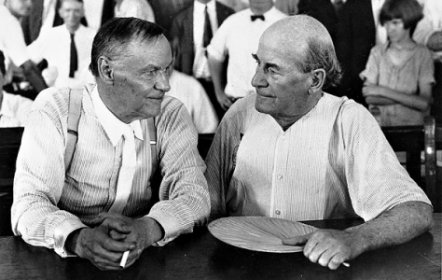
 

20th century cultural icons: cigarette smoking, agnostic advocate for science, Clarence Darrow vs. defender of the Bible, anti-evolutionist, populist politician, William Jennings Bryan, in the heat of a Tennessee summer.


Ironically, from today’s perspective, William Jennings Bryan was not a Young Earth Creationist. He was what might be a called a Day-Age Creationist, a form of Old Earth Creationism similar to what Hugh Ross at Reasons to Believe supports. While Scopes lost the court battle (at least initially), it was Christian “fundamentalism” which took the biggest hit, effectively pushing conservative Christians off the cultural mainstream. The sidelining of conservative Christianity would not show signs of reversing until the emergence of the “neo-evangelical” movement, embodied in personalities like Billy Graham, in the late 1940s and 1950s.

A few years ago, I wrote about the Scopes trial, along with a transcript of the (in)famous cross-examination of William Jennings Bryan conducted by Clarence Darrow, so I will not rehearse the details here. But the conversation about the Bible and its relationship to science has been a big part of the history of the Veracity blog over the past thirteen years. There are over a hundred blog posts about this conversation! Are the concepts of biblical creation and evolution compatible or incompatible with one another?

I thought it might be a good time to reflect on where I am now on the conversation. I have pretty much come to a similar conclusion that Dr. Swamidass has advocated for in his book, The Genealogical Adam and Eve: The Surprising Science of Universal Ancestry, one that I have reviewed and can highly recommend.

I think I can call him “Joshua” now, as I have personally corresponded with him before.  Joshua helps to run a discussion board website at PeacefulScience.org. On the one hand, Joshua is critical of others, whether they be scientists or bible scholars, who argue against the historicity of Adam, particularly a certain subset of Christians (but not all) associated with Biologos, a Christian think-tank started by Francis Collins. The argument against historical Adam is that genetic studies have shown that the human population could not have arisen from just two people, Adam and Eve, in that modern humanity arose from a much bigger population of hominids.

Joshua challenges that assertion against the historicity of Adam by citing an argument made centuries ago, that there were other humans living alongside of Adam.  In other words, the first humans created were not just Adam and Eve in Genesis 2. There were other humans, too, mentioned in Genesis 1.

There are several advantages to this solution: First, there is no need to tie all human descent as coming genetically from just two people. Other humans are involved as well. But what Joshua brings to the table is that all humans today, and even in Jesus and Paul’s day are all genealogically related to Adam and Eve, not necessarily genetically. The Bible is concerned about genealogy, not genetics.

Secondly, it resolves the difficulty made famous during the Scopes trial, when Clarence Darrow questioned William Jennings Bryan as to where Cain got his wife. Many Christian apologists today propose that Adam and Eve must have had an unnamed daughter, so that Cain must have married his sister. Various creationist groups, including the Young Earth Creationists at Answers in Genesis, as well as Old Earth Creationists at Reasons to Believe, hold to that apologetic proposal. There is no Bible proof text which explicitly supports this, as there is no mention in the Bible of Adam and Eve having daughters.

Yet this common proposal causes a big problem for historically orthodox Christianity, in that it effectively argues that God has changed his mind regarding the sexual morality status of incest. For if incest was okay for Cain, but then later declared by God to be sinful according to the Law of Moses, then this suggests that God can and has changed his mind regarding the definition of marriage. Many advocates of same-sex marriage today among Christians make the same sort of argument, saying that God could also change his mind regarding same-sex relations, condemning them all in the Bible times, but changing his mind today by accepting same-sex marriage now in the 21st century. Whole denominations of progressive Christians have gone down this route of biblical interpretation.

Joshua’s proposal is not a hill I am going to die on. But I do think it makes the best sense, considering other alternatives. A lot of Christians wrestle with the creation/evolution discussion, but Joshua’s book is one of the best I would recommend reading. I read Joshua’s book five years ago, and since then I have not found any proposal better than his. What makes Joshua’s proposal also helpful is that you can be a Young Earth Creationist, an Old Earth Creationist, or an Evolutionary Creationist, and still hold to a genealogical Adam and Eve and affirm the inerrancy of the Bible.

You might be interested in the following interview of Dr. Joshua Swamidass by another fellow scientist, who is a Christian, Rice University’s Dr. James Tour.  Dr. Tour does not agree with Joshua’s take on Genesis, but the following conversation shows that the two have more common ground as believers who affirm the bodily resurrection of Jesus. It is a great conversation showing how believers, with different views of Creation, can find a common bond between each other. Check it out!


UPDATE August 26, 2025:

Well, I have to say that YouTube and Tik-Tok sensation Dan McClellan actually gave me something to think about, which confirms my conclusion as to how best to interpret the rise of humanity in Genesis. McClellan argues that Genesis 4:1-2 teaches that Adam and Eve had sexual relations to produce Cain and then Abel.  However, the next time Genesis says that Adam “knew his wife again, and she bore a son and called his name Seth” is in Genesis 4:25.  However, the birth of Seth is after when “Cain knew his wife, and she conceived and bore Enoch. When he built a city, he called the name of the city after the name of his son, Enoch” (Genesis 4:17 ESV).

This rules out the traditional explanation that Cain married his sister. For the text says that the third child born to Adam and Eve was long after Cain got married, and so Cain could not have married his sister, if his sister had not been born yet, assuming Adam and Eve actually had a daughter to begin with.

Now that is something to ponder!!!

Some might object by saying that Adam and Eve could have had sexual relations prior to Eve’s pregnancy with Seth, thus allowing for another birth in between Abel and Seth, but not mentioned in the text, but the Hebrew does really allow for that kind of distinction, as the verse links both the sexual act and the pregnancy together with the “again,” thus indicating that this was Eve’s third pregnancy, and not a possible fourth pregnancy.

Or some might object that the third pregnancy mentioned is only regarding male children, and that the text simply ignores girls. Okay, that might be possible. But how do you know?

McClellan goes onto say that the author of Genesis 4 knows nothing about a global flood, for there were clearly other humans living during the time of Adam and Eve, who are not represented in the genealogies of Genesis 5, and who are not destroyed in a flood event described by Genesis 7-9.  This would indicate that if there really was a flood, it is local in nature (a large regional flood), and not a global flood.

Now, McClellan goes onto assert that these various discrepancies indicate that there were different authors involved in writing these various texts within Genesis, which explains what McClellan believes are contradictions in the text. But what if there were other humans living during the period of Adam and Eve and there was a local, and not a global flood, and that this is what Genesis is actually teaching? Then there is really no contradiction in these texts.

This does not specifically rule out the possibility of multiple hands involved in the writing of Genesis, but it does take away the strength of the argument, if it depends on the existence of supposed contradictions in the text, which really are not there. Something to think about!!

Does Science Make the Biblical Doctrine of Original Sin Obsolete? … (Glenn Morton’s Last Stand)

Neo-orthodox theologian Reinhold Niebuhr once famously said that original sin is “the only empirically verifiable doctrine of the Christian faith.” But what was once “empirically verifiable” is now questioned, and even science is being enlisted as its primary foe.

As the story goes, modern science indicates that it is impossible for the breadth of humanity today to have been derived from a single human pair. If there was no single human pair, there was no Adam and Eve, as the fountainhead of all of humanity. If there was no Adam and Eve, there was no cosmic Fall. Without a cosmic Fall, there was no original sin.1

The conclusion? If the core element of Christian teaching is that Jesus saves us from our sin, then without original sin, the entire Christian story regarding salvation falls flat. Therefore, science has made original sin obsolete. … To continue holding to an obsolete doctrine means that the Bible can not be trusted… The Christian story of sin and salvation implodes…. POOF!!

This is a narrative that has become increasingly popular in the West, as seen from different angles. Many former Christians and other agnostics/atheists point to this as one of the primary reasons why Christian faith must be rejected. Liberal-minded Christians will tend to look the other way and ignore such difficulties. Others from a Christian background will use this objection as a means of rewriting the whole of Christian theology to build a completely different worldview.

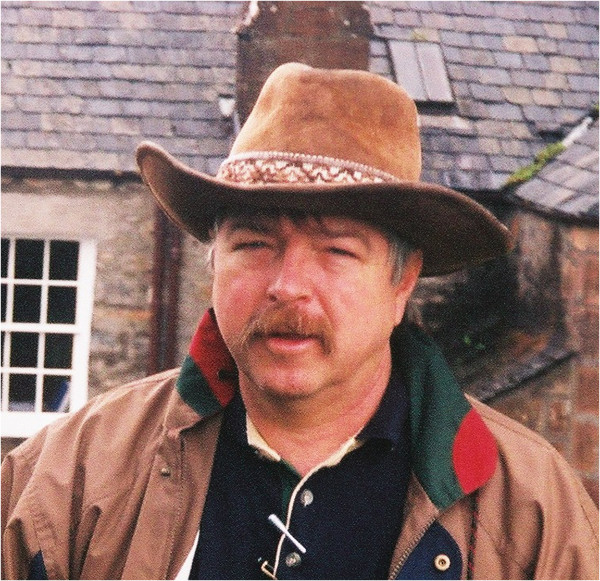
Glenn Morton (1950-2020). A maverick creationist(?), who defied labeling, finished his final book, Eden Was Here: New Evidence for the Historicity of Genesis, within days before his death. Morton makes the case for an historical Adam and Eve, thereby linking the Fall of humanity, and its association with original sin, to a specific event in the very ancient past.

Continue reading


A Genetic or Genealogical Adam and Eve? (… An Alternative to “Deconstruction”)

In the era of social media, we find out about a number of (relatively) well-known Christians walking away from their faith, commonly described as a process of “deconstruction.” In 2020, we have heard of Jon Steingard, lead singer and guitarist for the Christian band Hawk Nelson, and his “deconstruction” (for an excellent dialogue with Steingard, watch this conversation between him and Sean McDowell). We also have heard of Rhett and Link, former staff workers with Cru, a Christian ministry focused on outreach to college students. Rhett and Link are originators of the popular YouTube channel, Ear Biscuits, where Rhett describes in a video how doubts regarding Darwinian evolution led to his faith “deconstruction.

What do we make of all of this?

Readers of Veracity will know that I write a lot about the creation vs. evolution controversy on the blog. To date, I have authored over 100 posts on the topic, in nearly 8 years. While many Christians display little interest in scientific matters like this, the polling data shows that a loss of confidence in what the Bible says about human origins, is one of the number one reasons why kids from Christian homes walk away from the faith, when they grow up.

One of the biggest concerns is about the existence of a historical Adam and Eve: Did Adam and Eve really exist, or is this simply a biblical fairy tale? (See this video segment from Rhett’s deconversion story).

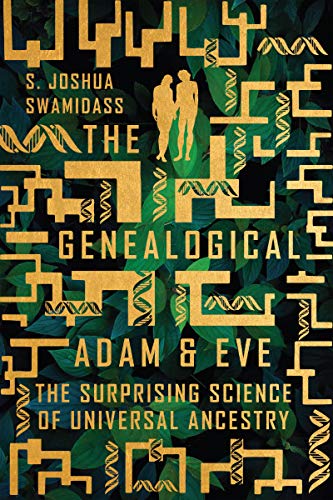
S. Joshua Swamidass’ The Genealogical Adam & Eve: The Surprising Science of Universal Ancestry, aspires to build bridges between Bible-believing Christians and scientists

The current scientific consensus, in the exploding discipline of genetics research, indicates that it would have been genetically impossible to account for today’s biological diversity, among humans, based on a solitary human couple, less than six thousand years ago.

A number of Christians see implications from this scientific pronouncement, but they differ on the specifics. For example, Canadian evangelical theologian and scientist, Denis Lamoureux, contends that science rules out the possibility of a single, Adam and Eve couple, since there had to have been an initial human population, of about 10,000 people, to produce the type of genetic diversity we see among humans today. For Lamoureux, without an Adam and Eve, you have no cosmic Fall event. Ironically, Lamoureux still believes that humans all sin; thereby, upholding historic Christian doctrine.

Lamoreux’s conclusion is therefore puzzling. For without a cosmic Fall event, where Adam and Eve were eating the forbidden fruit, it is difficult to determine a historical reason for exactly how sin entered the world, and corrupted the human race.

Rejecting an historical Adam and Eve bothers many Christians, and it is not that difficult to imagine why.

Many evangelicals remain blissfully unaware, but even C.S. Lewis, the Oxford don and great Christian apologist of the 20th century, did not believe that an historical Adam and Eve is required by a faithful reading of Scripture. However, the picture painted by a number of mainstream scientists today, including many Christians, goes beyond Lewis in insisting that the scientific data makes an historical Adam and Eve impossible.  What makes this situation all the more striking, and perplexing, is that the vast majority of prominent Bible teachers, over the past fifty years, all believe that Adam and Eve, as historical persons, are central to the biblical story. A massive array of essays, published as Theistic Evolution, in 2017, by Crossway publishers, slams Neo-Darwinian formulations for evolution, for having denied the existence of an historical Adam and Eve. Furthermore, some of the greatest preachers in the past fifty years, like J. I. Packer, John R.W. Stott and Tim Keller, have all believed in an historical Adam and Eve. My late pastor/teacher, Dick Woodward, thought the same.

Where does this leave us? Does this impasse signal an irreconcilable conflict? Does the historical reliability of the Scriptures crumble under the weight of not having a “real” Adam and Eve? Is there a way that science and Christian faith can come together, and make peace with one another? Or should we expect the inevitable, with more and more “deconversion” stories coming to light?

Enter S. Joshua Swamidass, a doctor and scientist teaching at Washington University, who runs a website at PeacefulScience.org.  Unlike those who favor the deconversion narrative, Swamidass is optimistic. He has proposed a very interesting answer to these questions, an answer that might resolve the difficulty. In short, to quote from his new book, “Evolution fractured the origin story of Adam and Eve, but we can recover it now” (The Genealogical Adam and Eve, ch. 14).

Dr. Swamidass grew up in a home where Young Earth Creationism was taught, and interestingly, he even shares the same birthday as Ken Ham, the founder of Answers in Genesis, the world’s leading Young Earth Creationist ministry. However, Swamidass suffered a crisis in his faith as a young person, as is the case with a number of young people today, who have his type of background. Yet in 2019, Swamidass published a book that he believes will help to bridge the divide between the church and science, regarding the historicity of Adam and Eve. The Genealogical Adam and Eve: The Surprising Science of Universal Ancestry is Swamidass’ proposal to try resolve this perplexing problem, and it deserves serious attention from thoughtful Christians, and skeptics and seekers alike… as well as those who might be prone to faith “deconstruction.”

Over the past few years, Swamidass has been bringing Young Earth Creationists, Old Earth Creationists, Evolutionary Creationists, and even atheists together, to try to find a solution to this question about Adam and Eve. Scholars from across spectrum, including veteran apologist William Lane Craig, Reasons to Believe’s A. J. Roberts, the Discovery Institute’s Ann Gauger, and atheist and molecular biologist Nathan H. Lents, have joined in these discussions, which form the thesis behind Swamidass’ book. The atheist here, Nathan H. Lents, actually wrote an endorsement of Swamidass’ book, as found in USA Today!! Lents is not planning to run forward for an evangelical altar call, anytime soon, but he does believe that the science behind Swamidass’ book is perfectly sound. Therefore, mainstream scientific critics of Christianity should take notice of what is being said here.

As I wrote about a few months ago, some post-Reformation era scholars, several hundred of years ago, began to reexamine the Bible, and noticed that there is evidence in the Scriptures that there were humans living on earth, as created by God, prior to and concurrent with the arrival of Adam and Eve. The exploration of this  idea helps to answer the age-old question of “where did Cain get his wife? This was the infamous question that Clarence Darrow asked William Jennings Bryan, while Bryan was on the witness stand, at the 1920s’ Scope Monkey Trial, the turning point moment in both the classic play and movie, “Inherit the Wind,” which were based on that trial.

Swamidass takes this idea of other humans, living alongside of Adam and Eve, outside of the Garden, and explores it, both in terms of its biblical and scientific possibilities. His conclusion? Pay close attention here: Neither the Bible, nor does science, indicate that all people today are genetically related to one another, as coming from a single human couple. Yet both the Bible and science can find room to agree, that all humans today are genealogically related to one another, from a single human couple, namely Adam and Eve, who lived about 6,000 years ago. Science, therefore, does not rule out the possibility of Adam and Eve being created de novo, by God, with no direct biological link to any other creatures.

Though Swamidass hopes his proposal will have a wide appeal, there are those at various extremes of the debate, who probably will not be convinced by what Swamidass lays out. For example, it is highly unlikely that Ken Ham, the president of Answers in Genesis, will be persuaded to change his mind, by Swamidass’ thesis. The idea of people existing outside of the Garden of Eden could be a bridge too far for those fully committed to Young Earth Creationism. A variety of creationists, Young Earth and Old Earth, have their doubts about Swamidass’ thesis. Furthermore, the folks at the Discovery Institute, who pioneer thought about Intelligent Design, are less than enthusiastic. Veteran apologist William Lane Craig critically interacts with Swamidass’ proposal in several videos (#1 and #2), applauding Swamidass for his peaceful efforts, but ultimately remains unconvinced.

But on the other side, those several contributors (but NOT all!) to Biologos, the Evolutionary Creationism think tank, founded by NIH director, Francis Collins, who are convinced that Adam and Eve never really existed, will be reticent as well (for a compilation of reviews at Biologos: #1, #2, and #3). Then, of course, there are atheists, like Jerry Coyne, who are quite dismissive of any proposal, suggested by a Christian.

In other words, Swamidass’ proposal seeks to build bridges across wide divides, but in doing so, he breaks all of the older molds. But perhaps the older molds all need  breaking. Perhaps those who are less in entrenched in their particular silos might be open to what Swamidass has in mind.

This is the reason I am really excited by professor Swamidass’ peace proposal. We see all kinds of issues where Christians will divide from one another: separating churches, damaging friendships, and even causing tensions in family relationships.  In an age when the church is divided about a number of issues (charismatic gifts, the EndTimes, women in ministry, etc.), it is really encouraging and refreshing to see how someone is creatively willing to try to get a number of Christians, with very different views of human origins, into a room, to try to hammer out a peace proposal, as a sincere attempt to try to build unity among believers, without compromising truth.

That is a pretty tall order.

But it is necessary, if we really believe that Jesus meant business when he prayed for his people to be united as one, in John 17. It is also necessary, if we really want to stem the tide against the increase of deconversions. In an age where it seems like Christians (myself included) can easily get caught up in debates, that can so easily divide us, in a world that is already dividing at an accelerated rate, such peace attempts are worth the effort.

When it comes to Adam and Eve, the dispute is quite simple. The theologian or pastor insists on an historical Adam and Eve. The scientist insists that there is no way that a solitary Adam and Eve can account for the evidence, regarding today’s biogenetic diversity among humans. Swamidass frames the dilemma sharply: “This is the impasse. It has been the impasse for over a century. Pastor explains his honest understanding of Genesis. A scientist objects. The conversation ends. A fracture.” (Kindle location 171). Having been stuck in the middle of these type of conflicts before, I can feel the pain. But Joshua Swamidass’ peace proposal has helped me to re-read the first few chapters of Genesis with new eyes.

Will Swamidass win over the critics? Who knows, but this does stand as a possible way forward. For readers of the book, you should know about the errata page that Dr. Swamidass has, where he is making updates, whenever readers find errors in the book itself. I have read a good chunk of the book, and it is totally refreshing and different, and I would encourage everyone who is interested in this topic to check it out, or at least start with one of the videos below.

The Genealogical Adam and Eve is also a good response book to the Biologos book project, Adam and the Genome: Reading Scripture after Genetic Science, by Dennis Venema and Scot McKnight, which I have only had only a small amount of time to dabble in. You can find some very interesting discussion at PeacefulScience.org.

For digging deeper……The following YouTube videos explore the questions raised by The Genealogical Adam and Eve. First, there is an episode of the Unbelievable? podcast, where Dr. Swamidass, and an atheist colleague, explains the thesis of The Genealogical Adam and Eve. I would start with that video first. Second, with a greater amount of depth, there is an interview with Dr. Swamidass, by two of my favorite young Christian YouTube apologists, Cameron Bertuzzi, of Capturing Christianity, and Michael Jones, of Inspiring Philosophy.  The third video dives into more of the nitty-gritty, as it is an engaging conversation between Dr. Swamidass and Dr. William Lane Craig, hosted by Capturing Christianity. Enjoy!!