Tag Archives: Genesis

The Scopes Monkey Trial: One Hundred Years Ago

I do not know where all readers of the Veracity blog live, but here in my native Virginia, it is blazing hot now in mid-July!

In between sweating through yet another shirt, I ran across a fascinating article by Washington University biologist Joshua Swamidass at Christianity Today magazine: “Setting Our Scopes on Things Above.” I was reminded that exactly one hundred years ago this week, that the “trial of the century” took place in an extremely hot Tennessee, long before courtrooms had air conditioning!

John T. Scopes, a high school biology teacher, was charged with violating Tennessee’s Butler Act, which prohibited the teaching of evolution in a public school. Scopes was found guilty, and forced to pay a $100 fine, which was later overturned, but that was not the real story.

The Scopes trial was ultimately a media event, not unlike the O. J. Simpson trials for the 1990’s. For those around at that time, people can remember television images of Simpson driving his white bronco as California police officers followed him down the interstate highway, trying to arrest the famous football player.

Likewise, the Scopes trial caught nearly everyone’s attention in 1925. While they did not have the Internet or television back then, they did have newspapers and radio, as dozens and dozens of journalists descended on the small town of Dayton to cover the trial. People were spellbound as William Jennings Bryan, a longtime presidential hopeful and conservative Christian, as the prosecuting attorney took on Clarence Darrow, an agnostic defender of science, and Scopes’ defense attorney. There was even a play written about the trial, which eventually became a movie, Inherit The Wind.
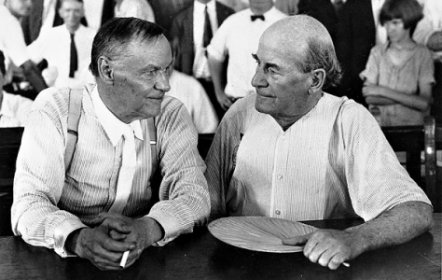
 

20th century cultural icons: cigarette smoking, agnostic advocate for science, Clarence Darrow vs. defender of the Bible, anti-evolutionist, populist politician, William Jennings Bryan, in the heat of a Tennessee summer.


Ironically, from today’s perspective, William Jennings Bryan was not a Young Earth Creationist. He was what might be a called a Day-Age Creationist, a form of Old Earth Creationism similar to what Hugh Ross at Reasons to Believe supports. While Scopes lost the court battle (at least initially), it was Christian “fundamentalism” which took the biggest hit, effectively pushing conservative Christians off the cultural mainstream. The sidelining of conservative Christianity would not show signs of reversing until the emergence of the “neo-evangelical” movement, embodied in personalities like Billy Graham, in the late 1940s and 1950s.

A few years ago, I wrote about the Scopes trial, along with a transcript of the (in)famous cross-examination of William Jennings Bryan conducted by Clarence Darrow, so I will not rehearse the details here. But the conversation about the Bible and its relationship to science has been a big part of the history of the Veracity blog over the past thirteen years. There are over a hundred blog posts about this conversation! Are the concepts of biblical creation and evolution compatible or incompatible with one another?

I thought it might be a good time to reflect on where I am now on the conversation. I have pretty much come to a similar conclusion that Dr. Swamidass has advocated for in his book, The Genealogical Adam and Eve: The Surprising Science of Universal Ancestry, one that I have reviewed and can highly recommend.

I think I can call him “Joshua” now, as I have personally corresponded with him before.  Joshua helps to run a discussion board website at PeacefulScience.org. On the one hand, Joshua is critical of others, whether they be scientists or bible scholars, who argue against the historicity of Adam, particularly a certain subset of Christians (but not all) associated with Biologos, a Christian think-tank started by Francis Collins. The argument against historical Adam is that genetic studies have shown that the human population could not have arisen from just two people, Adam and Eve, in that modern humanity arose from a much bigger population of hominids.

Joshua challenges that assertion against the historicity of Adam by citing an argument made centuries ago, that there were other humans living alongside of Adam.  In other words, the first humans created were not just Adam and Eve in Genesis 2. There were other humans, too, mentioned in Genesis 1.

There are several advantages to this solution: First, there is no need to tie all human descent as coming genetically from just two people. Other humans are involved as well. But what Joshua brings to the table is that all humans today, and even in Jesus and Paul’s day are all genealogically related to Adam and Eve, not necessarily genetically. The Bible is concerned about genealogy, not genetics.

Secondly, it resolves the difficulty made famous during the Scopes trial, when Clarence Darrow questioned William Jennings Bryan as to where Cain got his wife. Many Christian apologists today propose that Adam and Eve must have had an unnamed daughter, so that Cain must have married his sister. Various creationist groups, including the Young Earth Creationists at Answers in Genesis, as well as Old Earth Creationists at Reasons to Believe, hold to that apologetic proposal. There is no Bible proof text which explicitly supports this, as there is no mention in the Bible of Adam and Eve having daughters.

Yet this common proposal causes a big problem for historically orthodox Christianity, in that it effectively argues that God has changed his mind regarding the sexual morality status of incest. For if incest was okay for Cain, but then later declared by God to be sinful according to the Law of Moses, then this suggests that God can and has changed his mind regarding the definition of marriage. Many advocates of same-sex marriage today among Christians make the same sort of argument, saying that God could also change his mind regarding same-sex relations, condemning them all in the Bible times, but changing his mind today by accepting same-sex marriage now in the 21st century. Whole denominations of progressive Christians have gone down this route of biblical interpretation.

Joshua’s proposal is not a hill I am going to die on. But I do think it makes the best sense, considering other alternatives. A lot of Christians wrestle with the creation/evolution discussion, but Joshua’s book is one of the best I would recommend reading. I read Joshua’s book five years ago, and since then I have not found any proposal better than his. What makes Joshua’s proposal also helpful is that you can be a Young Earth Creationist, an Old Earth Creationist, or an Evolutionary Creationist, and still hold to a genealogical Adam and Eve and affirm the inerrancy of the Bible.

You might be interested in the following interview of Dr. Joshua Swamidass by another fellow scientist, who is a Christian, Rice University’s Dr. James Tour.  Dr. Tour does not agree with Joshua’s take on Genesis, but the following conversation shows that the two have more common ground as believers who affirm the bodily resurrection of Jesus. It is a great conversation showing how believers, with different views of Creation, can find a common bond between each other. Check it out!


UPDATE August 26, 2025:

Well, I have to say that YouTube and Tik-Tok sensation Dan McClellan actually gave me something to think about, which confirms my conclusion as to how best to interpret the rise of humanity in Genesis. McClellan argues that Genesis 4:1-2 teaches that Adam and Eve had sexual relations to produce Cain and then Abel.  However, the next time Genesis says that Adam “knew his wife again, and she bore a son and called his name Seth” is in Genesis 4:25.  However, the birth of Seth is after when “Cain knew his wife, and she conceived and bore Enoch. When he built a city, he called the name of the city after the name of his son, Enoch” (Genesis 4:17 ESV).

This rules out the traditional explanation that Cain married his sister. For the text says that the third child born to Adam and Eve was long after Cain got married, and so Cain could not have married his sister, if his sister had not been born yet, assuming Adam and Eve actually had a daughter to begin with.

Now that is something to ponder!!!

Some might object by saying that Adam and Eve could have had sexual relations prior to Eve’s pregnancy with Seth, thus allowing for another birth in between Abel and Seth, but not mentioned in the text, but the Hebrew does really allow for that kind of distinction, as the verse links both the sexual act and the pregnancy together with the “again,” thus indicating that this was Eve’s third pregnancy, and not a possible fourth pregnancy.

Or some might object that the third pregnancy mentioned is only regarding male children, and that the text simply ignores girls. Okay, that might be possible. But how do you know?

McClellan goes onto say that the author of Genesis 4 knows nothing about a global flood, for there were clearly other humans living during the time of Adam and Eve, who are not represented in the genealogies of Genesis 5, and who are not destroyed in a flood event described by Genesis 7-9.  This would indicate that if there really was a flood, it is local in nature (a large regional flood), and not a global flood.

Now, McClellan goes onto assert that these various discrepancies indicate that there were different authors involved in writing these various texts within Genesis, which explains what McClellan believes are contradictions in the text. But what if there were other humans living during the period of Adam and Eve and there was a local, and not a global flood, and that this is what Genesis is actually teaching? Then there is really no contradiction in these texts.

This does not specifically rule out the possibility of multiple hands involved in the writing of Genesis, but it does take away the strength of the argument, if it depends on the existence of supposed contradictions in the text, which really are not there. Something to think about!!


William Lane Craig on the Historical Adam

William Lane Craig is often regarded as the most prominent living Christian philosopher on the planet defending the Christian faith today. However, a recent article that Craig wrote for the magazine First Things has resulted in a firestorm of controversy.

Craig, the founder of the apologetics ministry, Reasonable Faith, and Professor of Philosophy at Houston Baptist University and Research Professor of Philosophy at Talbot School of Theology, has recently published a book regarding the historicity of Adam and Eve, and the literary genre of Genesis 1-11 more broadly:  In Quest of the Historical Adam: A Biblical and Scientific Exploration. His essay at First Things summarizes his thesis, and Craig concludes that the Adam and Eve of Genesis are both historical and mythological figures in the Bible, and Craig also concludes that Genesis 1-11 is an example of the literary genre of mytho-history found in the Bible. Furthermore, Craig argues that Adam and Eve go back to a common ancestor shared between modern humans and Neanderthals, between 750,000 to 1,000,000 years ago. Craig’s view can be quickly summarized in this 4-minute linked YouTube video.

Dr. Owen Strachan, Professor of Theology at Grace Bible Theological Seminary, has taken Dr. Craig to task at his Substack blog, describing Dr. Craig’s summary view as being “tortured.” According to the Substack blog, Strachan believes that Craig is not sufficiently nor clearly affirming the historicity of Adam and Eve.  The controversy provides an illustration at just how divided Christians are over the question of human origins, as it corresponds to the teaching of the Bible. This is not a new development, as such controversy extends back even to the days of Jesus.

Some Christians, such as Reformed apologist James White, of Alpha Omega Ministries, and one of the most capable Christian debaters today, hold largely to a presuppositionalist approach to Christian apologetics, where one begins one’s apologetic method with an assumption, or presupposition, that exists as revelation that can not be refuted. This is different from an evidentialist approach to Christian apologetics, that William Lane Craig tends to follow, urging Christians and non-Christians to “follow the evidence wherever it leads” towards the discovery of truth. Interestingly, White is not consistent with his own apologetic method, as White comes across as holding an evidentialist position when defending the reliability of modern Bible translations, in contrast with the presuppositionalist approach taken by KJV-Onlyists (see the comments in this linked Veracity article), who only view the King James Version of the Bible as being THE one-and-only divinely preserved version of the Bible. Nevertheless, James White gives his own broadly framed critique of William Lane Craig in this linked YouTube video, selected from one of his Dividing Line podcast programs. White’s critique here is a bit “off-the-cuff” but it can give you a flavor as to how different Christians approach apologetics differently.

Many Christians are convinced that the truthfulness of the Christian faith hangs and falls on the historical narrative of Adam and Eve. Others view Adam and Eve as merely metaphorical symbols representative of the story of humanity more broadly. Is there a common ground solution to be had here?

What makes this issue so challenging to navigate is that while many Young Earth Creationists, and even some Old Earth Creationists, will make an appeal to the beliefs of the earliest Christians among the early church fathers, in support of their views, the question of relating history and metaphor together is far from simple even among the early church fathers, when it comes to interpreting Genesis 1-11.

For example, even Philo of Alexandria, a Jewish philosopher and contemporary of Jesus, and perhaps the leading apologist for Scriptural faith in his day, had serious reservations about the literal interpretation of the “days” of Genesis, as well as the creation of Eve materially from Adam’s rib, and this was well over 1800 years before Charles Darwin ever came on the scene, well before the age of modern science!! Philo would later become a major influence upon Christian bible teachers in the early church.

In the following YouTube video, Protestant theologian Gavin Ortlund offers a friendly rebuttal to Owen Strachan’s critique of William Lane Craig, by focusing on the complex views of Saint Augustine, the most influential Christian theologian in the Western church, dating back to the early 5th century. After that, I have linked to a YouTube interview by apologist Sean McDowell with William Lane Craig about his new book. The Ortlund video is 15-minutes long. The Craig interview with McDowell is an hour long.

I would be interested in any Veracity reader feedback on any of this content. For further reading, I recommend the work of Joshua Swamidass in finding a peaceful solution to the controversy surrounding the historical Adam and Eve. For a deeper dive into the content of William Lane Craig’s book, you can follow this series of interviews with New Testament scholar Ben Witherington starting here.


Did God Create the World as “Perfect”… or As “Good?”

Most of us have heard the story.

God created the world in six days. On the first through fifth day, God declares what he has created to be “good.” Then, we get a step up on the sixth day, when humanity was created, God saying it was “very good.

But is “good” the same thing as “perfect?”

According to a few sermons I have heard over the years, “good” and “perfect” are synonymous. But is this Scripturally accurate? Is this really what the Bible teaches?


On the one hand, linking “good” and “perfect” sounds like a reasonable assumption. After all, Christians believe that God is indeed perfect. So why would God create anything other than something that was perfect?

Makes sense, right?

Many who take this view go onto believe that when Adam and Eve sinned, not only did they introduce human sin, suffering, and death into the world, they also introduced animal death and suffering into the world.  If humans had never sinned, then the animals never would have died either. This is consistent with what is considered to be a contemporary, Young Earth Creationist reading of the first few chapters of Genesis.

This is probably the strongest theological argument in favor of God creating the world, from nothing, within a span of six 24-hour days. It does make me wonder about where the mayfly fits in this timing scheme, with its life span of only 24-hours, but just go with me here….

In summary: God created the world perfectly. He would never create a world with millions of years of death, cancer, and suffering in it. For those things, we have Adam to blame. Not God.

This makes for a captivating story.

It might even be true.

But there is a difficulty with this reading of Scripture.

Take Genesis 1:2, the second verse of the Bible, before we even get to day one of Creation, for example. Here we read the first part of that verse:

The earth was without form and void, and darkness was over the face of the deep….(ESV)

If God created this universe as “perfect,” why would he create the earth, starting out, with what was without form and void? Was this really God’s doing?

How is an earth, without form and void, “perfect?”

Or, how about a little bit later, when God speaks to the humans he has just created, on day six:

Be fruitful and multiply and fill the earth and subdue it, and have dominion over the fish of the sea and over the birds of the heavens and over every living thing that moves on the earth…..(Genesis 1:28 ESV)

The word “subdue” is highlighted, because it sounds so… well…. rough and rugged, to say the least. If God created everything “perfect,” then why would humans be called upon to subdue the earth? Why try to subdue something, if it was perfect to begin with?

Some do raise answers to such questions. For example, some claim that God’s command to subdue the earth, only applies to the ground itself, and does not include the animals. To subdue the rocky ground, for farming, is quite different from trying to subdue the animal kingdom.1

I will leave it to the reader to consider if such an answer is compelling or not.

Biblical scholars tell us that, in the days of people like Abraham and Moses, the other gods surrounding ancient Israel,  such as Marduk of the Babylonians, and Atum of the Egyptians, were pretty much a disorderly mess, particularly when it came to the creation of the world. Pagan stories about creation treated the concept of creation itself as a kind of afterthought.

The Bible, on the other hand, tells a much different story.

It tells us that the God of the Bible is a God of order. He brings order out of chaos. Perhaps this is what Genesis has in mind, when in verse 2, we read about the earth being without form and void, which is consistent with a picture of chaos. As the reader proceeds through the days of Creation, the sense of a gradual movement from chaos to order emerges, such as when the creation of light, on day one, gets superseded by the appearance of the sun and moon, on day four, to mark off the days and years.

Then we read on down to day six, where God creates humanity to have dominion over all of the good that God has created. Perhaps, this is what is going on in Genesis, that God’s act of creation is a way of bringing order out of chaos. That might help to explain why God created everything good, but not necessarily perfect.

The perfection of creation was certainly on God’s agenda, but perhaps he created humankind specifically to help bring about that perfection of Creation…. However, as the story goes on, we pretty much blew it with the whole “eating of the forbidden fruit” in the Garden episode.

This still leaves the question open as to why there was chaos to begin with, and why the earth needed to be subdued? Unfortunately, the text of Scripture does not give us a direct answer to that question. It just leaves that question out unanswered… simply hanging there.

Thankfully, whatever we make of this state of chaos, in the initial creation, and the need to subdue the earth, the New Testament completes the story, that “for the creation waits with eager longing for the revealing of the sons of God” (Romans 8:19 ESV). As God’s people experience redemption, through the power of the Cross of Christ, we look forward to the day when Christ will restore all things, and cause all of Creation to have its eager longing fulfilled.

As Christians continue to debate about the age of the earth, and exactly how God brought about the creation of the world, and what sin, evil, death, and suffering have to do with it, it is a question worth thinking about.

Notes:

1. Terry Mortenson, a scientific historian, with Answers in Genesis rightly argues that “In Genesis 1:28 man is commanded to subdue (kabash) the earth…Kabash means to take complete control of something, to make it subservient.” But then Mortenson adds, ‘The text does not say that man should subdue the animals….The fact that God uses a different verb (radah) to refer to man’s “rule” over the fish of the sea, the birds of the sky, and everything that moves on the earth, strongly suggests that “subdue” relates to the non-living creation and “rule” relates to the living creatures. But nothing in the context warrants reading into “subdue it [the earth]” the idea that the creation had been filled with natural evil (death, disease, extinction, asteroid impacts, tsunamis, etc) for millions of years prior to man.’ Isolated by itself, Mortenson’s argument has a lot of appeal. Hebrew parallelism could indeed be in play here. But look more carefully at Mortenson’s contextual argument. What Mortenson ignores is the whole context of the verse, by omitting the very first part of the verse: “And God said to them, “Be fruitful and multiply and fill the earth and subdue it.” This is a command for humans to procreate and “fill the earth” with offspring. To suggest that “”subdue’ relates to the non-living creation;” presumably the physical ground of the earth, as Mortenson does, would suggest that humans are to fill the non-living creation with living humans. Once you fill the “non-living creation” with the “living creation” of human beings, then the “earth” is no longer a non-living creation. Terry Mortenson is a smart scholar, but his exegetical argument appears to be greatly forced. I am no grammar scholar, but why anyone would find this exegesis of the text convincing is baffling. But there you have it. 


Did Abraham Receive the Call to Go to Canaan While in Haran, or in Ur?

Answering this question is actually a fairly easy one to tackle. But there are two ways to go about it, and each way gives us a different picture of what the biblical writer is trying to do in Genesis.

In Genesis 11:26-32, we get the story about Terah, the father of Abraham (whose name was slightly different at this point, “Abram.”):

When Terah had lived 70 years, he fathered Abram, Nahor, and Haran. 
Now these are the generations of Terah. Terah fathered Abram, Nahor, and Haran; and Haran fathered Lot. Haran died in the presence of his father Terah in the land of his kindred, in Ur of the Chaldeans. And Abram and Nahor took wives. The name of Abram’s wife was Sarai, and the name of Nahor’s wife, Milcah, the daughter of Haran the father of Milcah and Iscah. Now Sarai was barren; she had no child. 
Terah took Abram his son and Lot the son of Haran, his grandson, and Sarai his daughter-in-law, his son Abram’s wife, and they went forth together from Ur of the Chaldeans to go into the land of Canaan, but when they came to Haran, they settled there. The days of Terah were 205 years, and Terah died in Haran (Genesis 11:26-32 ESV).

In summary, Abraham’s family moves from the land of Ur (in modern day Iraq), to Haran (in modern day Turkey), an area about half-way along the journey, across the Fertile Crescent, well short of reaching Canaan.

Continue reading


Is Genesis History?, or Is Del Tackett Confusing Film Viewers?

tackettfilm

The run-up to the one-night showing (tonight) for Del Tackett’s latest film, Is Genesis History?, introduced here at Veracity, is in full swing. So, I just have a brief follow-up: Christian media outlets across the country anticipate large crowds to go see this film in theaters nationwide.

For example, yesterday on “Hour 2” of the Eric Metaxas show, Del Tackett was interviewed by Metaxas. Eric Metaxas, a Christian public intellectual, himself is agnostic on the exact meaning of the “days” of Genesis, but he had a very friendly and warm conversation with Del Tackett, who endorses a literal, 24-hour view of the “days” of Genesis 1.

Tackett explains that the film relies on extended interviews with scientific and other experts, to defend the concept of Young Earth Creationism, the belief that the earth is no more than about 6,000 years old, contrary to the mainstream scientific paradigm, that argues that the earth is about 4.5 billion years old.  For example, Tackett interviews Hebraist and Semitic language scholar, Steven Boyd, who argues that the plain meaning of a literal, 24-hour day should be taken for each of the six, creational “days” of Genesis. A number of scholars take the view of Dr. Boyd, who is (unsurprisingly) a Young Earth Creationist, but does every scholar agree with this view? Apparently, not.

I decided to ask an Orthodox Jewish friend of mine, to get an answer from a Jewish perspective. After all, Jews and Christians share the Book of Genesis together in their Scriptures. As I expected, Jewish interpretation of the “days” of Genesis mirrors the variety of Christian views on the same topic, and the scholarly disagreements go back hundreds of years, predating the 19th century advent of Darwin’s theory of biological evolution, by a number of centuries.

As it turns out, even though Del Tackett’s list of scholars and scientific experts lean towards the Young Earth side of the debate, at least one of the experts interviewed, philosopher Paul Nelson, associated with the Discovery Institute, now says that Tackett’s Is Genesis History?  unfortunately “presents a false dichotomy” and that he “dissents from my role” in the film. The issue for Dr. Nelson is not the age of the earth, but rather, the question of “intelligent design” vs. “no design.”

Mmmmm…..

In the film trailers and in promotional interviews, Del Tackett, has a very homespun, unassuming demeanor, contrary to a lot of rancor this kind of debate often generates within the church, which is quite refreshing. But when I heard Del Tackett talk about soft tissue found in dinosaur fossils, I began to wonder if Del Tackett fully understands views contrary to Young Earth Creationism. So, it remains to be seen whether or not Del Tackett’s Is Genesis History? will serve to provide clarity in this controversial debate, or if it will be an awkward appeal to “alternative facts” that will only confuse believers, who simply want to be able to adequately defend the Bible, in a world that is often hostile to its central, core message.

If you are still interested in seeing the film, there are two showings in Williamsburg, Virginia, at Regal New Town Stadium 12, at 7:00pm, tonight, with tickets still available at the time of this blog posting.

UPDATE: 02/25/2017

All showings in Williamsburg on Thursday were sold out. An encore showing will be next Thursday, March 2nd.

A few early reviews of the film are in, and as to be expected, the reception is mixed among Christians:

Biologist Todd Wood: One of the Young Earth Creationist scientists in Is Genesis History? "It is the glory of God to conceal a matter; to search out a matter is the glory of kings. (Prov. 25:2)", which is Todd's tagline on his blog.

Biologist Todd Wood: One of the Young Earth Creationist scientists in Is Genesis History? “It is the glory of God to conceal a matter; to search out a matter is the glory of kings. (Prov. 25:2)”, which is Todd’s tagline on his blog.

If you want to find out more about some of the other scientific experts in Is Genesis History?, I would encourage you to first check out the blog for biologist Todd Wood, who this week published a Q&A regarding the film, on his website. Todd Wood understands and appreciates the mainstream scientific consensus, but he consciously adopts a worldview aligned with his Young Earth Creationist interpretation of the first few chapters of Genesis. Todd Wood is crazy smart, and quite likable, in my mind, even if he is more narrow in his beliefs. Whether or not Dr. Wood is able to come up with a viable scientific model, in which his hypotheses can be tested, a difficulty he readily admits, is another matter.

UPDATE: March 1, 2017

Here is another review from BioLogos. It would be great somehow if BioLogos and AnswersInGenesis were able to sit down and have a conversation together:

  • Gregg Davidson, an evangelical Christian and a geologist, and others, respond to some of Steve Austin’s comments in the most early part of the film (as seen on the film trailer, too), that suggests that geologists are abandoning the prevailing theory of long ages for the formation of the Grand Canyon. Steve Austin is a Young Earth Creationist scientist, and Davidson and his co-authors in this essay dispute Austin’s explanation based on actual evidence, while nevertheless affirming that “Our worldview is based on a belief that the Bible is true – cover to cover, from Gen. 1:1 to Rev. 22:21

UPDATE: March 6, 2017

I thought about publishing a new blog post, but I was not convinced that doing so would help to encourage dialogue or fan the flames of frustration, so I am merely updating here.  Todd Wood, one of the biologists in the film, that I highlighted above, has written a very thoughtful response to the claims of detractors, and one of the film’s experts, Paul Nelson, as noted above, that Is Genesis History? is promoting a false dichotomy. Todd Wood’s post is a bit difficult for me to grasp coherently, but I really appreciate the conciliatory tone that he displays. I just wish everyone in the Young Earth Creationist community were a little more like him.