The courage and conviction of a Swiss radical reformer, Felix Manz, has inspired Christians who have since come after him for almost 500 years. But who was Felix Manz?
In October, 2025, my wife and I took a trip to Europe, visiting a few sites linked to the history of the Protestant Reformation. One of those sites was the city of Zurich, Switzerland, the home of Huldrych Zwingli, one of the leading lights of the Protestant Reformation, alongside more well-known figures like Germany’s Martin Luther and Geneva’s John Calvin. Check out the two-partblog series about Zwingli recently covered a few months ago on Veracity, which gives some background regarding Felix Manz.
Felix Manz was at one time a follower of Zwingli, the great Protestant reformer of Zurich. Desiderius Erasmus, one of the most widely read authors of the day and a theologian from the Netherlands, had shocked the medieval world with his new, authoritative Greek New Testament. Since the fall of Constantinople to the Turks in 1453, scholars from the Christian East had brought their copies of the Greek New Testament to the Christian West. In examining these copies of the New Testament, which was originally written in Greek, it became apparent that some traditional interpretations of the New Testament popularly received in the West were not accurate. In going back to the original sources, “ad fontes,” as humanists like Erasmus called it, a new effort was made to refresh medieval ideas about the New Testament. Feliz Manz had become familiar with Erasmus’ work, and it changed his life.
Zwingli and Manz were part of this effort in Zurich, Switzerland. Like Zwingli, Manz had been educated in the biblical languages of Hebrew and Greek. Zwingli was the fiery preacher who advocated for the reforms of Erasmus, but Zwingli went beyond Erasmus in challenging papal authority itself. At first, Felix Manz applauded Zwingli’s efforts for reform. However, later on, Manz did not believe that Zwingli went far enough.
Zwingli was convinced that the traditional Christian view affirming the practice of infant baptism was thoroughly biblical. But Manz was not convinced. Manz and his friends were persuaded that only the practice of “believer’s baptism,” whereby adults (or perhaps older children) who made a profession of Christian faith should be baptized.
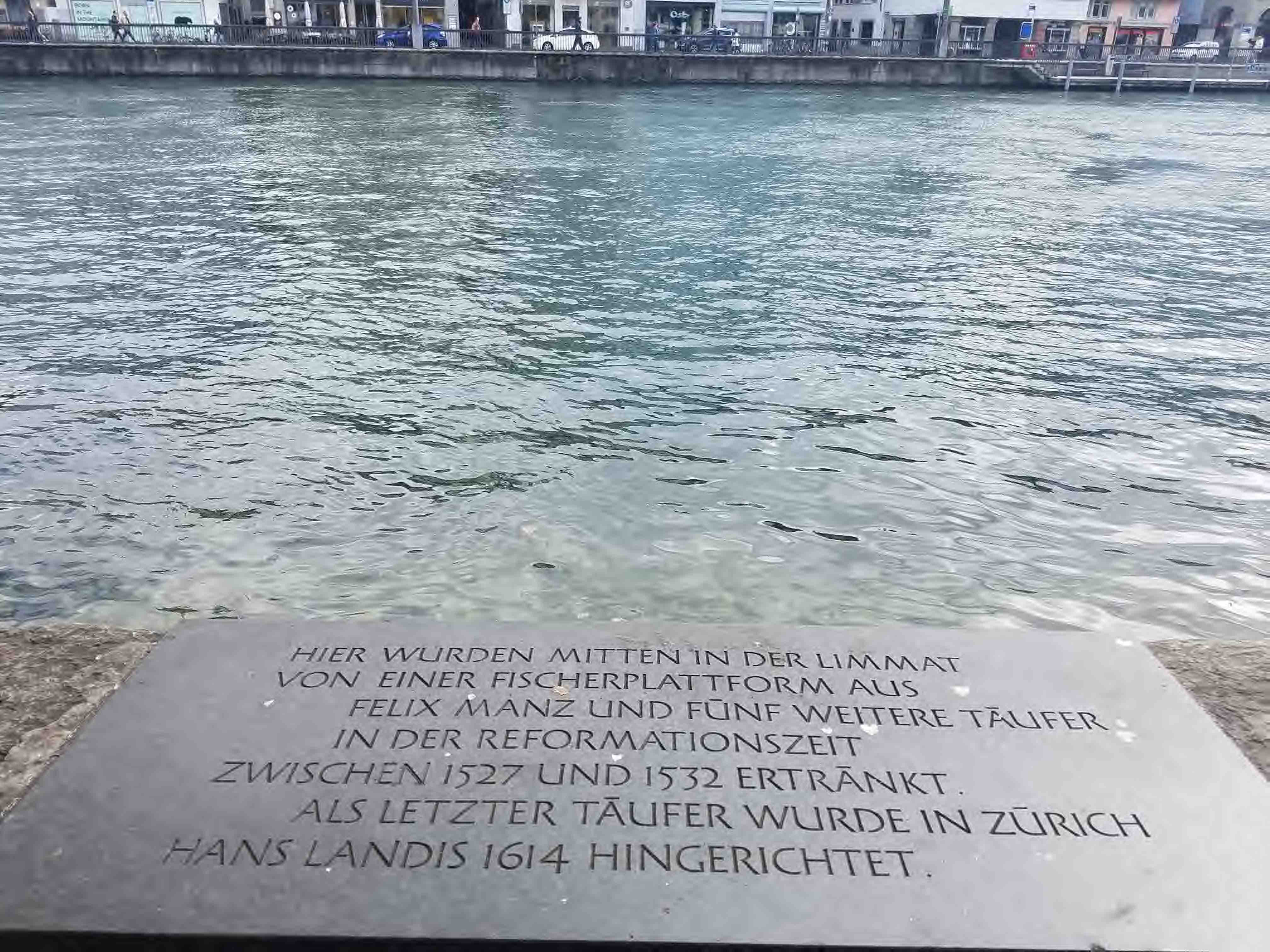
Felix Manz, who had been baptized as an infant, was baptized as an adult near this spot in Zurich, Switzerland, an act defiance and conviction, which cost him his life. Manz’ “believer’s baptism” happened just over 500 years ago, in January, 1525. Manz was executed two years later, 1527. My photo, October, 2025.
The Anabaptist Movement: Felix Manz, the First Anabaptist
A debate was held in the mid 1520’s, some five hundred years ago, presided by the Zurich city council, to determine who was right, Zwingli or Manz. In the end, the Zurich government authorities sided with Zwingli. Manz and his friends took the radical step of having themselves baptized by one another.
Imagine the shock to the medieval mind this type of thinking created. Felix Manz had already been baptized once as a baby. But now, as a believing adult, he became re-baptized, or baptized for a second time, having become convinced that his baptism as a baby was not grounded in Scriptural teaching. Ephesians 4:5 called for “one Lord, one faith, one baptism,” so Manz’ second baptism threw a wrench into the older, traditional theology. It was for this reason that Manz and his friends became founders of the Anabaptist movement, whereby the term meant to be “baptized again.”
Yet the authority of the church and the state were tightly intertwined at this time. The Zurich government decided that Manz should be punished, to set an example for others who dared to challenge the state’s authority to weigh in on religious matters.
What was Manz’ punishment? To be baptized yet a third time, but this time, it would be death by drowning in the Limmat River, which passes through the city of Zurich.
His former friend, Zwingli, did nothing to intervene. As the citizens of Zurich looked on, Felix Manz was tied up and bound, and then tossed into the freezing Limmat River in early January, 1527.
Felix Manz became the first martyr for the Anabaptist cause, inspiring groups today like the Mennonites and the Amish, who follow in that same theological tradition established in the early 16th century. The Anabaptists tended to pick up other radical teachings, associated with their readings of the New Testament, such as the rejection of military service and communal living with no private property, ideas which led to further persecution from both Roman Catholics and more mainline Protestant movements.
A little over a century later, Felix Manz’ specific teaching regarding believer’s baptism was embraced by another reform movement within the larger Protestant movement, which we now know as the Baptist faith. Those early Baptists were very much like their “Reformed” cousins in their theology, except for where they stood on infant baptism. In other words, while Felix Manz did not survive his “third” baptism, his teachings did survive and flourishes in both Anabaptist and Baptist circles all over the world today.
Thankfully, Christians today generally try not to use the force of the state to regulate theological opinions. Local churches will have their differences on whether or not infant baptism is permitted for their congregations. But it is quite common for infant baptism affirming churches to maintain some form of fellowship with infant baptism non-affirming churches, and vice-versa, despite differences in such practices. This is not wholly unlike how local churches may differ regarding whether or not women may serve as elders; part of the so-called complementarian-egalitarian controversy, or with differences regarding whether or not certain supernatural gifts of the Spirit; such as speaking in tongues and prophecy, are thought to be normative today.
For centuries, most Christians in the West from the era of the early church developed the habit of having their children baptized within a few weeks, if not days, after birth. Felix Manz broke the mold which had anchored Western Christianity, and he paid for that with his life.
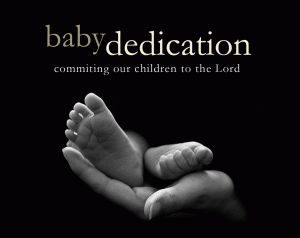
Many evangelical churches today, of the so-called “interdenominational” or “non-denominational” variety, have replaced infant baptism with something called “baby dedications.” This practice is kind of a half-way approach to resolving the baptism controversy. A “baby dedication” looks like infant baptism (sort of), but it is not baptism. But at least it conveys to parents a means by which their infant children can have some type of meaningful connection to their local church.
The only problem with a “baby dedication” is that it only has vague support for it in the Bible, if any. But so-called “interdenominational” or “non-denominational” churches often go that route as it is an imperfect yet practical means of maintaining some type of peace in such churches.
Before Felix Manz, Christians never practiced “baby dedications,” for the first 1500 years of the Christian movement’s history, and scholars debate as to when the practice finally caught on. Some say that the Anabaptists themselves adopted the practice in the 16th century, looking to examples in the Bible like Hannah dedicating her child to the Lord (1 Samuel 1:11) and Mary and Joseph presenting their baby to the Lord in the Temple (Luke 2:22). But it has only really been in the modern era, with “interdenominational” or “non-denominational” churches, that “baby dedications” have become normative in at least certain parts of the Protestant evangelical world.
Basically, either you have infant baptism in a local church, or you do not. It is a binary choice. But “baby dedications” offer such local churches a means of adhering to the common ground held by all Christians affirming the validity of “believer’s baptism” for adults or older children, and not introducing a potentially divisive issue like infant baptism.
It has become standard practice in such churches to have their children, whether dedicated or not, wait until they have made a profession of faith, as they get older, before stepping forward to be baptized.
You can pretty much thank Felix Manz for setting that precedent.
In English, this marker on the Limmat River reads: “Here, Felix Manz and five other Anabaptists were drowned off a fishing platform in the middle of the River Limmat during the 1527-1532 Reformation. Hans Landis was the final Anabaptist executed (1614).” Memorial Plaque, Schipfe Quater, Zürich, CH. My photo, October 2025.
Do you know how to diagnose theological controversy, and treat it well? Author Gavin Ortlund helps us to figure this out.
Wearing masks in church? Vaccinations? What about critical race theory? Racism? QAnon? The Election!! I try to be optimistic, but it seems like Christians have had a lot of opportunities to divide over many different issues in 2021, many of them with theological underpinnings (The challenges of trying to do “online church” for over a year has not helped matters). Finding the right hill(s) to die on is not easy. I have my own story to tell about theological controversy, but it goes back a few years.
However, before I jump into that, I need to issue a disclaimer: It is very tempting, in the face of intractable theological disputes (or political disputes among Christians) to either run off into a corner, and cut yourself off from other people, and double-down on your viewpoint. It is also tempting to try to “church hop,” in order to find another expression of Christian faith that suits you better…. only to find that your new church has a lot of the same problems as your old church did, just framed in a different way.
Yet perhaps the most difficult temptation is to become cynical, and simply get disgusted when theological controversy arises, over a matter that you find to be somewhat trivial, over-hyped, or perhaps destructive, or even downright stupid, but that someone else considers to be super-important. Of course, there is the other side to this: someone ELSE might strongly disagree with YOU, because they think the issue is really super-important, and they find it frustrating that you do not seem to understand the gravity of the issue! After all, the same Jesus who loves the whole world is also the same Jesus who threw the money-changers out of the Temple, challenging the complacent! So, maybe you SHOULD be more concerned about the issue being discussed!!
Provocative stuff, for sure. But pretty sad in the end.
By the grace of God, I have not gone to such major extremes, with any of these temptations, and I certainly would not encourage them in others. When Christians double-down on their beliefs, or church-hop to get away from other Christians who do not see things exactly the same way, or who walk away completely and give into cynicism, the result is usually bitterness and resentment towards others, and that is never healthy. However, I can see how a lack of honest conversation, preventing people from expressing their questions and doubts in a non-confrontational way, can drive people to go to certain extremes. Finding the right hills to die on is not a very easy thing to figure out. Raising questions and doubts can sound scary when theological controversy surfaces, but they need not prompt conversation partners to automatically go into “freak out” mode when controversy arises. I would like to share my own brief story, and offer a positive resource I have found for working through such difficulties.
Why Splits in Churches and/or Other Christian Fellowships Can Be Nerve-Racking
Perhaps this will sound like a rant, but it is a pet peeve of mine: There are certainly times where Christians do need to separate from church bodies and/or other Christian fellowships, when they have lost their way spiritually or morally, drifting into theological error. However, there are other times when Christians can divide over matters that during the time of crisis seemed all-important and ultra-critical. However, looking back on the controversies months or years later, we realize that such controversies were far too overblown, doing more harm than good.
Here is my story: It was the 1980s and I was a campus leader in my small college Christian fellowship group. The charismatic movement swept through my group and I was caught right in the middle. Two of my dearest friends, who both helped to disciple me, took opposing perspectives in the controversy.
One of them, who later married a wonderful gal I had dated in college, had taken me to a charismatic prayer meeting. For a guy like me, growing up in a liberal mainstream Protestant background, I was dumbfounded when people started to speak in tongues all around me. My friend helped to establish me in having a regular “quiet time” with the Lord, using the Dake Annotated Bible, a popular Pentecostal study Bible in those days (Though I must confess I found myself buried more often in reading Finis Jennings Dake’s notes, as opposed to just focusing on the text of Scripture itself… but that is another topic for another time).
My other friend, who helped to answer a lot of my spiritual questions while I did my laundry, was one of the most passionate defenders of biblical inerrancy… a real stickler for clinging to the text of the Bible. He had been kicked out of a charismatic Bible study, for asking too many questions, and was told never to come back. To say that he “disliked” the “charismatic movement” would be an understatement. He firmly believed that the miraculous gifts of the Holy Spirit ceased to operate after the last of the first century apostles had died. Once the New Testament was completed, the church had no more need for such miraculous gifts. In his mind, speaking in tongues in our modern era has continued to be all about promoting deception in the church.
Both of my friends truly sought to love Jesus, but they had a difficult time getting along with one another. Trying to find common ground between my two friends was like trying to get my dog to get along with another neighbor’s dog. It was exceedingly difficult. And the rancor disturbed our whole fellowship group. Most people simply tried to stay on the sidelines, adopting more of a “stick-your-head-in-the-sand” approach, but that did not go over very well either.
After my friends both graduated from my school, the controversy erupted among the followers my two friends left behind. As a campus Christian leader, I was simultaneously accused of “quenching the Spirit” by one party and of “smuggling charismatic deception” into the group, by another party. Weeks of meeting with people who had gotten their perspectives out of joint eventually produced some good fruit, and many relationships were eventually restored. We got through the crisis, but this was not terribly unlike the “pro-mask” versus “anti-mask” parties that have divided churches in the era of the coronavirus pandemic.
I really hated being in the middle of this theological controversy, which was also a controversy of different personalities. Nevertheless, theological controversy is just something that Christians, particularly Protestant evangelicals, simply do and have from time to time. The question is how do we navigate such treacherous waters. Trying to figure out which battles to fight and which battles to lay aside requires gaining a lot of wisdom, a process that I must honestly (and personally) admit can be pretty hard to discern.
Gavin Ortlund’s Helpful Resource for Doing Theological Triage
Gavin Ortlund outlines, as I would frame it, basically four orders of theological issues, faced by Christians:
First rank issues: These would be theological issues that are “essential to the gospel.” For example, if someone denies the authority of Scripture, the divinity of Jesus, or the necessity of believing that Jesus died for our sins, then these would be issues serious enough for a Christian to leave a church and seek a new fellowship.
Second rank issues: These would be doctrines that are “urgent for the church (but not essential to the gospel).“
Third rank issues: These would be doctrines that are “important for Christian doctrine (but not essential to the gospel or necessarily urgent for the church.”
Fourth rank issues: These would be teachings that are “indifferent (they are theologically unimportant).“
The ranking system that Ortlund uses is reasonable enough. The problem comes in trying to figure out what doctrines fit in which ranking. This is where the “triage” part comes in, where being able to diagnose which issues belong in which category requires some wisdom and forethought.
Starting from the bottom up is easiest for me to process. A good example of a fourth rank issue is about where the Apostle Paul wrote his letters to the Ephesians and the Colossians from. My lead pastor holds the view that Paul wrote these letters while in a prison in Rome. This is the predominant view among many scholars as well. But I disagree with my pastor on this one, as I find the case for Paul having been in an Ephesian jail, when writing these letters, as more convincing. But is this dispute weighty enough for me to leave the church? No, of course not. The average Christian probably might yawn, and say, “Who cares?“, and for the most part, they would be right. The theological ramifications involved are in the category of indifferent.
However, there are other issues that are important, but neither essential to the gospel, nor urgent for the church. Like Gavin Ortlund believes, issues such as the age of the earth, and the timing sequence of events surrounding the Second Coming of Jesus, including the nature of millennium, are surely important, but they are neither essential to the gospel, nor urgent for the church.
It is the second rank category that most troubles me. Yes, there are issues that are “urgent for the church (but not essential to the gospel).” But I find that the category of urgent is far more elusive and slippery than what counts as essential and non-essential. For example, Gavin Ortlund is a credo-baptist, believing that believer’s baptism for adults should be a doctrinal standard for the church, while generally accepting previous receivers of infant baptism as members in his church; that is, infant baptism is “improper, yet valid.”
Ortlund therefore places the nature of baptism in the category of a second rank issue. It is urgent for the church, and it has an impact on how a local church governs itself.
But as someone in an interdenominational church, who values the diversity of different church backgrounds, I am not convinced that baptism necessarily belongs in that second rank category. As I experienced in my college years, I found it valuable to look for common ground, and cling to that, for the sake of the unity of the fellowship, while honoring that a subset of the group, or particular individuals, might hold to one particular perspective rather strongly. To that end, I find it worth it to try to keep the category of second rank issues as small as possible, and move as many issues as possible down into the third rank category. Ideally, I would hope that the second rank category can be squeezed down to basically nothing….However, that is not always practical.
The issue of baptism, to me, can fit within a third rank category, as long as there is a genuine commitment to find common ground. For example, both proponents of credo-baptism (adult believers baptism) and paedo-baptism (infant baptism) can agree that adults can be baptized. So, it surely makes sense that you can have adult, believer’s baptisms in a Sunday morning worship service.
But it is also reasonable NOT to have infant baptism performed during a Sunday morning worship service, lest you disturb the consciences of those credo-baptists, who do not find paedo-baptism to be legitimate. Instead, if someone wants to have their infant child baptized, then why not have a private, at-home service, or part of a small group experience, as long as a pastor is willing to perform such a baptism?
Such a solution sounds acceptable to me, but this may not satisfy the need for clarity that a pastor like Gavin Ortlund would have for a local congregation. Being content with having a “common-ground” solution, with allowances for practices that fit an individual’s or a small group’s consciences, may not satisfy a local church’s desire for consistent doctrine and practice across the entire church fellowship. There are those for whom a “common-ground” solution would not be good enough, coming across to some as being too restrictive and over-emphasizing conformity, while others would protest that not enough uniformity in church doctrine and practice can lead to other problems in the life of the local church.
The two areas that stick out for me, where this would be most problematic, is in the charismatic movement controversy, as exemplified by the introductory anecdote from my years in college; and in the complementarian/egalitarian controversy, particularly regarding whether or not women should serve as elders in a local church, in terms of governance of the church.
Some local churches do have a commitment to look for “common-ground,” while honoring issues of conscience, whereas other churches will find certain conflicting applications of conscience to be unworkable, in a local church. For example, speaking in tongues in a corporate worship service, in an interdenominational church, is not a workable solution, as that would not be pursuing a “common-ground” approach, though it might be very permissible to allow speaking in tongues in a small group Bible study, in the same church.
The various complexities surrounding the “pro-mask” versus “anti-mask” debates have taught me over the last year that the quest for unity can often be elusive when dealing with “urgent” matters, where the coronavirus controversies do fit within that second-rank category. Compound all of this with seemingly endless controversies regarding critical race theory and racism on the left, and nutty QAnon conspiracy theorizing on the right, have left many churches struggling for maintaining bonds of fellowship and unity. The craziness of 2020 led apologist Natasha Crain to call this “disagreement fatigue,” and I think that is a good way to put it. Finding “common-ground” is not always easily found.
For example, I know of Christians who refuse to wear masks and/or refuse to get vaccinated, based on some moral principle. They will cite their “freedom in Christ” as a reason why they should follow their conscience on this matter. But if someone is in church leadership, and they hold to this position, they also need to realize that their exercise of freedom is not beneficial to those other believers, whom for whatever reason, are unable to take the vaccine. Such vulnerable persons will likely not feel safe to stay in such a church. If the exercise of someone’s “freedom in Christ,” particularly in leadership, causes another fellow believer in Jesus to feel like the only path they can reasonably take is out the exit of the church door, then that tells me that such a church needs to rethink what it means to truly follow one’s conscience. If there is one thing that the coronavirus pandemic has taught me, is that I have a greater appreciation now for why some churches implement theological triage that includes the value of second-rank categories of controversy.
I just wish we did not have to be so distracted by such second-rank category issues, as I believe they keep us from focusing on fulfilling Christ’s Great Commission, to make disciples of all of the nations. But alas, that is just the nature of things, in our social media driven world today.
Gavin Ortlund has a helpful YouTube channel, where he tries put of lot his theological triage philosophy into practice, by in particular inviting Roman Catholics and Eastern Orthodox persons into conversations, in an attempt to find common ground with his own Protestant evangelical tradition, and the other major historic Christian faith movements. It is worth taking a look at the Truth Unites channel to see how he does it.
In the following video, Gavin Ortlund applies some of the insights from Finding the Right Hills to Die On to the discussion of the millennium, making the case that the millennium is a third-rank doctrine, and not a first or second-rank doctrine. So, I appreciate Gavin’s graciousness towards others, even in areas of disagreement, which is a big reason I consider Finding the Right Hills to Die On to be an excellent resource for working through issues of Christian conscience, within the context of a local church.
Here is an introduction to the themes found in Gavin Ortlund’s book:
I worship in a community of faith where such baby dedications are practiced. Who is not moved when the pastor prays over a miniature human in their arms?
But it really is rather odd, if you think about it.
Consider this: Until the last thirty or forty years or so, baby dedications were rarely, if ever, practiced in any evangelical church. Why has such a novelty, with the slimmest of Biblical backing, taken off in interdenominational churches today? What Wilson does not dive into that much is summarized by his Tweet from a few months ago, “baby dedications are perhaps the most obvious symbol of credobaptist cultic deprivation.”
What I think Andrew Wilson means by that is this: Modern evangelical churches are drawn to baby dedications because they serve as a compromise solution to the long-standing baptism debate: infant baptism (paedobaptism) vs. believer’s baptism (credobaptism). With baby dedication, it is not to be confused with baptism, while it still symbolizes the notion of bringing a child into the community, passing on the faith to the next generation (or so we hope). So, while baby dedication steps around the controversy (which is understandable), it nevertheless fails to engage the Christian to fully think through how the covenants of God work within Scripture, and how baptism is related (I stand guilty myself). So, we get a workable solution that makes peace between the differing viewpoints, but at the expense of shallowing the theological depth of our Biblical thinking in our churches.
As a first step, it might be better to rename “baby dedications” as “parent dedications” instead, as these events are more about the parents dedicating themselves to present the Gospel to their children, along with the help of the surrounding church community, and about praying to God that He would touch the hearts of those children, over the coming years, with His Word of Truth and Life. Any thoughts?






 Veracity