Tag Archives: Cambridge House

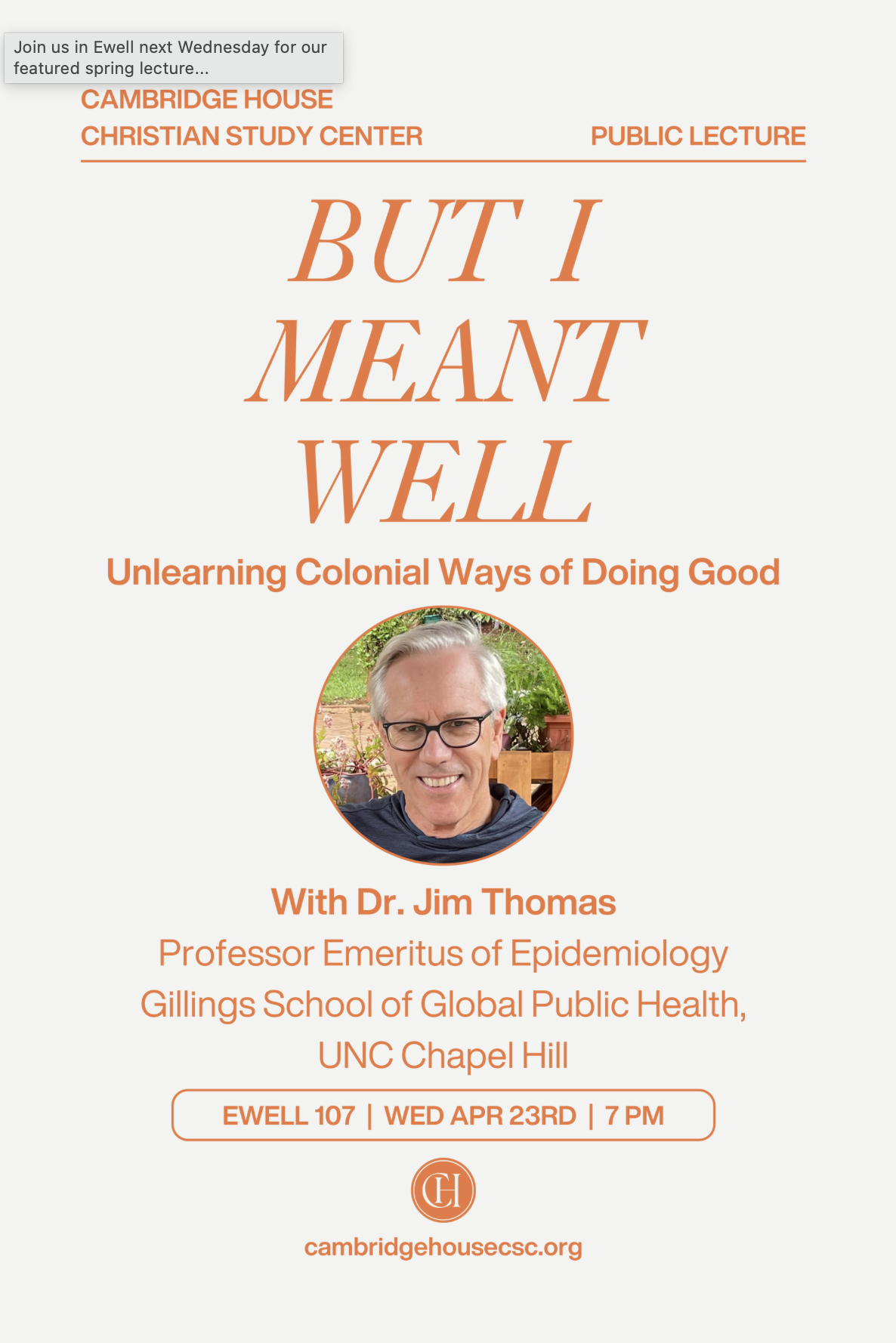
CAMBRIDGE HOUSE: Spring Public Lecture, Next Wednesday, April 23rd, 7pm

Come on out next week for the annual spring lecture sponsored by the Cambridge House, the Christian study center near the campus of the College of William & Mary.  Cambridge House is about fostering dialogue about the historically orthodox Christian faith within the campus academic community, offering hospitality to students, faculty, staff, and friends of the study center in the Williamsburg area.

But I Meant Well: Unlearning Colonial Ways of Doing Good
Wednesday, April 23rd   |   7 PM   |   Ewell Hall, Room 107
Our spring lecture, “But I Meant Well: Unlearning Colonial Ways of Doing Good,” will be presented by Dr. Jim Thomas at Ewell Hall.

Jim has worked as an epidemiologist and ethicist in more than 40 countries. As a social epidemiologist, he studied how social forces, such as mass incarceration, shape the distribution of health outcomes in a community. As an ethicist, he was the principle author of the first American public health code of ethics and now advises other countries as they write their codes. While in Ghana to coordinate with the World Health Organization on data collection following an Ebola epidemic, he visited Elmina Fort. Elmina is where Africans were enslaved and held to be put on ships to the Americas. Seeing a church in Elmina was a shock to Jim’s Christian faith. On Wednesday, April 23rd, he will talk about how he processed that shock over the following years and how it affects his international work now.

Jim is an Emeritus Professor of Epidemiology in the Gillings School of Global Public Health at the University of North Carolina, Chapel Hill. Additionally, he serves as an Adjunct Professor at the French École des Hautes Études en Santé Publique.

If you can come, take a minute and RSVP, so that we can have a semi-accurate head count!  See you next Wednesday!


Cambridge House at William & Mary: Public Lecture, Images of the Divine in C.S. Lewis, , April 12, 7pm

Great things are happening at the Cambridge House Christian Study Center at the College of William & Mary. Dozens of college students and Christian faculty & staff at William & Mary are learning together what it means to love God with all their hearts and minds, on a secular college campus.

On Friday, April 12, members of the Williamsburg Christian community can get a sense of what the mission of the Cambridge House is all about.

Every year, William & Mary graduates students who end up becoming culture shapers and leaders, their influence trickling across all sectors of society. Who will be tomorrow’s culture leaders, on par with those W&M graduates like today’s Robert Michael Gates (former U.S. Secretary of Defense & Director of Central Intelligence), Glenn Close (actress), Sean McDermott (head coach of the Buffalo Bills), James Comey (former FBI Director), Jon Stewart (comedian, television host), or Jen Psaki (former White House Press Secretary under Biden)? Those who are praying for the Cambridge House hope that among them will be students whose experience with the Cambridge House is helping to form their spiritual and intellectual passions for serving Christ.

I had the privilege earlier in the semester of leading a small reading group of Cambridge House students, to survey the history of the church. It was thrilling for me to be with young people with brilliant minds and open hearts discussing everything from the Nicene Creed to Martin Luther to Vatican II. But more is happening!

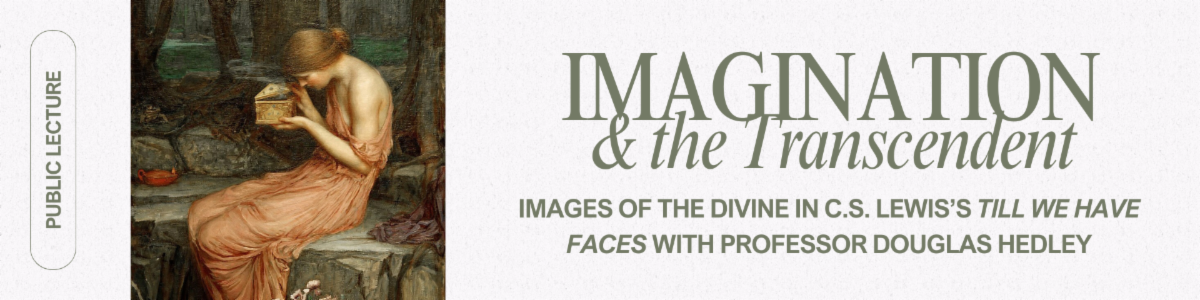
Jon Thompson, the director of the Cambridge House, has invited a gifted speaker to give a public lecture on the topic of “Imagination & the Transcendent: Images of the Divine in C.S. Lewis’ Till We Have Faces.” Douglas Hedley is a Professor of Philosophy of Religion at the University of Cambridge.

One of the things that Dr. Hedley has been known for was to participate in one of the roundtable discussion groups organized by the well-known Canadian psychologist, Jordan Peterson.  Here is a short YouTube clip featuring Dr. Hedley:

More information about Dr. Hedley’s lecture can be found below, where you can click on the image to RSVP for the event: Friday, April 12th, at 7pm, Washington 201.  Put that on your calendar! If you have not done so already, please be sure to sign up for the Cambridge House newsletter, to keep up-to-date with such events.


——————————————————————–


Imagination & The Transcendent Public Lecture

Friday, April 12th at 7 PM | Washington 201

Join us for the next lecture in our Human Nature and Humanistic Endeavor series, presented by Douglas Hedley, Professor of Philosophy of Religion at the University of Cambridge. Professor Hedley will discuss images of the Divine in C.S. Lewis’s Till We Have Faces.

This lecture will explore C.S. Lewis’s celebrated novel Till We Have Faces. The novel is a retelling of the myth of Cupid and Psyche, but Lewis explores in it themes of imagination and the grounds of religious knowledge. The lecture will be delivered by Douglas Hedley, Professor of Philosophy of Religion at the University of Cambridge, who has published many works on religion and the imagination. These include a trilogy of books: The Iconic Imagination, Living Forms of the Imagination, and Sacrifice Imagined.

This lecture is co-sponsored by Reformed University Fellowship, and our Human Nature and Humanistic Endeavor series has been generously supported by the Center for Religion, Culture & Democracy.

RSVP

If you missed an earlier Cambridge House lecture this year, enjoy “Personalism and the Black Intellectual Tradition” by Dr. Angel Adams Parham on YouTube:


Christmas in Europe: A Tour of Cambridge, England

My wife and I were able to tack on a few extra days, after our Christmas stay in Belgium, to go and visit friends staying in Cambridge, England.

Jon Thompson, the director of the Cambridge House at the College of William and Mary, had taken his family back to Cambridge, where he had previously studied philosophy, before eventually coming to Williamsburg, Virginia. A wide-ranging group of believers in Williamsburg had prayed for several years for the founding of a Christian Study Center at William and Mary, so it has been wonderful to see how God brought Jon Thompson and his family to Williamsburg less than two years ago, to oversee the work at the Cambridge House.

Our Christmas in Europe made it possible to meet up with Jon and his family in his old “stomping grounds” in Cambridge, England. Sickness made traveling quite difficult for us, but Jon was able to take me on a tour of the university town of Cambridge one afternoon.

Jon Thompson, director of the Cambridge House, at the College of William and Mary, took me on tour of the namesake for the Cambridge House, the university town of Cambridge, England, in January, 2024. We are standing in front of the residence the Thompsons’ had while in Cambridge for a few weeks.


Part of Jon’s interest in coming to Williamsburg to serve as the director of the Cambridge House at the College of William and Mary stems from his experience as an intern at the Round Church, a medieval church building in the very center of Cambridge, which now serves as a Christian Study Center for the academic community of Cambridge. This was also where we began our tour of the town of Cambridge, England.

William and Mary Cambridge House director, Jon Thompson, in front of the Round Church, now a Christian Study Center, in Cambridge, England.


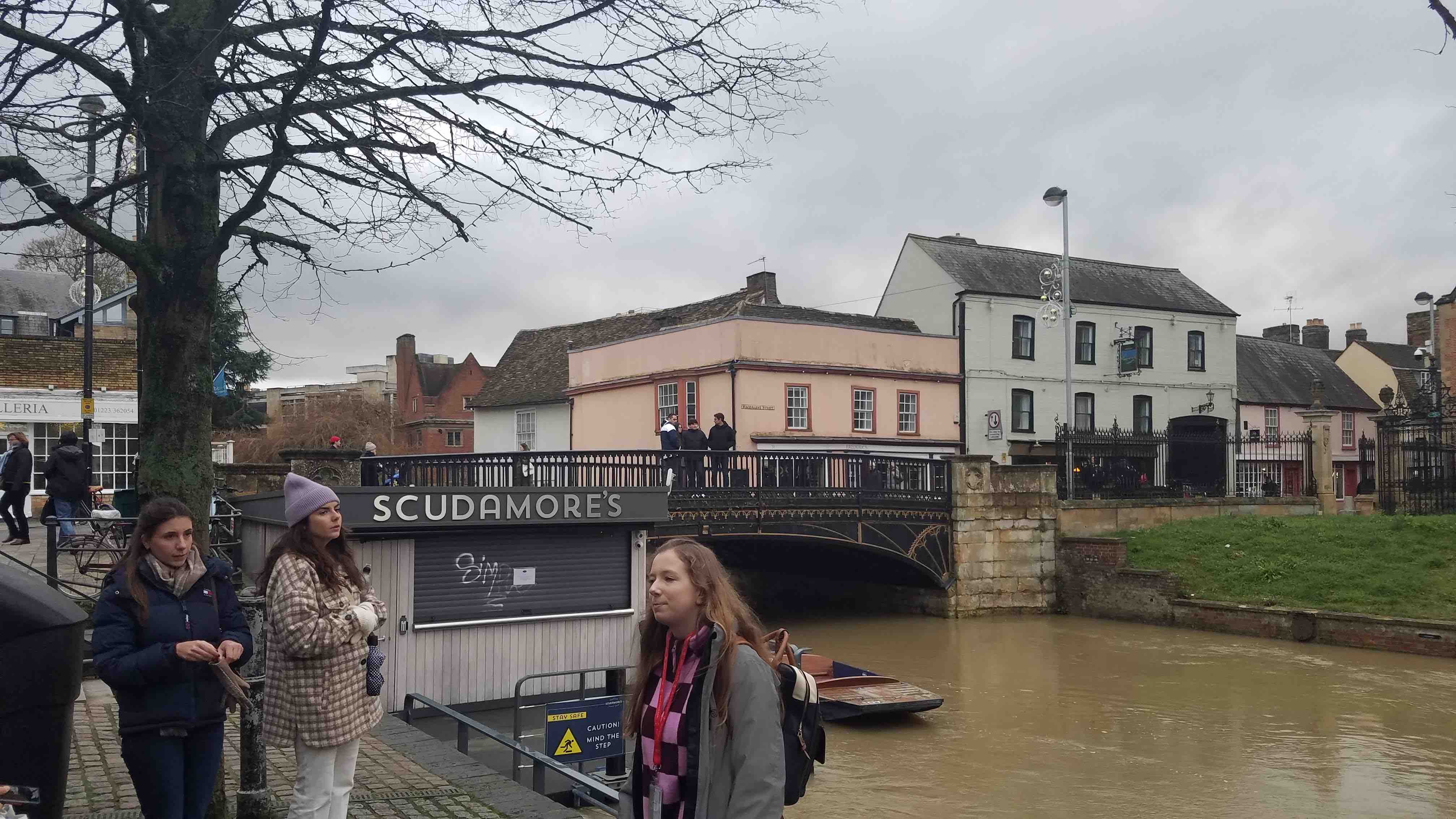
Cambridge, England is an interesting college town, as it is actually a network of loosely affiliated colleges, all part of the Cambridge academic community. The famous Christian apologist and Oxford scholar, C.S. Lewis, spent the last nine years of his life as the Chair of Medieval and Renaissance English for Magdalene College, one of the many colleges that are part of Cambridge. Our official tour guide for a “Christian Heritage” tour of Cambridge, was a wonderful young lady who told us about Lewis’ teaching career at Magdalene, as we gazed across the river Cam, looking at the Bridge that crosses the river, hence the name of the city: “Cam-Bridge.”


Visitors to Cambridge often will go “punting” along the River Cam to view colleges that dot its shoreline. However, the river was running quite high while we were in Cambridge, and the cold weather discouraged us from any “punting” experience.


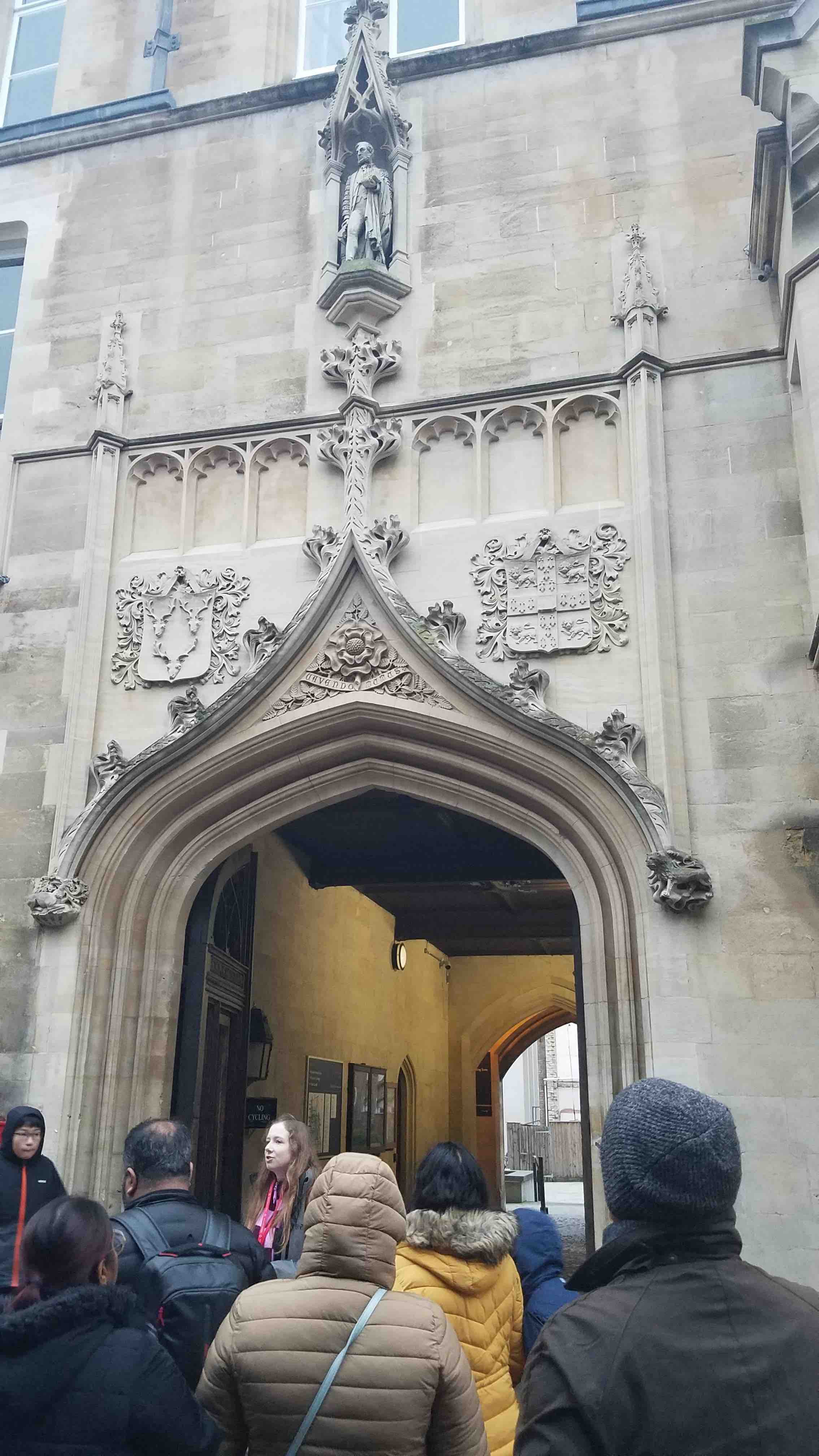
The neat thing about this “Christian Heritage” tour is that we got the opportunity to visit inside some of the various colleges, where several of the colleges typically charge separate fees to visit. Some of greatest names in church history are tied to the Cambridge community, not just C.S. Lewis. For example, William Wilberforce, the 19th century evangelical Christian leader and outspoken advocate for getting rid of the British slave trade, attended St. John’s College. We were able to walk the grounds of St. John’s College and even take a few minutes to visit inside of the beautiful Chapel at St. John’s:

The courtyard of St. John’s College in Cambridge, England. Several Christian leaders in the early 19th century attended college at St. John’s, including William Wilberforce.


St. John’s Chapel at St. John’s College, in Cambridge, England.


We even had the opportunity poke our heads in and glance at the Cavendish Laboratory, led in its early years by James Clerk Maxwell, a leading Scottish scientist of the late 19th century and devout evangelical Christian, whose meditation on the doctrine of the Trinity helped to inspired him to develop his field theory of electricity and magnetism.  His work on “Maxwell’s equations” directly influenced Albert Einstein to develop his theories of relativity. Einstein described Maxwell’s work as the “most profound and the most fruitful that physics has experienced since the time of Newton.” It was at Cavendish Laboratory that the existence of the electron was first discovered:

Entrance to the Cavendish Laboratory, historically one of premier physics labs in the world.


What a treat it was walk along the same streets that some of the greatest names in intellectual history have walked: from Isaac Newton to William Wilberforce to James Clerk Maxwell to Clives Staples Lewis.

I will have more photos from our Christmas in Europe trip in future Veracity blog posts.

Emmanuel College, in Cambridge, England. The school was founded by Puritans, with one of its pupils being Thomas Harvard, who would later travel to New England and establish the first English-speaking college in the Americas, which still bears his name.

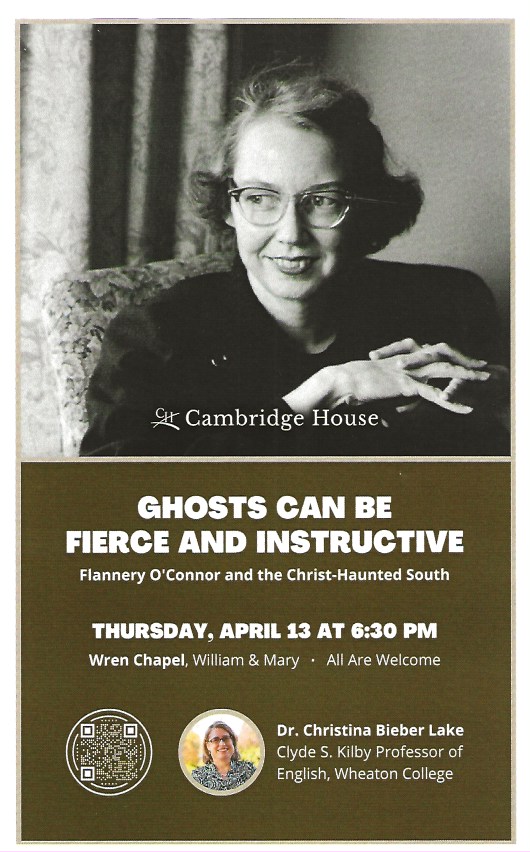
Cambridge House Public Lecture: Flannery O’Connor and the Christ-Haunted South

The Southern writer Flannery O’Connor wrote: “While the South is hardly Christ-centered, it is most certainly Christ-haunted. The Southerner, who isn’t convinced of it, is very much afraid that he may have been formed in the image and likeness of God.”

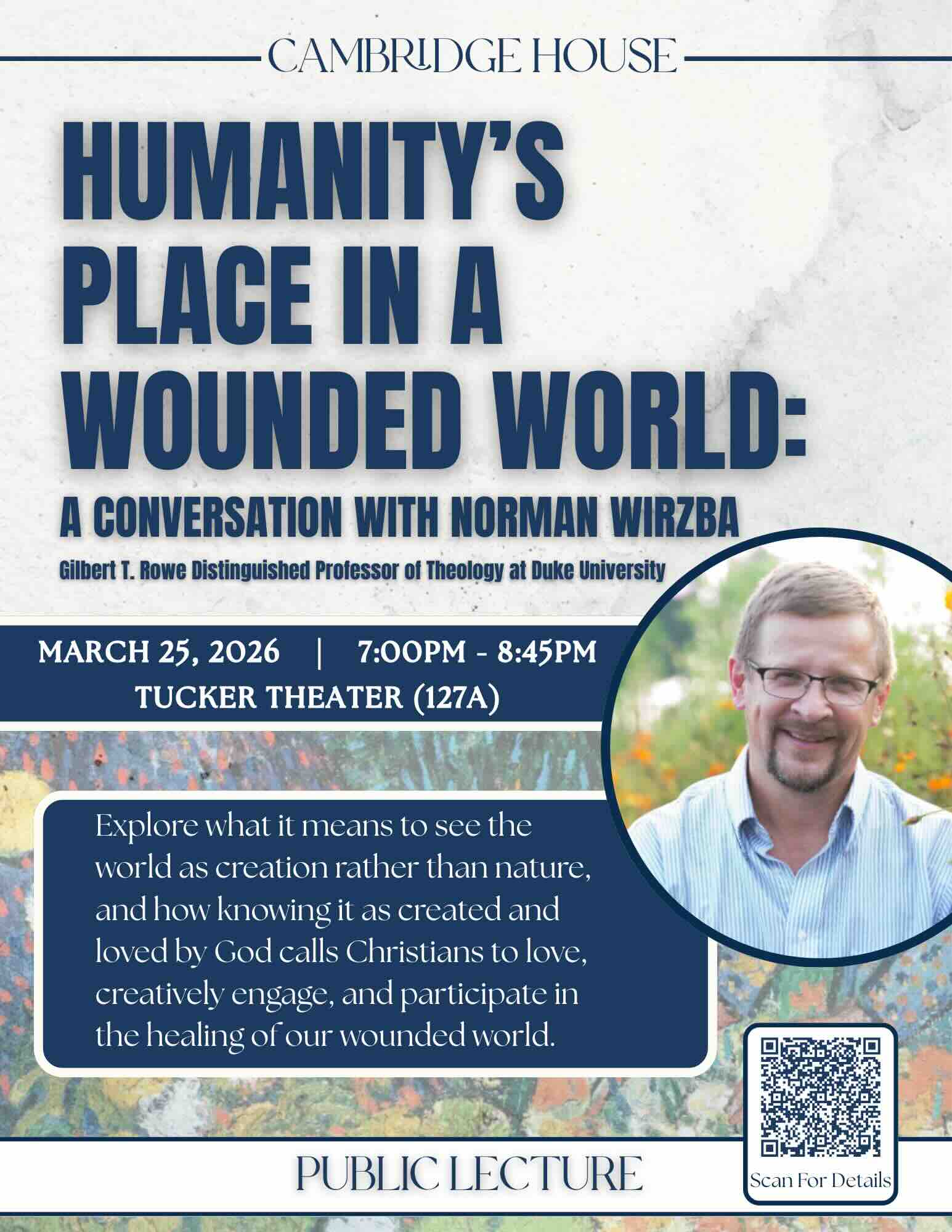
On Thursday, April 13th, at 6:30pm, at the Wren Chapel, on the campus of William and Mary, the Cambridge House at the College of William and Mary will sponsor its first public lecture, a talk given by Dr. Christina Bieber Lake, professor of English, at Wheaton College entitled “Ghosts Can Be Fierce and Instructive: Flannery O’Connor and the Christ-Haunted South.

Flannery O’Connor is widely regarded as one of America’s greatest fiction writers of the 20th century. O’Connor, who died at age 39 after a long, debilitating battle with lupus, was not simply a master of her literary craft, she was a devout Roman Catholic, living in the predominantly Protestant Deep South, in Georgia. For you diehard Protestants, do not let Flannery O’Connor’s confessional loyalty dissuade you. O’Connor wrote dark yet funny stories about Southerners, where she was able to communicate a subtle Christian theological vision of what it means to be human, in a way that still fascinates secular critics decades later. Her short-stories, such as the 1955 gothic tale “A Good Man is Hard to Find,” have become classics of American literature.

Dr. Lake specializes in the area of Flannery O’Connor scholarship. A brief reception at the Wren Chapel will follow her lecture. All members of the William and Mary community, students, faculty, staff, and friends and neighbors of the College are welcome to attend, to find out what the work of the Cambridge House is all about.

Bishop Robert Barron offers a brief video introducing people to Flannery O’Connor. Remember, the lecture is the Thursday after (Western) Easter. In the meantime, have a great Holy Week, and take some time this week to recall the momentous events in the last week of Jesus before his Crucifixion.


A Chapel Institute Conversation on Progressive Christianity (Veracity Video Special !!)

My friend and one of my pastors, Hunter Ruch, sat me down after lunch not too long ago to record two sessions for the Williamsburg Community Chapel Institute. The Chapel Institute is a ministry of the Williamsburg Community Chapel, in my hometown, Williamsburg, Virginia.

During this interview, Hunter and I talk about some very important topics. First, we briefly share about another ministry that he and I are very much excited about, the Cambridge House, at the College of William and Mary. The Cambridge House is a Christian Study Center located within walking distance of the College, where I work. Just a week or so before my interview, another friend and new director of the Cambridge House, Jon Thompson, was interviewed by Hunter about what it means to be human. Read more about the Cambridge House here!

After that, in the first session, we launch into a conversation about what is “progressive Christianity“, how it differs from “historic orthodox Christianity,” and some of the history behind the movement, offering a few examples of what “progressive Christianity” might look like in certain expressions of the church. We talk about how the “progressive Christianity” of the 20th century has morphed into the “progressive Christianity” of the 21st century.

In the second session, we drill down on one particular example of “progressive Christianity,” the idea of “Christian universalism,” which contends everyone will ultimately be saved and reconciled to God in the end, through Jesus. At first, ideas like this look attractive, but it can lead to warped understandings of what the Bible actually teaches. It is very sad and disconcerting when certain evangelical influencers drift off in this direction. We wrap up our conversation talking about ways that we can help others who are wrestling with “progressive Christianity,” and trends like “deconstruction,” and how we can avoid drifting into “progressive Christianity” ourselves.

Just a few comments about what you will see and hear. First, Hunter introduced me as the senior networking “director” of IT at the College, which is not accurate. I am more properly a “senior network engineer,” part of a team of IT staff, though my main responsibility is in the area of architecture and design. Secondly, I got a little lost halfway through the second segment, explaining some of the problems associated with “Christian universalism,” but hopefully I got back on track!! Please let me know what you think in the comment section below.